


1. Background
Cancer could be a distressing experience, and it can also change the quality of patients’ lives (1). The situation is even worse for advanced cancer patients (2). However, psychological problems of patients during treatment often remains unrecognized (3), the increase of prevalence of distress with illness progression is well established (4, 5). Distress is described as a hard and unpleasant emotional experience of a social, psychological, and spiritual nature in cancer patients by the National Comprehensive Cancer Network (NCCN). Also, it can intervene effectively with the ability to cope with cancer, its treatment, and side effect (6). Actually, many patients experience multitude symptoms after being diagnosed with cancer, and it can affect their social and spiritual functioning, family relationships, and financial issues (7-9). Moreover, the underestimation and insufficient treatment of emotional disorders and distress may lead to some negative results; for example, the lower rate of satisfaction with medical service (10, 11), decreased patient’s quality of life and their relatives (12, 13), long hospitalization (14), low therapy compliance (15), and probably reduced chances of survival (16, 17).
Therefore, in order to make the best use of limited health sources and prepare convenient and easy access to mental health services, the psychological pain of cancer patients should be recognized quickly and simply (18). Usually, the used mental health services are either based on physician referral or self-initiated. However, there is little similarity between physicians’ conjectures and patients’ self-report and finding a standardized validated tool for measuring emotional distress is necessary (3, 19). Likewise, patients who are receiving palliative care because of their physical condition, may not be able to follow out long questionnaires. Therefore, short self-reports are simple to perform and, if correctly validated, it can help to detect patients who need more professional mental healthcare (18).
For the mentioned reasons, the NCCN recommended that healthcare team screen distress of all cancer patients at the first visit and at appropriate intervals, especially with changes in disease status (20). The distress thermometer (DT) is a tool, which measures whole emotional distress with one item (an 11-point rating scale from 0 - 10) (21). Then, Mitchell et al. (22) designed a new tool named “the Emotion Thermometers” (ET), retaining the convenience of the DT, but with superior accuracy, which initially assessed 5 areas of the patient’s emotional intensity including 4 predictor domains (distress, anxiety, depression, and anger) and 1 outcome domain (need for help). Mitchell’s study noted the ET tool expanded on the strengths of the DT, with additional visual analog scales that on a scale of zero to 10, patients are asked to mark the number that best describes how distressed they have been during the last week. Then, 4 is the threshold score, which indicates significant distress that warrants more evaluation. In fact, the level of zero means no degree of emotion and 10 means having intense emotion. A threshold score was changed from 4 - 5 to ≥ 4 in 2007 and if the score is higher than a cut-off point, experts start treatment for patients (23) (The figure of the tool is included in the Supplementary File Appendix 1).
This scale is an easy and rapid instrument for detection, screening, and monitoring patients with emotional distress in clinical places (23). The simplicity and effectiveness of this tool have caused some countries such as Spain, Italy, China, Portugal, and Singapore to translate it into their languages and widely use it (24, 25). In addition, it has been used most frequently in several studies for measuring the patients’ emotional distress (26). Also, some studies have used this instrument in diseases other than cancer (27-29). In Iran, DT, which consisted of a visual analog tool, has been used by Mansoorabadi et al. for the first time in cancer patients (30).
2. Objectives
The present and more complete version have not been studied in Iran. Therefore, the aim of this research was to examine the validity and reliability of the ET in patients with advanced cancer.
3. Methods
3.1. Procedures
In the present cross sectional study, the ET was translated and its Persian version was validated in advanced cancer patients in 2017. Moreover, the translation and validation were carried out, using the method suggested by Wild et al. (31).
The study protocol was approved by the Ethics Committee of Iran University of Medical Sciences in Tehran, Iran (IR.IUMS.REC.1394.94-04 27049). The ethical issues that were considered in this research included obtaining informed consents from all patients prior to beginning the study and explaining them about the aims and methods of the research. Moreover, all patients were informed that their participation was voluntary; they could refuse to complete the questionnaire and all their information would be kept confidential.
3.2. Participants
The population of this study consisted of all advanced (metastatic) cancer patients, who had been referred to palliative care at Firoozgar Hospital of Iran University of Medical Sciences, from September to November 2017. Since about 300 patients (on average) were referred to the palliative care at Firoozgar Hospital in a 3-month period, according to Cochran’s sample size formula and the inclusion and exclusion criteria, 169 patients (aged 18 years or older) were selected through convenience sampling method as the sample size.
The inclusion criteria consisted of being willing to volunteer in the study and cognitively alert. Cognitively alert meant participants were able to give informed consent and were not disoriented. Also, participants were eligible for this study as they had Iranian nationality and pathology report with any type of advanced (metastatic) cancer except brain cancer. The diagnosis of advanced (metastatic) cancer was made by the participants’ oncologist. Also, patients aged 18 to 90 years were included in the study. The exclusion criteria were as follow: inability to speak and diagnosis of psychotic disorders before getting cancer. Also the patients with a history of psychotherapy were excluded from the study.
The questionnaire was a self-administered; though, if the patients needed the help, a family member or psychologist could support them. Eventually, 19 patients, who did not complete the questionnaire, were excluded from the study; so, there were no missing values and the sample size included 150 (96 females and 54 male) advanced cancer patients.
3.3. Preparation and Translation
The scale of ET was translated to Persian by a non-psychologist. Then, the Persian version was translated back into English by two translators, one of whom was a native English speaker and fluent in Persian and one another had not seen the original English form.
3.4. Scale Validation Methods
Based on the nature of the tool (5 visual thermometers) and Mitchel et al.’s study (22), for assessing the validity of ET, content, face, predictive, convergent, and divergent validity methods were used; then, the sensitivity and specificity of ET were determined by the use of receiver operating characteristics curve (ROC).
3.4.1. Content Validity
The content validity was evaluated qualitatively and assessed by 15 experts, including clinical psychologists (7), psychiatrist (1), nurses (2), psychometrics (2), social worker (1), and oncologists (2). All of them were involved in either scale development or advanced cancer care. The scale’s compliance with Persian grammar and its use of suitable phrasing were examined by the qualitative method.
3.4.2. Face Validity
To verify the face validity, the translated questionnaire was given to 30 participants for their review and feedback. They were all requested to comment on the difficulty of the scale’s terminology (difficulty) and the likelihood of misunderstanding the items and the word ambiguities (ambiguity).
3.4.3. Convergent and Divergent Validities
The divergent and convergent validities of the scale were tested by 2 questionnaires of McGill Quality of Life and Hospital Anxiety and Depression. The patients were asked to complete a Persian version of 3 questionnaires in 1 session and the relationship between the Persian version of ET and 2 questionnaires was calculated with the Pearson correlation coefficient.
3.4.3.1. Hospital Anxiety and Depression Scale (HADS)
The HADS is generally used as a screening tool for anxiety and depression of the patients during the last week. This scale has 2 subscales, 7 statements for depression, and 7 statements for anxiety. Each part was scored on a scale of zero to 3. Therefore, scores of depression and anxiety subscales of the questionnaire are in the range of zero to 21. For both subscales, scores are considered in the range of zero to 7 like a normal, 8 to 10 as a mild, 11 to 14 as a moderate, and 15 to 21 as a severe range (32). Montazeri et al. assessed the psychometric evaluation of a Persian version of this scale in breast cancer patients. The results of this study indicate good internal consistency of subscales (33). Also, in this study, the Cronbach’s alpha value of the whole questionnaire of the hospital’s anxiety and depression was 0.95 and the index for anxiety and depression components was 0.89 and 0.91, respectively.
3.4.3.2. McGill Quality of Life Questionnaire (MQOL)
It contains 17 self-report items, whose reliability and validity have been approved in patients with HIV and cancer patients. The McGill quality of life questionnaire (MQOL) consisted of 3 general views about the quality of life, physical symptoms, and psychological dimensions. The answer to any questions was expressed as the Likert scale (0 - 10 points) (34). The Persian version of this questionnaire was translated by Shahidi et al. They evaluated its psychometric criteria in Iranian advanced cancer patients; the results of this study confirmed its validity and reliability. Also, for testing reliability, the test-retest method was used and the correlation coefficient of life quality was 0.87 (35). In the present study, the internal consistency of the quality of life questionnaire by Cronbach’s alpha was 0.93.
3.4.4. Predictive Validity
In order to investigate the predictive validity of the research variables after recoding the HADS scores based on a cut-off line of the questionnaire, the incidence, and absence of depression and anxiety were considered as the criterion variable and through logistic regression, the role of emotional thermometers as predictors was studied and the accuracy of these variables was also determined in the classification.
3.5. Reliability
To evaluate the reliability of the ET, the test-retest method was used. The test-retest correlation was calculated for 74 patients through the Pearson correlation coefficient with an interval of 1 week. Values of Pearson correlation coefficient are variable between 1 and zero.
3.6. Statistical Analysis
The data were analyzed by SPSS 21 software, using statistics that included the mean and standard deviation of the demographic variables; test-retest correlation for determining the reliability, Pearson correlation coefficient for assessing the convergent and divergent validity of the scale, logistic regression for predictive validity and sensitivity, and specificity of emotional thermometer were determined by use of the ROC.
4. Results
4.1. Sample Characteristics
A total of 150 cancer patients completed the questionnaire, 64% of whom were female and 36% were male. The patients had a mean age of 54 ± 14, ranging from 18 to 87. The majority of the patients were married (118, 78%) and only 10% had a university education.
4.1.1. Description of Participants in Psychological Distress
The results of this study showed that 44.7% of the participants (67 individuals) in the hospital depression scale had a score higher than the cut-off line and similarly and 42% of them (63 individuals) in the hospital anxiety scale scored higher than the cut-off line. It was also found that 31% of the participants (47 individuals) simultaneously in both scales received a score higher than the cutoff point.
4.1.2. Description of Participants in the Research Based on ET
In the present study, 51 participants in all emotional thermometers received a score higher than or equal to the cutting line (4). Similarly, in the thermometers of distress, anxiety, depression, anger, and the need for help, 99, 92, 77, 71, and 93 others, respectively, have scored above the cut-off line. Therefore, based on Michel’s proposed cutting line (22), it is observed that most participants exhibit significant problems in emotional thermometers. Before analyzing the data, the assumptions of normality and multicollinearity were investigated. The degree of skewness and kurtosis were used to examine the assumption; the distribution of the 5 variables was normal, which was accounted for distress (Sk = -0.304, Ku = -1.39), anxiety (Sk = -0.064, Ku = -1.46), depression (Sk = 0.25, Ku = -1352), anger (Sk = 347, Ku = -1.315), and need for help (Sk = -0.214, Ku = -1.466 ) and was in the range of ± 3 and it was assured by the presence of these values in the range of ± 3 for the establishment of this assumption. In order to investigate the multicollinearity assumption, we used variance inflation factor (VIF) and tolerance index, which is based on the fact that none of the tolerance index values were less than 0.01 and none of the values of the VIF was greater than 10; accordingly, it can be ensured about the assumption of multicollinearity.
4.2. Validity
To investigate the content and face validities of ET, based on some comments of the experts and patients, small changes were made in the words, which protected the main content.
To verify the convergent and divergent validities of emotional thermometers, their correlation with HADS and MQOL were calculated and the results were presented in Table 1.
Table 1.Correlation of Emotional Thermometers with Hospital Anxiety, Depression and Quality of Life
aP < 0.01.
According to Table 1, all emotional thermometers according to the researchers’ expectations have a direct and strong relationship with HADS, which shows the convergent validity of ET. The results showed that among the thermometers, the anxiety thermometer had the most relationship with hospital anxiety and depression thermometer with hospital depression. Regarding the divergent validity of emotional thermometers with MQOL, it was also found that all thermometers had a significant and reverse relationship with quality of life and among them, respectively, the anxiety and depression thermometers have the highest correlation with the quality of life variable.
In order to investigate the predictive validity of the research variables after recoding the HADS scores based on cut-off line of the questionnaire, the incidence, and absence of depression and anxiety were considered as the criterion variable and through logistic regression, the role of emotional thermometers as predictors was studied and the accuracy of these variables was also determined in the classification. The results of logistic analysis in Table 2 showed that the model based on 5 variables of prediction (distress, anxiety, depression, anger, and need for help) could explain 65% of the variance of hospital anxiety variable and in comparison with the fixed-constant model and significantly leads to better prediction (χ2 [5, N = 150] = 99.9968, P < 0.05). Also, according to Table 2, it can be seen that the anxiety thermometer has a significant role in predicting the classification of people with anxiety in non-affected individuals.
Table 2.Logistic Regression Results to Predict the Incidence and Absence of Hospital Anxiety and Depression Using Emotional Thermometers
| Step/Entered Variables | B | SE | Wald | DF | P Value |
|---|---|---|---|---|---|
| 1, (to predict the incidence and absence of hospital anxiety) | |||||
| Distress | 0.145 | 0.119 | 1.490 | 1 | 0.222 |
| Anxiety | 0.530 | 0.118 | 20.067 | 1 | 0.001 |
| Depression | 0.004 | 0.128 | 0.001 | 1 | 0.976 |
| Anger | 0.105 | 0.095 | 1.223 | 1 | 0.269 |
| Need for help | -0.002 | 0.095 | 0.000 | 1 | 0.986 |
| Constant | -4.437 | 0.756 | 34.406 | 1 | 0.001 |
| 1, (to predict the incidence and absence of hospital depression) | |||||
| Distress | 0.196 | 0.109 | 3.271 | 1 | 0.071 |
| Anxiety | -0.033 | 0.102 | 0.106 | 1 | 0.744 |
| Depression | 0.338 | 0.115 | 8.711 | 1 | 0.003 |
| Anger | 0.076 | 0.078 | 0.943 | 1 | 0.332 |
| Need for help | 0.012 | 0.078 | 0.024 | 1 | 0.878 |
| Constant | -3.187 | 0.572 | 31.024 | 1 | 0.001 |
Based on the logistic regression, it was also found that the rate of success in the correct prediction was 86%, and the prediction rate for patients with hospital anxiety was 86% and the prediction rate for non-hospital anxiety was 85.5%. In the case of hospital depression, the results of logistic analysis in Table 2 showed that the model based on 5 predictors (distress, anxiety, depression, anger, and need for help) could explain 51% of the cases of not having hospitalized depression, and in comparison with the fixed-constant model significantly leads to better prediction (χ2 [5, N = 150] = 527.26, P < 0.05). Also, according to Table 2, it can be seen that the depression thermometer has a significant role in predicting the variables in the classification of people with depression from non-affected individuals.
Based on the logistic regression, it was also found that the rate of total success in the correct prediction was 80%, the correct prediction rate for those with hospitalized depression was 76.2%, and the prediction rate for non-hospitalized depression was 82.8%.
In the following, through the ROC, the sensitivity and specificity for predicting the presence and absence of hospital anxiety was calculated, in which the sensitivity and specificity of the anxiety thermometer (AT) (with a cut-off line of 3 to 4) in prediction equaled to 0.97 and 0.68, respectively (Figure 1).
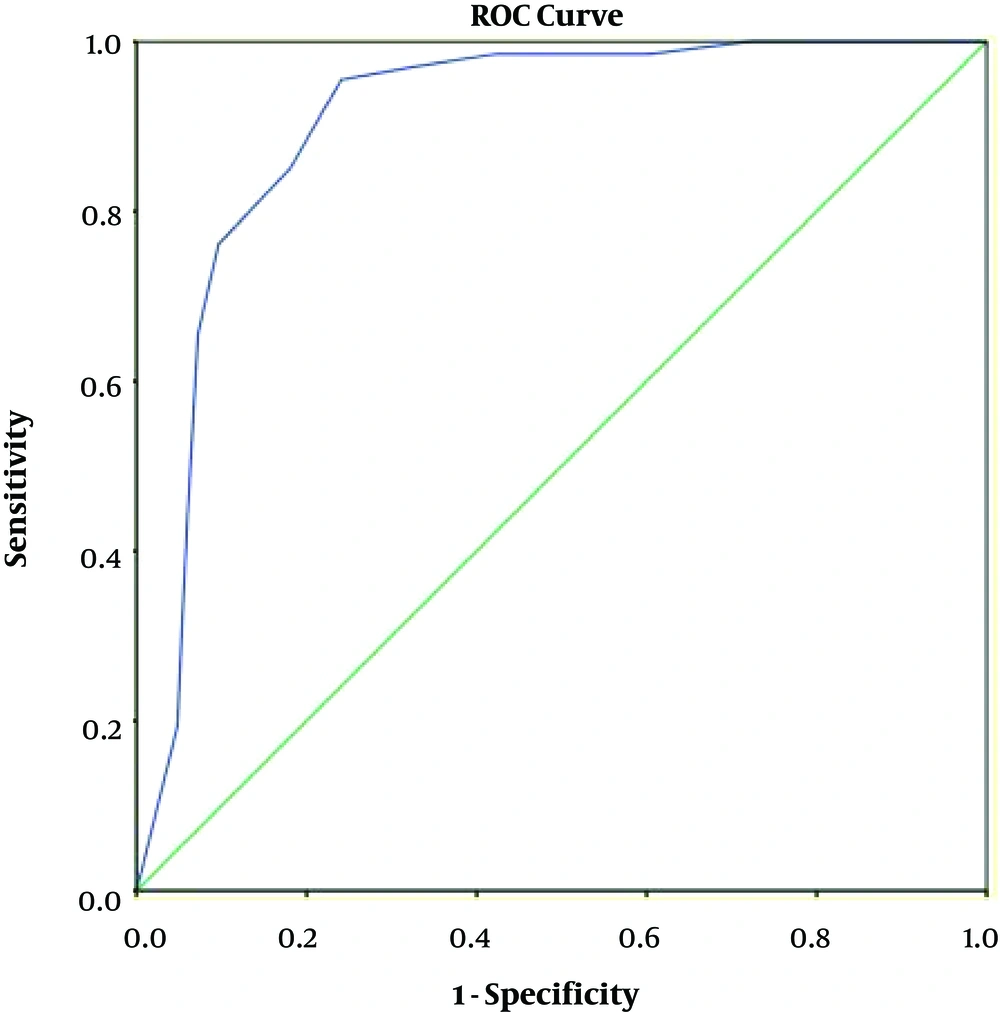
Figure 1.
ROC to predict the incidence of hospital anxiety based on AT
Also, through ROC, the sensitivity and specificity for predicting the presence and absence of hospital depression was calculated, in which the sensitivity and specificity of the depression thermometer (DT) (with a cutting line of 3 to 4) in prediction equaled to 0.82 and 0.74; the diagram is presented in Figure 2.
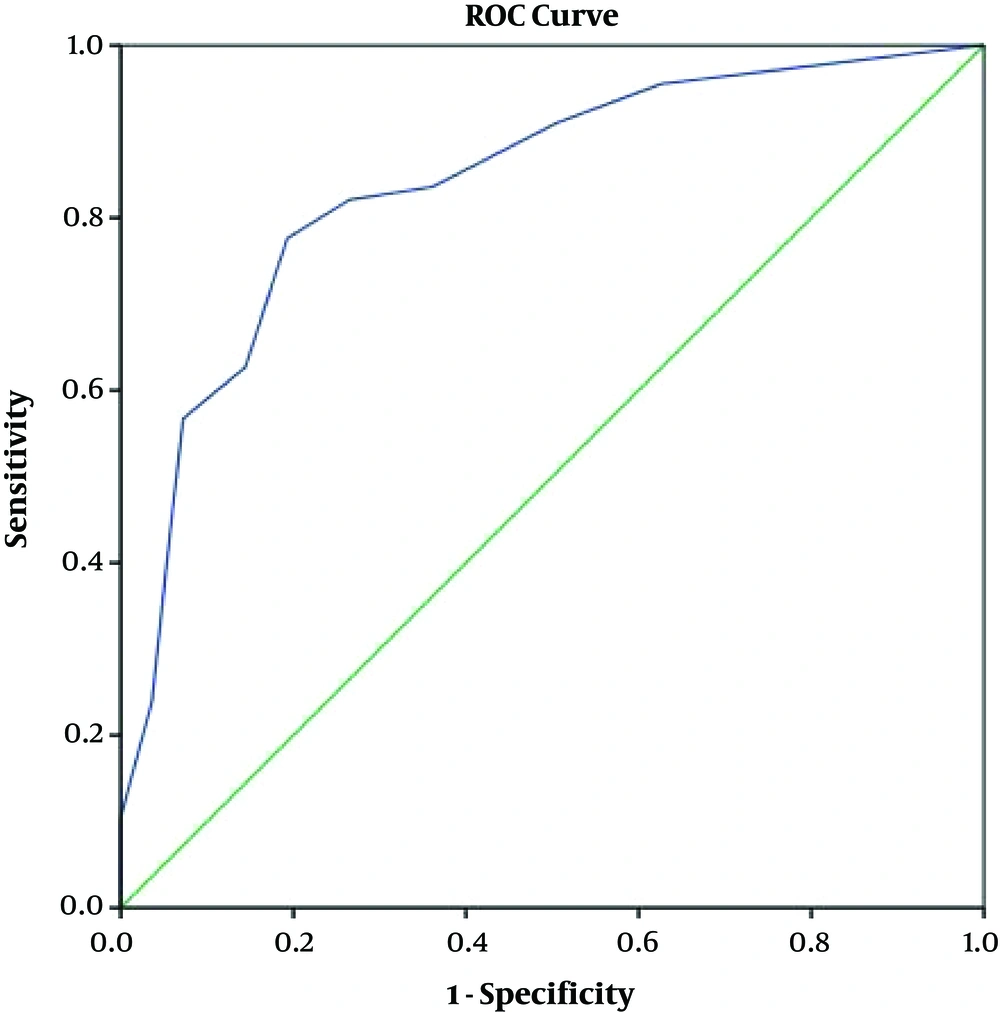
Figure 2.
ROC to predict the incidence of hospital depression based on DT
4.3. Reliability
The test-retest method was used to measure the reliability of the ET. The results showed that the test-retest correlation coefficient for distress, anxiety, depression, anger, and need for help was 0.81, 0.83, 0.84, 0.88, and 0.81, respectively; these results indicate the reliability of thermometers are very good (Table 3).
According to Table 3, there are positive and significant correlations between emotional thermometers and this can somehow confirm the theoretical relationship of these variables.
5. Discussion
This study aimed at measuring the validity and reliability of the Persian form of ET in advanced cancer patients. To achieve this goal, reliability, content, face, predictive, convergent, and divergent validity methods have been used, and the results of all of them indicate that it is an appropriate tool for assessing the emotional state of advanced cancer patients.
During cancer treatment, especially in the advanced stage, maintaining or improving the patients’ quality of life and decreasing their distress are important goals (36, 37). Therefore, the distress of patients should be well recognized. As a result, it is necessary for appropriate tools to identify distress and intervene to reduce it. Although several tools have been designed through recent decades, according to experts, the right instrument for assessing distress and quality of life should have favorable psychometric characteristics and be multidimensional (38). In selecting a screening tool, however, there are trade-offs to be made among brevity and ease of administration and scoring, and most importantly, the effectiveness of the scale in identifying distress. ET is the tool to measure psychological fluctuations during the disease and treatment and it is an easy and rapid instrument for detection, screening, and monitoring of patients’ emotional distress that it also has a simple visual-analog design. It is facile for most people including seniors and children to understand and complete (18). In order to use ET, like any other scientific instrument, it needs to be reliable and valid. Therefore, we guess that using this scale in clinical settings and future research in Iran will encourage healthcare teams and researchers.
The assessment of the convergent validity of the scale showed that all emotional thermometers have a direct and strong relationship with HADS. According to the results, among the thermometers, the anxiety thermometer had the most relationship with hospital anxiety and depression thermometer with hospital depression. Regarding the divergent validity of ET with MQOL, it was also found that all thermometers had a significant and reverse relationship with quality of life and among them, respectively, the anxiety and depression thermometers have the highest correlation with the quality of life variable. Therefore, given the results and the advantages of this tool (fewer items, less time to respond, simplicity, visibility, and suitability for children, elderly, and even illiterate people), its use is preferred to the other 2 tools.
In order to investigate the predictive validity of the research variables after recoding the HADS scores based on cut-off line of the questionnaire, the results of logistic analysis showed that the model based on 5 variables of prediction (distress, anxiety, depression, anger, and need for help) could significantly predict the classification of people with anxiety and depression in non-affected individuals. As expected, among 5 emotional thermometers, the anxiety and depression thermometers with the rate of the total success of 86% and 80% have a significant role in the correct prediction of hospital anxiety and depression.
Moreover, the sensitivity and specificity for predicting the presence and absence of hospital anxiety were calculated, in which the sensitivity and specificity of the anxiety thermometer (with a cut-off line of 3 to 4) in prediction were 0.97 and 0.68, respectively. Also, the sensitivity and specificity for predicting the presence and absence of hospital depression were 0.82 and 0.74, respectively. These results, which show the sensitivity and specificity of the two anxiety and depression thermometers, are also better than previous research results (22, 26).
In sum, all these results show the high validity of this tool, which is consistent with previous researches (22, 25, 26). In fact, this tool has a good ability to use it in Iranian advanced cancer patients.
Likewise, the reliability of the scale was evaluated by the test-retest method via the Pearson correlation coefficient. As it would be expected from the majority of previous research in different countries (25), the results showed that the test-retest correlation coefficient for distress, anxiety, depression, anger, and need for help was 0.81, 0.83, 0.84, 0.88, and 0.81, respectively; these results indicate the reliability of thermometers.
The most important point of this study is to prepare the novel scale, which can help healthcare teams to identify distress in advanced cancer patients by the short and sufficiently accurate way.
There were some limitations in this study that should be considered when interpreting these findings. Firstly, we used convenience sampling method; hence, we cannot extrapolate the results to fit the entire population. Hospitalizing of all the participants is another limitation; so, generalizing the results to out-patients should be cautious. Also, this tool is used to investigate emotional distress and, therefore, cannot assess physical aspects (such as heart rate) and cognitive aspects (such as rumination).
Despite these limitations, the primary findings of this study have implications for the diagnosis of the patients’ distress, which can help the screening of high-risk patients, who are in this situation. Actually, it would be advantageous to focus on reducing or controlling specific sources of distress and, at the same time, designing targeted preventative programs or treatments. Furthermore, systematic screening allows the healthcare team to forecast their workload.
5.1. Conclusions
The results of this study demonstrate that new Persian form of the ET is valid and reliable, which is consistent with previous studies. Therefore, the translated ET can be an appropriate tool for the appraisal of advanced cancer patients and evaluating the efficiency of interventions performed on these specific patients. It can also help the psychologists to recognize the distress quickly and, then, help to control them and improve the quality of life of the patients. However, since this study was a preliminary study, it is recommended that this scale should be examined in a larger group of patients and, consequently, its results would be generalized well and used safely.


