



1. Background
Thyroid disease in pregnancy is a common disorder and an important health problem worldwide. It has been estimated that 2% - 3% of women are affected by thyroid dysfunction, and around 10% suffer from autoimmune thyroid disease (1-4). Thyroid disorders in pregnant women mainly include iodine deficiency, subclinical hypothyroidism or hyperthyroidism (defined as high or low thyroid-stimulating hormone (TSH) level associated with normal serum concentrations of free thyroid hormones), and overt hypothyroidism or hyperthyroidism (defined as low or high unbound thyroxine (FT4) level accompanied by high or low TSH level) (3, 5).
The available data clearly reveal that untreated thyroid disorders in pregnancy result in an increased rate of maternal and neonatal adverse events (6). Overt maternal hypothyroidism is associated with gestational hypertension, miscarriage, preterm birth, low birth weight, fetal death, and defective fetal neurocognitive development (1, 5). Positivity for thyroid peroxidase antibodies (TPOAbs), a marker of autoimmune thyroid disorders (7), in the first trimester of pregnancy is known to be associated with adverse pregnancy complications and future maternal morbidities related to thyroid diseases (8).
Abruptio placenta, cesarean section, postpartum thyroiditis, and abnormal neonatal thyroid function are among the other adverse outcomes of maternal thyroid dysfunction during pregnancy (9). Moreover, untreated maternal thyrotoxicosis is associated with miscarriage, prematurity, low birth weight, gestational hypertension, thyroid storm, and maternal congestive heart failure (6, 10).
With regard to the high prevalence of thyroid diseases during pregnancy and their undesirable effects on pregnant women and newborns, precise evaluation, diagnosis, and treatment are critical. Although optimal treatment of maternal thyroid disorders is important to achieve favorable pregnancy outcomes, detection and treatment of maternal thyroid disorders in pregnancy are still controversial issues among clinicians (11-13).
General practitioners (GPs) play a key role in public health systems. GPs, as primary care providers, are also considered as first-choice professionals to provide maternity care for women because of their knowledge on the physiology of pregnancy (14). Despite international agreements on the benefits and importance of evidence-based medicine, knowledge, attitude, and practice of physicians regarding thyroid disorders during pregnancy are less investigated.
Moreover, limited information is available on the familiarity of GPs with the current research on thyroid disorders during pregnancy and recent clinical guidelines on the management of thyroid diseases in this period. Most surveys in this field have included endocrinologists and specialists rather than GPs (15, 16). In this regard, a survey among endocrinologists, obstetricians/gynecologists, internists, and family physicians in New Jersey, New York, USA revealed the suboptimal level of knowledge regarding thyroid diseases during pregnancy (17). Moreover, Kut et al. showed that the knowledge and clinical practice of GPs in the management of thyroid disorders are not satisfactory among pregnant Turkish women (18).
With this background in mind, in this study, we aimed to evaluate the knowledge of Iranian GPs about the diagnosis and management of thyroid disorders during pregnancy.
2. Methods
In this cross sectional survey, a total of 120 GPs, who participated in a continuous medical education (CME) program, entitled “practical endocrinology”, were randomly selected and invited to complete the questionnaire.
The demographic characteristics of the participants, including age, sex, experience in general practice, location of practice, and participation in CME programs regarding thyroid disorders during pregnancy, were assessed in the first part of the modified version of a multiple-choice questionnaire (MCQ). CME programs in our country are usually one-day symposia or workshops conducted by cooperation of Ministry of Health and Medical Education (deputy of education) and different medical universities. In the second section of MCQ, which has been previously validated (16, 17, 19), the knowledge level of clinicians regarding thyroid function, thyroid disorders, and iodine requirements during pregnancy was assessed.
The questionnaire was translated into Persian. The content of the questionnaire was modified, according to most recent national guidelines on thyroid disorders during pregnancy. Face and content validity of the questionnaire was confirmed via interviews with 10 experts and professionals in the field of endocrine disorders. Good knowledge was defined as knowledge score ≥ 75 (19). The questionnaires were distributed among GPs attending the meeting. Post- and pretest evaluations were conducted to examine the reliability of the questionnaire. Intraclass correlation coefficient (ICC) was calculated to test the reliability of the questionnaire. Cronbach’s alpha was also measured to be 0.91s.
Briefly, the questionnaire contained 20 multiple-choice questions about the screening of thyroid function, iodine requirements, diagnosis, and management of hyperthyroidism and hypothyroidism during pregnancy (see the supplementary file). It was based on the definition, pathophysiology, diagnosis, complications, and treatment of thyroid disorders during pregnancy. Questions on pathophysiology were related to TSH receptor antibodies, laboratory screening of thyroid disorders, TSH changes during pregnancy, common causes of hypothyroidism during pregnancy, thyroid autoimmunity, and differential diagnosis of thyrotoxicosis.
Diagnostic questions assessed the subjects’ knowledge about indications of screening for thyroid diseases, diagnosis of Graves’ disease and overt hypothyroidism, and thyroid-related laboratory profile of pregnant women. GPs’ knowledge was also assessed regarding iodine supplements during pregnancy, lower and upper limits of dietary iodine intake in pregnant women, and perinatal complications of hyperthyroidism.
Treatment-related questions focused on different pathological conditions, including increased TSH level, positive antithyroid peroxidase antibodies, autoimmune hypothyroidism, levothyroxine requirements during pregnancy, and Graves’ disease. The questionnaire included 3 clinical scenarios, related to the diagnosis and management of thyroid disorders (thyrotoxicosis and hypothyroidism) during pregnancy.
All frequencies were adjusted on a 100% basis. Statistical analyses were conducted using SPSS version 16.0 (Chicago, IL, USA), and P values below 0.05 were considered statistically significant. After exclusion of nonrespondents, all frequencies were adjusted on a 100% basis. The mean (SD) and frequency (%) of participants’ characteristics were compared, using independent t test and Chi square test.
3. Results
Overall, 100 GPs completed the survey. The mean age of the participants was 37.8 ± 7.6 years, and 41.4% were men. The majority of the participants (72.9%) worked in governmental medical and health centers, and 51.4% had ≥ 10 years of work experience. The majority of the participants (64.3%) had ≥ 10 years of practice after graduation. Also, 91% of the clinicians had previously participated in CME programs on thyroid disorders.
The mean (± SD) knowledge score of GPs was 39.9 ± 15.9. Based on the findings, 27% of the participants had good knowledge, while 73% showed poor knowledge regarding thyroid disorders during pregnancy. Overall, physicians had insufficient and/or erroneous knowledge about thyroid disorders during pregnancy, and the mean knowledge of GPs was 39.9%. The general characteristics of the participants with respect to the knowledge scores are presented in Table 1. No significant difference was observed between GPs with good and poor knowledge in terms of age, work experience, workplace (public or private), or marital status.
| Variables | Good Knowledge (≥ 75/100) (N = 27) | Poor Knowledge (< 75/100) (N = 73) | P Value |
|---|---|---|---|
| Age, y | 36.4 ± 7.6 | 38.3 ± 7.5 | 0.34 |
| Men, % | 31.6 | 45.1 | 0.30 |
| Work experience, y | 7.6 ± 1.4 | 10.6 ± 2.4 | 0.19 |
| Marital status, % | 0.61 | ||
| Single | 31.6 | 25.5 | |
| Married | 68.4 | 74.5 | |
| Workplace, % | 0.61 | ||
| Public | 68.4 | 74.5 | |
| Private | 35.5 | 25.5 | |
| Participation in CME programs, % | |||
| Yes | 26.3 | 2.0 | 0.001 |
| No | 73.7 | 98.0 |
aData are presented as mean ± SD or proportion (%).
bIndependent t test and Chi square were used for continuous and dichotomous variables, respectively.
Abbreviation: CME, continuous medical education.
On average, the rate of correct response to questions about definitions, pathophysiology, diagnosis, complications, and treatment of thyroid disorders was 39.0%, 39.3%, 48.8%, 34.3%, and 44.6%, respectively (Figure 1). The lowest percentage of correct response was related to dietary iodine intake (21.4%), iodine supplementation (25.7%), complications of hyperthyroidism (28.6%), and TSH changes during pregnancy (30.0%), whereas the highest rate of correct response was related to Graves’ disease and overt hypothyroidism (75.5% and 54.3%, respectively).
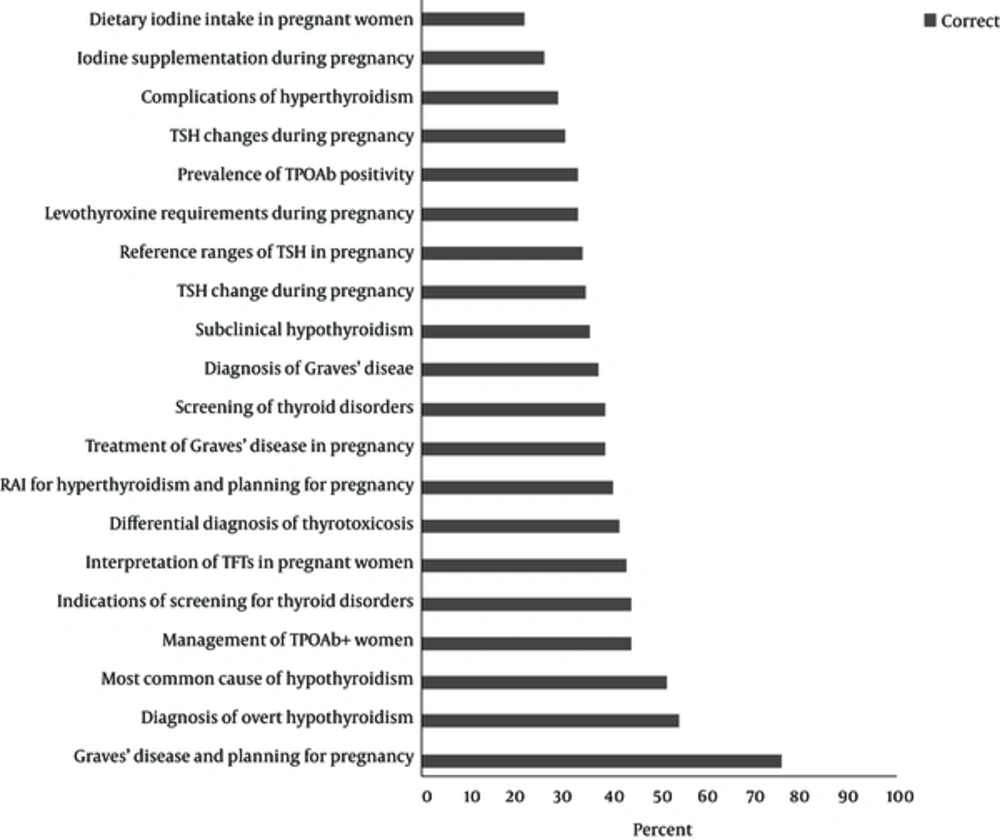
Figure 1.
Percentage of Correct and Incorrect Responses to Different Areas of Knowledge About Thyroid Disorders During Pregnancy (TPOAb, Thyroid Peroxidase Antibody; TFTs, Thyroid Function Tests; RAI, Radioactive Iodine; TSH, Thyroid-Stimulating Hormone)
There was a significant difference in the knowledge of GPs, who had and had not passed CME programs. Compared to GPs who did not pass CME programs higher knowledge scores were reported with respect to treatment (73.3% vs. 41.8%; P < 0.05) and diagnosis (69.0% vs. 46.8%; P < 0.05) among GPs who had passed them (Figure 2).
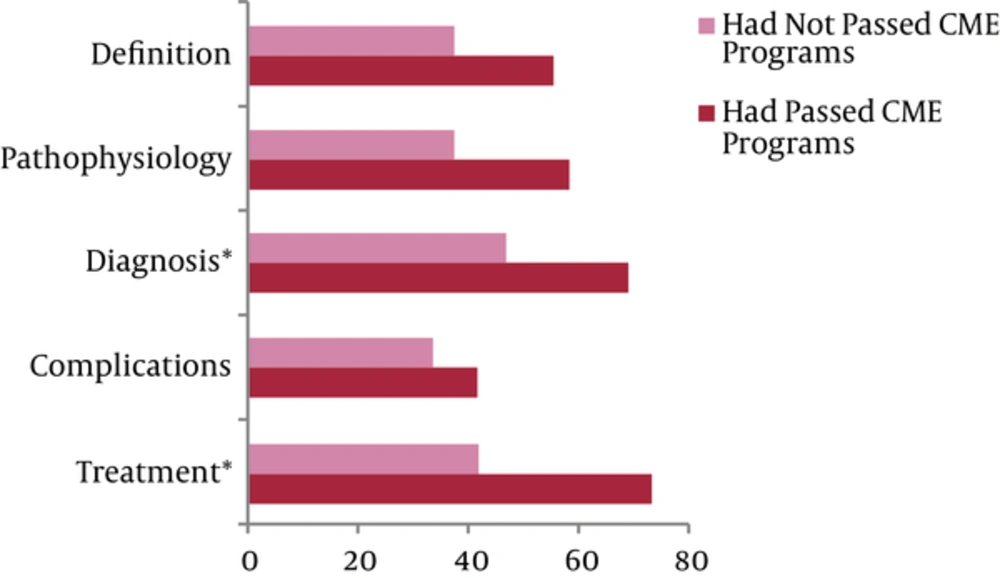
Figure 2.
Comparison of the Mean Knowledge of Thyroid Disorders During Pregnancy Among GPs Who Had and Had Not Passed Continuous Medical Education Programs (*P < 0.05)
4. Discussion
The present study assessed the knowledge of GPs about different aspects of thyroid function and disorders during pregnancy, including the definition, pathophysiology, prevalence, diagnosis, complications, and treatment. By using a 20-item questionnaire, we found that over 70% of GPs lacked adequate knowledge in relation to thyroid disorders during pregnancy. The lowest scores were related to iodine requirements and complications of thyroid disorders during pregnancy, whereas the highest scores were related to diagnosis.
Moreover, our findings revealed that educational courses, such as CME programs, have significant effects on the knowledge of GPs in relation to thyroid disorders during pregnancy, especially diagnosis and treatment. Therefore, it seems that CME programs may have considerable impacts on knowledge about different aspects of thyroid function and disorders in pregnancy.
The available data on routine clinical diagnosis and management of thyroid disorders, particularly hypothyroidism and hyperthyroidism during pregnancy, have revealed great variations in daily practice of European (15, 16) and Asian (12, 13) physicians, mostly internists and endocrinologists. Furthermore, findings of these studies reflect no adherence to guidelines published by international associations (6).
Rinaldi et al. in a survey of knowledge regarding thyroid disorders during pregnancy among endocrinologists, obstetricians, gynecologists, internists, and family physicians (n = 99), used a 16-item questionnaire, addressing the following topics: hypothyroidism and Graves’ disease during pregnancy, postpartum thyroiditis, thyroid antibodies, and decreased neonatal IQ due to maternal thyroid problems. They found a suboptimal level of knowledge regarding thyroid diseases during pregnancy among physicians.
In the mentioned study, endocrinologists showed the highest rate of correct response, and the mean general scores were similar among internists and family practitioners. Moreover, medical specialty, years of training, confidence, and management of pregnant women with thyroid diseases were all independently related to the general scores. The authors concluded that comprehensive educational programs for physicians are needed to improve the knowledge of clinicians regarding thyroid disorders during pregnancy (17).
Furthermore, Kut et al. in a survey of 322 clinicians from different disciplines (including 107 family physicians) reported that physicians had insufficient and erroneous knowledge about thyroid disorders during pregnancy. In this study, 73.1% of endocrinologists, 32.7% of family physicians, and 17.8% of obstetricians had accurate knowledge regarding TSH levels during pregnancy. Moreover, 67.1% of physicians believed that iodine supplementation is unnecessary for pregnant women (18).
Additionally, Azizi et al. conducted a survey on 76 endocrinologists and 33 internists and general practitioners from 6 East-Asian countries to assess and compare the practice of physicians in the screening and management of thyroid diseases during pregnancy. The findings indicated great variations in the clinical screening and management of thyroid disorders during pregnancy. They also observed that many clinicians, particularly GPs, did not adhere to clinical guidelines in the treatment of thyroid disorders (19).
To the best of our knowledge, the present study is the first to assess the knowledge of Iranian GPs regarding thyroid function and disorders during pregnancy. Use of a validated and modified questionnaire was another strength of this study. Some limitations should be also considered in the interpretation of our findings. First, the questionnaire comprised of only 20 multiple-choice questions that may not be sufficient to cover all aspects of different fields of knowledge. Selection bias might have occurred with regard to GP recruitment and questionnaire completion. Moreover, the number of participants was relatively low, and the participants were not representative of the medical community; also, there was no control group (e.g., specialists) for comparison.
In conclusion, GPs attending pregnant women in Iran lack the adequate information and knowledge regarding the pathophysiology, diagnosis, and management of thyroid disorders during pregnancy. It seems that participation in CME programs would improve the knowledge level of GPs, especially in the fields of diagnosis and treatment. Considering the key role of GPs in public health systems, design of high-quality educational programs and development of specific educational packages about thyroid and pregnancy are necessary. Follow-up surveys of GPs after participation in new educational programs are also recommended.
