
1. Background
With a population of 79.9 in 2017, Iran is the most populous country in the Middle East Region. Those aged 60 years or older comprise 8.6 % of the population, in which 1.65 million of them live in three Southern provinces (i.e., Fars, Bushehr, and Hormozgan) (1). Based on the forecasts, the share of elderly in the total population will increase in Iran in the near future (1). The health equity index should be considered due to the unsuitable distribution of health services in specific age and social groups. Iranian policy-makers have emphasized especial importance for coverage of health services. For instance, children, the elderly, minorities, and pregnant women are expected to be effectively supported by the government. Aging is a cognitive and demographic phenomenon with various impacts (2). But Accessibility to health care services among older adults is challenged by living in remote places, impassable routes home to the health center, and some health-related reasons. These reasons deprive older adults of required services (3). Living as a member of elderly communities in rural regions can be highly demanding. This challenge can be intensified by several factors such as remoteness, marginalization, sense of loneliness, miscommunication, and inadequate environmental and legal authority (4, 5). Moreover, one of the obstacles faced by the elderly is substance abuse, especially illegal drugs. While roughly 1% of elders are addicted to illicit drugs (6), only 6% - 7% of them received necessary services (7). In other words, this issue is neither investigated in drug abuse-related disciplines nor appropriately discussed within the framework of elderly concerns. As a result, the lack of comprehensive studies has resulted in a situation in which drug addiction among the elderly is not taken seriously by health professionals (8).
Illegal drug abuse has been one of the long-lasting dilemmas in rural communities. Recently, drug abuse-oriented problems have become more widespread (9). Unlike the subject of addiction, which has been extensively studied, its consequences in rural areas are almost ignored, especially among the elderly. Smoking hookah, in this group, is very popular, which is partly due to the policies provided by the Ministry of Health and Medical Education. Meanwhile, due to the high rates of illiteracy among this group, the distribution of information wouldn’t be effective (4). Moreover, age-related issues and addiction have been considered as the most serious public health concerns (10) Besides, those addicted to drugs have lower levels of quality of life (QOL) compared to non-addicts (11). There is evidence that suggests addicted elderly exaggerate their medical and psychiatric signs and symptoms (4). These signs constitute stimulated brain-related aging processes such as cognitive problems (4, 10). Several studies have mentioned high rates of addiction among the elderly. For example, Shikha et al. (12) reported a prevalence of 37% for drug abuse. They also noted that tobacco use had the highest prevalence among the elderly (12). Singh et al. (13) reported a prevalence of 33.2% for smoking. In addition, the prevalence of smoking among the elderly in 17 European countries was shown to be 11.5% (14). Lugo found a reverse correlation between education level and smoking in men. In Iran, the annual prevalence of addiction among those aged 15 years or more is estimated to be 2.09% (15). The prevalence of smoking as continuous, often, occasionally, and rarely is estimated as 14.6%, 12.7%, 9.4%, and 2.6%, respectively, in a sample of Iranian elderly (16).
2. Objectives
This study was conducted to investigate the prevalence of illegal drug abuse in older adults in the rural regions of Southern Iran include Fars (Shiraz, Jahrom, Marvdasht and Khafr), Bushehr (Bushehr and Kangan) and Hormozgan (Bandarabbas and Minab) provinces in 2019.
3. Patients and Methods
Six hundred and forty one elderly people (310 males and 331 females) aged 60 years and higher supported by rural health centers participated in the present study. About 15.7% of the samples have had records in the penitentiary system. The sample size was generalized from 326 to 1,650,000 using a novel bootstrapping simulation technique. To do this, the reputation time in the Mersenne Twister coefficient was placed at 2 million times of the simulation. In our analysis, the sample size was simulated with 2,000,000 times of stimulation (real sample: n = 641 and simulated samples: n = 1,650,000, CI level = 98%).
3.1. Monte Carlo Simulation Sampling
Acquiring information for a whole population, as we’re interested, is neither practical nor useful. Therefore, sampling and calculating the sample size is inevitable. Meanwhile, special attention should be paid to the representativeness of the sample. In addition, since we are applying samples rather than a whole population, statistical techniques’ assumptions should be followed carefully to maximize their efficiency. However, traditional assumptions occasionally either are not supported or there is uncertainty in the sample efficacy. To overcome these challenges, two advanced statistical techniques were added by IBM SPSS Statistics in versions 18 and 21, respectively, which allow the users to estimate Bootstrapping and Monte Carlo simulation. The idea behind bootstrapping is creating additional samples by resampling data (with replacement) from the original sample, instead of obtaining additional samples from the population who are hard to reach due to their familiarity. By following the same data distribution, as in the original sample, the new samples are likely to be representative of the population. Bootstrapping also is helpful in situations where the exact sampling distribution of the statistics is hard to attain. Monte Carlo is a computational technique based on constructing a random process for a problem and carrying out a numerical experiment by N-fold sampling from a random sequence of numbers with a prescribed probability distribution (17). Although the bootstrapping technique is simple, the Monte Carlo sampling technique is one of its strongest models to determine and estimate the statistical accuracy as well as the distribution from real-world sample statistics, respectively (18). In return, the bootstrapping technique is quite useful in unreachable and less well-known communities, such as elderly peasants in Southern Iran (1,650,000 elderlies in the census of 2016), resulting in 98% confidence (19). This is a descriptive and cross-sectional study. Difficulties in finding contributors due to the unstable status of addiction in the statistical society, and people’s reluctance for providing information influenced by the nature of smoking cigarette, and drug addiction imposed us to use snowball sampling. This method functions like a chain in a way that one person introduces a researcher to other people with the same characteristics, and then the researchers will observe and review introduced individuals. This process continues until the pre-specified sample size is completed. To recruit participants, initially, all individuals who were visiting the health care center were listed (n = 326), then they were evaluated against inclusion and exclusion criteria. In this way, we could find 326 addicted older adults in the first episode of sampling. In addition, 641 older people were recruited by 5 sampling episodes. Finally, the simulation of sampling was applied to 1,650,000 simulated samples according to the national census in 2017 with regard to the older adult population in Southern Iran.
3.2. Instrumentation
In this study, Alcohol, Smoking, & Substance Involvement Screening test (ASSIST), V. 3.0, (2017) developed by the WHO was used to collect data. It’s Cronbach alpha was calculated as 0.89 (20). We didn’t prioritize any specific distribution pattern. The screening questionnaire was revised according to the characteristics of the Iranian elderly population. In an investigation conducted by the World Health Organization, the validity of the screening test is reported as 80%. Concerning the domains of the test, the following values are reported: 0.80 for tobacco, and 0.94 for narcotics (21-23). Based on the calculated score, individuals divide into three categories of drug abuse, including low-risk, medium-risk, and high-risk behavior (21-24). The validity and reliability of this screening questionnaire in Iran are evaluated by Hooshyari et al. (25) in a sample of 2600 participants aged 36.5 and more. They recruited participants using random cluster sampling and used Cronbach’s alpha as an indicator of validity for the whole test and its sub-scales as follows 0.79 and 0.95, respectively. ASSIST includes 8 parts with 71 questions. Tobacco, alcohol, marijuana, cocaine, amphetamines, sedatives, hallucinogenic substances, inhaled drugs, and narcotics were taken into account in the questionnaire. The first item examines the substance abuse over the lifespan, items 2 to 7 estimate the risk of that substance, and item 8 is about having a history of intravenous drug use. These 8 items are repeated for other illegal drugs in order. First, the objectives of the study were explained to eligible participants, then, if they were agreeing, informed consent was obtained from them. The inclusion criteria were as follows: habitation in the rural area, the cognitive ability to answer the mini-mental state examination (MMSE), and willingness to cooperate. All questionnaires were filled correctly, and none of them was excluded. In this study, descriptive statistics, mean comparisons, analysis of variance, and t and χ2 tests were incorporated to analyze the data. Data were analyzed using IBM SPSS V.25. The validity of the test was evaluated using the Cronbach’s alpha coefficient (0.92) and Gutman (lambda of 0.91:1 and lambda of 0.994:6), which both indicated high credibility. The normal distribution of data was evaluated using the Kolmogorov-Smirnov and Shapiro-Wilk tests (K-S and S-W) (P ≤ 0.02).
4. Results
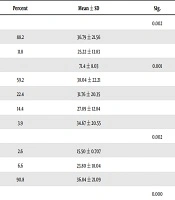
In this study, 641 older people aged 60 years and higher with a mean age of 71.44 ± 8.33 were included. eighty-eight and two tenths percent and 11.8% of participants were males and females, respectively. The demographic characteristics of participants and the differences between males and females are shown in Table 1.
Table 1.
Demographic Characteristics and Their Significant Difference in the Total Index of Addiction Tendency (P ≤ 0.02)
| Items | Percent | Mean ± SD | Sig. |
|---|---|---|---|
| Gender | 0.002 | ||
| Man | 88.2 | 36.79 ± 21.56 | |
| Female | 11.8 | 25.22 ± 13.83 | |
| Age, y | 71.4 ± 8.03 | 0.001 | |
| 60 - 90 | 59.2 | 38.04 ± 22.21 | |
| 70 - 79 | 22.4 | 31.76 ± 20.35 | |
| 80 - 89 | 14.4 | 27.89 ± 12.84 | |
| > 90 | 3.9 | 34.67 ± 20.55 | |
| Marital status | 0.002 | ||
| Married | 2.6 | 15.50 ± 0.707 | |
| Widow | 6.6 | 23.80 ± 18.04 | |
| Divorced | 90.8 | 36.84 ± 21.09 | |
| Job | 0.000 | ||
| Agricultural-stock-raising | 68.4 | 34.46 ± 22.28 | |
| Public section | 5.3 | 45.25 ± 22.86 | |
| Private section | 26.3 | 35.33 ± 17.49 | |
| ASSIST | |||
| Section 1 (a): Tobacco consumption level (score 0 to 3) | 2.25 ± 1.305 | 0.000* | |
| Section 1 (b): The level of opioid use (score 0 to 3) | 2.13 ± 1.370 | 0.000* | |
| Risk level of tobacco misuse | |||
| Section A, questions 2 to 7 (score 0 to 33) | 14.14 ± 9.776 | 0.000* | |
| Risk level of opiate misuse | 0.000* | ||
| Section B questions 2 to 7 (score 0 to 33) | 14.78 ± 11.016 | 0.000* |
The results of the Leven’s test indicated the assertion of equal zero hypotheses, homogeneity of the variance of the samples (F (17 - 58) = 0.818, P ≥ 667), the feasibility of performing a multivariate analysis between the main variables, and the total test score index of addiction and substance abuse (ASSIST-WHO). Multivariate analysis of variance (ANOVA) was used to compare the subscales of demographic components and the risk of tobacco use. The results of this test are presented in Table 2.
Table 2.
Results of Multivariate Variance Analysis for the Main Variables of the Survey with Regard to the Risk Level of Smoking Index
| Items | Variance Resources | SS | DF | MS | F | P | Adj. R Squared | Eta Sqr. | 95% CI | Sample Simulation Volume | |
|---|---|---|---|---|---|---|---|---|---|---|---|
| UP | LL | ||||||||||
| Gender | Between the group | 1061.894 | 1 | 1061.894 | 2.697 | 0.001 | 0.217 | 0.784 | 21.04 | -10.37 | 714 |
| Intergroup | 32114.630 | 74 | 433.981 | ||||||||
| Total | 33176.526 | 75 | |||||||||
| Employment | Between the group | 472.303 | 2 | 236.152 | 0.739 | 0.007 | 0.462 | 0.478 | 36.71 | -17.13 | 805 |
| Intergroup | 32704.223 | 66 | 448.003 | ||||||||
| Total | 33176.526 | 68 | |||||||||
| Marital status | Between the group | 1607.980 | 2 | 803.990 | 1.127 | 0.033 | 0.219 | 0.302 | 37.07 | -10.99 | 587 |
| Intergroup | 31568.546 | 66 | 432.446 | ||||||||
| Total | 31176.526 | 68 | |||||||||
| Age | Between the group | 1149.501 | 4 | 287.375 | 0.634 | 0.003 | 0.213 | 0.521 | 23.74 | -11.18 | 980 |
| Intergroup | 32027.025 | 71 | 451.085 | ||||||||
| Total | 33176.526 | 75 | |||||||||
As shown in Table 3, all four main variables as well as intra-group variation, had a similar effect on the trend of tobacco use tendency. The highest impact was for the variable of gender (coefficient Eta = 0.784), followed by age (Eta = 0.521). Internal group comparison revealed a significant difference. Moreover, there was a significant difference between the pairs concerning age (P < 0.003). In other words, the age categories of the elderly people don’t seem to be an effective and distinct component to predict the trend of the tendency toward addiction and tobacco products (mean difference = 0.74, P = 0.120, CI = -26.05, 1.56). However, findings indicated a significant difference from the analysis of variance. There was also a significant difference in the employment variable (P < 0.001), highlighting elderly occupational classification as an effective and distinct component for predicting the tendency toward tobacco use. Nomads and farmers (mean difference = 9.7, P = 0.000, CI = -17.3, 6.71) had higher levels of tobacco consumption and its-related consequences compared to the employees in the public sector and those in the services sector. The variance analysis table revealed a significant difference.
Table 3.
Results of Multivariate Variance Analysis for the Main Variables in Narcotics Risk Level Index
| Items | Variance Resources | SS | DF | MS | F | P | Adj. R Squared | 95% CI | Eta Sqr. | Sample Simulation Volume | |
|---|---|---|---|---|---|---|---|---|---|---|---|
| UP | LL | ||||||||||
| Sex | Between the group | 831.229 | 1 | 831.226 | 2.320 | 0.0013 | 0.417 | 5.56 | 1.842 | 0.408 | 5216 |
| Intergroup | 26515.296 | 74 | 385.315 | ||||||||
| Total | 27346.526 | 75 | |||||||||
| Employment | Between the group | 414.919 | 2 | 207.429 | 0.562 | 0.0072 | 0.45 | 34.02 | 15.79 | 0.472 | 9212 |
| Intergroup | 26931.608 | 73 | 368.926 | ||||||||
| Total | 27346.526 | 75 | |||||||||
| Marital status | Between the group | 1304.676 | 2 | 338.652 | 1.692 | 0.0068 | 0.419 | 31.52 | 10.20 | 0.342 | 5165 |
| Intergroup | 26041.851 | 73 | 356.738 | ||||||||
| Total | 27346.526 | 75 | |||||||||
| Age | Between the group | 954.042 | 4 | 238.511 | 0.462 | 0.0015 | 0.513 | 47.65 | 40.48 | 0.221 | 1999 |
| Intergroup | 26392.484 | 71 | 371.725 | ||||||||
| Total | 27246.526 | 75 | |||||||||
After controlling for marital status, the differences in the pairs were significant (P > 1.000). This introduces the marital status classification of the elderly as an effective and distinct component to predict the tendency towards addiction and tobacco products. Those who were widow and divorced (mean difference = 13.04, P = 0.001, CI = -10.9, 37.07) were more involved in tobacco and its-related consequences compared to peasants who were married. Also, the analysis of varfiance (Table 3) revealed a significant difference. The elderly women’s and men’s subgroups were tested by means of mean comparison tests due to the impossibility of performing follow-up tests with respect to independent gender variable (Table 3) and confirmation of the assumption of the variance of the samples. This indicated that men were more influenced by tobacco use’s complications (male = 36.79 ± 1.52, female = 21.22 ± 3.83, P < 0.000) (Table 3), in which this finding was significant. Both males and females subgroups were assessed by mean comparison tests owing to the impossibility of performing post hoc tests with respect to the independent gender variable (Table 3) and confirmation of the assumption of the equal variance of the samples, indicating that men were significantly more affected by tobacco use’s dilemma (male = 36.79 ± 1.52, female = 21.22 ± 3.83, P < 0.000).
The results of the ANOVA for the risk level of narcotics use, considering the demographic variables, are shown in Table 3. By applying a novel bootstrapping simulation technique, the sample size was simulated and upgraded to 1,650,000 elderly samples (n = 1,650,000, CI level = 98%). Harmony of variances was investigated by the Levene test, and the hypothesis of zero harmony of variations of samples as well as the feasibility of ANOVA were verified (Levene test (4.71) = 0.433, P = 0.653, harmonic mean = 4.876).
Employment and its types with an Eta squared coefficient of 47.2% had the highest risk of drug addiction and narcotics use (P = 0.0072, with bootstrapping simulation of 9212 elderly subjects) (Table 3), followed by the gender variable and marital status with squared eta coefficients of 40.7% and 34.2%, respectively (Ρ = 0.0013 and 0.0067and bootstrap simulation of 5216 and 5165 elderly people, respectively). Similarly, risk factors were also assessed by the running post hoc tests (Bonferroni) to identify and differentiate peer pairs and to classify the subgroups (P < 0.000). Accordingly, samples formed a separate group against other subscales and had the highest risk of substance abuse among their variable pairs. That is, the probability of drug addiction in 5216 old people aged 60 - 69, 5165 elderly divorced people, and 9212 elderly people in the animal husbandry industry was 41%, 34%, and 47%, respectively (confidence level of 98% and the error of 0.001 or less). The male and female elderly subgroups were evaluated concerning abuse risk owing to the impossibility of performing post-hoc tests in the independent gender variable. The results confirmed the assumption of equivalence of variance, highlighted the fact that men were at increased risk (male = 31.79 ± 9.55, female = 21.56 ± 2.64, Bootstrap Bias = -0.027, Bootstrap samples = 1000, P < 0.000). In general, it can be stated that, for males, being a nomad and farmer, accompanied by widowhood and divorced significantly intensify the tendency of elderly people toward narcotics abuse. based on finding, among rural older adults, the level of tobacco consumption can predict the probability of drug addiction (mean (SD) = 21.78 (11.01), F (20, 55) = 3.58, P ≤ 0.000, Eta2 = 0.566).
5. Discussion
The prevalence of addiction has continuously increased during the past decades, and nowadays, many societies are struggling with addiction as a widespread phenomenon that downgrades the QoL, even in rural communities (5). Although addiction-related issues have been extensively studied and discussed, little attention is paid to illegal drug abuse in elderly people, especially in rural areas. The current study intended to evaluate illegal drug addiction in a rural community in Southern Iran (n = 641). According to the findings, men have more tendency toward addiction than women. Even men in the sixth and seventh decade of life had a higher tendency towards addiction than women. The tendency towards addiction was higher among those who were divorced, widows, farmers, and nomads.
In terms of smoking, the most predictive power was observed for variables of gender and age, and these variables were more powerful in men than women. Moreover, the younger was the person, the higher was the predictive power of these two variables. The results are in line with previous studies. For example, Shikha et al. (12) showed that tobacco addiction was significantly more common in men than women in the rural area of India. In one rural community in India, 29% of older men were smoking, while women didn’t do so (2). It should be noted that 29.3% of men and 45.4% of women in this study used chewing tobacco (2). In Europe, in 2010, smoking was observed in 11.5% of the elderly over the age of 65 years. In other words, smoking was more prevalent in men than women (15.3% vs. 6.6%). It is more widespread in people aged 65 - 74 rather than people over 75 years (14). Saberi et al. (20) also reported a significant association between gender and smoking in Amol city, so that men were more likely to smoke tobacco than women. However, they did not study the association between age and illegal drug abuse (20).
The occupational classification is generally considered as employed, retired, and unemployed (housewife) for assessing the relationship between employment and tobacco abuse. Nevertheless, a different occupational classification was adopted in the current study due to the special working conditions of elderly people in the studied villages. (They were engaged in agriculture and nomads even in older ages and didn’t go through retirement). Consequently, in the current study, smoking prevalence was higher among farmers and nomads than other occupations. Hence, as we modified the occupation classification, the generalizability of the results has significantly declined. However, recent studies indicated that smoking tobacco is significantly higher among unemployed (housewives) and retired old people than employed elderly, which emphasizes the association between smoking tobacco and occupation in the elderly people (16, 20). The present study illustrated that divorced and widow elderly were more likely to commit smoking than married elderly people. Also, in the present study, a significant association was found between smoking and loneliness (16). Based on the findings, the prevalence of abused smoking was significantly lower among married elderly than their single counterparts, even though no association was observed with respect to divorce among the elderly (20). In this study, some occupations (farmer and cattleman more than other occupations) had the highest predictive power, followed by gender. In a study conducted in a rural Indian region, substance abuse was reported significantly higher in men than women (12). Unlike our results, Kritika et al. found a significant association between age and substance abuse (12).
A review study reported a significant correlation between smoking psychoactive substances in adults over 50 years old and employment status and gender. In this study, there was a significant association between substance abuse and age (10). Similar results are reported by Saberi et al. (20) conducted in Amol in northern Iran. They found an association between substance abuse, employment status, and gender. In the present study, similar to smoking, narcotics abuse in elderly widows or divorced people was significantly higher than the married elderly, consistent with other studies (10). However, Saberi et al. (20) did not find an association between narcotics abuse and divorce. Generally, it seems that, for males, employment in agriculture and animal husbandry sectors and a history of divorce and widowhood strongly influence the elderly’s tendency toward tobacco abuse and addiction. Since older adults are more vulnerable, it is essential for health authorities and other organizations to perform extensive studies concerning older adults’ addiction. Also, a comprehensive program should be implemented to prevent an increase in addiction among older adults. For example, in the national health services system (SIB), annual screening of the elderly should be included. The system of referral to addiction treatment centers should be integrated. Finally, inaccurate information and data on the prevalence of addiction and its risk factors, especially in Iranian older people living in rural communities, are among the limitations of the present study. Because along with multimorbidity in the elderly, the economic burden on the health system may be intensified in the poor rural regions.