
1. Background
Suicide is an act through which one intentionally performs to hurt oneself, with or without the intention to end one’s life (1). Although suicide may cause by a complexity of factors, the most obvious reason is the complicacy of problems. Hence, some may find suicide as the best solution to get rid of problems (2). In this regard, the concept of “suicide attempt” arises, a nonfatal self-directed potentially injurious behavior with any intent to die but for the purpose of expressing feelings (3). Therefore, the objectives of suicide and suicide attempt are different (4). Suicide is one of the leading causes of death worldwide. However, a suicide attempt does not always result in death (5). Based on various studies, 10% - 40% of suicide attempts result in death (6).
Suicide is the 13th leading cause of death worldwide (7) and the third reason of death in ages 11 - 44 years (8). According to the World Health Organization, the prevalence of suicide was 804,000 in 2018 and this number is predicted to reach 1530,000 in 2020 (9, 10). Some researchers reported that suicide attempts have increased by 60% during the past five decades; Japan, the USA, and the north of Europe have the highest suicide attempt rates. The prevalence of suicide ranges from 6.5 per 100,000 in Latin America to 30 per 100,000 in Finland, Lithuania, New Zealand, Russia, and Slovenia. In Islamic countries like Bahrain, Pakistan, and Turkey, the suicide rate is lower than 6.5 per 100,000, mainly due to suicide stigma in Islam (11, 12). Also, In Iran, the suicide rate is lower than in most Western countries, but it is higher than in other Middle Eastern countries (13). Concerning death due to suicide, Iran was ranked globally as the 58th. However, various regions of the country have different rates of suicide, ranging from 16.8 in the south to 117.8 (per 100,000) in the north (7). On average, there are about 10 suicides per day in Iran (14). Ilam province has experienced a significant increase in suicide-related actions, so that currently, it has the highest rate of suicide attempts and suicide in the country (15). A total of 35 297 deaths due to suicide have been reported in Iran in 2005 - 2015, and it is estimated that years of life lost for males and females has been 34.52 and 13.61 per 1000 for males and females, respectively (16). The current trend of suicide indicates its significant burden for families (17). Although suicide occurs among all age groups, more potential life is lost in young communities (18). Suicide and its related factors not only have a great deal of emotional impact on families and society but also bring adverse consequences for public services organizations (19, 20).
Investigating suicide statistics and its related factors can increase the knowledge of health system authorities, which will translate into developing preventive measures for this social problem.
2. Objectives
This study aimed to examine suicide and suicide attempt and their association with some demographic features in the city of Sirjan, Iran in 2019.
3. Materials and Methods
This descriptive cross-sectional study was conducted on all those who attempted suicide and were referred to hospitals located in the city of Sirjan in 2018. Before conducting the study, approval of the ethics committee of Sirjan School of Medical Science was obtained (IR.SIRUMS.REC.1398.001). A researcher-developed scale, which contained two sections, was used to collect the data: (A) demographic information; and (B) a checklist for collecting data on suicide attempts. The content validity of the checklist was assessed by 10 experts, and its internal reliability was evaluated by Cronbach alpha (0.72). After arranging with the hospital's authorities, before data collection, researchers agreed to ensure confidentiality of the collected data and only applying them for research purposes in the present study. Data were collected using the medical records of hospitals. Chi-square or Fisher’s exact test were used to analyze the data in SPSS version 19 (IBM statistic, New York, NY, USA). Statistical significance was considered when P-value < 0.05.
4. Results
A total of 768 people who were referred to Sirjan’s hospitals with the diagnosis of suicide attempt were investigated in the present study. The one-year incidence rate of suicide was 120.6 in males and 116.3 (per 100,000 peoples) in females. The youngest and oldest age for males was 12 and 67 years (mean age of 26.0 ± 9.2), and for females were 10 and 55 years (mean age of 24.2 ± 8.1). Most suicide attempt cases were in the age group of 20 - 29 years and 10 - 19 years. The male-to-female ratio was higher in the 20 - 29 age group. Nevertheless, for the age group of 10 - 19 years, the number of female cases was more than males, which the difference was significant based on the chi-square test (P = 0.013).
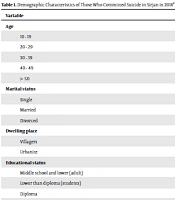
Most people who attempted suicide were single, which was more common among males than females. For married people, the suicide attempt was higher among females than males. This difference was significant based on Fisher’s exact test (P < 0.001). Among people who attempted suicide, most cases were urbanite. Drug intoxication was reported as the most common method of attempting suicide in both genders, followed by opium poisoning in females and self-mutilation in males. This difference was statistically significant based on the results of Fisher’s exact test (P < 0.001). In the present study, most suicide attempters were educated up to a diploma, and few of them had academic education. This difference was statistically significant based on the results of the chi-square test (P < 0.001) (Table 1).
Table 1.
Demographic Characteristics of Those Who Committed Suicide in Sirjan in 2018a
| Variable | Female | Male |
|---|---|---|
| Age | ||
| 10 - 19 | 147 (39.0) | 108 (27.6) |
| 20 - 29 | 141 (37.4) | 174 (44.5) |
| 30 - 39 | 70 (18.6) | 80 (20.1) |
| 40 - 49 | 14 (3.7) | 18 (4.6) |
| > 50 | 5 (1.3) | 11 (2.8) |
| Marital status | ||
| Single | 183 (48.9) | 238 (60.9) |
| Married | 185 (49.5) | 153 (39.1) |
| Divorced | 6 (1.6) | - |
| Dwelling place | ||
| Villagers | 67 (17.8) | 75 (19.2) |
| Urbanite | 310 (82.2) | 316 (80.2) |
| Educational status | ||
| Middle school and lower (adult) | 42 (11.1) | 44 (11.3) |
| Lower than diploma (students) | 197 (52.3) | 85 (21.7) |
| Diploma | 117 (31.0) | 235 (60.1) |
| Academic education | 21 (5.6) | 27 (6.9) |
| Methods of suicide attempt | ||
| Drug intoxication | 314 (83.3) | 257 (66.9) |
| Self-mutilation | 15 (4.0) | 60 (15.4) |
| Hanging | - | 8 (2.1) |
| Alcohol or methadone consumption | 2 (0.5) | 5 (1.3) |
| Agricultural pesticides | 17 (4.5) | 15 (3.9) |
| Opium intoxication | 29 (7.7) | 38 (9.9) |
| Self-immolation | - | 1 (0.3) |
| Result of suicide attempt | ||
| Survive | 375 (99.5) | 381 (97.4) |
| Death | 2 (0.5) | 10 (2.6) |
aValues are expressed as No. (%).
In this study, 12 deaths were occurred due to suicide attempt (1.56 in 100,000 people), most of the suicide cases were occurred in males (N = 10), in those aged 10 - 19 year as same as those aged 20 - 29 years (40% in each age group). Most people with a successful suicide were single (N = 7), which was 5 out of 10 male cases and all female cases (2 out of 2). Among people who committed suicide, most cases were urbanite (11 of 12 cases), and most were educated up to high school diploma (7 out of 12). Hanging was the most common method of suicide in males (60%). Detailed information are presented in Table 2.
Table 2.
Demographic Characteristics of Those Who Committed Suicide in the City of Sirjan in 2018a
| Variable | Female | Male |
|---|---|---|
| Age | ||
| 10 - 19 | 1 (50) | 4 (40) |
| 20 - 29 | 1 (50) | 4 (40) |
| 30 - 39 | - | 1 (10) |
| 40 - 49 | - | 1 (10) |
| Marital status | ||
| Single | 2 (100) | 5 (50) |
| Married | - | 5 (50) |
| Dwelling place | ||
| Villagers | - | 1 (10) |
| Urbanite | 2 (100) | 9 (90) |
| Educational status | ||
| Lower than diploma (students) | 1 (50) | 3 (30) |
| Diploma | 1 (50) | 6 (60) |
| Academic education | - | 1 (10) |
| Methods of suicide attempt | ||
| Drug intoxication | 1 (50) | - |
| Self-mutilation | - | 1 (10) |
| Hanging | - | 6 (60) |
| Alcohol or methadone consumption | - | 1 (10) |
| Agricultural pesticides | 1 (50) | - |
| Opium intoxication | - | 1 (10) |
| Self-immolation | - | 1 (10) |
aValues are expressed as No. (%).
5. Discussion
According to the findings, the suicide rate in the city of Sirjan in 2018 has been 236.9 per 100,000 people. Suicide attempt cases in Ilam province, in the period of 2010 to 2014, is reported as 180 - 276 per 100,000 (20), in another study in Jiroft, a city that is in the same province as Sirjan, the suicide rate is reported as 200 per 100,000 people in 2001 (21). Some studies reported that the annual average incidence rate of suicide has been lower than 200 per 100,000 population (9, 22, 23). According to the findings, Sirjan is one of the areas with a high prevalence of suicide attempts in Iran, which may be due to ease of access to drugs, the geographical status of the city (easy access to opium and agricultural pesticides), and also hardworking conditions that can be attributed to pervasive mining activities. However, further evidence are needed. Various studies reported an increase in suicide attempts in developing countries; while in developed countries, the suicide attempt rate is reported to be fixed or declining (24).
Moreover, according to the findings, the suicide attempt rate was 120.6 in males and 116.3 in females (per 100,000 people), but there was no significant difference between males and females, which is consistent with the study by Moravveji (2011) (25). Some studies reported a higher rate of suicide attempts in females than in males (9, 22, 24). On the other hand, other studies mentioned a higher rate in males (26-28).
Based on the findings, the mean age of suicide attempts in females was lower than that of males, so that the youngest age of suicide attempts in females and males was 10 and 12 years, respectively, which is consistent with other studies (22, 29, 30). Moreover, the results showed that 39.0% of suicide attempts in females occurred in the age group of 10 - 19 years, but in males, 27.6% of cases were in this age group. Some studies mentioned that the younger the age of suicide attempt, the higher the number of repetitions (29). On the other hand, adolescence is a sensitive period in life, and the suicide attempt is increasing among adolescences worldwide, as 8% of high school students stated they experienced at least one suicide attempt (31). The transition from adolescence to adulthood is a vital period so that youth experience many changes in their life goals, emotional bonds, and worldview, which make them more sensitive (32). As the age of puberty and marriage in females is lower than males, females experience these issues at younger ages. Ladio (2017) stated that, in the period of 2001 to 2014, the suicide attempt rate in Australian young males has decreased but has been constant in females (33). Various studies in China, India, and Iran reported that for those aged 10 - 19 years, the rate of suicide attempts is higher among females than males (24, 34, 35). Other studies in Iran found that around half of suicide attempts occur in ages younger than 24 years, and most of them occurred in females (36, 37). It was reported that around 91,209 people aged 12 - 17 years and 103,524 people aged 18 - 25 years receive treatment in emergency departments due to suicide attempts each year (38).
According to the results of the present study, the rate of suicide attempts among males and females in ages of 20 - 29 years was 44.5% and 37.4%, respectively. Studies mentioned economic problems, unemployment, and divorce as factors that increase the risk of suicide attempts in young males (37, 39, 40). Hardworking condition is also mentioned as another risk factor for suicide attempts in males (41). Family disputes and marriage-associated problems were pointed in some studies as other factors of suicide attempts in this age group (35, 38). The inability of young adults to communicate effectively (with their friends, partner, and parents), the tendency to drug abuse, and unemployment are mentioned as causes of more suicide attempts in youth (25). O'Connor (2018) found that 11% of 18 - 34-year-old people have attempted suicide at least one time, but because of receiving outpatient treatment and failure in recording patients’ information, all cases are not registered (29). The results of this study are in line with other studies that showed after passing the early adulthood stage, the tendency to suicide attempts will reduce (24, 25, 38). In the present study, less than one-third of suicides occurred after the age of 30.
Based on the findings, the suicide attempt is more prevalent among single people. A study reported that marriage is a protective factor against suicide, mainly by providing social support, enhancing social relationships, and improving self-esteem (42). Navaneelan (2012) declared that married people are the least likely group to commit suicide and complete suicide is much more common in single men (43). As the results showed, all 6 suicide cases with a history of divorce were female, which is consistent with results of other studies that point to high rates of suicide among widow’s women (43). This finding highlights the effective role of social support in decreasing suicide attempts. Various studies reported a direct relationship between the marital status of females and suicide attempts (20, 36). According to the results, people with a diploma and school students had the highest rate of suicide attempts, respectively, which is consistent with other studies (2, 22, 37). This finding can be attributed to the higher frequency of high school diploma in Iranian society.
Based on the results, drug intoxication is the most common method of suicide attempt (83.3% of females and 66.9% of males), which is consistent with various Iranian studies (22, 24, 36, 37). It may be due to easy access to drugs in Iran. Thus, the authorities should have more control over the sale of drugs without a physician's prescription. Also, more female suicide attempters used the drug intoxication method. Females usually choose mild methods for suicide, whereas invasive methods are more common among males (32, 38). Milder methods of suicide are used to get attention, relief, or punishment (33). Other common suicide methods in this study were self-mutilation, opium poisoning, agricultural pesticide, hanging, alcohol and methadone Abuse, and self-immolation. These methods were more common among males. A study mentioned drug intoxication, using poison, self-immolation, hanging, self-mutilation, alcohol consumption, and self-shooting as methods of suicide attempt (20). Some other studies point to pesticides as a common suicide method in developing countries (44).
According to the results, 1.56% of suicide attempts led to death, and most of the completed suicides were in males, mostly in those aged 10 - 19 and 20 - 29 years. According to the literature, the suicide rate ranges from 1.1 to 13.1 (24, 35, 39, 45), which indicates the lower rate of completed suicide in the city of Sirjan compared to other cities, despite the high rate of suicide attempts. The highest rate of suicide is reported in Western provinces of Iran like Ilam and Lorestan. While the lowest rate is reported in northern provinces of the country like Azarbayjan Sharghi and Zanjan, which may be due to atmospheric and economic conditions, religious beliefs, and easy access to invasive methods of suicide (37). According to the World Health Organization, the prevalence of suicide ranges from 0.55 to 5.4 per 100,000 people (24). In Iran, the rate of leading to death suicides, in 2001 - 2010, is reported as 5.5 per 100,000 people (37). Mokhtari expressed that the suicide rate in the ages of 10 - 19 years was 7.91 per 100,000 people (24). In Australia, the suicide rate is reported as 4.57 per 100,000 in young people (29). In Kashan, 25 - 35-year-old males had the highest rate of suicide (25). In general, 1.4 of the world’s premature death are due to suicide. In addition, according to the statistics, males are 3 times likely to commit suicide than females (45). Other studies also reported higher rates of suicide in males (33), which may be related to applying more invasive suicide methods than females. In this study, hanging was the most common method (60%) of suicide, which is consistent with the study by Hasanpoor (37). Also, in European countries, hanging is reported as the most common method of suicide (46). In the study by Silk (2017), the most common suicide method was hanging, followed by insecticide poisoning and self-shooting (45). In this study, poisoning and drug abuse were the most common suicide methods among females. A study conducted in Ilam mentioned hanging and self-immolation as the most common methods of suicide in males and females, respectively (20). In the present study, only one male used self-immolation that resulted in death. In Australia, the most common methods of suicide in young people are reported as hanging and jumping in front of a moving vehicle (33). In the USA, self-shooting is reported as the most common method of suicide (46), which can be due to legal access to weapons. Most suicide attempts are due to mental disorders, such as depression, opium addiction, and psychosis (47). Concerning marital status, the suicide rate was similar among single and married males, but in females, suicide was more prevalent among single females. It can be argued that, regardless of gender, the number of suicides is higher among single people, which is consistent with the study by Mokhtari (24), and can be related to less emotional dependence of the singles and lack of social support.
5.1. Conclusions
According to the statistics, Sirjan is one of the areas with a high prevalence of suicide attempts, young people are at increased risk of suicide. Suicide attempt at young ages is associated with increased repeated suicide attempts, which in turn causes an increased risk of completed suicide. So, preventive measures should be implemented based on related factors in order to prevent its negative effects on families and society. Preventive measures include restricting access to means used for suicide, especially illegal drugs, and lethal poisons, training doctors and health care providers to identify people at increased risk of suicide commitment and following up them, and, most importantly, improving the resilience of youth in the face of life challenges. Therefore, the findings of the present study can be regarded as a step forward in future researches to consider interventions intended to improve mental health and finding useful solutions to prevent suicide.