
1. Background
The spread of the Internet and the improvement of audio and video media have led to the emergence of an industry called pornography (1). Pornography is sexually explicit written or visual content designed for triggering sexual arousal in the reader/viewer (2). Increasing access to this industry has created the concept of pornography addiction. Studies have indicated that pornography addiction is a real phenomenon that plays a destructive role in people’s marital and everyday lives (3), so that it causes tension between couples and diversely impacts marital satisfaction (4). Marital satisfaction is people’s subjective evaluation of their marriage made based on whether or not their needs, expectations, and desires are satisfied (5). Sexual satisfaction, as a component of marital satisfaction, is an emotional response resulted from the subjective evaluation of the sexual relationship (6). Some studies have demonstrated that watching pornography reduces marital sexual satisfaction (4, 7). Also, research confirmed the negative impact of pornography on the sexual satisfaction of men who reported low levels of emotional connection with their spouses (8). Research has also shown that pornography use has significant and inverse associations with levels of love and marital satisfaction (9).
Results of studies conducted to assess the role of pornography in marital sexual satisfaction are quite contradictory. While men’s pornography use is an important factor in reducing the sexual relationship quality, the use of pornography in women correlates with sexual satisfaction (10). On the other hand, it has also been suggested that pornography use significantly improves relationship satisfaction, commitment, and intimacy between couples (11).
Also, research dictated that excessive pornography use can increase the possibility of infidelity as a factor affecting the failure of a couple’s relationship (12). According to Drigotas and Barta, infidelity, with regards to a dyadic relationship, is a breach of commitment by engaging in either physical or emotional intimacy with someone outside the current relationship (13). The prevalence of infidelity in women has increased by almost 40% over the past two decades; however, this rate (21%) has remained stable in men (14). Research has proven that pornography use is one of the strongest predictors of extradyadic sexual involvement (15, 16). Moreover, a study showed that pornography use in couples significantly increases the likelihood of divorce and extradyadic affairs (12, 17). The results of a study conducted on 531 Internet users indicated that watching pornographic images had significant and direct relationships with infidelity and unfaithfulness (18, 19). Research conducted in Iran has also demonstrated that pornography use is effective in increasing insensitivity to the spouse, distorting the perceptions of sexuality, and reducing the values associated with monogamy and marriage (11). Infidelity can affect marital satisfaction (because about 2 to 4% of spouses engage in sexual infidelity annually), and it occurs in 20 to 25% of all marriages (20). On the other hand, in Iranian research, little attention has been paid to the relationship between pornography and marital satisfaction; most of the studies have reported the negative effects of the Internet and satellite on couples’ lives (21, 22). Accordingly, it is necessary to research the relationship between pornography, marital satisfaction, and attitudes toward marital infidelity.
2. Objectives
This study examined the role of pornography use in marital sexual satisfaction and attitudes toward marital infidelity among married women in Zahedan.
3. Patients and Methods
3.1. Participants
This descriptive study had a correlational-predictive design. Its statistical population consisted of married women who were either employees of governmental organizations or housewives in Zahedan in 2018. The sample size was determined by the Cochran formula with 0.07 (d), 1.96 (z), and 0.05 (p q). It included 190 women (95 housewives and 95 employees) selected by a convenience sampling method. Being married with the age of 25 to 50 years was the inclusion criterion.
3.2. Ethical Considerations
The approval of the Ethics Committee of the University of Sistan and Baluchestan in Zahedan, Iran (IR.USB.REC.1399.009) was obtained. Before the study, explaining the main objectives of carrying out this study to the participants, obtaining the participants’ informed consent to take part in the study, giving them the freedom of choice to withdraw from the study at any stage that they saw fit, and ensuring them of the confidentiality of the obtained data and the anonymity of the individuals filling out the questionnaires.
3.3. Instruments
3.3.1. Problematic Pornography Use Scale (PPUS)
This scale is a 12-item tool designed by Kor et al. It is scored based on a six-point Likert-type scale (never = 0 to always = 5). It has four subscales, i.e., social and psychological problems, excessive use, difficulties in self-control, and internet pornography use (IPU) to escape or avoid negative emotions. In a study carried out by Kor et al. (23), the Cronbach’s alpha coefficients of these subscales were 0.91, 0.86, 0.75, and 0.93, respectively. Additionally, in another study, the Cronbach’s alpha coefficient of this scale was 0.85 (24). In this study, Cronbach’s alpha coefficient was 0.91.
3.3.2. Marital Sexual Satisfaction Questionnaire (Women’s Form)
Mostafavi developed this questionnaire. It has 36 five-option items. It is scored from four (completely agree) to zero (completely disagree). Some items are scored diversely. Using Cronbach’s alpha, the reliability of the Marital Sexual Satisfaction Questionnaire was 0.85 (25). In the present study, its Cronbach’s alpha coefficient was 0.87.
3.3.3. Attitudes toward Infidelity Scale
Whatley designed this scale in 2006. It has 12 items, each of which is scored based on a seven-point scale ranging from one (totally disagree) to seven (totally agree). The maximum score is 84, indicating the acceptance of infidelity, and the minimum score is 12, showing the rejection of infidelity. The cut-off point is 48. In a study conducted on 383 married and single men and women living in Ali Abad and Behshahr, the Cronbach’s alpha coefficient of this scale was 0.84 (26). In the current study, its Cronbach’s alpha coefficient was 0.81.
3.4. Statistical Analyses
To analyze the data, we used descriptive and inferential statistics (Pearson correlation coefficient and regression analysis). SPSS version 23 was employed to analyze the data.
4. Results
The Pearson correlation coefficient and the stepwise regression analysis were used to analyze the data.
Table 1 shows that the mean scores of all the subscales of pornography use obtained by housewives were higher than those of employed women. The mean score of marital sexual satisfaction obtained by employed women was higher than that of housewives. Furthermore, the mean score on infidelity was higher in housewives than in employed women.
Table 1.
| Variables | Social and Psychological Problems | Excessive Use | Difficulties in Self-Control | IPU to Escape or Avoid Negative Emotions | Overall Score of Pornography Use | Marital Sexual Satisfaction | Attitude Toward Marital Infidelity |
|---|---|---|---|---|---|---|---|
| Housewives | 0.80 ± 1.79 | 0.81 ± 1.95 | 1.07 ± 2.43 | 1.17 ± 2.52 | 3.85 ± 7.70 | 87.14 ± 20.1 | 24.66 ± 12.60 |
| Employed women | 0.17 ± 0.72 | 0.12 ± 0.55 | 0.24 ± 1.20 | 0.04 ± 0.32 | 0.58 ± 1.95 | 105.49 ± 15.49 | 15.71 ± 5.69 |
a Values are expressed as mean ± SD.
b N= 180 (housewives 90; employed women 90).
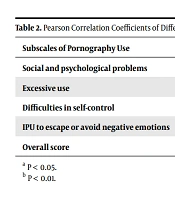
As Table 2 demonstrates, the overall score of pornography use and the subscales of social and psychological problems, difficulties in self-control, and IPU to escape or avoid negative emotions had significant and diverse correlations with marital sexual satisfaction. Moreover, there were significant direct correlations between all the subscales of pornography use and marital infidelity. Table 3 reports the results of stepwise regression analysis conducted to predict the overall marital sexual satisfaction score via the subscales of pornography use.
Table 2.
Pearson Correlation Coefficients of Different Subscales of Pornography Use with Marital Sexual Satisfaction and Attitudes Toward Marital Infidelity
| Subscales of Pornography Use | Marital Sexual Satisfaction | Attitude Toward Marital Infidelity |
|---|---|---|
| Social and psychological problems | -0.16 a | 0.23 b |
| Excessive use | -0.12 | 0.21 b |
| Difficulties in self-control | -0.14 a | 0.21 b |
| IPU to escape or avoid negative emotions | -0.16 a | 0.22 b |
| Overall score | -0.17 a | 0.25 b |
a P < 0.05.
b P < 0.01.
Table 3.
Stepwise Regression Results of the Overall Marital Sexual Satisfaction Score Predicted via Subscales of Pornography Use
| Variable | R | R2 | B | SE | Beta | t | Sig. |
|---|---|---|---|---|---|---|---|
| IPU to escape or avoid negative emotions | 0.16 | 0.02 | -1.749 | 0.767 | -0.164 | -2.280 | 0.02 |
As can be seen in Table 3, IPU to escape or avoid negative emotions could explain 2% of the variances in the overall marital sexual satisfaction score. Besides, IPU to escape or avoid negative emotions (Beta = -0.164 and Sig. = 0.02) was a negative predictor of marital sexual satisfaction. The other subscales did not have the criteria for entering the equation and were eliminated.
According to Table 4, social and psychological problems could explain 5% of the variance in the overall marital infidelity score. The subscale of social and psychological problems (Beta = 0.237 and Sig. = 0.001) was a positive predictor of marital infidelity. The other subscales did not have the criteria for entering the equation and were eliminated.
Table 4.
Stepwise Regression Results of Overall Marital Infidelity Score Predicted via the Subscales of Pornography Use
| Variable | R | R2 | B | SE | Beta | t | Sig. |
|---|---|---|---|---|---|---|---|
| Social and psychological problems | 0.23 | 0.05 | 1.816 | 0.542 | 0.237 | 3.349 | 0.001 |
5. Discussion
The current study aimed to investigate the relationship of pornography use with marital sexual satisfaction and attitudes toward marital infidelity among married women in Zahedan. According to the findings, the overall mean score of pornography use was very low among these housewives and employed women (with a value of 2.21). This low score may be due to that it is taboo. Also, the mean scores of all the subscales of pornography use obtained by housewives were higher than those of employed women. Furthermore, the mean scores of marital sexual satisfaction and attitudes toward marital infidelity (with values of 96.18 and 20.18) were at high and low levels, respectively. The mean score on infidelity was higher in housewives than in employed women. The lower scores of employed women on the pornography use scale and attitudes toward marital infidelity, compared to housewives, may be due to their fears and concerns about the employment situation.
The findings showed that pornography use and its subscales had significant diverse correlations with marital sexual satisfaction, and pornography use to escape or avoid negative emotions was a negative predictor of marital sexual satisfaction. These findings are consistent with the results of Wright et al. (7), Leonhardt and Willoughby (4), Veit et al. (8), Doran and Price (17), and Jafarzadeh Fadaki and Amani (9) that have demonstrated that pornography use reduces marital sexual satisfaction.
In a survey of 1,500 adults in the United States, for example, Wright et al. (7) concluded that there was a diverse association between watching pornography and sexual satisfaction. Minarcik et al. (11) stated that pornography use significantly improved relationship satisfaction, commitment, and intimacy between couples. Examining a sample of married university students, Jafarzadeh Fadaki and Amani (9) also found that pornography use had inverse and significant correlations with levels of love and marital satisfaction.
The nature of pornography is to trigger sexual arousal in individuals. Pornography raises the viewer’s expectations by stimulating sexual feelings or thoughts. If the spouse is unable to satisfy the person at the level of arousal triggered by pornographic images, the sexual satisfaction will reduce (27). On the other hand, watching pornography allows the person to spend less time with his/her sexual and emotional partner in real life and leads the person to prefer watching pornographic images to getting sexual satisfaction from his/her spouse (28).
However, some research does not confirm the results of this research, such as Poulsen et al. (10) and Minarcik et al. (11). They suggested that pornography use significantly improves relationship satisfaction, commitment, and intimacy between couples. This result may be due to cultural and subcultural factors or because of differences in instrument and the method of research.
The findings also proved that pornography use and its subscales had direct relationships with attitudes toward marital infidelity. This finding is consistent with the results of Doran and Price (17), Maddox et al. (16), Gwinn et al. (12), Stack et al. (18), and Idr and Mardani (19). As an instance, Doran and Price (17) reported that adults who had seen a large number of pornographic movies in the past year before the study were more likely to get a divorce and had more extradyadic affairs. Idr and Mardani (19) concluded that there was a significant positive association between watching pornographic images and movies and extramarital relationships.
Pornography use disrupts the process of arousal in the user’s brain, weakens the emotional and sexual commitment to the life partner, and leads to infidelity. Moreover, it destroys the couple’s trust in each other, and ultimately, the person using the pornography compares the pornographic images with the image of his/her partner. If this comparison is not desirable enough and the spouse cannot satisfy the porn user’s sexual satisfaction, this all in all can increase the person’s likelihood of looking for someone else to satisfy his/her needs (27).
5.1. Study Limitations
Limitations of the present study include using non-probability sampling, utilizing self-report questionnaires, and not studying the role of demographic variables and cultural and social factors; also, there was a possibility of the effect of the nature of the questionnaires on the participants' answers.
On the other hand, the sample was limited to married employed women and housewives in Zahedan, and it did not include married men. Additionally, a few studies have been conducted in Iran to examine the role of pornography in marital sexual satisfaction, especially marital infidelity. This negatively affected explaining the findings.
Therefore, conducting similar studies in other cities with a larger sample size, including married men, and examining the role of demographic variables are highly recommended.
5.2. Conclusions
Finally, concerning the role of pornography in couples’ lives, it is recommended that counseling centers and media pay more attention to the consequences of pornography and provide appropriate training in this regard. Accordingly, considering the negative effects of pornography use on couples’ lives, providing solutions to reduce pornography use and inform people about its consequences is recommended.