
1. Background
Research on the nutritional status of Syrian refugee children shows that the prevalence of acute malnutrition varies between 0.3 - 4.4%. The prevalence of stunting varies between 10.5% and 21.0% among 2000 children aged 6 - 59 months living in different settlements in Jordan, Lebanon, and Iraq (1).
Displacement affects children’s health in almost all dimensions (2). School-aged refugee children either living inside or outside of camps are in a highly vulnerable position. Therefore, it is very important to evaluate their physical health and nutritional status. Studies in the literature mainly focus on the nutrition of Syrian refugee children under 5 years of age and their nutritional status shortly after resettlement (1, 3).
On the other hand, it is crucial that the amount of energy and nutrients should be at the recommended extent due to the fact that it does not only positively affect the individual’s wellbeing and academic success, but also it helps to prevent chronic diseases such as obesity, cardiovascular diseases, and diabetes. For this reason, at least three main meals in a day should be consumed, and health-disrupting preferences such as one-way nutrition, prolonged starvation, or over-nutrition should be avoided (4). These standards establish an adequate, balanced, and regular nutrition, which is especially important in the mental and physical development of children (5). A healthy breakfast not only provides energy, but also it keeps school-age children healthier and more energetic. Studies have shown that many school health problems will arise if school-age children skip breakfast (6, 7).
An adequate, balanced, and healthy diet also prepares the individual for daily life (8, 9). The duration of nutrients’ digestion depends on the type of nutrients taken, the frequency, and the time interval between the meals. Prolonged fasting causes many metabolic disorders and growth retardation in children (10). Breakfast is essential for sufficient energy. In case individuals fail to have breakfast, fatigue, headache, and carelessness may arise. In addition, academic success in childhood might decrease. Furthermore, breakfast increases the available energy level, providing the required energy for the brain, which leads to effective learning (11).
2. Objectives
The aim of this study was to examine the relationship between breakfast habit, breakfast quality index (BQI), and academic success. There are few studies on the relationship between breakfast habits and academic achievement of elementary school students living in refugee settlements in Turkey. This is the most important feature that distinguishes this study from others. The study is an innovative research that addresses refugees and different ethnic groups.
3. Methods
3.1. Type of Research
This study is a cross-sectional/descriptive study that aims at investigating the relationship between breakfast habits and academic success.
3.2. Sample Size of Study
The research population consists of all the primary school refugee students in Mardin District Center of Mardin Province (1875 students in total). Using Epi Info Statical calculation program, our sample size was determined as 384, at 95% confidence interval.
Using the stratified random sampling method, the proportional selection was utilized, and students were represented in the sample in proportionate to the number of students in each primary school in Mardin district center.
3.3. Date of Research and Collection of Data
The study was carried out among primary school students between March and May 2018. The research data was collected through an information collection form.
3.3.1. Demographic Information Form
This form includes items on age, the grade, the number of individuals in the family, and health status.
3.3.2. The Information on Breakfast Habits Form
This form comprises questions about breakfast habits, nutrient groups, and beverages frequently consumed at breakfast (12).
3.3.3. Breakfast Quality Index (BQI)
While creating the BQI index, a point was given for the consumption of cereals, fruits/vegetables, dairy products, and MUFA oils. In addition, a point was given if 5% of the total daily energy is supplied by simple sugar. If the total calcium intake for breakfast is 200 - 300 mg, it is considered as a point. One point for MUFA: SFA ratio above the median for the population was also assigned. In addition, one point was given if cereals, dairy products, fruits, and vegetables were consumed. The total score can range from 1 to 10 points in terms of breakfast nutrient content. BQI scores are divided into three groups as poor (≤ 3), medium (4 - 7), and adequate (≥ 8) (Table 1) (13).
Table 1.
Breakfast Quality Index (BQI): Items Included and Scoring (Points Awarded) (12)
| Items Included | Yes | No |
|---|---|---|
| Cereals and derivatives (bread, breakfast cereals, biscuits, bakery products) | + 1 | 0 |
| Fruit and vegetables (fruit, fruit juice, vegetables) | + 1 | 0 |
| Dairy products (whole and semi-skimmed milk, milk shake, yoghurt, cheese) | + 1 | 0 |
| Foods rich in simple sugars (sugar, jam, honey), 5% of total daily energy | + 1 | 0 |
| MUFA-rich fats (olive oil, vegetable oil) | + 1 | 0 |
| MUFA: SFA > median | + 1 | 0 |
| Compliance with energy intake recommendations (20 - 25% of total daily energy) | + 1 | 0 |
| Cereals 1 fruit 1 dairy product in the same meal | + 1 | 0 |
| Calcium (200 - 300 mg) | + 1 | 0 |
| Absence of SFA and trans-rich fats (butter, margarine) | + 1 | 0 |
| Total point refer to breakfast quality index |
3.3.4. Calculation of Breakfast Nutrient Content
Scores over three days were averaged to create an overall breakfast quality score for each participant (14). Students who had breakfast were asked to write their breakfast for three consecutive days by their families. After writing breakfast for three days, the data were recorded in the nutrition information system (NIS). The average of 3-day recordings was taken for the nutrient contents. The frequency of the foods consumed at breakfast, along with the average, was recorded. The breakfast quality score was calculated according to the foods consumed regularly and the frequency of breakfast consumption.
3.3.5. Academic Success Status
To determine the academic success of the students participating in the study, the database of students’ information system was used. Those with an academic score of 5 were considered as ‘very good’, those with 4 points as ‘good’, those with 3 points as ‘medium’, and 1 or 2 points are marked as ‘very bad’.
3.4. Body Weight and Height
3.4.1. Anthropometric Measurements Form
This form includes questions regarding body weight and height.
The body weights of the students were measured by the same researcher, and the measurement was recorded as an integer and in kilograms (kg). Students were weighed with their daily clothes and without shoes. Height was measured by the mechanical length measurement apparatus (Frankfurt horizontal plane position), and the collected data was recorded in centimeters (cm).
For the 1st and 2nd-grade primary school students taking part within the research sample, the questionnaire was filled out by the researcher following one-on-one interviews with the students, while the 3rd and 4th grade students were asked to complete the forms by themselves with the researcher’s observation.
3.5. Data Analysis
Data were analyzed using SPSS version 22. Descriptive data were shown as mean ± standard deviation for variables with normal distribution, median (top-bottom) for sub-normality variables, number of students, and respective percentage (%) for nominal variables. The chi-square test was utilized to examine the relationship between two categorical variables. The students with an academic success status of ‘very good’ and ‘good’ were evaluated as ‘successful’, whereas those who were marked as ‘medium’ and ‘very bad’ were evaluated as ‘unsuccessful’.
3.6. Ethical Issues
Ethical committee approval was obtained from Mardin University’s Research Ethics Committee, and the required institutional/official permission was obtained from the Provincial Directorate of National Education. In addition, the study complied with the guidelines of the Declaration of Helsinki, and written informed consent was obtained from all children and their parents.
4. Results
The distribution of the students included in the study by the habit of making breakfast is presented in Table 2. The age range of these students varied between (min-max) 5 - 13 years, and the students’ mean age was 8.3 ± 1.25 years, their mean height was 126.6 ± 10.04 cm, their mean weight was 27.8 ± 6.25 kg, and mean BMI was 17.29 ± 3.01 kg/cm2. Overall, 91.6% of the students generally had a breakfast habit. The majority of the students consisted of boys (64.6%). The reason for skipping breakfast in students of all levels can be listed as being late for school (68.7%) and not liking to have breakfast (18.8%). The reasons for skipping breakfast were not liking to eat anything in the morning (9.4%) or fear of gaining weight (3.1%). Breakfast skippers mostly preferred toast (31.1%) and fries (18.8%) as their first meal.
Table 2.
Characteristics of Students Participating in the Study a
| Variables | Values |
|---|---|
| Gender | |
| Boys | 248 (64.6) |
| Girls | 136 (35.4) |
| Age (y) range (min - max) | 5 - 13 |
| Age (y) | 8.36 ± 1.25 |
| BMI (kg/cm2) range | 9.99 - 30.84 |
| BMI (kg/cm2) | 17.29 ± 3.01 |
| Breakfast habit | |
| Yes | 352 (91.7) |
| No | 32 (8.3) |
| The reasons for skipping breakfast | |
| I am late for school since I wake up late | 22 (68.7) |
| I do not like having breakfast | 6 (18.8) |
| I do not have appetite in the mornings | 3 (9.4) |
| I am afraid to gain weight | 1 (3.1) |
a Values are expressed as No. (%) or mean ± SD unless otherwise indicated.
Characteristics of students with the habit of breakfast eating is given in Table 3. In general, 69.3% of the students had regular breakfast every day, and 21.1% of the students had breakfast 4 - 5 times a week, and 5.6% had breakfast 3 - 4 times in a week, and 4.0% of the students had breakfast 1 - 2 times in a week. Most individuals (86.9%) preferred to have breakfast with their families and at home (92.3%). Information about the duration of having breakfast was that 66.2% of the individuals had less than 30 minutes for breakfast, 27.1% had 30 - 60 minutes for breakfast, 6.2% had 1 - 2 hours for breakfast, and 0.5% had more than 2 hours for breakfast. The individuals stated that they had breakfast because they were usually hungry in the morning (40.1%). Students included in the research reportedly consumed mostly cheese (32.4%), boiled eggs (20.2%), olives (12.2%), and fried eggs (9.9%) as food, and milk (49.1%), tea (31%), and water (13.6%) as beverages.
Table 3.
Characteristics of Students with the Habit of Having Breakfast
| Variables | No. (%) |
|---|---|
| Frequency of having breakfast | |
| Every day on a regular basis | 244 (69.3) |
| 4 - 5 times in a week | 74 (21.1) |
| 3 - 4 times in a week | 20 (5.6) |
| 1 - 2 times in a week | 14 (4.0) |
| With whom/who do you usually have breakfast? | |
| Alone | 42 (11.9) |
| With family | 306 (86.9) |
| With relatives | 2 (0.6) |
| With friends | 2 (0.6) |
| Where would you like to have breakfast the most? | |
| At home | 325 (92.3) |
| In the canteen | 11 (3.2) |
| In the class | 16 (4.5) |
| How long does it take to have breakfast after you wake up? | |
| Less than 30 min | 233 (66.2) |
| Between 30 min and 1 hour | 95 (27.1) |
| Between 1 and 2 hours | 22 (6.2) |
| 2 hours or more | 2 (0.5) |
| The reasons for having breakfast | |
| Because my parent being happy if I make breakfast. | 11 (3.1) |
| Part of our family habit and tradition | 19 (5.4) |
| I am hungry in the mornings | 141 (40.1) |
| Because my family prepares breakfast | 37 (10.5) |
| It makes me feel active and energetic | 93 (26.4) |
| My family is happy if I eat | 13 (3.7) |
| One of the most important meals | 35 (9.9) |
| I am imitating my friends | 3 (0.9) |
| Total | 352 (100.0) |
Nutritional contents of the breakfast served by the students are shown in Table 4. There were 226 boys and 126 girls in the study. The nutritional contents of breakfast served in different age ranges were determined. It was observed that the energy and nutrients in the breakfast increased with age. However, the difference was not statistically significant.
Table 4.
Breakfast Nutritional Contents of the Students a
| Variables | Age (y) | F | P b | ||
|---|---|---|---|---|---|
| ≤ 7 | 8 - 9 | ≥ 10 | |||
| Boys (n = 226) | |||||
| No. | 73 | 113 | 40 | - | - |
| Nutrients | |||||
| Energy (kcal) | 234.20 ± 69.24 | 251.05 ± 65.81 | 259.13 ± 62.55 | 0.315 | 0.730 |
| Carbohydrate (g) | 30.09.39 ± 10.34 | 32.45 ± 8.23 | 34.42 ± 8.31 | 0.376 | 0.687 |
| Protein (g) | 7.39 ± 1.87 | 8.12 ± 2.70 | 10.09 ± 2.44 | 0.379 | 0.685 |
| Fat (g) | 9.36 ± 2.50 | 9.87 ± 2.81 | 9.68 ± 2.51 | 0.247 | 0.782 |
| Calcium (mg) | 201.00 ± 99.41 | 193.06 ± 92.09 | 166.42 ± 90.76 | 2.516 | 0.083 |
| Fiber (g) | 0.93 ± 0.38 | 1.53 ± 0.88 | 1.56 ± 0.98 | 0.482 | 0.619 |
| Girls (n = 126) | |||||
| No. | 33 | 64 | 29 | - | - |
| Nutrients | |||||
| Energy (kcal) | 228.83 ± 64.79 | 253.67 ± 73.20 | 256.15 ± 64.79 | 0.463 | 0.630 |
| Carbohydrate (g) | 29.53 ± 7.11 | 32.82 ± 9.23 | 32.08 ± 8.51 | 0.417 | 0.660 |
| Protein (g) | 7.52 ± 3.11 | 8.19 ± 2.86 | 7.94 ± 2.17 | 0.274 | 0.861 |
| Fat (g) | 8.96 ± 2.94 | 9.96 ± 3.08 | 9.56 ± 2.40 | 0.539 | 0.584 |
| Calcium (mg) | 194.83 ± 112.28 | 172.72 ± 90.09 | 168.98 ± 96.85 | 0.208 | 0.812 |
| Fiber (g) | 2.20 ± 0.14 | 1.13 ± 0.56 | 1.43 ± 0.98 | 1.711 | 0.196 |
a Values are expressed as mean ± SD unless otherwise indicated.
b One-way ANOVA.
Academic success according to the BQI score can be seen in Table 5. BQI values of the most successful boys and girls were 3 point and 5 points, respectively. Low 'BQI' value was observed in both girls and boys student with poor academic achievement.
Table 5.
Academic Success According to Breakfast Quality Index
| Variables | Academic Success | P a | |||
|---|---|---|---|---|---|
| Very Good (5 Point) | Good (4 Point) | Medium (3 Point) | Bad (1 or 2 Point) | ||
| Boys (n = 226) | 0.163 | ||||
| No. | 78 | 110 | 34 | 4 | |
| Breakfast Quality Index score median [IQR] (point) | 3 [2] | 4 [3] | 4 [3] | 3 [4.5] | |
| Girls (n = 126) | 0.388 | ||||
| No. | 36 | 61 | 25 | 4 | |
| Breakfast Quality Index score median [IQR] (point) | 5 [4] | 3 [2.5] | 4 [3] | 3.5 [2.5] | |
a Kruskal-Wallis test.
Figure 1 shows that BQI score by the number of students. The academic success of 37 boys with breakfast quality score ≤ 3 was ‘very good’. The number of students with breakfast quality score ≥ 8 point was very low. It was observed that boys had the most academic success with the lowest breakfast quality score. The breakfast quality score of girls with the best academic success was between 4 - 7 points. Accordingly, the breakfast quality score was between ≤ 3 and 4 - 7 point in girls with poor academic success. In addition, it was observed that the academic success level of girls whose breakfast quality score was ≥ 8 point, was very poor.
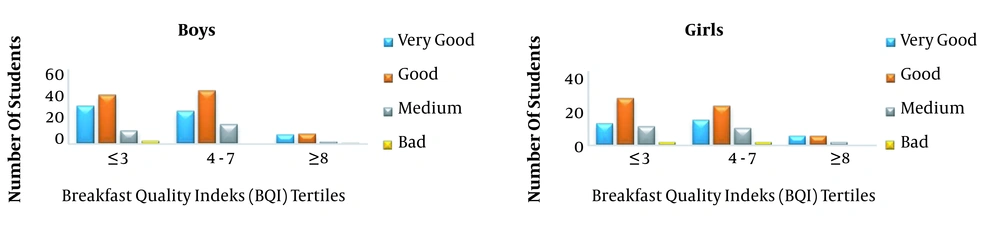
Figure 1.
Breakfast quality index score by the number of students with academic success
Table 6 shows the BQI score in three age groups, which was classified as ≤ 7 years, 8 - 9 years, ≥ 10 years, based on gender. The number of boys in the three age groups was 73, 113, 40, respectively, and the number of girls in the three age groups was 33, 64, 2, respectively. The BQI score was marked as low for both boys and girls and all age groups. According to this value, all the age groups had poor nutritional breakfast meals. While the age groups were significantly different in this regard in girls (P = 0.046), there was no significant differences for boys (P = 0.671).
Table 6.
Breakfast Quality Index Score Three Tertiles and Age Groups a
| Breakfast Quality Index | Age (y) | P b | Pearson Chi-Square | |||
|---|---|---|---|---|---|---|
| ≤ 7 | 8 - 9 | ≥ 10 | Total | |||
| Boys | 0.671 | 1.324 | ||||
| No. | 73 | 113 | 40 | - | ||
| ≤ 3 point | 33 (32.7) | 51 (50.5) | 17 (16.8) | 101 (100.0) | ||
| 4 - 7 point | 33 (32.0) | 51 (49.5) | 19 (18.4) | 103 (100.0) | ||
| ≥ 8 point | 7 (31.8) | 11 (50.0) | 4 (18.2) | 22 (100.0) | ||
| Total | 73 (32.3) | 113 (50.0) | 40 (17.7) | 226 (100.0) | ||
| Girls | 0.046 | 2.353 | ||||
| No. | 33 | 64 | 29 | - | ||
| ≤ 3 point | 18 (31.0) | 31 (53.4) | 9 (15.5) | 58 (100.0) | ||
| 4 - 7 point | 14 (25.9) | 24 (44.4) | 16 (29.6) | 54 (100.0) | ||
| ≥ 8 point | 1 (7.1) | 9 (64.3) | 4 (28.6) | 14 (100.0) | ||
| Total | 33 (26.2) | 64 (50.8) | 29 (23.0) | 126 (100.0) | ||
a Values are expressed as No. (%) unless otherwise indicated.
b Pearson chi-Square.
5. Discussion
There are numerous studies examining the relationship between breakfast habit and academic performance/success of children and adolescents (15-20). Our research was conducted to identify the relationship between breakfast quality index and academic success of primary-school refugee children.
In a study conducted in the Netherlands (2012), 605 adolescents were examined. In that study, the rate of having breakfast was as high as 84.7% (21). In the study by ALBashtawy, the frequency of having breakfast was determined as 80.4% (22). In our study, it was found that most students had breakfast on a regular basis, and the rate of having breakfast was found to be higher than the reported results in the literature (17, 18). The status of school-age children’s living with their families can affect their eating habits. In a study conducted in Jordan, it was found that children’s living with their families had a positive effect on the habit of having breakfast (22). The majority of the participants lived with their families in the current study. It is emphasized that individuals would rather have their breakfast regularly. In a US study conducted in 2017, the frequency of having breakfast was found to be 5 days per week (23).
In a study conducted in England (2013), many factors were found to influence children’s breakfast habits. Most of the individuals who had breakfast reported that they had breakfast with their families. The level of education and knowledge level of families were found to influence this habit (24-26). It was observed that students with a breakfast habit mostly had their breakfast with their families. Breakfast, when eaten in the home environment, was found to be more satisfying and more nutritious (8, 17, 22). In the current study, it was observed that individuals with breakfast eating habit tend to have their breakfast at home, indicating that having breakfast is a family-related habit (27).
It is also emphasized that the time spent for breakfast is as important as having breakfast. There are many studies suggesting that having breakfast for 30 minutes or less will result in inadequate nutrients intake (5, 28). In the current study, the number of children who spent 30 minutes or less for breakfast was relatively high. Following a prolonged fasting (about 8 - 10 hours), the desire to have breakfast as early as waking up in the morning is considered to be due to a decrease in blood glucose and the immediate need for energy (9, 22, 29-31). A significant number of students who had the habit of eating breakfast in this study stated that the reason for having breakfast was because they were hungry in the morning. The students indicated that the reason for having breakfast is to maintain energy. Many studies show that having breakfast makes individuals feel more energetic and renders students to be more academically successful (5, 32, 33).
School-age children of growth and developmental age should also be fed sufficiently and in a balanced manner at breakfast. Foods consumed in breakfast, such as cheese and eggs, are high-quality sources of protein, and they can meet a great part of the essential amino acids required for individuals. Raaijmakers et al. reported that 83.8% of adolescents preferred to consume cereals and cereal derivatives for breakfast, 70.9% preferred dairy and dairy products, 42.2% had fat groups, and 33.1% had fruits (34). In our study, it was observed that cheese consumption was the most frequent, followed by boiled egg consumption. In a study (2016) of 1258 children aged from 7 to 12 years in Thailand, the most frequent beverages in breakfast were investigated, and it was found that 70% of children consumed milk (31). Aranceta et al. (2001) reported in their study of children and young people aged 2 - 24 years that the main beverage in breakfast was milk (35). In the current study also the most preferred beverage in breakfast was milk. In this particular aspect, our research findings were lower than those of other studies, and this may be due to both habits and low socio-economic status.
In the study of Deshmukh-Taskar et al. (2010), it is found that breakfast is the most frequently skipped meal; it has been stated that the rate of breakfast skipping in children aged 9 - 13 years is 20%, and breakfast skipping frequency is 36% in 14 - 18 year-old children. The reasons for the findings are expressed as inadequate time in the morning, the lack of appetite, and not being able to relinquish sleep in the morning (36). Research on the benefits of breakfast for children and adolescents reported that breakfast skipping increases proportionally with age (37). In the current study, it was found that out of the students who skipped breakfast meal (n = 32, 8.4%), 53.1% stated that it is due to late awakening and limited time to be at school in time. In several studies conducted on children, the frequency of children skipping breakfast was found to be between 12 and 34% (28, 29, 38-40). Levin’s study in Scotland (2012) showed that 11 to 15-year-old children skipped breakfast reportedly because of not having enough time for it (41). Brener et al. noted that the consumption of foods with high carbohydrate content may have adverse effects on health. On the other hand, they reported that the consumption of instant beverages in adolescents was high and that they replaced water and milk intake (42). Studies show that individuals tend to consume more carbohydrate-containing foods as a result of skipping breakfast. In the current study, when students who skipped the breakfast meal were investigated as to what kind of foods they consumed, answers were mostly foods with high carbohydrate contents, such as toast. It is considered that this may lead both to poor dietary habits in children and may cause health problems due to malnutrition such as obesity. Individuals with regular breakfast habit have a higher school success and better growth and development compared to their peers (43-45). In the current study, the relationship between children’s breakfast habit and school success was examined, and it was found that most of the children who had ‘good’ school success had a consistent breakfast habit, and 92.3% of children were found to have their breakfast at home. The fact is that individuals acquire the habit of breakfast eating at early ages and the continuation of this habit is of great importance both for the individual and for the society (5, 16, 46).
In the current study, the energy and nutrient content of male and female students at breakfast were examined. It was determined that the nutrients taken were insufficient. The reason for inadequate food intake may be the economic situation or breakfast habits (35). Higher BQI scores were associated with improvements in the levels of macronutrients, energy intake, and minerals, especially Ca and P intake and unsaturated fatty acids. According to our study, the number of children with a medium-quality score was significantly higher (score 4 - 7). When the individuals were examined according to BQI score and academic achievement status, it was observed that the number of individuals with a BQI score of 4 - 7 points was highest in the group with very good academic success. It can be stated that a moderate breakfast is important for good academic success.
High-quality breakfast may improve the dietary status and learning performance of young people and would be especially valuable for those who receive poor nutrition during the rest of the day. Healthy children may be seen as the basis for having a healthy society in the future. Consequently, this study may well be conceived as a guide for future studies and for other programs and projects in similar fields.
5.1. Conclusions
In sum, this study provided no evidence that habitual breakfast consumption correlates with a representative measure of academic performance in the sample of children aged 6 to 13 years. In drawing conclusions from this study, it is important to consider the proxy measure of academic performance utilized. Moreover, this study showed an association between habitual breakfast consumption, breakfast quality, and academic performance outcome variables and differed from previous studies methodologically. It is early to make firm conclusions about the value of habitual breakfast consumption for academic performance from this study. However, the current study highlighted important methodological issues that can be taken forward and applied to future studies to better understand the relationship between habitual breakfast consumption, breakfast quality, and academic performance.
5.2. Recommendations
There are several reasons why breakfast should be considered the most important meal of the day. Deciding what to eat and drink at the beginning of the day has been shown to have some profound effects on health, wellbeing, and cognitive performance. There are undoubtedly significant cultural differences in the types of foods people in different parts of the world eat or find appropriate at different times of the day.