
1. Background
Pain is an unpleasant emotional and sensory experience associated with a potential or actual injury that everyone experiences in some way throughout life (1). Pain is experienced in almost everyone at least once in a lifetime, and a small number of individuals with acute pain develop chronic pain (2, 3). Acute pain emerges following tissue damage and should resolve during the healing process. This pain usually lasts for up to three months and, after that, is considered chronic or persistent pain (4). In fact, the experience of acute pain is multidimensional and personalized for each patient and the difference in response to it is associated with biological factors, psychological and non-situational status as well as social context (5).
People may respond differently to pain, and patients who interpret pain as non-traumatic are more likely to be engaged in daily activities and have a greater chance for recovery. In contrast, a vicious cycle develops in those who catastrophize and misinterpret pain (6). Pain catastrophizing is negatively magnifying an actual pain or expected experience. A study showed that catastrophizing, as a mediating variable, causes chronic pain in patients who use it as a defense mechanism (7). According to the fear-avoidance model, pain catastrophizing, as the first variable after experiencing pain, leads to the fear of pain, vigilance to pain, avoidance behaviors, disability, and ultimately more pain perception (8). For example, it has been indicated that catastrophizing and fear of pain are predictors of chronic pain development in injured individuals (9).
Several studies have reported significant relationships between the variables vigilance, fear of pain, and catastrophizing (10, 11). Fear of pain means the severity of a disability, fear of physical activity, and movement due to feeling vulnerable and weak against pain, which plays a prominent role among chronic pain predictors (8). The term vigilance to pain refers to paying too much attention to sensory and physical symptoms, such as pain, and was first used by Chapman in the pain literature (12). The results indicated that the vigilance of people with acute and chronic pain was associated with pain catastrophizing and the fear of pain (13).
Many factors play a role in pain catastrophizing. Some patients catastrophize pain to avoid responsibilities, arouse support, and draw the attention of the important people of their life (14). Empathetic or supportive responses of such individuals may intensify and maintain pain behaviors in these patients (15, 16). For example, patients prolong pain catastrophizing in the presence of their spouses (17). There are various theories about chronic pain and the causes of acute or chronic pain. In recent years, a new line of research claims that the internal working models of attachment theory, as a bio-psychosocial factor, are related to physical health throughout life (18-22).
According to the literature, attachment theory serves as a dynamic model for understanding how pre-existing personality factors, such as an insecure attachment style, can develop chronic pain and disability following acute injury (23). The processes through which insecure attachment may lead to chronic pain and poor judgment about pain are investigated in these studies (24). Wilson and Ruben emphasized the ability of individuals to perceive empathy and support from the important people of their life when facing pain as a function of their attachment pattern (25). Kolb, for the first time, established a relationship between attachment and pain and used attachment theory to express the behavior of patients with pain. This author considered pain-related complaints an attachment behavior formed in childhood through relationships with caregivers and displayed in adulthood relationships. These behaviors include complaining, whining, screaming, clinging, asking about illness, asking for help and support, frequent seeing of a doctor, seeking proximity or isolation, criticizing the support and empathy of others, and denying helplessness (26). There are similarities in reactions to separation from important people in life and pain complaints. The findings suggested that in response to physical pain and separation anxiety, the same mechanisms in the attachment system are activated to regulate negative emotions (27).
According to the Bartholomew model, adult attachment is characterized by two main dimensions anxiety (with a negative view of oneself and a positive view of others) and avoidance (with a negative view of others and a positive view of oneself) (28). Individuals who score high in anxiety are concerned about the accessibility and positive attention of attachment figures (primary caregivers), while those who score high in avoidance feel uncomfortable with closeness and dependence on others (29).
Furthermore, based on a model of attachment styles and emotion regulation strategies, anxious individuals use hyperaction strategies, namely catastrophizing, vigilance, prolonged emotional helplessness, and severe dependence on others. In contrast, individuals with avoidant behavior use deactivation strategies, such as underestimating threats and avoiding the support and empathy of others (30). Hyperaction strategies are characterized by a tendency toward vigilance to a threatening situation, the exaggerated expressions of fears, needs, doubts, and constant concerns about the availability and responsiveness of attachment figures. Applying these strategies indicates high dependence, constant proximity, and attachment to attachment figures. However, deactivation strategies are characterized by ignoring, denying, and suppressing attachment needs. Using the latter approaches reflects the neglect of attachment figures, ignoring their support and empathy, and not being engaged in intimate relationships (31).
In the first study on attachment and pain in a sample without chronic pain, the anxious style was considered a vulnerability factor for chronic pain in patients with acute pain (32). In a study on an individual without chronic pain, people with a preoccupied attachment style (high anxiety and low avoidance) had higher catastrophizing when observing painful figures (33). In another study, the anxious style was identified as a predictor of chronic pain syndrome in patients with acute pain and healthy individuals (34). A study reported a significant relationship between anxious attachment and catastrophizing in a case without chronic pain (35). In the research by McWilliams and Asmundson on 278 students without pain, a significant relationship was found between anxious attachment and variables of pain catastrophizing, the fear of pain, and vigilance to pain. They also found a low correlation between avoidant attachment and catastrophizing, while avoidant attachment and fear of pain and vigilance did not have a relationship (36).
Based on the results of a study, no difference was reported between the two variables of catastrophizing and perception of pain intensity in the two groups with secure and anxious attachment styles in samples without pain (37). Moreover, it has been shown that insecure, anxious attachment separately acts as a mediator of pain and pain behaviors. Therefore, high levels of anxious attachment positively correlate with a poor relationship between pain perception and pain-related behaviors (38).
Some researchers have pointed out that the role of the variables of pain and attachment style in the development of each other cannot be simply stated. In other words, it is difficult to determine the cause-and-effect relationship between the mentioned factors. Research conducted on healthy populations (ie, without pain) can determine pain-related and attachment style variables (39). In fact, by identifying behaviors related to insecure attachment style prior to injury or trauma in subjects without pain and their similarity, the causal relationship of the variables can separately be understood by comparing them with pain behaviors in those with chronic pain and insecure attachment style. Therefore, specialists and clinicians can prevent the development of chronic pain by identifying insecure attachment style in cases with acute tissue injury, as a vulnerable case, by providing necessary training (23).
2. Objectives
With this background in mind, the present study investigated the formation and continuation of the chronic pain cycle in healthy individuals with insecure, anxious attachment styles. According to the literature, no similar study has been conducted in Iran. The hypothetical model of the research is presented in Figure 1.

Figure 1.
Conceptual model of the relationships of anxious attachment style with pain catastrophizing, the fear of pain, and vigilance to pain
3. Methods
The current study with the correlational design was performed on a study population of all BA and MA students, as well as the Ph.D. candidates of Tabriz University, Iran. The study samples were selected from physics, chemistry, civil engineering, mechanics, and foreign languages schools by the convenience sampling method. A total of 210 samples (132 females and 78 males) within the age range of 18 - 36 years were enrolled. The investigation aimed to assess the effect of insecure, anxious attachment style on the formation and continuation of the chronic pain cycle in individuals without chronic pain. Consequently, having chronic pain for at least three months was considered the exclusion criterion. The participants were selected through a clinical interview by an expert with a master's degree in clinical psychology, and they completed the research tools under the supervision of the researcher.
3.1. Data Analysis
All the data were analyzed using descriptive statistics (ie, mean and standard deviation), inferential statistics, and Pearson’s correlation coefficient utilizing the SPSS version 21. In addition, LISREL software was applied for structural equation modeling. In data analysis, only completed questionnaires were used.
3.2. Data Collection Tools
3.2.1. Pain Catastrophizing Scale
It was developed by Sullivan, Bishop, and Pivik in 1995. It has 13 items in three subscales of rumination, magnification, and helplessness (40). It is used for clinical and non-clinical populations and has good validity and reliability in students and the clinical population (41). The Pain Catastrophizing Scale (PCS) items are scored on a five-point Likert scale (0 - 4). A study reported the alpha coefficient of 41% of the total variance for rumination, 10% for magnification, and 8% for helplessness (40). Moreover, in research on an Iranian population, Cronbach's alpha coefficient for rumination, magnification, helplessness, and the whole scale was 0.65, 0.53, 0.81, and 0.84, respectively (42).
3.2.2. Pain Vigilance and Awareness Questionnaire
It was made by Mc Cracken in 1997 and consisted of 16 items scored based on a six-point Likert scale (0 - 5). It has two subscales of paying attention to pain and paying attention to pain changes. The internal validity of the questionnaire was reported as acceptable with a Cronbach's alpha of 0.87 (43). In the present study, the Cronbach's alpha coefficients of paying attention to pain, paying attention to pain changes, and the whole scale were 0.75, 0.82, and 0.85, respectively.
3.2.3. Fear of Pain Questionnaire
It was designed by McNeil and Rainwater in 1998, consisting of 30 items and scored based on a five-point Likert scale from 1 (not at all) to 5 (extreme). It has three subgroups of severe, minor, and medical pain (44). Vala et al. reported the alpha coefficient of Fear of Pain Questionnaire (FPQ) as 0.91 for the whole scale and 0.86, 0.84, and 0.84 for the subscales severe pain, minor pain, and medical pain, respectively (45).
3.2.4. Relationships Scale Questionnaire
It is a continuum measurement tool for determining adult attachment styles and was developed by Griffin and Bartholomew in 1994. Participants respond to it regarding how they establish close emotional relationships with others, and the score of each style is determined as the mean of sum scores for each subscale (46). In a study, the model validity (avoidance continuum) was reported acceptable as 0.68, and the model reliability (anxiety continuum) was 0.5 (47). The validity and reliability of the questionnaire were also examined in Iran. The structural validity of the questionnaire was confirmed by confirmatory factor analysis, and the validity of both anxiety and avoidance models in Cronbach's alpha coefficient was 0.64 and 0.8, respectively. The results showed that the two-factor model fit better than other Relationships Scale Questionnaire (RSQ) scoring models (48). In the present study, a two-factor scoring model was utilized.
4. Results
The demographic data of the study samples are shown in Table 1.
Table 1.
Demographic Information of the Study Samples
| Variables | Values |
|---|---|
| Gender | |
| Female | 132 |
| Male | 78 |
| Level of education | |
| Bachelor’s degree | 174 |
| Master’s degree | 36 |
| Marital status | |
| Single | 182 |
| Married | 28 |
The means and standard deviations of the studied variables are presented in Table 2.
Table 2.
Descriptive Indicators of the Studied Variables
| Variable Index | Anxious Attachment | Catastrophizing | Fear of Pain | Vigilance |
|---|---|---|---|---|
| Mean ± SD | 6.95 ± 4.04 | 23.13 ± 9.57 | 66.9 ± 13.96 | 44.06 ± 12 |
| No. | 210 | 210 | 210 | 210 |
The Pearson’s correlation coefficients are given in Table 3.
Table 3.
The Correlation Matrix of the Study Variables
| Variables | Anxious Attachment | Catastrophizing | Fear of Pain | Vigilance |
|---|---|---|---|---|
| Anxious attachment | 1 | |||
| Catastrophizing | 0.324 a | 1 | ||
| Fear of pain | 0.166 b | 0.229 a | 1 | |
| Vigilance | 0.144 b | 0.372 a | 0.277 a | 1 |
a P < 0.01
b P < 0.05
According to Table 3, anxious attachment style had a significant positive relationship with all three variables of pain catastrophizing, the fear of pain, and vigilance to pain. Anxious attachment and catastrophizing had the highest correlation (r = 0.324), which is in line with the theoretical background of the research. In order to clarify the nature of the relationships between the discussed factors, structural equation modeling by LISREL software version 8.8 was used. According to Table 4, the model fit of study samples indicated a good fit with the data, with a chi-square (χ2) of 4361.95, degree of freedom of 1592, and significance level of < 0.001. The root mean square error of approximation (RMSEA) was 0.091, with a range of 0.08 - 0.1, which indicates the average fit of the model. Furthermore, the indices of comparative fit (CFI), normed fit index (NFI), goodness-of-fit (GFI), adjusted GFI (AGFI), and incremental fit (IFI) ranged from 0 to 1, and values closer to 1 show better model fit. According to the data shown in Table 4, the mentioned indices have a moderate fit with the model. The Parsimony NFI (PNFI) and Parsimony GFI (PGFI) are good at the range of 0.5 - 1, and both were in the range, as indicated in Table 4. It can be concluded that the experimental model results, to some extent, supported the theoretical model.
Table 4.
Model Fit Indices
| RMSEA | χ2 | df | χ2/df | CFI | GFI | AGFI | NFI | IFI | PNFI | PGFI |
|---|---|---|---|---|---|---|---|---|---|---|
| 0.091 | 4361.95 | 1592 | 2.73 | 0.8 | 0.8 | 0.85 | 0.71 | 0.8 | 0.68 | 0.54 |
The structural relationship between anxious attachment and pain-related variables is shown in Figure 2. According to Figure 2, all these variables have a significant role in the model.
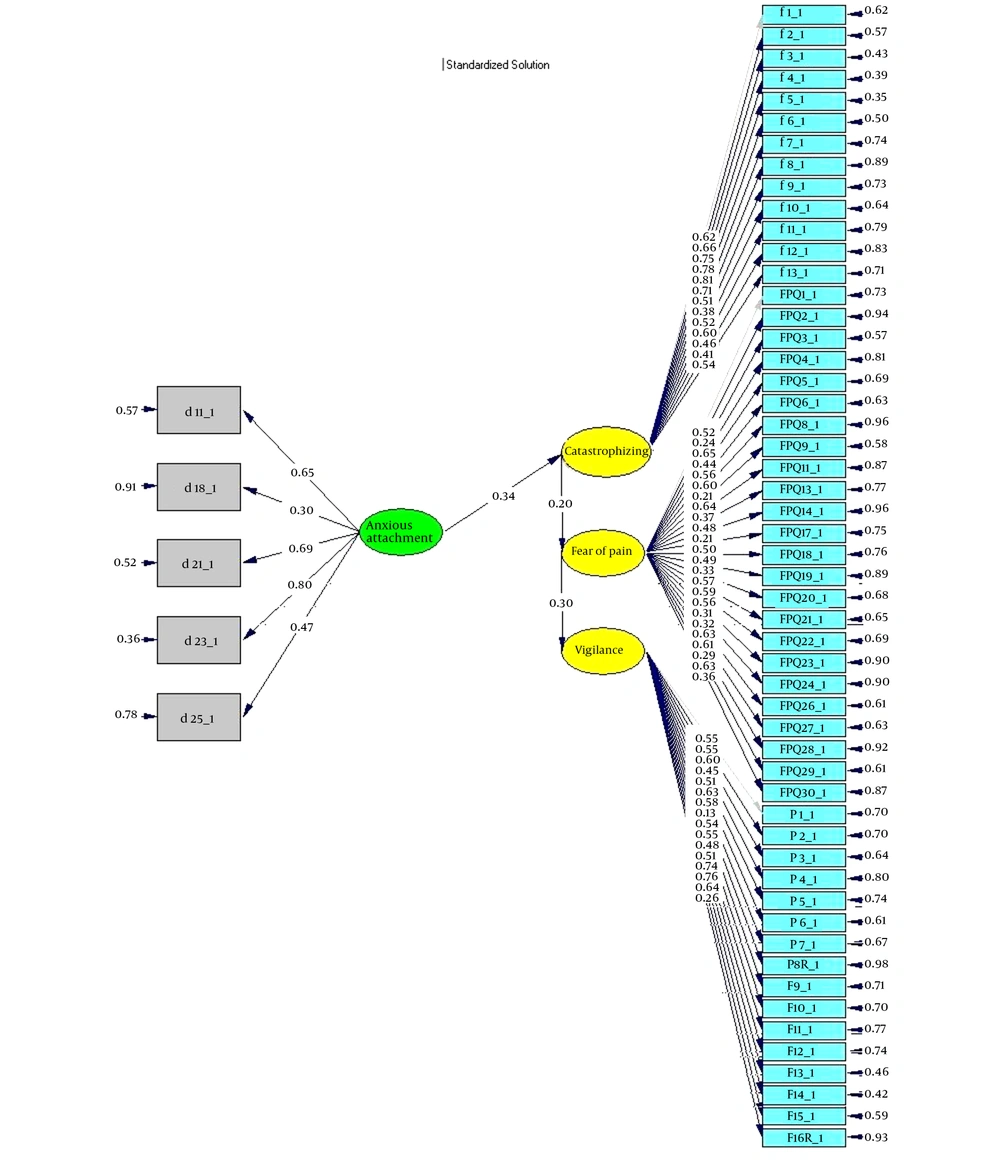
Figure 2.
Structural model of the relationships of anxious attachment style with pain catastrophizing, the fear of pain, and vigilance to pain. The values written on the arrows indicate the amount of variance of the item that can be explained by the agent, and the small arrows show the residual variance (error variance) by Factors are not determined. Chi-square = 4361.95, df = 1592, P-value = 0.00000, RMSEA = 0.091.
5. Discussion
The results of the present study showed that anxious, insecure attachment style, as a vulnerability factor, plays an effective role in chronic pain. This finding was consistent with those of previous research (32-36) and could be explained in terms of the following probabilities:
According to attachment theory, early interpersonal experiences in attachment figures lead to developing the internal working models of oneself and others in subsequent relationships with important people of life. It helps to regulate emotions when facing stressful situations. One of these stressful conditions is pain, which activates attachment behaviors that bring people closer to attachment figures. These figures help individuals regulate emotions by providing a secure physical and emotional base.
Some researchers believe that both secure and anxious attachment styles similarly absorb the shock against the pain as people with these two styles have a positive view of others and seek support and empathy from attachment figures when needed. However, the difference is that people with secure attachment styles elicit this support easily with appropriate emotion regulation strategies. On the other hand, people with anxious attachment styles seek this support and empathy through inappropriate emotion regulation strategies (ie, hyperaction), such as catastrophizing (37). Unlike people with an avoidant attachment style, who are reluctant to perceive and express their negative emotions, people with an anxious attachment style have a strong tendency toward expressing their emotions because it is compatible with their attachment goals of eliciting support and empathy.
People with an anxious attachment style have low self-esteem due to a negative view of themselves and do not have confidence in their abilities. This feature causes them to be engaged in sticky behaviors. These people lack a secure base because of the experiences they had with their primary caregivers, such as uncertainty in accessibility and receptivity, as well as the use of hyperaction strategies, including vigilance, catastrophizing threats, and generally high sensitivity to the internal and external signs of a threat to gain a secure base (31). People with avoidant attachment styles show less catastrophizing because they have learned from experiences with primary caregivers that if they reveal their helplessness, they are ignored and neglected by their caregivers. At the same time, if they hide the need for support and empathy from their caregivers, they are more likely to receive attention (31).
As stated in the introduction section, according to the fear-avoidance model, people who catastrophize their pain are more likely to exhibit fear of pain, vigilance to pain, and avoidant behaviors that eventually lead to the formation of the vicious cycle of chronic pain (8). According to this model, the fear of pain and vigilance to pain can also be justified in such people. In this regard, the results of the present study, consistent with previous ones, indicated that insecure, anxious attachment style and pain-related variables, such as pain catastrophizing, fear of pain, and hypervigilance, are correlated before the development of chronic pain. Consequently, the potential role of anxious attachment style in developing chronic pain-related mechanisms is justified in individuals without pain.
However, our results were inconsistent with studies demonstrating no difference between the two variables of pain catastrophizing and the perception of pain intensity in individuals with secure and anxious attachment styles. In other words, both safe and anxious styles reported high tolerance thresholds for painful stimuli (37). This unexpected finding may be attributed to people with secure and anxious attachment styles having positive thoughts and feelings toward others and expecting the accessibility and support of their primary caregivers when they face pain. In people with a secure attachment style, this expectation is positive, while negative in those with an anxious attachment style due to ambivalent feelings. Despite ambivalent feelings, a higher tolerance threshold of people with an anxious attachment style can be justified by the social pain theory. In fact, according to this theory developed by Macdoland and Leary, people with anxious attachment styles, not receiving support from their primary caregivers, respond to pain by reducing sensitivity. Therefore, analgesia is an adaptive response in such individuals (49). The Vlaeyen and Linton model and the results of most previous research revealed a significant relationship between the variables catastrophizing, fear of pain, and vigilance to pain (8).
Considering the mentioned debates and based on the attachment theory and Bartholomew model of anxious and avoidance styles, as well as the model for emotion regulation strategies, people with insecure style cannot use appropriate emotion regulation strategies due to the lack of developed behavioral coping and emotion regulation strategies when facing stressors, such as pain. As a result, they become helpless over time, cannot trust their secure figures, and establish intimate relationships with them, leading to catastrophizing. According to the Vlaeyen and Linton model, these catastrophic thoughts, in turn, result in the idea of fear of pain and, consequently, more vigilance to pain. The activation of this mechanism elicits support and empathy from people who are important in life in the short term, while it works adversely in the long run and even may lead to rejection by them. Consequently, intensified catastrophizing and the chronic pain cycle may occur. These explanations show why pain in people with an anxious attachment style is chronic.
Assessing fixed (dispositional) personality traits in the early stages of pain experience and giving insights to individuals can prevent the development of complex mechanisms involved in the chronic pain process. According to the social pain theory and the role of external factors, such as the support and empathy of others, the importance of internal factors, such as attachment styles, should also be highlighted (49).
5.1. Limitations and Suggestions
The sample of the current investigation may not represent the whole population due to the employment of the convenience sampling method. Therefore, the results should be generalized with caution. Another limitation of our study was the disproportion of female participants to male subjects, which should be considered in future studies. Given the high prevalence of chronic pain and the drastic costs of recovery imposed on both individuals and society, preventive methods for people at the risk of chronic pain, identification of risk factors, and striving for early intervention are recommended. It was the first study on this subject in Iran. As a result, further research is recommended to better identify the potential role of attachment styles and choose the appropriate treatment for each.