Fulltext
Full text is available in the PDF.
IJ Psychiatry and Behavioral Sciences
IJPBS is the Official Journal of Mazandaran University of Medical Sciences
Image Credit:Iran J Psychiatry Behav Sci
Authors
Objective: Early maladaptive schemas are deep feelings or patterns that are formed in childhood and recur later in their lifetime. Young has classified these schemas. The purpose of the present study was to validate the Young Early Maladaptive Schema Questionnaire (YEMSQ) for early maladaptive schemas in a group of university students.
Methods: Five hundred and seventy nine students were randomly selected from the freshman students of 2009 semesters. The participants completed the YEMSQ and Criterion questionnaires. Then data was analyzed by Factor analysis of Varimax Rotation sort. Factor analysis by principle components analysis (Varimax Rotation) revealed eighteen factors (that account for a high level of the variance).
Results: Data were indicative of high level of Coranbach, Alpha and Split-half (86% and 91%) reliability coefficients of the YEMSQ and the extracted factors. The convergent and discriminate validity of the questionnaire was examined by some measurement tools for psychological distress, positive and negative affect, self- confidence, cognitive vulnerability for depression and personality disorder. The correlation results for the six criteria are sequentially as follow: 37%, 34%, 40%, 39%, 35%, and 36% which were significant at p<0001. There were no significant differences between male and female (except for the factors 7, 12, and 14) and age groups with respect to early maladaptive schema degree.
Conclusion: The results of factor analysis are consistent with previous findings showing that YEMSQ can be used in research and clinical settings and in screening the normal among early maladaptive schema population in Iran.
© 2010, Author(s). This open-access article is available under the Creative Commons Attribution 4.0 (CC BY 4.0) International License (https://creativecommons.org/licenses/by/4.0/), which allows for unrestricted use, distribution, and reproduction in any medium, provided that the original work is properly cited.
Masoudzadeh A, Alami S, Pourasghar M, Naderi Rajeh Y. Factor Structure and Psychometric Properties of Persian Version of Relationship Emotional Schema Scale Among Iranian Victims of Domestic Violence. Int J High Risk Behav Addict. 2021;10(3):e112252. doi: https://doi.org/10.5812/ijhrba.112252
Ghaffari M, Omidmehr A, Yavari E, Dehqan M. Psychometric Properties of the Persian Version of the Revised Implicit Theories of Intelligence (Self-Theory) Scale in High School Students. Iran J Psychiatry Behav Sci. 2018;12(3):e57497. doi: https://doi.org/10.5812/ijpbs.57497
Khoramdel K, Sajadian P, Bahrami F, Zangene S. Validation of the Adolescent Meta-cognition Questionnaire Version. Zahedan J Res Med Sci. 2012;14(1):e93665. doi:
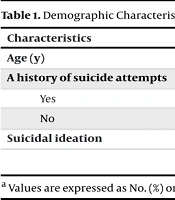
Bagian Kulehmarzi MJ, Rajabi M, Moosivand M, Zaremohzzabieh Z. Psychometric Properties of the Persian Version of the Suicide Resilience Inventory in Adolescents with Suicidal Ideation. Int J High Risk Behav Addict. 2025;14(3):e160448. doi: https://doi.org/10.5812/ijhrba-160448
Bakhshi Bojed F, Nikmanesh Z. Role of Early Maladaptive Schemas on Addiction Potential in Youth. Int J High Risk Behav Addict. 2013;2(2):72-76. doi: https://doi.org/10.5812/ijhrba.10148
Last Update: 3 weeks ago
Last Update: 3 weeks ago
Last Update: 3 weeks ago
Last Update: 19 hours ago
Last Update: 1 day ago
Last Update: 4 days ago