

Fulltext
Full text is available in the PDF.
IJ Psychiatry and Behavioral Sciences
Objective: Type D personality is based on negative affectivity (NA) and social inhibition (SI). The purpose of this study was to examine the reliability and validity of the Persian version of 14-item Type D personality scale (DS14).
Methods: The study included 191 normal participants and 176 patients with myocardial infarction (MI). They all filled out the Persian version of DS14, containing 7-item NA and SI subscales; 71 normal subjects completed the neuroticism and extroversion subscales of Eysenck questionnaire. Besides, 71 participants filled out the DS14 twice over a 2-month period.
Results: In this study, 35.8 % of MI patients and 24.6% of healthy people were classified as Type D. Factor analysis of Persian version of DS14 yielded the two-factor structure; all of the NA and SI items loaded between 0.65 to 0.80 in patients and 0.48 to 0.79 in healthy people on their corresponding factor. Test–retest stability of the NA and the SI subscales were 0.86 and 0.77 respectively over a 2-month period. High internal consistency of Cronbach's alpha coefficient has been found to be 0.84 in patients and 0.87 in healthy people for the NA subscale and 0.86 in patients and 0.75 in healthy people for the SI sub-scale. The construct validity of NA and SI sub scales were confirmed against neuroticism (r = 0.65) and extroversion (r = -0.62) subscales of Eysenck questionnaire respectively.
Conclusion: Persian version of DS14 is an acceptable, reliable and valid measure of dimensions of Type D personality.
Declaration of Interest: None.
Citation: Bagherian R, Bahrami Ehsan H. Psychometric properties of the persian version of Type D Personality Scale (DS14). Iran J Psychiatry Behav Sci 2011; 5(2): 12-7
© 2011, Author(s). This open-access article is available under the Creative Commons Attribution 4.0 (CC BY 4.0) International License (https://creativecommons.org/licenses/by/4.0/), which allows for unrestricted use, distribution, and reproduction in any medium, provided that the original work is properly cited.
Amini M, Lotfi M, Sadeghi S, khorrami Z. Structure and internal consistency evaluation of personality inventory for DSM-5 in an Iranian population. koomesh. 2019;21(1):e153936. doi:
Shojaei Z, Mohammadi A, Zarei M. Psychometric Properties of the Persian Version of Personality Inventory for DSM-5 (PID-5) in Psychiatric Patients. Iran J Psychiatry Behav Sci. 2020;14(4):e87974. doi: https://doi.org/10.5812/ijpbs.87974
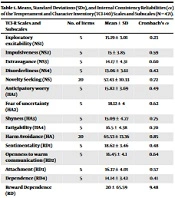
Hajirezaei S, Mohammadi A, Cloninger R, Cummings J, Abasi I, et al. Psychometric Properties of the Persian Version of the Revised Temperament and Character Inventory (TCI-140) in a Psychiatric Outpatient Sample in Iran. Iran J Psychiatry Behav Sci. 2023;17(4):e127391. doi: https://doi.org/10.5812/ijpbs-127391
Dadgostar H, Nedjat S, Dadgostar E, Soleimany G. Translation and Evaluation of the Reliability and Validity of Eating Disorder Inventory -3 Questionnaire Among Iranian University Students. Asian J Sports Med. 2017;8(2):e13950. doi: https://doi.org/10.5812/asjsm.13950
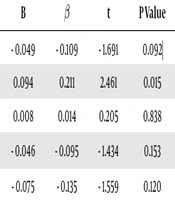
Saeidi M, Kakabraee K, Momeni K. Comparing 10-Item and 60-Item Big Five Personality Inventories in Explaining the Depressive Symptoms in Patients with Acute Myocardial Infarction. J Clin Res Paramed Sci. 2019;8(2):e95134. doi: https://doi.org/10.5812/jcrps.95134
Last Update: 2 weeks ago
Last Update: 2 weeks ago
Last Update: 2 weeks ago
Last Update: 4 days ago
Ordering Reprints
Articles are published under the Creative Commons license stated on each article. No permission or royalty fee is required for uses permitted by that license. CCC handles optional bulk and customized reprint orders. Any quotation covers production and delivery services only, not copyright permission. > Request Reprints from CCC