Fulltext
Full text is available in the PDF.
IJ Psychiatry and Behavioral Sciences
IJPBS is the Official Journal of Mazandaran University of Medical Sciences
Image Credit:Iran J Psychiatry Behav Sci
Authors
Objective: The problem of runaway girls is one of the social problems which has become more prevalent and is considered a serious challenge for families, welfare centers and governmental organizations in Iran. This study aimed at determining the demographic, personality and psychopathology characteristic of a sample of runaway girls in Shiraz, Iran.
Methods: Fifty girls who had escaped from their home and were referred to the Womenís Social Emergency and Rehabilitant Centre of Shiraz were compared with fifty girls who lived with their parents (control group). They were assessed by semi-structured interview based on the DSMIV-TR criteria, demographic questionnaire, the General Health Questionnaire-28 (GHQ-28) and the Eysenck Personality Questionnaire-R-106 (EPQ-R-106).
Results: Mean (±SD) age of the runaway girls was 19.9 (±3.81) years. Twenty (40%) were the first child of the family. Forty-three subjects (86%) were resident of cities. Physical abuse and neglect were more prevalent in the runaway girls (P < 0.05). There were no significant differences between two groups in history of major psychiatric disorders. Regarding GHQ-28, only in social function subscale, the runaway girls showed more disturbances in their social function compared to control group (P < 0.05). There were significant differences in extroversion, lying tendency, addiction tendency and crime seeking (P < 0.05) between the two groups and escaped girls showed more disturbances in comparison with the control group.
Conclusion: The social burden of runaway girls in Shiraz is of significance and this subject warrants more attention from non-governmental and governmental organizations in order to provide more psychological and social support for these girls.
Declaration of interest: None
Citation:Demographic, personality and psychopathology characteristics of the runaway girls in social emergency and rehabilitation centre of Shiraz, Iran. ToubaeiSh, Nateghi, DehbozorgiGhR Sadr EsfahaniH.Iran J Psych Behave Sci 2012; 6(1):33-9.
© 2012, Author(s). This open-access article is available under the Creative Commons Attribution 4.0 (CC BY 4.0) International License (https://creativecommons.org/licenses/by/4.0/), which allows for unrestricted use, distribution, and reproduction in any medium, provided that the original work is properly cited.
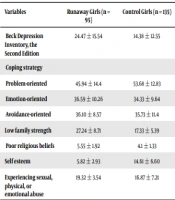
Taremian F, Moloodi R, Karimian S, Masoudi Farid H, Noroozi M. Risk Factors of Running Away in Young Iranian Girls: A Cross-sectional Study. Int J High Risk Behav Addict. 2022;11(3):e122456. doi: https://doi.org/10.5812/ijhrba-122456
Shakiba M, Ziai M. Comparative Study of Mental Health of Female Students Living in Dormitories of Welfare Organization and University of Sistan & Balouchestan. Zahedan J Res Med Sci. 2012;14(2):e93582. doi:
Babaee E, Nojomi M, Asadi-Aliabadi M, Eshrati B. Bullying and Being Bullied; How Much Can It Increase the Risk of Depression and Anxiety in Students? A Multilevel Fixed-effect Model Analysis. Iran J Psychiatry Behav Sci. 2021;15(2):e109730. doi: https://doi.org/10.5812/ijpbs.109730
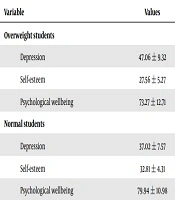
Kaveh Farsani Z, Khabazi M. The Psychological Consequences of Obesity in Adolescent Girls: A Causal-Comparative Study. J Kermanshah Univ Med Sci. 2020;24(2):e102339. doi: https://doi.org/10.5812/jkums.102339
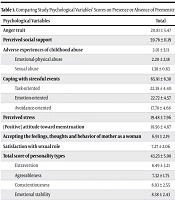
Barari M, Shahhosseini Z, Hosseinnataj A, Khaleghi F, Azimi Lolaty H. Predicting Premenstrual Syndrome Among University Students: Considering Anger, Social Support, Childhood Adversity, and Stress Related Factors, Menstrual Attitudes, and Sex Role Satisfaction. J Nurs Midwifery Sci. 2026;13(1):e165764. doi: https://doi.org/10.5812/jnms-165764
Last Update: 2 weeks ago
Last Update: 2 weeks ago
Last Update: 2 weeks ago
Last Update: 1 day ago
Last Update: 48 minutes ago
Last Update: 1 hour ago