


1. Background
Interpersonal problems are one of the most important aspects of one’s personal life. These problems have a strong relationship with psychological disorders (1), quality of life, and mental health (2). Interpersonal problems include repetitive patterns in interpersonal relations, which may lead to an inefficient interaction through maladaptive coping strategies and responses (3). These problems have been studied with respect to traits such as decisiveness, sociability, obedience, intimacy, liability, and emotional control (4). Disruption in interpersonal relations also plays an important role in eliciting a wide range of pathological behaviors (5) and is one of the major factors contributing to the durability of psychological disorders (6). On the other hand, according to various studies, emotional dysregulation plays a significant role in major aspects of life (e.g. job and personal relations) and is an effective and predictive factor for interpersonal problems. Emotional dysregulation is also taken into account with regards to a wide range of psychopathological and mental disorders (7, 8).
Emotional regulation, which includes awareness and knowledge of emotions, acceptance of these emotions, and the ability to control impulsive behaviors and act properly, can effect one’s physiological responses and social interactions (9). The nature of one’s personal experience, emotional expression, and emotion regulation could significantly contribute to healthy and intimate social relations and improve one’s emotional well-being (10). Various behavioral and cognitive strategies are used for regulating emotions, some of which are maladaptive and intensify negative feelings and interpersonal problems. People, who apply maladaptive coping strategies, such as suppression, rumination, self-blame, exaggeration, avoidance, and overeating, are more vulnerable to emotional problems, when compared to those, who use adaptive coping strategies (such as positive re-evaluation) (11, 12). Moreover, maladaptive coping strategies have a significant correlation with disorders such as depression, anxiety, frustration, anger, and interpersonal problems (13). In a previous study by Gross and John (2003), use of adaptive strategies for emotional regulation could increase positive emotions and improve interpersonal relations and psychological health in comparison with maladaptive strategies (14). Thus far, different methods, such as short-term psychodynamic approaches (15), interpersonal therapy (16), and dialectical behavior therapy have been introduced for resolving interpersonal problems (17). Acceptance and commitment therapy (ACT) is a novel method used to overcome interpersonal issues and a wide range of psychological problems (18). Furthermore, ACT, which is one of the most studied third-wave approaches, is based on a new behavioral approach to language, known as relational frame theory (RFT) (19). The emphasis of this method is on reducing the severity and frequency of disturbing thoughts and emotions and promoting efficient behaviors, despite unpleasant thoughts and feelings (20). This treatment is based on the assumption that people try to change or avoid unpleasant experiences when facing irritating and negative emotions (21). Such attempts might be unfruitful, resulting in the exacerbation of negative thoughts and feelings (22). The six core processes of ACT interventions include ‘acceptance’, ‘cognitive defusion’, ‘being present’, ‘self as context’, ‘values’, and ‘committed action’ (23). In fact, the ultimate aim of ACT is to achieve emotion regulation and psychological flexibility. Since people with interpersonal problems have rigid and inflexible models of behavior, ACT can be used as an effective therapy to improve their psychological flexibility through adopting acceptance techniques and cognitive defusion of thoughts, emotions, and beliefs (schemas) (3). Various studies have revealed the effectiveness of ACT on improving psychological problems, such as depression (24), social anxiety (25), generalized anxiety disorder (26), obsessive compulsive disorder (27), and dysfunctional marital relations (28). Therefore, given the increasing prevalence of these problems, especially among students, the importance of treatment is strongly felt in different communities. Besides, analysis of interpersonal relations among youth, as tomorrow’s adults, is of great importance, as these relations signify one’s mental health and people define themselves through such relations (29).
2. Objectives
The current study aimed at evaluating the effect of group ACT on interpersonal problems and difficulties in emotion regulation of female university students.
3. Materials and Methods
This randomized clinical trial was performed at Azad University of Gorgan (Iran), between September and November, 2015. The study population consisted of female students, aged 18 to 35 years. This study was approved by the Ethics Committee of Kashan University of Medical Sciences (IRCT No.: 2015051922321N1).
The inclusion criteria were as follows: 1) age range of 18 to 35 years; 2) a score above 40 on the inventory of interpersonal problems (IIP-32); 3) willingness to participate in the study; and 4) not having a psychotic disorders (according to the structural clinical interview for DSM disorders for Axis I; SCID_I administered by a clinical psychologist); 5) no history of psychotherapy or pharmacotherapy over the past 6 months; and 6) no prior history of addiction or suicide. On the other hand, participants, who were absent from the intervention for more than 2 sessions, were excluded from the study.
The sample size was calculated according to a previous study by Avigail Lev (2011), which examined the effectiveness of ACT on interpersonal relations among individuals with drug abuse. The mean and standard deviation of interpersonal relations before and after the intervention were 1.64 ± 0.66 and 1.09 ± 0.62, respectively (3). By using the Cohen’s formula, the minimum sample size was estimated as 24 cases per group (95% confidence level and 90% power).
After determining the sample size, sampling was performed in 2 stages. In the first stage, 150 students were selected through convenience sampling and completed the IIP-32 scale. In the second stage, 80 students were selected based on the inclusion criteria and their scores on the IIP-32 scale. By using the table of random numbers, the participants were categorized to control and intervention groups.
The ACT, consisting of ten 90-minute sessions, was performed for the intervention group by a trained clinical psychologist, based on a study by Mckay, Lev, and Skeen (2012) (Table 1), while the control group received no training. The intervention continued for almost two and a half months. The IIP-32 and difficulties in emotion regulation scale (DERS) were completed as pre-test (before the first session in the ACT group). After 10 sessions, posttest was performed for the 2 groups. Figure 1 presents the CONSORT flow diagram of the study.
Table 1.The Brief Outline of the Acceptance and Commitment Therapy (According to Mckay, Lev, and Skeen, 2012)
| Sessions | Sessions Content |
|---|---|
| First | Explaining the objectives and rules, administration of a pre-treatment assessment (such as the young schema questionnaire), guiding the group in a mindfulness practice, psycho-education on schema and schema coping behaviors, and setting homework. |
| Second | Mindfulness practice, review of the homework from session 1, exploration of schema triggers, coping behaviors, and setting homework |
| Third | Mindfulness practice, review of homework from session 2, exploration of the costs of schema coping behaviors, use of such metaphors, and setting homework |
| Fourth | Mindfulness practice, review of the homework from session 3, psycho-education on values, assistance of group members in clarifying and identifying values, and setting home work |
| Fifth | Mindfulness practice, review of homework from session 4, psycho-education and teaching specific defusion techniques, and setting homework |
| Sixth | Review of home work from session 5, focus on evaluations versus descriptions, and setting homework |
| Seven | Review of homework from session 6, exploration of willingness via a discussion of pain and loss in relationships, discussion and psycho-education on anger as a coping strategy, use of mindfulness practice, and setting homework |
| Eight | Review of homework from session 7, psycho-education on emotion and unworkability of control strategies, exploration and letting go of old control strategies, and setting homework. |
| Ninth | Review of homework from session 8, discussion of effective communication, role play and exercise to practice defusion, and setting homework. |
| Tenth session | Review of homework from session 9, group member experiences over the past 10 weeks, discussion of potential barriers and development of strategies for acting on valued intentions, and administration of post-treatment assessments. |
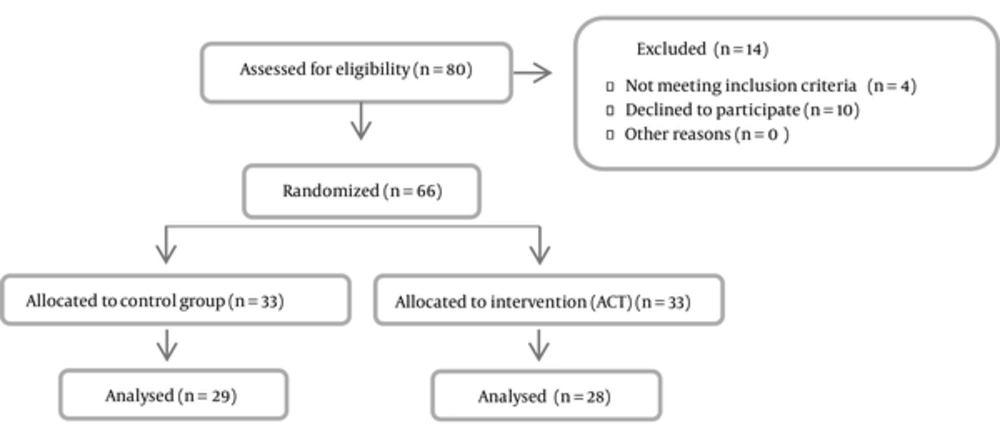
Figure 1.
CONSORT flow diagram of the study
3.1. Measures
3.1.1. The Inventory of Interpersonal Problems-Short Version
The short version of the inventory of interpersonal problems by Barkham et al. (1996) was developed and scored, according to a 5-degree Likert scale, from 0 (not at all) to 5 (strongly). This scale is a self-report inventory, the questions of which are in relation to the problems people usually experience in interpersonal relations, and high scores on IIP-32 are indicators of a poorer interpersonal functioning (30). These 8 factors are assertiveness and sociability, openness, caring, aggression, supportiveness and involvement, and dependency. The IIP subscales’ internal consistency was calculated using Cronbach’s alpha coefficient, which was 0.60 to 0.83 and for the total consistency a score of 0.81 and 0.86 was determined (31). Reliability of the Persian version of IIP-32 was calculated using internal consistency and half-split coefficients, which was 0.82 and 0.83, respectively (32).
3.1.2. Difficulties in Emotion Regulation Questionnaire
This questionnaire was developed by Gratz and Romer (2004) and has 36 questions, which assesses emotional regulation patterns in the form of 6 subscales (rejection, emotional responses, difficulty in participation behavior leading to goal, impulse control problems, lack of emotional awareness, restrictions on the path to emotional regulation, and lack of emotional clarity), with a focus on difficulties in emotion regulation. Graz reported the validity of the questionnaire as 0.93 and its reliability was 0.80, using Cronbach’s alpha (9). The reliability of the questionnaire was calculated by Khanzadehet al. (2012) in Iran. Two methods of Cronbach’s alpha and split-half were used to calculate reliability, which was 0.86 and 0.80, respectively, proving acceptable coefficients for the emotional regulation difficulties questionnaire. Khanzadeh et al. (2012) for determination of the validity of this questionnaire, correlated the score of this questionnaire with the score of Zakrmn’s sensation seeking scale, and found a significant positive correlation between them, indicating the validity of the emotion regulation questionnaire (33).
3.2. Statistical Analysis
Covariance analysis was used to compare interpersonal problems and emotion regulation difficulties between the intervention and control groups. In addition, t test was used to compare differences between the 2 groups. Chi-square test was also used to compare other demographic variables, such as educational level and educational field. P-values of less than 0.05 were considered statistically significant.
4. Results
Table 2 presents the demographic inforamation of the study population. Among 66 participants, 5 cases from the intervention group and 4 cases from the control group were excluded, as they were absent from the intervention for more than 2 sessions and were unwilling to complete the questionnaires. As presented in Table 3 evaluation of the mean scores of dependant variables (interpersonal relations and emotion regulation difficulties) and comparison of pretest and posttest scores showed that the mean scores of interpersonal relations and emotion regulation difficulties decreased in the ACT group in the posttest in comparsion with the pretest. The result of covariance showed that there were significant differences between the experimental and control groups in interpersonal problems and difficulties in emotion regulation in the posttest stage (P < 0.001) (Table 4). Therefore, the ACT group could improve the interpersonal problems and difficulties in emotion regulation of female collage students.
Table 2.Demographic Characteristics of the Subjects
| Variable | Experimental Group (ACT) | Control Group |
|---|---|---|
| Level of education | ||
| Bachelor, ya | 28 (0.100) | 17 (58.6) |
| Postgraduate | 0 | 12 (41.4) |
| Course | ||
| Accounting | 6 (21.4) | 6 (20.7) |
| Law | 0 | 2 (6.9) |
| Midwifery | 9 (32.1) | 3 (10.3) |
| Nursing | 6 (21.4) | 2 (6.9 ) |
| Management | 1 (3.6) | 6 (20.7) |
| Laboratory sciences | 0 (0) | 6 (20.7) |
| Architecture | 6 (21.4) | 4 (13.8) |
aValues are expressed as mean (SD).
Table 3.Mean (SD) Scores of Interpersonal Problems and Difficulties in Emotion Regulation in Pre-Test and Post-Test
| Group | Pre-Test | Post-Test | P Value |
|---|---|---|---|
| Interpersonal problems | < 0.001 | ||
| ACT | 56.2 (9.04) | 40.85 (8.63) | |
| Control | 53.6 (9.30) | 54.6 (10.10) | |
| Difficulties in Emotion Regulation | < 0.001 | ||
| ACT | 92.4 (12.9) | 71.2 (6.89) | |
| Control | 100.82 (13.9) | 92.65 (11.9) |
Table 4.Results of Analysis of Covariance on Mean Scores of Interpersonal Problems and Difficulties in Emotion Regulation in Post-Test Stages
| Source | Mean Square | df | f | P Value |
|---|---|---|---|---|
| Interpersonal problems | 2536.954 | 1 | 74.899 | < 0.001 |
| Difficulties in emotion regulation | 3000.257 | 1 | 34.817 | < 0.001 |
Abbreviation: df, degree of freedom.
5. Discussion
The findings of the present study showed that ACT could decrease interpersonal problems and difficulties in emotion regulation in the ACT group in comparison with the control group. These findings were in line with the results reported by Mckay et al. (2012) and Lev (2011) (3, 34). Also, the results of previous research using other treatment methods are in congruence with the present findings (35, 36). The present study showed that ACT could reduce interpersonal problems. To explain such findings, it can be said that ACT and a combination of scheme therapy formulation (such as maladaptive interpersonal schemes) aiming at the improvement of psychological flexibility could help improve interpersonal relations through acceptance techniques and defusion of thoughts, emotions, and beliefs. In fact, ACT does not aim at removing or changing the individuals’ core schemas and beliefs, yet it rather helps them accept the pain associated with these schemas through different methods (e.g. acceptance, cognitive defusion, being present, self as context, values, and committed action) and improve their behavioral flexibility to promote a principled way of life (3).
The findings of this study showed that DERS scores were significantly different between the intervention and control groups. In other words, ACT could reduce difficulties in emotion regulation in the intervention group, compared to the control group. This finding was in line with the results reported by Gratz and Gunderson (2006), Blackledge and Hayes (2001) Mohammadi at al. (2015), Gratz and Tull (2006) (37-40). An explanation for the mentioned finding is that ACT techniques are useful in maladaptive emotion regulation strategies, with development of emotional awareness, and focus on different aspects of emotional regulation (41, 42).
Furthermore, ACT focuses on acceptance techniques for dealing with maladaptive emotion regulation strategies (such as suppression). In this fashion, it encourages patients to accept the pain instead of changing or removing unwanted thoughts and emotions such as anxiety and guilt (20).
In addition, cognitive defusion techniques, as the core of ACT, lead to a decline in negative emotions (37). Also, willingness to experience internal events and understanding the importance of these events in interpersonal relations (instead of avoidance) help individuals use adaptive emotion regulation strategies and discard maladaptive methods. Several experimental studies have shown that acceptance strategies positively effect emotion regulation, reduce physiological arousal, and promote effective responses in emotional control (43, 44). Acceptance and Commitment Therapy, along with mindfulness and acceptance techniques, has a major impact on reducing cognitive disorders and emotion regulation difficulties and promotes healthy coping behaviors. In addition, ACT strategies improve self-awareness, self-observation, emotion regulation, positive emotional reactions in interpersonal relations, and environmental control (28). The present study showed that people with interpersonal problems can overcome their poor emotional regulation and interpersonal problems through ACT. The results showed that administration of acceptance and commitment therapy leads to a decrease in interpersonal problems and difficulties in emotion regulation scores; therefore, intervention played an effective role in improvement of interpersonal problems and difficulties in emotion regulation among university students.
5.1. Limitations
The limitations of this study were the inclusion of only female participants as the study sample, the small sample size, and lack of follow-up sessions. Therefore, it is recommended for future studies to recruit larger groups of participants, incorporate longer follow-ups, and include both genders in their analyses. Considering the importance of interpersonal relations in adulthood, it is also suggested for further studies to be performed in other parts of the country on more diverse samples.

