

Introduction
Cyclooxygenase (COX) also known as prostaglandin synthase (PGH) is apotent mediator
of inflammation. Non-steroidal anti-inflammatory drugs (NSAIDs) bind to
cyclooxygenase, thereby inhibiting the production of prostaglandins. However,
inhibition of COXs may lead to undesirable side effects. Nowadays, it is well
established that there are at least two COX isozymes, COX-1 and COX-2 (1).The constitutive COX-1 isozyme is produced in
a variety of tissues and appears to be important to the maintenance of physiological
functions such as gastric protection and vascular homeostasis (2, 3). As COX-2 is usually
specific to inflamed tissue, there is much less gastric irritation associated with
COX-2 inhibition. This has led intense efforts in searching for potent and selective
COX-2 inhibitors which could provide anti-inflammatory drugs with fewer risks.
Several classes of compounds having selective COX-2inhibitory activity have been
reported in the literature such as rofecoxib and celecoxib (Figure 1). Selective cyclooxygenase-2 (COX-2) inhibitors
frequently belong to a class of diaryl heterocycles that possess two vicinal rings
attached to a central heterocyclic scaffold in conjunction with a COX-2
pharmacophore such as a para-SO2Me substituent on one of
the rings (4-6). As an initial attempt to discover novel COX-2 inhibitor with
selectivity and safety profile, we have recently reportedseveral investigations
describing the design, synthesis, and a molecular modeling study for a group of
5-oxo-1,4,5,6,7,8-hexahydroquinoline regioisomers including compound (1) from our compound library showed a good COX-2
inhibitory activity (Figure 1) (7).In continuation of our ongoing research work
directed towards the development of selective COX-2 inhibitors, we have focused on
the modification of compound (1) and designed
some novel 1,4-dihydropyridines possessing
p-SO2Me-phenyl moiety at C-4 position, different
hydrophobic groups at C-2 position (R1) and different alkoxycarbonyl
(COOR2) groups at the C-3 position (Figure 1).1,4-Dihydropyridines (DHP) are biologically and synthetically
important class of compounds in the field of drugs and pharmaceuticals and have
attracted attention of synthetic chemists due to their pharmacological properties
(8, 9).The Hantzsch reaction is a well-known method for synthesizing of
dihydropyridines (10). Hantzsch reaction is a
kind of multi component reactions (MCRs) which have gained wide applicability in the
field of synthetic organic chemistry as they increase the efficiency of the reaction
and decrease the number of laboratory operations along with quantities of solvent
and chemicals (11, 12).
In this study novel 1, 4-dihydropyridine derivatives were prepared according to
Hantzsch reaction and evaluated for in vitro COX-1/COX-2 isozyme inhibition. We also
performed docking studies to determine the orientation of the synthesized compounds
in the COX-2 active site which led to the better understanding of the
structure-activity relationship in designed COX-2 inhibitors.
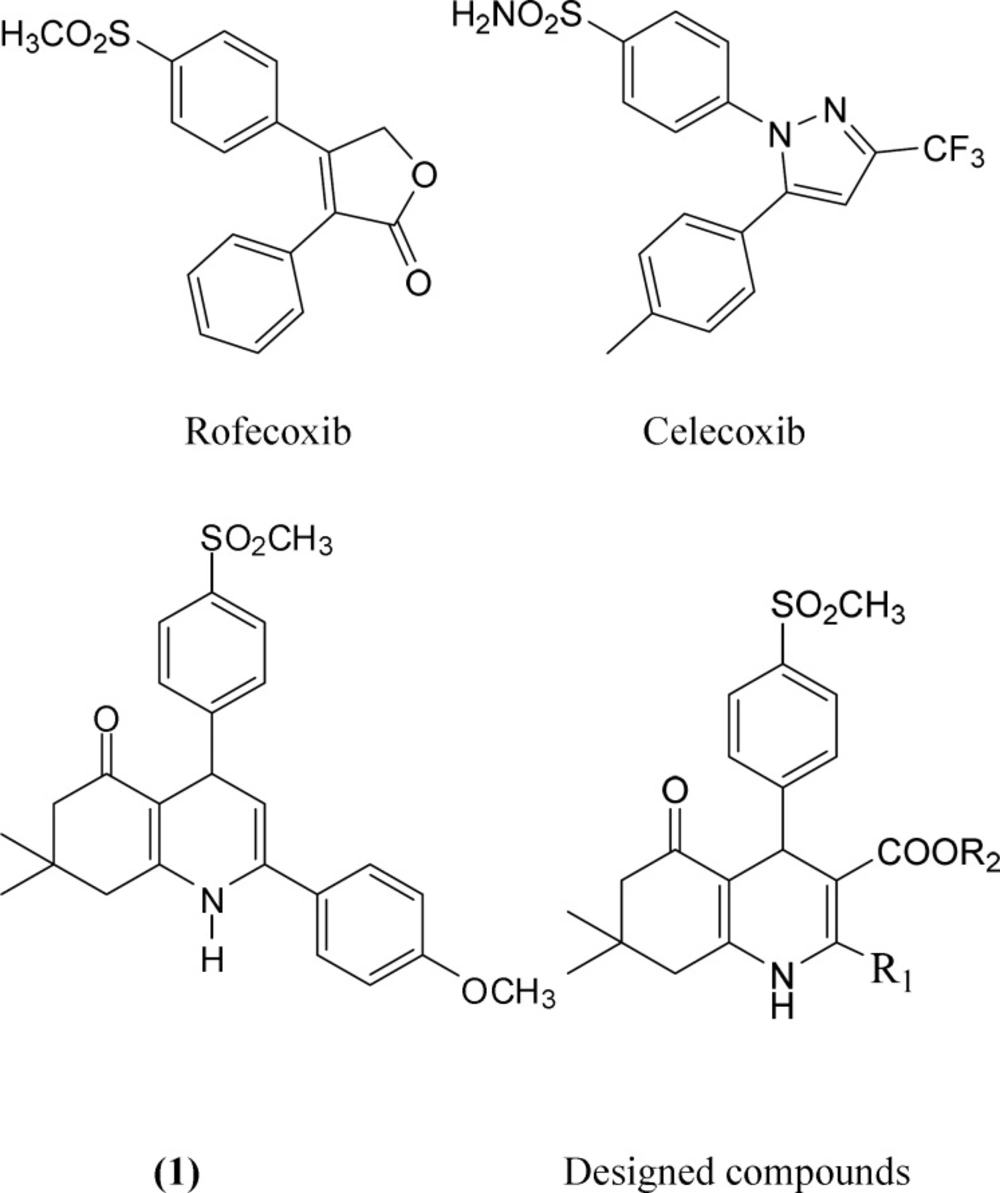
Figure 1.
Selective COX-2 inhibitors (Rofecoxib, Celecoxib), lead compound (1) and designed scaffold.
Experimental
General
All chemicals and solvents used in this study were purchased from Merck AG and
Aldrich Chemical. Melting points were determined using a Thomas-Hoover capillary
apparatus. Infrared spectra were acquired using a Perkin Elmer Model 550 SE
spectrometer. A Bruker AM-300 NMR spectrometer was used to acquire 1H NMR
spectra with TMS as internal standard. Coupling constant (J) values
are estimated in hertz (Hz) and spin multiples are given as s (singlet), d (double),
t (triplet), q (quartet), m (multiplet), and br (broad). Low-resolution mass spectra
were acquired with an MAT CH5/DF (Finnigan) mass spectrometer that was coupled on
line to a Data General DS 50 data system. Electron-impact ionization was performed
at an ionizing energy of 70 eV with a source temperature of 250oC.
Elemental microanalyses, determined for C and H, were within ±0.4% of theoretical
values. All chemicals and solvents used in this study were purchased from Merck AG
and Aldrich Chemical. Melting points were determined with a Thomas-Hoover capillary
apparatus. Infrared spectra were acquired using a Perkin Elmer Model 1420
spectrometer. A Bruker FT-500 MHz instrument (Bruker Biosciences, USA) was used to
acquire 1HNMR spectra with TMS as internal standard. Chloroform-D was
used as solvents. Coupling constant (J) values are estimated in
hertz (Hz) and spin multiples are given as s (singlet), d (double), t (triplet), q
(quartet), m (multiplet) and br (broad). The mass spectral measurements were
performed on a 6410 Agilent LCMS triple quadrupole mass spectrometer (LCMS) with an
electrospray ionization (ESI) interface.
Chemistry
Preparation of1, 4-dihydropyridine derivatives based on Hantzsch method is shown in
Scheme 1.Accordingly, a mixture of 5,
5-dimethyl-1,3-cyclohexandione (2),
appropriate β-oxoesters (3) and
4-(methylsulfonyl)benzaldehyde (4) in the
presence of ammonium acetate was refluxed in methanol to obtain target compounds
(5a-i) in 54-95% yield.The structure of the synthesized compounds was confirmed by
IR, 1H NMR and ESI-MS.
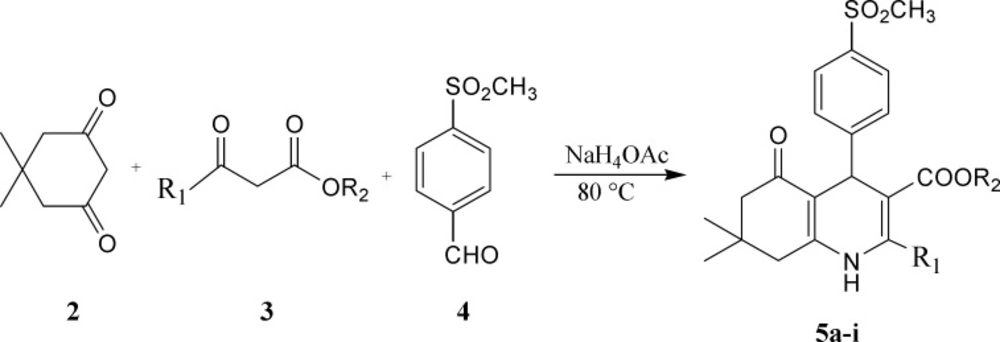
Scheme1
Synthesis of 1, 4-dihydropyridine derivatives (5a-i).
General procedure for the synthesis of 1, 4-dihydropyridine
derivatives (5a-i)
A mixture of β-oxoesters (1 mmol), 4, 4-(5, 5)-dimethyl-1,3-cyclohexandione (1 mmol)
and 4-(methylsulfonyl)benzaldehyde (1 mmol) in the presence of ammonium acetate (4
mmol) was refluxed in methanol at 80°C for overnight. After completion of the
reaction, the mixture was cooled to room temperature; ethanol (10 mL) was added to
dilute mixture. The mixture was poured into 80 mL ice water the precipitate was
filtered off and washed with water. The crude products were purified by
recrystallization from ethanol to give final products.
Methyl-1, 4, 5, 6, 7, 8-hexahydro-2, 7,
7-trimethyl-4-(4-(methylsulfonyl)phenyl)-5-oxoquinoline-3-carboxylate
(5a)
Yield, 78%; mp: 244-245 °C; IR (KBr disk) υ (cm-1): 1150, 1300
(SO2); 1400-1600 (aromatic); 1689(C=O); 3356 (NH); 1HNMR
(CDCl3, 500 MHz): δ 0.91 (s, 3H, CH3), 1.12 (s, 3H,
CH3), 2.16-2.20 (m, 2H, dihydroquinoline H8), 2.26-2.29
(m, 2H, dihydroquinoline H6, J=15.8 Hz), 2.45 (s, 3H,
CH3), 3.04 (s, 3H, SO2Me), 3.64 (s, 3H,
CO2CH3), 5.17 (s, 1H, dihydroquinoline H4),
5.84 (s, 1H, NH), 7.54 (d, 2H, methanesulfonyl phenyl H2'&
H6', J=7.6 Hz), 7.81 (d, 2H,methanesulfonyl phenyl
H3'& H5', J=7.6 Hz); LC-MS
(ESI)m/z: 404.3 (M+1, 100); Anal. Calcd. for
C21H25NO5S: C, 62.51; H, 6.25; N, 3.47. Found:
C, 62.81; H, 6.45; N, 3.59.
Methyl-2-amino-1, 4, 5, 6, 7, 8-hexahydro-7,
7-dimethyl-4-(4-(methylsulfonyl)phenyl)-5-oxo quinolone-3-carboxylate
(5b)
Yield,64%; mp: 177-179°C; IR (KBr disk) υ (cm-1): 1150, 1300
(SO2); 1400-1600 (aromatic); 1697 (C = O); 3350 (NH);1HNMR
(CDCl3, 500 MHz): δ 0.99 (s, 3H, CH3), 1.12 (s, 3H,
CH3), 2.20 (d, 1H, dihydroquinoline H8,
J=16.3 Hz), 2.29 (d, 1H, dihydroquinoline H8, J =
16.3 Hz), 2.48 (s, 2H, dihydroquinoline H6), 3.07 (s, 3H,
SO2Me), 3.62 (s, 3H, CO2CH3), 4.81 (s, 1H, NH),
6.27 (br s, 2H, NH2), 7.49 (d, 2H, methanesulfonyl phenyl
H2'& H6', J=8.2 Hz), 7.86 (d, 2H,
methanesulfonyl phenyl H3'& H5', J=8.2
Hz); LC-MS (ESI)m/z: 405.1 (M+1, 100); Anal. Calcd. for
C20H24N2O5S: C, 59.39; H, 5.98; N,
6.93. Found: C, 59.71; H, 6.25; N, 6.59.
Methyl-2-ethyl-1, 4, 5, 6, 7,
8-hexahydro-7,7-dimethyl-4-(4-(methylsulfonyl)phenyl)-5-oxoquinoline-3-carboxylate
(5c)
Yield, 87%; mp: 186.5-188°C; IR (KBr disk) υ (cm-1): 1150, 1300
(SO2); 1400-1600 (aromatic); 1697 (C = O); 3369 (NH);1HNMR
(CDCl3, 500 MHz): δ 0.94 (s, 3H, CH3), 1.07 (s, 3H,
CH3), 1.36 (t, 3H, CH3), 2.17-2.44 (m, 4H,
dihydroquinoline H6& H8), 2.85 (q, 2H, CH2),
3.04 (s, 3H, SO2Me), 3.64 (s, 3H, CO2CH3), 5.19 (s,
1H, dihydroquinoline H4), 5.80 (br s, 1H, NH), 7.51 (d, 2H,
methanesulfonyl phenyl H2'& H6', J=8.1
Hz), 7.81 (d, 2H, methanesulfonyl phenyl H3'& H5',
J=8.2 Hz); LC-MS (ESI)m/z: 418.4 (M+1, 100); Anal.
Calcd. for C22H27NO5S: C, 63.29; H, 6.52; N, 3.35.
Found: C, 62.91; H, 6.35; N, 3.50.
Methyl-1, 4, 5, 6, 7, 8-hexahydro-2-isopropyl-7,
7-dimethyl-4-(4-(methylsulfonyl)5-oxoquinoline-3-carboxylate (5d)
Yield, 54%; mp: 163-164°C; IR (KBr disk) υ (cm-1): 1150, 1300
(SO2); 1400-1600 (aromatic); 1657 (C=O); 3352 (NH); 1HNMR
(CDCl3, 500 MHz): δ 0.92 (s, 3H, CH3), 1.11 (s, 3H,
CH3), 1.21 (d, 3H, CH3, J=6.9
Hz), 1.27 (d, 3H, CH3, J=7.0 Hz),
2.19 (d, 1H, dihydroquinoline H8, J=16.3 Hz),2.29 (m,
2H, dihydroquinoline H8& H6, J=15.0 Hz),
2.45 (d, 1H, dihydroquinoline H6, J=16.6 Hz), 3.04 (s,
3H, SO2Me), 3.63 (s, 3H, CO2CH3), 4.27 (m, 1H, CH),
5.19 (s, 1H, dihydroquinoline H4), 6.07 (s, 1H, NH), 7.50 (d, 2H,
methanesulfonyl phenyl H2'& H6', J=8.3
Hz), 7.80 (d, 2H, methanesulfonyl phenyl H3'& H5'
, J=8.3 Hz); LC-MS (ESI)m/z: 432.2 (M+1,
100); Anal. Calcd. for C23H29SO5N: C, 64.01; H,
6.77; N, 3.25. Found: C, 64.21; H, 6.95; N, 3.19.
Ethyl-1, 4, 5, 6, 7, 8-hexahydro-2, 7,
7-trimethyl-4-(4-(methylsulfonyl)phenyl)-5-oxoquinoline-3-carboxylate
(5e)
Yield,81%;mp: 180.7-182.3°C;IR (KBr disk) υ (cm-1): 1150, 1300
(SO2); 1400-1600(aromatic); 1685(C = O); 3359 (NH);1HNMR
(CDCl3, 500 MHz): δ 0.91 (s, 3H, CH3), 1.10 (s, 3H,
CH3), 1.24 (t, 3H, CH3), 2.12-2.15 (d, 1H,
dihydroquinoline H8), 2.18-2.28 (m, 2H, dihydroquinoline H8
& H6 ), 2.35-2.38 (d, 1H, dihydroquinoline H6),2.40
(s, 3H, CH3), 3.01 (s, 3H, SO2Me), 4.06 (m, 2H,
CH2), 5.14 (s, 1H, dihydroquinoline H4), 7.09 (s, 1H, NH),
7.51 (d, 2H, methanesulfonyl phenyl H2'& H6',
J=8.0 Hz), 7.76 (d, 2H, methanesulfonyl phenyl
H3'& H5',J=8.0 Hz); LC-MS
(ESI)m/z: 418.1 (M+1, 100); Anal. Calcd. for
C22H27NO5S: C, 63.29; H, 6.52; N, 3.35. Found:
C, 63.41; H, 6.75; N, 3.42.
Ethyl-1, 4, 5, 6, 7,
8-hexahydro-7,7-dimethyl-4-(4-(methylsulfonyl)phenyl)-5-oxo-2-propylquinoline-3-carboxylate
(5f)
Yield,54%; mp: 163-164°C; IR (KBr disk) υ (cm-1): 1150, 1300
(SO2); 1400-1600 (aromatic); 1658(C = O); 3305 (NH);1HNMR
(CDCl3, 500 MHz): δ 0.88 (s, 3H, CH3), 1.05 (t, 3H,
CH3), 1.12 (s, 3H, CH3), 1.27 (t, 3H, CH3),
1.71 (m, 4H, 2CH2), 2.16-2.20 (d, 1H, dihydroquinoline
H8, J = 16.2 Hz),2.26-2.29 (m, 2H, dihydroquinoline
H6 & H8), 2.39-2.42 (d, 1H, dihydroquinoline
H6, J=16.0 Hz), 3.04 (s, 3H, SO2Me), 4.07
(m, 2H, CH2), 5.19 (s, 1H, dihydroquinoline H4), 5.93 (br s,
1H, NH), 7.52 (d, 2H, methanesulfonyl phenyl H2'& H6',
J=7.9 Hz), 7.80 (d, 2H, methanesulfonyl phenyl
H3'& H5', J=7.8 Hz); LC-MS
(ESI)m/z: 446.2 (M+1, 100); Anal. Calcd. for
C24H31NO5S: C, 64.69; H, 7.01; N, 3.14. Found:
C, 63.89; H, 6.95; N, 3.32.
Ethyl-1, 4, 5, 6, 7,
8-hexahydro-7,7-dimethyl-4-(4-(methylsulfonyl)phenyl)-5-oxo-2-phenylquinoline-3-carboxylate
(5g)
Yield,87%; mp: 187.9-189 °C; IR (KBr disk) υ (cm-1): 1150, 1300
(SO2); 1400-1600 (aromatic); 1687(C = O); 3344 (NH);1HNMR
(CDCl3, 500 MHz): δ 0.89 (t, 3H, CH3), 0.97 (s, 3H,
CH3), 1.14 (s, 3H, CH3), 2.19-2.32 (m, 3H,
dihydroquinoline H6 & H8), 2.45-2.48 (d, 1H,
dihydroquinoline H6, J=16.6 Hz), 3.03 (s, 3H,
SO2Me), 3.86 (m, 2H, CH2), 5.28 (s, 1H, dihydroquinoline
H4), 6.07 (s, 1H, NH), 7.36 (m, 2H, benzyl H3&
H4), 7.45 (m, 3H, benzyl H2, H5&
H6), 7.68 (d, 2H, methanesulfonyl phenyl H2'&
H6', J=7.6 Hz), 7.85 (d, 2H, methanesulfonyl phenyl
H3'& H5', J=7.5 Hz); LC-MS
(ESI)m/z: 480.2 (M+1, 100); Anal. Calcd. for
C27H29NO5S: C, 67.62; H, 6.09; N, 2.92. Found:
C, 63.96; H, 6.25; N, 3.12.
t-Butyl-1, 4, 5, 6, 7,
8-hexahydro-2,7,7-trimethyl-4-(4-methanesulfonyl-phenyl)-5-oxo-quinoline-3-carboxylate
(5h)
Yield,95%; mp: 163-164°C;IR (KBr disk) υ (cm-1): 1150, 1300
(SO2); 1400-1600 (aromatic); 1694 (C = O); 3300-3500 (NH);
1HNMR (CDCl3, 500 MHz): δ 0.95 (s, 3H,°C H3),
1.11 (s, 3H, CH3), 1.37 (s, 9H,CH3), 2.14 (d, 1H,
dihydroquinoline H8, J=16.3 Hz), 2.26 (d, 1H,
dihydroquinoline H8, J=15.9 Hz), 2.36-2.39 (d, 2H,
dihydroquinoline H6), 2.41 (s, 3H, CH3), 3.03 (s, 3H,
SO2Me), 5.10 (s, 1H, dihydroquinoline H4 ), 5.91 (br s,
1H, NH), 7.54 (d, 2H, methanesulfonyl phenyl H2'& H6',
J=8.2 Hz), 7.81 (d, 2H, methanesulfonyl phenyl
H3'& H5', J=8.2 Hz); LC-MS
(ESI)m/z: 446.2 (M+1, 100); Anal. Calcd. for
C24H31NO5S: C, 64.69; H, 7.01; N, 3.14. Found:
C, 64.89; H, 7.21; N, 3.22.
Benzyl-1, 4, 5, 6, 7, 8-hexahydro-2, 7,
7-trimethyl-4-(4-(methylsulfonyl)phenyl)quinoline-3-carboxylate (5i)
Yield,87%; mp: 136.9-138.9 °C;IR (KBr disk) υ (cm-1): 1150, 1300
(SO2); 1400-1600 (aromatic); 1694 (C=O); 3557 (NH);1HNMR
(CDCl3, 500 MHz): δ 0.86 (s, 3H, CH3), 1.04 (s, 3H,
CH3), 2.01-2.07 (d, 1H, dihydroquinoline H8,
J=16.3 Hz), 2.17-2.20 (d, 1H, dihydroquinoline
H8, J=16.4 Hz), 2.20-2.36 (q, 2H, dihydroquinoline
H6), 2.38 (s, 3H, CH3), 2.96 (s, 3H, SO2Me),
4.98 (s, 2H, CH2), 5.10 (s, 1H, dihydroquinoline H4),
7.11-7.12 (m, 2H, benzyl H2& H6), 7.26 (m, 3H, benzyl
H3, H4 & H5), 7.41 (d, 2H, methanesulfonyl
phenyl H2'& H6', J=8.3 Hz), 7.67 (d, 2H,
methanesulfonyl phenyl H3'& H5', J=8.3
Hz); LC-MS (ESI)m/z: 480.2 (M+1, 100); Anal. Calcd. for
C27H29NO5S: C, 67.62; H, 6.09; N, 2.92. Found:
C, 67.32; H, 5.84; N, 3.02.
Molecular Modeling
The active compound was selected for docking studies which performed using Autodock
software Version 4.0. The ligand molecule was constructed using the Chem Draw and
was energy minimized for 1000 iterations reaching a convergence of 0.01 kcal/mol Å.
The coordinates of the X-ray crystal structure of COX-2 enzyme was obtained from the
RCSB Protein Data Bank (3NT1) and the protein structure was prepared for docking.
First of all, co-crystallized ligand and all water molecules were removed from
crystal protein. Polar hydrogens wereadded and non polar hydrogens were merged,
finally Kallman unitedatom charge and atom type parameter was added to 3NT1. Grid
map dimensions (20×20×20) were set surrounding activesite. Lamarckian genetic search
algorithmwas employed anddocking run was set to 50. The aim of docking is to search
for suitable binding configuration between the ligands and the rigid protein. These
docked structures were very similar to the minimized structures provided initially.
The quality of the docked structures was determined by measuring the intermolcular
energy of the ligand-enzyme assembly (13).
Result and Discussion
A group of 1,4-dihydropyridine derivativespossessing a MeSO2 at the
para-position of the C-4 phenyl ring, alkyl
groups(R1) at the C-2 position and alkyloxycarbonyl
groups(COOR2) at the C-3 position were prepared and evaluated for
their ability to inhibit COX-1 and COX-2 using chemiluminescent kit (Cayman
chemical, MI, USA) according to our previously reported method (14). Potent and selective COX-2 inhibitor,
celecoxib was used as a reference compound inthe COX activity assay. All experiments
were carried out at leastthree times and the data of inhibitory effects were
summarized in Table 1.
Table 1 In-vitro COX-1 and COX-2 enzyme inhibition data for
compounds 5a-i.
Values are mean values of two determinations acquired using an ovine COX-1/COX-2 assay kit, where the deviation from the mean is < 10% of the mean value.
In-vitro COX-2 selectivity index (COX-1 IC50/ COX-2 IC50).
As shown in Table 1, all compounds except 5i
and 5g (IC50 > 100 μM) displayed moderate to good inhibitory
activities against COX-2 and were more potent inhibitor of COX-2 (IC50 =
0.3-1.38 μM range) than COX-1 (IC50 = 22.9-46.1 M range) with COX-2
selectivity indexes (SI) inthe range of 18.2-92.0. However, in all cases, the
measured activities were lower than that of celecoxib. Our results indicated that
different hydrophobic substituents at C-2 and C-3 position of 1, 4-dihydropyridine
core affected the activity of the target molecules. In compounds series possessing
methoxycarbonyl as COOR2 group (5a-d), replacement of methyl (5a,
IC50 = 0.48 μM) at C-2 position with other alkyl groups such as ethyl
(5c, IC50 = 0.59 μM) and isopropyl (5d, IC50 =0.62 μM)
slightly decreased the COX-2 inhibitory activity. Compound 5b showed approximately
similar potency (IC50 = 0.44 μM) to compound 5a. This may be due to
isosteric replacement of methyl group with NH2 group in compound 5b. It
is found that replacement of methoxycarbonyl with ethoxycarbonyl as R2
group in compound 5a resulted in compound 5e with improved COX-2 inhibitory effect
(IC50 = 0.30 μM). Introduction of larger groups such as propyl and
phenyl at C-2 position of compound 5e led to compounds 5f and 5g with significant
loss of activities. Theexperimental results showed that
t-butoxycarbonyl as COOR2 group is well tolerated and
the corresponding compound, 5h exhibited IC50 value of 0.40 M. In
addition, modification of ethoxycarbonyl group to benzyloxycarbonyl group in
compound 5e led to compound 5i with no activity (IC50>100 μM). This
may be due to large size of substitution and resulting steric hindrance. The effects
of substituents introduced into the 1, 4-dihydropyridines moiety of compounds
demonstrated that methyl and ethoxycarbonyl groups were the most appropriate
substitutions at C-2 and C-3 positions, respectively and the corresponding compound,
5e was the most potent COX-2 inhibitor in this series with IC50 value of
0.30 μM and COX-2 selectivity index of 92.
Molecular docking studies helpto understand the various interactions between the most
active ligand (5e) and enzyme active sites in details. According to docking studies
results (Figure 2), it is clear that
p-SO2Me-phenyl moiety of compound 5e inserts deep
inside the COX-2 active site pocket and forming hydrogen bond with Arg513
(distance = 4.8 Ǻ) and His90 (distance = 3.1 Ǻ). In addition, the
N-Hof the 1, 4-dihydropyridine scaffold interacts with C=O of
Val349 (distance = 4.0 Å). Moreover, the carbonyl group of central
ring and ethoxycarbonyl bind to Arg120 (distance = 2.8 Å) and
Gly526 (distance = 3.9 Å) through hydrogen bonds, respectively.
Molecular docking studies associated with experimental results showed that compound
5e possesses the pharmacophoric requisites for COX-2 inhibition.
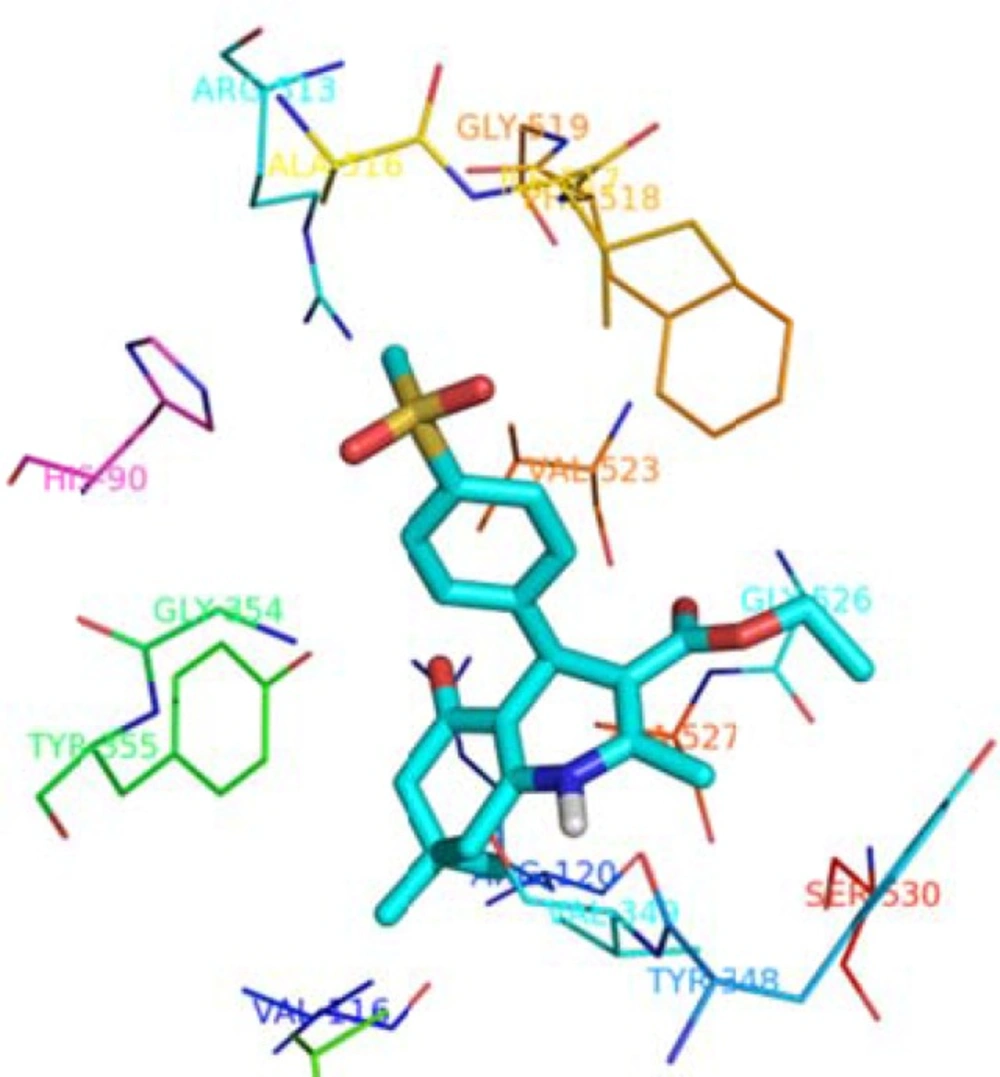
Figure 2
Binding mode of compound 5e in the COX-2 active site.
Conclusion
In conclusion, new 1, 4-dihydropyridine derivatives were synthesized and evaluated
for COX-1/COX-2 inhibition. Among them, compound 5e exhibited good COX-2 inhibitory
activity and selectivity (IC50=0.30 μM and COX-2 selectivity index=92).
Experimental results in conjunction with molecular docking studies indicated that
compound 5e with methyl and ethoxycarbonyl groups as R1 and
COOR2 substitutionscould interactappropriately with COX-2 active
site. Therefore, this compound provides a promising lead for further development.
