Fulltext
The full text is available in PDF.
International Cardiovascular Research Journal
An annual journal in scientific affiliation with the Cardiovascular Research Center, Shiraz University of Medical Sciences
Image Credit:Int Cardiovasc Res J
Authors
Background: There is evidence that inflammation may be involved in pathogenesis of MetS. Inflammatory biomarkers are moving to the forefront as the potent predictors of MetS.
Objectives: The present study aimed to evaluate the association between MetS and some inflammatory biomarkers.
Patients and Methods: This community-based cross-sectional study was conducted on 800 subjects aged above 35 years selected through random sampling in Borujerd (west of Iran) from 2011 to 2013. MetS was defined based on ATP III criteria and the subjects were divided into two groups (MetS and non-MetS groups). Waist circumference and Body Mass Index (BMI) were calculated. In addition, blood samples were taken and C-Reactive Protein (CRP), lipid profile, Fasting Blood Sugar (FBS), and Bleeding Time (BT) were measured. Then, the correlations between MetS and the above-mentioned variables were estimated. After all, the data were entered into the SPSS statistical software (v. 17) and analyzed using T-test, chi-square, median test, and spearman’s rank correlation.
Results: In this study, 344 subjects (43%) met the ATP III criteria. The results showed a significant difference between MetS and non-MetS groups regarding BMI, white blood cell, total cholesterol, LDL, platelet, and high-sensitivity CPR (hs-CRP) (P < 0.0001, P = 0.040, P < 0.0001, P < 0.0001, and P = 0.045, respectively). Besides, waist circumference, Triglyceride (TG), FBS, and systolic and diastolic blood pressure were significantly higher, while HDL was significantly lower in the MetS group (P < 0.0001).
Conclusions:: The incidence rate of MetS in our survey was higher compared to the previous reports. In addition, this incidence rate was higher in females in comparison to males. The results also showed a significant correlation between inflammatory biomarkers and MetS and that the higher levels of hs-CRP were associated with higher rate of MetS.
© 2017, Author(s). This open-access article is available under the Creative Commons Attribution 4.0 (CC BY 4.0) International License (https://creativecommons.org/licenses/by/4.0/), which allows for unrestricted use, distribution, and reproduction in any medium, provided that the original work is properly cited.
Mahdavi-Roshan M, Shoaibinobarian N, Noormohammadi M, Fakhr Mousavi A, Savar Rakhsh A, et al. Inflammatory Markers and Atherogenic Coefficient: Early Markers of Metabolic Syndrome. Int J Endocrinol Metab. 2022;20(4):e127445. doi: https://doi.org/10.5812/ijem-127445
Kawada T, Otsuka T, Endo T, Kon Y. Number of Components of the Metabolic Syndrome; Smoking and Inflammatory Markers. Int J Endocrinol Metab. 2012;11(1):. doi: https://doi.org/10.5812/ijem.8403
Zoghi G, Nejatizadeh A, Shahmoradi M, Ghaemmaghami Z, Kheirandish M. Prevalence of Metabolic Syndrome and Its Determinants in the Middle-aged and Elderly Population in A Southern Coastal Region, Iran (the PERSIAN Cohort Study): A Cross-sectional Study. Shiraz E-Med J. 2022;23(3):e116838. doi: https://doi.org/10.5812/semj.116838
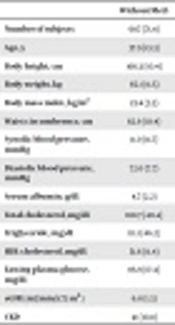
Bakhshayeshkaram M, Roozbeh J, Heidari ST, Honarvar B, Dabbaghmanesh MH, et al. Relationships Between Various Components of Metabolic Syndrome and Chronic Kidney Disease in Shiraz, Iran. Int J Endocrinol Metab. 2019;17(2):e81822. doi: https://doi.org/10.5812/ijem.81822
Kawada T. Insulin-Related Biomarkers to Predict the Risk of Metabolic Syndrome. Int J Endocrinol Metab. 2013;11(4):e10418. doi: https://doi.org/10.5812/ijem.10418
More by these authors
Last Update: 0 months ago
Last Update: 0 months ago
Last Update: 0 months ago
Last Update: 3 days ago
Last Update: 1 day ago
Last Update: 1 day ago

