1. Background
University students are the developers of their nations’ future and make a significant number of young people. The number of students is increasing as universities and higher education centers develop (1). University students experience a wide array of changes in their social and personal relations. Some of them are capable of complying with the new environment and can promote themselves by taking a flexible approach against changes and their own educational and cognitive successes (2). However, about 30% of students have poor academic performance as a result of issues like not being familiar with the environment of their university or the dominant culture of the region in case they are non-native, away from their family, lack interest in the field of study, incompatibile with the other people of the environment, or have mental disorders such as depression (3). In Iran, mental disorders like depression have been reported to be found in 21% of adults, 17.6% of people aged 15 to 24, and 15.6% of students (4). One of the possible psychological mechanisms, which affect students’ depression is experiencing loneliness. Empirical findings have proved that young people experience loneliness more than adults. Loneliness has long been a problem for both consultants and therapists (2).
Desire for interpersonal intimacy with anyone lasts from birth to death and there is no one who is not threatened by it. Human beings are born with an inherent need for intimacy and relationship. This need consists of an inclusive desire for establishing and maintaining at least a few positive, stable, and important interpersonal relationships. Therefore, individuals, who fail to establish and maintain satisfactory relations with others and as a result have problems meeting their need for belonging to someone, most likely undergo a sense of deprivation, which reveals itself in the form of loneliness (5). Evidence shows that loneliness is a widespread and pervasive phenomenon, which is more common in females than males (6). In their study on female medical students, Hoferek and Sarnowski reported that the rate of loneliness was 97.8 % (7). Studies have shown that loneliness is not analogous to living in solitude but it is experienced when social interactions are quantitatively and qualitatively flawed (5). This feeling is a significant factor in causing, predisposing, or intensifying mental and physical ailments. Furthermore, it causes a variety of unbalanced psychosocial conditions such as depression, suicide and extreme despair, social isolation, detachment from friends, disappointment, impatience, anxiety, impaired self-care behaviors, disruption of the normal way of life, and impaired physical health such as impaired function of immune system, eating disorders, and sleep problems (8).
Experts believe that successful treatment of loneliness likely reduces the risk of serious side effects, such as depression and it may lead to students’ health promotion (9). Considering the importance of students’ mental health and its effects on the quality of their life, it is undeniable that there have been a few studies that probe in loneliness among university students. However, it is worth mentioning that loneliness can have variable prevalence in accordance with social, cultural, religious, and welfare factors of every region. Thus, the present study aimed to determine the epidemiological pattern of loneliness and related factors among Maragheh University of Medical Sciences students during year 2015.
2. Methods
The present study was an analytical cross-sectional study that was performed during year 2015. The study population of the present study consisted of Maragheh University of Medical Sciences students, who were studying at the time of the project. Convenience sampling method was used in the present study. After obtaining a written consent, exerting a second semester student criteria, making sure they did not have any chronic mental disorder or physical complaints, which may interfere in the subjects’ participation, out of the 500 students of the faculty, 323 people were selected for the study and were asked to complete the questionnaires. When delivered to the researchers, the completed questionnaires were reviewed and, if necessary, they were returned to fix potential problems.
A validated and reliable questionnaire was used in the present study, which consisted of two sections (10). The first section was used to obtain the demographic profile of the students. The second section of the questionnaire was the revised University of California Los Angeles (UCLA) loneliness scale. This scale was devised by Russell et al. in 1980. This questionnaire includes 20 questions and the score of every individual is calculated from the sum of the scores of all 20 questions. The scoring method of this scale included descriptive phrases. Participants had to choose between the following phrases, “never”, “rarely”, “sometimes”, and “often”. Several questions were scored in a reverse manner. The lowest score that any subject could obtain was 20 and the highest was 80. Scores 20 to 34 suggested mild loneliness, which means no loneliness, 35 to 48 showed moderate loneliness, and scores over 48 represented severe loneliness (11). Through retesting, the reliability of the test was reported by Russell to be 89%. In addition, Russell et al. (1998) in a repeated retest reported that the reliability of the test was 78% (12). In their study, Sodani et al. by means of Cronbach’s alpha method estimated that the reliability of this scale is 81% (10).
The collected data were entered into the SPSS software version 20 (SPSS, Inc., Chicago, IL, USA). Quantitative and qualitative variables were presented as mean ± standard deviation and numbers (percent), respectively. P values of less than 0.05 were considered statistically significant.
3. Results
In terms of personal profiles of the research units, the findings briefly indicated that the mean (standard deviation) age of the subjects was 21.35 (1.68) years. In this study, the majority of participants were females (52.0%) and single (92.6%) (Table 1).
Table 1.
Demographic Characteristics of College Students
| Demographic Factors | No. (%) |
|---|---|
| Age, y | |
| Under 24 | 294 (91.6) |
| 24 and over | 27 (8.4) |
| Gender | |
| Female | 168 (52.0) |
| Male | 155 (48.0) |
| Marital status | |
| Single | 299 (92.6) |
| Married | 24 (7.4) |
| Place of residence | |
| Dormitory | 241 (74.6) |
| Personal home | 82 (25.4) |
| Major | |
| Nursing | 108 (33.4) |
| Operation room | 72 (22.3) |
| Public health | 66 (20.4) |
| Medical Emergency | 31 (9.6) |
| Medical Laboratory Sciences | 46 (14.6) |
| Semester | |
| 1 - 2 | 103 (31.9) |
| 3 - 4 | 91 (28.2) |
| 5 - 6 | 61 (18.9) |
| 7 - 8 | 68 (21.1) |
| Birth order | |
| 1 - 2 | 219 (67.8) |
| 3 - 5 | 97 (30.2) |
| 6 and over | 7 (2.2) |
| Free time activities | |
| Sports and physical activities | 33 (10.2) |
| Rest | 49 (15.2) |
| Study | 20 (6.2) |
| Internet | 28 (8.7) |
| A mixing of these activities | 162 (59.4) |
| Other | 1 (0.3) |
| Family income | |
| Low | 38 (11.8) |
| Average | 272 (84.2) |
| High | 13 (4.0) |
| Parental survival status | |
| Living | 306 (94.7) |
| Death of at least one parent | 17 (5.3) |
In this study, the percentage of moderate and severe loneliness in the subjects was estimated as 50.5 and 31.6, respectively. The frequency distribution of loneliness is provided in Figure 1. Also, Table 2 shows the relationship between different levels of loneliness and the factors affecting it. The results indicate that there is a significant relationship between loneliness and gender, area of residence, birth order, and semester (P < 0.05).
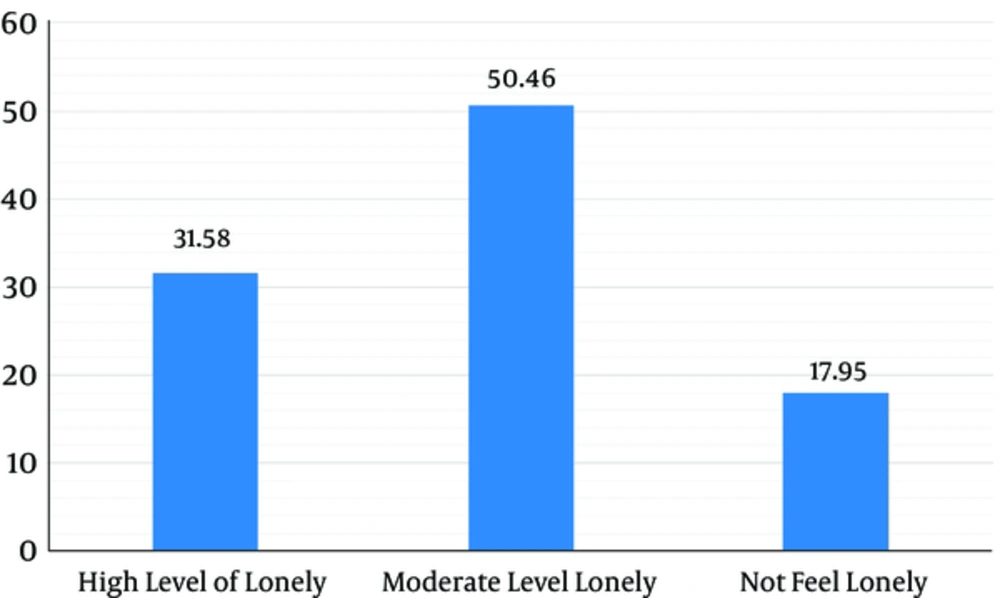
Figure 1.
Distribution of State of Loneliness Among Studied Students in 2015
Table 2.
Distribution of the Relationship Between Loneliness and Factors Affecting it
| Effective Factors | No Loneliness | Moderate Loneliness | Severe Loneliness | Test Results | |
|---|---|---|---|---|---|
| X2 | P Value | ||||
| Gender | 18.827 | < 0.001 | |||
| Male | 42 (72.4) | 88 (54.0) | 38 (37.3) | ||
| Female | 16 (27.6) | 75 (46.0) | 64 (62.7) | ||
| Major | 8.586 | 0.378 | |||
| Nursing | 18 (31.0) | 57 (35.0) | 33 (32.4) | ||
| Operation room nursing | 9 (15.5) | 36 (22.1) | 27 (26.5) | ||
| Public health | 19 (32.8) | 29 (17.8) | 18 (17.6) | ||
| Medical emergencies | 5 (8.3) | 18 (11.0) | 8 (7.8) | ||
| Medical laboratory sciences | 7 (12.1) | 23 (14.1) | 16 (15.7) | ||
| Age group | 2.134 | 0.344 | |||
| Under 24 | 52 (89.7) | 153 (93.9) | 91 (89.2) | ||
| 24 and over | 6 (10.3) | 10 (6.1) | 11 (10.8) | ||
| Living place | 18.115 | 0.001 | |||
| Dormitory | 54 (93.1) | 123 (75.5) | 64 (62.7) | ||
| Personal home | 4 (6.9) | 40 (24.5) | 38 (37.3) | ||
| Marital status | |||||
| Single | 54 (93.1) | 149 (91.4) | 96 (94.1) | ||
| Married | 4 (6.9) | 14 (8.6) | 6 (5.9) | ||
| Birth order | 0.697 | 0.706 | |||
| 1 - 2 | 31 (53.4) | 123 (75.5) | 65 (63.7) | ||
| 3 - 4 | 14 (24.1) | 28 (17.2) | 27 (26.5) | ||
| 5 and over | 13 (22.4) | 12 (7.4) | 10 (9.8) | ||
| Semester | 15.304 | ||||
| 1 - 2 | 25 (43.1) | 51 (31.3) | 27 (26.5) | ||
| 3 - 4 | 16 (27.6) | 48 (29.4) | 27 (26.5) | ||
| 5 - 6 | 16 (27.6) | 30 (18.4) | 15 (14.7) | ||
| 7 - 8 | 1 (1.7) | 34 (20.9) | 33 (32.4) | ||
| Free time activities | 8.301 | 0.405 | |||
| Sports and physical activities | 2 (3.4) | 17 (10.4) | 14 (13.7) | ||
| Rest | 7 (12.1) | 29 (17.8) | 13 (12.7) | ||
| Study | 2 (3.4) | 11 (6.7) | 7 (6.9) | ||
| Internet | 7 (12.1) | 12 (7.4) | 9 (8.8) | ||
| A mixing of all these activities | 40 (69.0) | 94 (57.7) | 59 (57.8) | ||
| Family income | 0.397 | 0.983 | |||
| Low | 8 (13.8) | 19 (11.7) | 11 (10.8) | ||
| Average | 48 (82.8) | 137 (84.0) | 87 (85.3) | ||
| High | 2 (3.4) | 7 (4.3) | 4 (3.9) | ||
| Parental survival status | 0.700 | 0.705 | |||
| Living | 54 (93.1) | 154 (94.5) | 98 (96.1) | ||
| Death of at least one of the parents | 4 (6.9) | 9 (5.4) | 4 (3.9) | ||
4. Discussion
The results of this study on students of medical sciences showed the rate of severe, moderate, and mild loneliness was 31.6%, 50.5%, and 18.0%, respectively. In their study, Najafi et al. estimated severe, moderate, and mild loneliness as 32.7%, 34.1%, and 33.1%, respectively (13). The discrepancy between their study and the present study is likely due to regional, cultural, economic, and social factors that affected the results.
Regarding the relationship between loneliness and certain personal and social traits, the data indicated that there was a significant relationship between gender and loneliness and the level of loneliness in female students was more than males. The result of Ceyhan’s study corresponds to our findings (14, 15). However, in Ozin study on 525 subjects, level of loneliness in male students was more than females (16), which is the opposite of the current results. This difference can be attributed to the difference in size of the sample and/or the differences in cultural and social factors.
According to this study, rate of loneliness among nursing students was higher than other fields of the study; however, the relationship between degree, major, and loneliness was not significant. The results of the studies done by Hasanzadeh Taheri et al. and Ibrahim et al. correspond to the findings of the present study (17, 18).
The results of the present study showed that there was a significant relationship between loneliness and the number of semesters. Ceyhan and Ceyhan’s study also showed that there was a significant relationship between loneliness and the number of semesters, which corresponds to the results of the current study. It is important to mention that senior students had lower levels of loneliness in comparison to the freshmen (14).
The results also proved that there was a significant relationship between birth order of students and their loneliness so that level of loneliness in students, who were the first or second child of the family was higher, which is supported by findings of other researchers. It is possible that first and second children of a given family may receive different levels of affection and attention in their family (19). The present research showed that there was a significant relationship between loneliness and residential status. The students, who lived in dormitories, had higher levels of loneliness than those living off campus. It seems that the reason for this is detachment and distance from family, not being familiar with the environment, and confronting new people at university. These findings are similar to the results of other studies (20-22).
Deniz et al. in a study showed that there was a significant relationship between loneliness and marital status (23). However, our study did not indicate a significant relationship between loneliness and marital status. This difference may be because of the fact that the majority of our subjects were single. Therefore, this issue demands more profound and expansive research.
It is worth mentioning that one of the limitations of the present study was the limited number of the faculty students and thus random sampling was not possible. Therefore, it is suggested that similar research on students of various universities and with a random sampling method be done and also further research be carried out on the causes of this phenomenon.
4.1. Conclusions
The results of the present study showed that the majority of participants had different levels of loneliness and more than half of them had moderate loneliness. Therefore, findings of the present study should make the authorities increase the number of cultural, religious, and recreational activities, especially for students living in dormitories. They should also prevent loneliness and promote the students’ health through encouraging students to actively participate in these programs, strengthening student counseling centers, and offering welfare facilities in dormitories since the students are future brokers and specialists and play a noticeable role in progress of their country. The information obtained from this study can be employed by other studies in this filed to open up other horizons about this phenomenon.