- • Screening personnel
- • Medicine within military units
- • Surgery in the theatre of operations
- • Emergency medicine
- • Disaster response
- • Public health
- • Dentistry
- • Pharmacy
- • Veterinary sciences
- • Administration and medical logistics training.
- • Exchanges and Information Forum.
- • The ICMM major role is to contribute to exchanges in all the medico-military fields both technological and scientific.
- • This is achieved mainly during World and Regional Congresses regrouping delegations of Member States and representatives of observer countries, but also during multilateral exchanges.
- • The 40th World Congress on Military Medicine was held in Jeddah, Kingdom of Saudi Arabia in December 2013.
- • Pan-American, Pan-African, Pan-European, Maghreb and Pan-Arab Regional Working Groups organize Regional Congresses and Courses.
- • Each quarter, the ICMM publishes its official organ, the International Review of the Armed Forces Medical Services.
- • Scientific ICMM showcase, the International Review of the Armed Forces Medical Services is the material link between Medical Services and Member States. Several copies are sent for free to the delegates of each Member State and to other structures of the Medical Services. This link is strengthened with the ICMM official website, where all information about ICMM’s activities, structures and official working documents are updated.
- • The active participation of Member States allows them to get all advantages they could expect during the different congresses and multilateral exchanges.
- • The official languages for the exchanges are French and English.
{"type":["paragraph","list"],"content":["• In Study of Training and Coaching field the ICMM objectives are:",{"type":"paragraph","content":"Making exchanges easier on training methods used in the world,"},{"type":"paragraph","content":"Trying to make out guidelines (Not restrictive),"},{"type":"paragraph","content":"Establishing a database on existing training,"},{"type":"paragraph","content":"Organizing international courses."}],"list_type":"order"}
- • Assessment of disaster situations: The ICMM promotes discussions on the Medical Services activity during natural or technological main disasters.
- • Cooperation with international organizations: The ICMM has signed agreements with WHO, OIE and UNAIDS. These agreements provide for cooperation with medical services of our Member States in order to detect and respond to major epidemics posing a global threat to public health. WHO, OIE and UNAIDS contact each government individually. We are also discussing draft agreements with other international organizations.
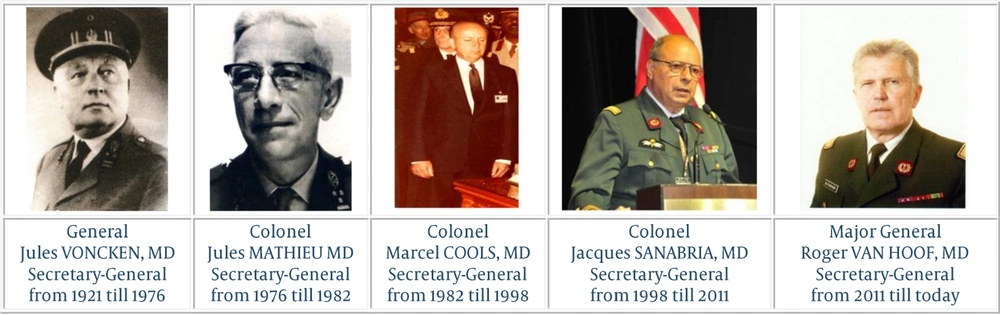
{"type":["paragraph","list"],"content":["• Study of International Humanitarian Law evolution:",{"type":"paragraph","content":"It is clear today that current conflicts and military interventions impose an evolution of this law. Based on actual experience within the ICMM context, we can collaborate, in this aim, with specialized organizations."},{"type":"paragraph","content":"Fruitful exchanges are taking place during different meetings at the ICMM."},{"type":"paragraph","content":"A course of Law of Armed Conflicts is organized each year with the support of Switzerland. This course is actually decentralized in different regions of the world.” (<a href=\"#A27393R1\">1</a>). Shortly, the 41st World Congress on Military Medicine will be hosted by Indonesia in Bali, in May 2015. Iranian military forces are going to have active participation in this congress by presenting papers, workshops, and roundtables. Nevertheless, it is not enough. We must reorganize our activities in order to be an active and effective member of ICMM and play our role in the regional committees. In addition, we expect to have at least one candidate for the next ICMM Prize (Jules Voncken Prize). Therefore, I sincerely invite my colleagues for further action to reach these goals."}],"list_type":"order"}