
1. Background
Nowadays, obesity and weight gain are one of the problems of societies, which affect about 35.1% of children (1). Obese children may refer because of a small penis. The penis length is mostly normal in these boys, and this is due to the fatty pubis, which hides the penis. This condition is called concealed or buried penis (2).
Micropenis is truly small with a normal structure with a stretched penis length (SPL) of < 2.5 standard deviations (SDs) of mean age-related size (3). These boys and their parents are concerned with decrease quality of life, anxiety, depression, fear of sexual relationship, and impotence (4, 5). Today, parents are paying more attention to the penis size of their children, especially obese children (6). On the other hand, delay in diagnosis of true micropenis in these children may decrease response to treatment and increase parental concern. Therefore, evaluation of the penile length and its correct measurement are crucial to both parents and health workers.
Accordingly, the understanding of the relationship between micropenis and weight and hormonal levels is critically relevant. To date, few studies have focused on true micropenis and its relationship with body mass index (BMI) and hormonal levels in non-obese and obese children. There is no consensus and agreement on the relationship between these factors and micropenis. Different results have been obtained from previous studies, which indicates the importance of further studies to achieve more definite results.
2. Objectives
The aim of this study was to investigate the correlation between weight, height, testosterone, and estradiol and micropenis in prepubertal non-obese and obese prepubertal children to provide clear suggestions for this issue.
3. Methods
3.1. Study Populations
This case-control study was done on children at Golestan Hospital, Tehran, Iran, from June 2018 to May 2020 selected by simple convenience sampling method. In this study, 765 prepubertal children aged 8 - 13 years who referred because of small penis size and were subjected to evaluations, including stretched penile length (SPL) were studied. Patients were evaluated by a urologist and a pediatrician, and if they had true micropenis, they were enrolled in the study. Inclusion criteria were healthy boys aged 8 - 13 years and true micropenis (less than 2.5 SD below the mean penis size for age) without any chronic disease and abnormality of the penis, such as curvature, scarring, and penile surgery. Exclusion criteria were history of taking corticosteroids, chronic disease, endocrine diseases, such as thyroid disease and growth hormone deficiency, concealed penis, undescending testis, testis atrophy, varicocele, and any form of hypospadias. By reviewing the previous studies and using the below formula, and C = 1.5, at least 56 non-obese children and 84 obese children were considered for the study.
P0 = 30%, OR = 2, α = 5%, β = 10%.
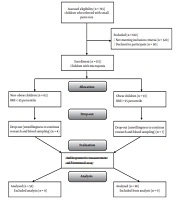
One hundred fifty-five children were enrolled in this study. Eleven subjects were excluded during the study because they did not refer back to the hospital due to the unwillingness to continue research and blood sampling. Finally, 58 non-obese micropenis children with BMI < 95 percentile and 86 obese micropenis children with BMI ≥ 95 percentile completed the study. The flow diagram of the study is shown in Figure 1.
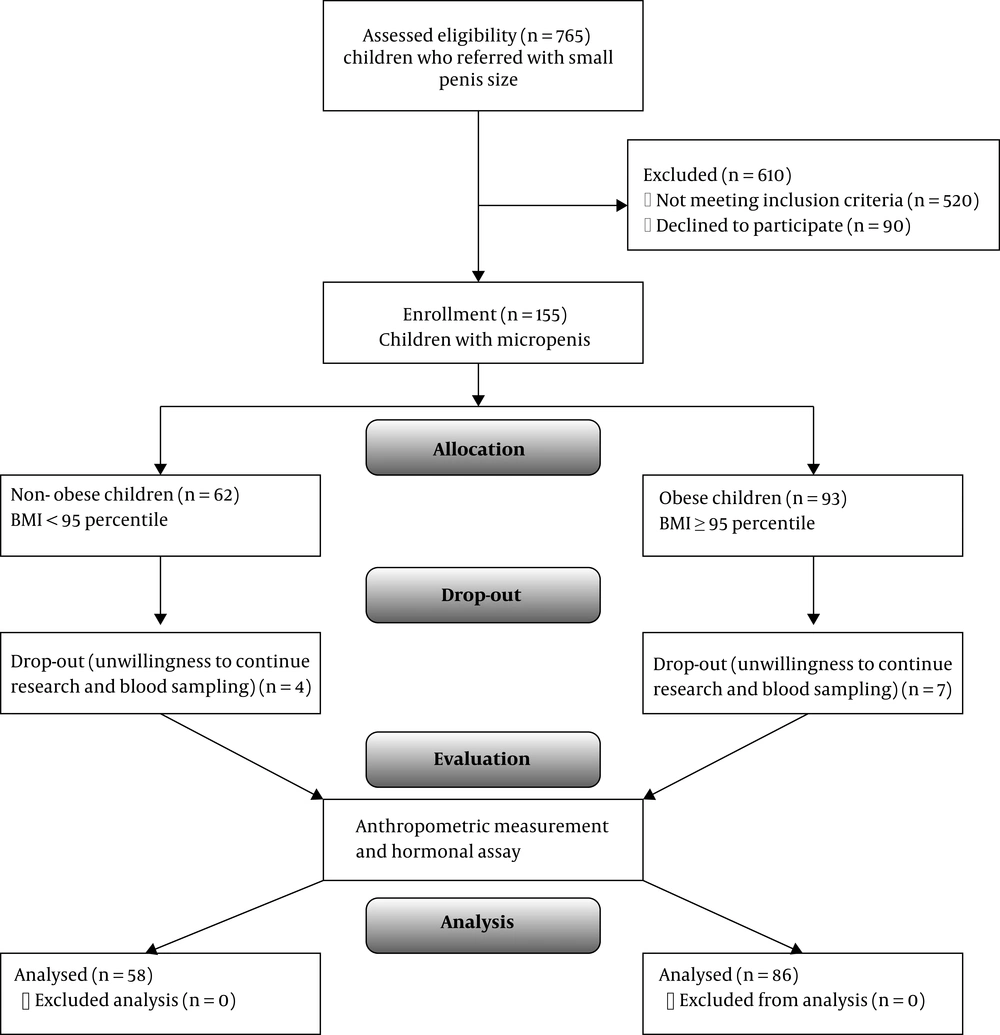
Figure 1.
Flow diagram of the study
Based on the previous studies, we found the most confounders of micropenis: abnormality of the penis, such as curvature, history of taking corticosteroids, chronic and endocrine diseases, such as thyroid disease and growth hormone deficiency, undescending testis, testis atrophy, varicocele, and any form of hypospadias. Non-essential and acquired factors were excluded by considering the inclusion and exclusion criteria. We focused on the selection of the main and potential confounders in isolated micropenis in healthy prepubertal children, including age, sex steroid factors, height, weight, and BMI.
Minimizing and control of the confounders in study design was done by restricting the study population to male prepubertal children aged 8 - 13 years. Age distribution was similar in both groups, so that cofounding was minimized. Furthermore, we tried to preserve the homogeneity of the groups with respect to possible confounders, such as age, sex steroid factors, height, weight, and BMI, by matching the two groups. The Cochran-Mantel-Haenszel method was used to control confounders, and statistical analysis was performed by multiple variable regression analysis.
For effect modification, pooled data converted to stratum-specific measures, and stratified analysis was performed. If stratified measures of association were similar, but they differed from the total crude estimate by 10% or more, there was only confounding, no modifiers.
To evaluate the results, a sensitivity analysis was performed that measures how the impact of uncertainties of input variables can lead to uncertainties on the output variables. In this study, due to the variety of parameters, the one-at-a-time (OAT) technique was used to reconsider the correlation between height, testosterone, weight, and estradiol and the penile length. The sensitivity analysis using graphs for each variable was performed.
All examinations were performed in a supine position at a temperature of 20°C - 23°C. Measurements were done with a ruler (cm), and after compressing the adipose tissue on the pubis, the SPL was calculated from the distance of the symphysis pubis to the tip of the penis, which was completely stretched. Measurements were done twice for each child by only one urologist, and the mean of these was recorded.
Height measurement (cm) was performed with a standing meter without shoes with an accuracy of 0.5 cm. Beurer scale (Germany) was used for measuring children’s weight (kg) without shoes and with light clothing with an accuracy of 100 g. BMI was considered as follows: Weight (kg)/Height2 (m2). Those with BMI ≥ 95 percentile were considered obese, and those with BMI < 95 percentile were non-obese (1). Measurements were done twice for each child by only one pediatrician, and the mean of these was recorded.
Venous blood samples were taken at the hospital laboratory and kept at -20°C temperature. Testosterone was measured with radioimmunoassay with the detection limits 1 ng/mL and intra-assay and inter-assay coefficients of variation (CV) of < 7.2% and < 8.5%, respectively (Pishtazteb Company, Tehran, Iran). Estradiol was measured with radioimmunoassay. The detection limit was 4.45 pg/mL and intra-assay and inter-assay CV of < 10% and < 12%, respectively (Pishtazteb Company, Tehran, Iran). Hormonal levels were adjusted based on age.
3.2. Main Outcome Measures
The testosterone, estradiol, weight, height, BMI, and SPL and the relationship between penile length and these variables in obese and non-obese groups were studied as the study outcomes.
3.3. Statistical Analysis
Data were analyzed by SPSS statistical software version 24 (SPSS Inc, Chicago, IL, USA). For quantitative variables, mean and SDs, and for qualitative variables, frequency and frequency percent were calculated. The difference between SPL and anthropometrics and hormonal variables evaluated by student t-test and Pearson’s correlation coefficient (r) was used for statistical analyses. In subgroups, stratified variables were compared by the chi-square test. Also, a multiple logistic regression model was done to evaluate the odds ratio (OR) with confidence intervals 95% (CI 95%) to control the confounding variables. P value < 0.05 was considered significant. Categorical factors with significant OR (P < 0.05) were taken as possible risk factors for micropenis.
4. Results
The mean age of children in the non-obese and obese groups was 10.2 ± 1.34 and 10.5 ± 1.6 years, respectively. Adjustment for confounding variables in study design was performed by restricting the study population to male healthy prepubertal children aged 8 - 13 years. Mean, and SD of SPL in non-obese and obese were 3.1 ± 1.3 and 2.9 ± 1.22 cm, respectively. Anthropometric measures and hormonal assessments of the non-obese group were as follows: height: 143.5 ± 10.3 cm, weight: 50.3 ± 11.6 kg, BMI: 20.12 ± 4.34 kg/m2, testosterone: 1.4 ±1.82 ng/mL, and estradiol: 49.54 ± 9.7 pg/mL and height: 148.83 ± 11.63 cm, weight: 60.58 ± 16.27 kg, BMI: 39.24 ± 6.01 kg/m2, testosterone: 1.05 ± 1.66 ng/mL, and estradiol: 52.28 ± 12.22 pg/mL for obese children. Demographic characteristics and hormones levels of the subjects are shown in Table 1. Non-obese and obese groups were matched regarding basic characteristics. Furthermore, the study groups did not differ with respect to possible confounders, such as age, sex steroid factors, height, and weight.
Table 1.
Basic Characteristics and Hormonal Levels of Micropenis Children in Obese and Non-Obese Groupsa
| Groups | Non-Obese (N = 58) | Obese (N = 86) | P Value | ||||
|---|---|---|---|---|---|---|---|
| Min | Max | Mean ± SD | Min | Max | Mean ± SD | ||
| Age, y | 8 | 13 | 10.2 ± 1.34 | 8 | 13 | 10.5 ± 1.6 | 0.72 |
| Height, cm | 131 | 169 | 143.5 ± 10.3 | 123 | 176 | 148.83 ± 11.63 | 0.43 |
| Weight, kg | 31 | 73 | 50.3 ± 11.6 | 30 | 132 | 60.58 ± 16.27 | 0.04 |
| BMI, kg/m2 | 14.06 | 26.5 | 20.12 ± 4.34 | 30.4 | 48.48 | 39.24 ± 6.01 | 0.02 |
| SPL, cm | 1 | 4.9 | 3.1 ± 1.3 | 1.3 | 5.5 | 2.9 ± 1.22 | 0.52 |
| Testosterone, ng/dL | 0.7 | 10.2 | 1.4 ± 1.82 | 0.01 | 12.7 | 1.05 ± 1.66 | 0.33 |
| Estradiol, pg/mL | 18.9 | 69.7 | 49.54 ± 9.7 | 16 | 75 | 52.28 ± 12.22 | 0.29 |
Abbreviations: BMI, body mass index; SD, standard deviation; SPL, stretched penile length.
aObese and non-obese groups were matched regarding basic characteristics.
SPL in non-obese group was positively correlated with height and testosterone (height: r = 0.210, P = 0.023; testosterone: r = 0.332, P = 0.001) but not with BMI, weight, and estradiol (r = -0.156, P = 0.091; r = - 0.036, P = 0.696; r = 0.088, P = 0.341, respectively). Similarly, SPL in obese children was positively and significantly correlated with height and testosterone (height: r = 0.239, P = 0.009; testosterone: r = 0.344, P = 0.001) but not with BMI, weight, and estradiol (r = -0.175, P = 0.058; r = - 0.036, P = 0.701; r = 0.093, P = 0.317, respectively) (Table 2).
Table 2.
Correlation Coefficients (r) of Penile Length, BMI and Hormonal Levels in Each Groupa
| Groups | Height | Weight | BMI | T | E |
|---|---|---|---|---|---|
| SPL (non-obese) | |||||
| r | 0.210 | -0.036 | -0.156 | 0.332 | 0.088 |
| p | 0.023 | 0.696 | 0.091 | 0.001 | 0.341 |
| SPL (obese) | |||||
| r | 0.239 | -0.036 | -0.175 | 0.344 | 0.093 |
| p | 0.009 | 0.701 | 0.058 | 0.001 | 0.317 |
Abbreviations: BMI, body mass index; E, estradiol; SPL, stretched penile length; T, testosterone.
aSPL was positively and significantly correlated with height and testosterone but not with weight, estradiol, and BMI in both groups.
For effect modification, the data were stratified by height, weight, testosterone, and estradiol. Stratified measures of association were similar to each other, but they differed from the total crude estimate by 10% or more. Therefore, there was only confounding, no modifiers. The categorical factor with significant OR (P < 0.05) was taken as a possible risk factor for micropenis. In multiple variable regression analysis, non-obese micropenis children showed no significant ORs regarding weight and/or estradiol levels compared with obese children. Height and testosterone had significant OR (P < 0.05). Therefore, these were taken as a possible risk factor for micropenis (Table 3).
Table 3.
| Groups | Non-Obese | Obese | Crude | Adjusted | P Value | ||
|---|---|---|---|---|---|---|---|
| OR | 95% CI (Lower-Upper) | OR | 95% CI (Lower-Upper) | ||||
| Height, cm | 1.43 | (0.82 - 1.68) | 1.57 | (0.91 - 1.85) | 0.009 | ||
| 120 - 150 | 20 (34.5) | 37(43) | |||||
| 151 - 180 | 38 (65.5) | 49 (57) | |||||
| Weight | 0.39 | (0.24 - 0.67) | 0.43 | (0.26 - 0.74) | 0.69 | ||
| 30 - 70 | 37 (63.8) | 35 (40.6) | |||||
| 71 - 130 | 21 (36.2) | 51 (59.4) | |||||
| Testosterone | 0.76 | (0.51 - 0.89) | 0.84 | (0.56 - 0.98) | 0.001 | ||
| < NL | 40 (68.9) | 54 (62.9) | |||||
| NL | 18 (31.1) | 32 (37.1) | |||||
| Estradiol | 0.68 | (0.57 - 0.84) | 0.75 | (0.63 - 0.93) | 0.32 | ||
| NL | 18 (31.1) | 20 (23.6) | |||||
| > NL | 40 (68.9) | 66 (76.4) | |||||
Abbreviation: NL, normal; 0R, odds ratio.
aValues are expressed as No. (%).
bIn the multiple variable regression analysis, obese micropenis children had not a significant odds regarding weight, and estradiol levels compared with non-obese children. Height and testosterone had significant odds ratio (P < 0.05). Therefore, they were taken as possible risk factors for micropenis.
Crude and adjusted ORs with CI 95% for penile length in non-obese and obese children with micropenis across to height and Testosterone levels were shown in Table 4. After adjustment by age, BMI, weight and Estradiol, in relation to height in non-obese group, OR with 95% CI was 1.52 (0.91 - 1.83), P = 0.001 and in relation to Testosterone levels was 0.56 (0.36 - 0.98), P = 0.001. In relation to height in obese group, OR with 95% CI was 1.42 (0.81 - 1.66), P = 0.001 and in relation to Testosterone levels was 0.75 (0.51 - 0.87), P = 0.001.
Table 4.
Overall Crude and Adjusted Odds Ratio with 95% Confidence Interval for Penile Length in Non-Obese and Obese Groups Regarding Height and Testosterone Levels
| Penile Length | |||||
|---|---|---|---|---|---|
| Non-Obese (N = 58) | Obese (N = 86) | P Value | |||
| ORb | 95% CI (Lower-Upper) | OR | 95% CI (Lower-Upper) | ||
| Height | 0.001 | ||||
| Crude | 1.39 | (0.82 - 1.66) | 1.29 | (0.74 - 1.51) | |
| Adjusteda | 1.52 | (0.91 - 1.83) | 1.42 | (0.81 - 1.66 | |
| Testosterone | 0.001 | ||||
| Crude | 0.51 | (0.33 - 0.89) | 0.68 | (0.46 - 0.79) | |
| Adjusted | 0.56 | (0.36 - 0.98) | 0.75 | (0.51 - 0.87) | |
Abbreviations: CI, confidence interval; OR, odds ratio.
aAdjusted = adjusted for age, BMI, weight and estradiol.
bThe odds ratio was determined by the multiple logistic regression analysis.
The sensitivity analysis-graph for each variable had analyzed in the given charts (Figure 2). The line graphs showed the sensitivity of SPL to the height and testosterone but not to weight and estradiol.
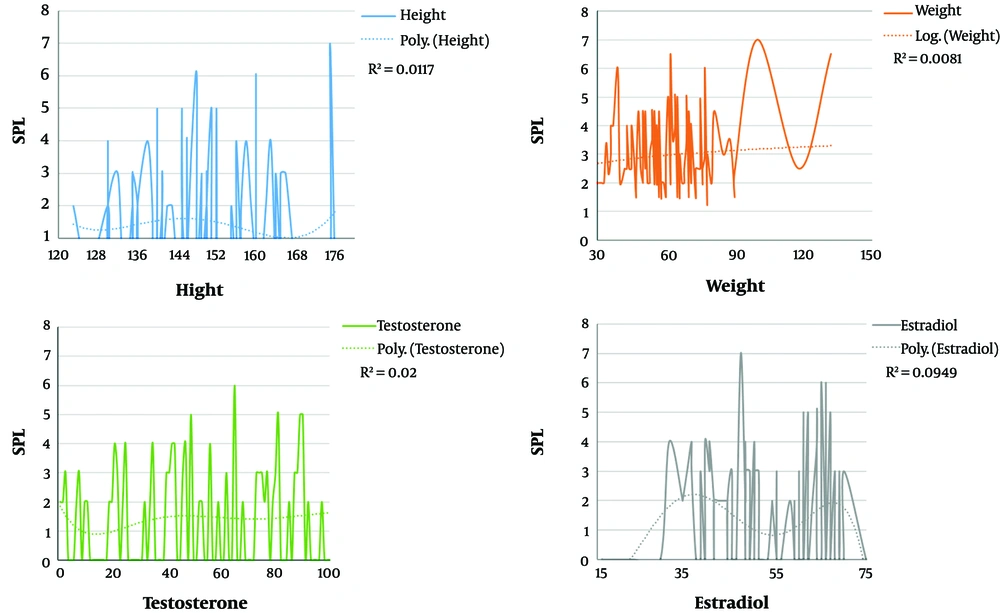
Figure 2.
The sensitivity of SPL to height, testosterone, weight, and estradiol. The line graph compares the sensitivity of SPL to heights. The results showed the correlation between height and SPL and the trend line has the least regression to graph (R2 = 0.011), which shows its sensitivity to the height. The line graph also measures how the impact of uncertainties of testosterone as an input variable can lead to uncertainties on SPL as an output variable. The R2 amount shows that testosterone is the second correlated parameter to the SPL. The line graph shows a lower sensitivity between SPL and weight in comparison with others. The given chart argues the non-sensitivity of SPL measurements to the amount of estradiol (according to the higher R2).
5. Discussion
Today, parents are highly concerned with their children’s penis size, especially obese children. Therefore, it is important to know the age-related penis size and accurate measurements in distinguishing true micropenis children and concealed penis. Furthermore, it is necessary and important to study the correlation between true micropenis and BMI, weight, and height, especially in children. This study showed that SPL in non-obese and obese children was positively and significantly correlated with height and testosterone but not with BMI, weight, and estradiol. Also, this study showed that obesity was not a significant factor in the development of micropenis.
Most of the concerns of parents and their children with micropenis are sub-fertility, decreased sexual activity, prostatitis, and poor urination (7). Therefore, the correct diagnosis and treatment of these boys are crucial to prevent these concerns and reduce the problems of the lower urinary tract, especially the prostate (8, 9).
A study on 369 healthy neonates in Sri Lankan showed that SPL was positively correlated with height but not with weight. Hormonal levels were not studied in this study (10). However, our study was done in prepubertal non-obese and obese children with micropenis. Likewise, this study showed that SPL was correlated with height but not with weight and BMI.
A study on 259 boys aged 6 - 24 months indicated that the penile length in infants with unilateral undescending testis was smaller than normal boys. Weight and height did not differ between the two groups (11). The hormonal levels were not defined in groups. Probably, low testosterone levels were the cause of this difference. Our study showed that testosterone levels were not significantly different in obese and non-obese groups. Also, the penile length was significantly correlated with the height.
A systematic review showed that SPL or erect penile length was significantly correlated with height in healthy adult men (12). A study in India found that SPL in neonates was linked to height and foot size (13). Another study in term and preterm infants in Turkey showed that SPL was related to gestational age and height (14). A study on Egyptian healthy term neonates showed that penis length was positively linked to weight, height, and head circumference (15). These articles were performed on neonates and did not study hormonal levels. However, the present study was done on prepubertal micropenis children using anthropometric measures and hormonal survey. Furthermore, our study showed that penile length was significantly correlated with height, but not with BMI and weight.
Soylemez et al. (16) studied the relationship between penis size and BMI in normal young men (mean age 21 ± 3.1 years). This study showed that penile length was not correlated with BMI. Adriansyah et al. (17) studied the relationship between penis size and BMI in 108 normal prepubertal boys (6 obese, 102 non-obese) in Indonesia. They showed that the relationship between flaccid penile length and BMI was not significant. Furthermore, there was a significant difference between the two groups regarding penile length. Limitations of this study were its small sample in the obese group and no hormonal study. The subjects in our study were prepubertal micropenis boys (86 obese, 58 non-obese), and we showed that SPL in obese and non- obese micropenis children was not significantly different.
Most issues of the micropenis men are fear of sexual inadequacy, depression, anxiety, and, subsequently, premature ejaculation (18). Therefore, diagnosis and treatment of micropenis are crucial to both parents and health workers.
Most studies have focused on penis size to get the normal size of the society in healthy young men, especially term or preterm neonates, but the present study was conducted to assess pre-pubertal children with true micropenis. To date, few studies have focused on true micropenis and its relationship with weight and hormonal levels. This study investigated the relationship between anthropometric measures, testosterone, and estradiol in pre-pubertal children with micropenis to provide clear suggestions for this issue, which makes both physicians and parents worried.
One of the limitations of our study was that flaccid penile length was not determined. Furthermore, there are different results about the relationship between penile length and BMI, weight, height, and hormonal levels in multiple studies. It is recommended to perform a meta-analysis on this issue to define correct and comprehensive results.
5.1. Conclusions
On the basis of our findings, the low testosterone level is the most important finding in isolated micropenis. Testosterone and estradiol levels in non-obese prepubertal children with micropenis are similar in obese micropenis boys. Also, SPL in non-obese micropenis boys was not significantly different from obese micropenis boys. Penile length is positively correlated with height but not with weight and BMI in non-obese and obese children. Therefore, it is probably not essential and obligatory to recommend weight loss for this issue, and weight loss should not be considered by the children and their parents.