
1. Background
Foreign body aspiration is a life-threatening emergency in children, which sometimes leads to fatal consequences (1, 2). The out-hospital mortality rate for airway foreign bodies has been documented to be about 36.4%, while the in-hospital mortality rate for the given bodies has been reported to range from 0.26 to 13.6% (3). Most cases of foreign body aspiration occur at home. In other words, aspiration cases often occur when the child is playing or eating in the presence of other people (4). Complications associated with these injuries can be significant and include cerebral anoxia and esophageal perforation. In addition, deaths due to suffocation occurring in the home environment account for up to 95% of cases (5). Parents and caregivers’ knowledge about injury prevention is limited. A study investigating the awareness of American parents about the dangers posed by choking has found that parents have limited knowledge of how to recover children from choking accidents, especially when they face with choking by food. Therefore, improving parents’ knowledge of choking seems to be a necessary preventive measure (6). One of the most useful ways to prevent choking accident by foreign body aspiration in children is to launch targeted educational programs to help health care providers, childcare providers, or anyone engaged with children increase their general knowledge of the accident. These training programs should be intended to raise the awareness about the dangers of suffocation and familiarity with special foods and toys putting the child at risk of death (4).
A study evaluating the impact of media advertising on public awareness of foreign body aspiration showed that the number of bronchoscopies to reduce foreign body aspiration was lower than that before advertising. The study concluded that in addition to media advertising, offering individual education programs focusing on foreign body aspiration for young children’s parents may have proven effective in preventing this type of aspiration (7).
Familiarity with first aid for choking is also of particular importance. The results from another study assessing mothers' knowledge about using first aid for 3- to 6-year-old children during asphyxiation revealed that mothers had insufficient knowledge about first aid, especially about suffocation. Researchers argue that the practical first aid exercises should start systematically before children reach school age and continue during their lifetime. This may increase the scope and effectiveness of prehospital care (8).
2. Objectives
This study mainly aimed to fill the gap in mothers' knowledge about the causes of choking in children in Dezful, Iran, as well as to provide the mothers with necessary information about the issue since no previous study had ever been conducted in this city to examine the given causes. The present study also aimed to address the issue due to its enormous importance in and serious impact on maintaining children's health. The results from the studies investigating the basic knowledge about child suffocation may help researchers and practitioners obtain a reliable estimate of a particular group’s knowledge about the issue, which, in turn, facilitates developing educational activities based on the target community with the aim of improving the required knowledge and skills to prevent the choking incidences from happening (9).
3. Methods
3.1. Study Design
The present study was a quasi-experimental, interventional study conducted in Dezful from October to April 2021. Since quasi-experimental studies have either no random segmentation or no control group, it was not possible to randomize the samples in the present study.
3.2. Sample Size
Inclusion criteria were mothers referring to health centers in Dezful to monitor the growth and vaccination of their children, willing to participate in the study, using WhatsApp software, and completing questionnaires. Exclusion criteria were physicians, medical students, nurses and nursing students, and health care workers who were forced to use basic and advanced resuscitation in their work as well as those who did not speak Persian.
A single-blind study was carried out, and the mothers were blinded to their group. Those in the intervention and control group received a message sent by the researchers telling them to start watching educational film while they were not aware of their group type.
Initially, 15 participants eligible for the study were piloted. Then, 71 individuals were assigned to each group (142 people in total) with power of 85% and an alpha level of 0.05 sample size. Taking into account the probability of 10% drop in the sample and in order for maintaining the strength of the study, a total of 155 mothers were selected to participate in the study, 75 ones in each group. Then 120 participants out of 155 ones completed the pretest (80%), and 110 out of 120 (92%) ones having completed the pretest were allowed to watch the video and finish the posttest survey (55 mothers in each group). The samples were matched together in terms of age.
3.3. Data Collection
Sampling was done according to the postal areas of Dezful. Three areas were identified as sampling clusters, and one center in each cluster was selected adopting random sampling after specifying the list of health centers in each area. A total of six health centers were assigned to the intervention and control group (three centers for each group).
Three questionnaires were used as the data collection tools. The first questionnaire included the items inquiring about the demographic characteristics of the participants.
The second questionnaire consisted of seven questions, taken from the study by Bentivegna et al. (10), assessing the participants’ knowledge about the causes of choking. The content validity of these two questionnaires were evaluated (CVI = 0.78, CVR = 0.79). The reliability of the questionnaire were also confirmed by Cronbach's alpha (0.88).
The third questionnaire contained questions about first aid in choking children. This questionnaire was developed by the researcher based on the protocol of the American Children's Association which has 14 questions (11). Formal and content validity was performed by providing five faculty members of the Nursing School with the questionnaires. The reliability of the questionnaire was 0.80.
Content validity of the questionnaire was performed (CVR > 0.78, CVI > 0.79).
At the beginning of the study, the two questionnaires were distributed among the mothers in two groups (intervention and control) for measuring their level of knowledge about the causes of choking and first aid for choking in children aged 6 months to 8 years.
Then the educational video about the causes of choking extracted from the study by Bentivegna et al. (10) was shared with mothers via WhatsApp software in intervention group. It is noteworthy that the film had already been translated into Persian by a translator. There was also an instructional video downloaded from the internet on how to help a child facing suffocation by hitting him on the back and performing a Heimlich maneuver. Images retrieved from the American Children's Association protocol on first aid for child suffocation were used to facilitate learning the film content.
As for the control group, an educational video was prepared in the form of a lecture on how to care for infants and young children (vaccination, prevention of falls, etc., according to the national instructions of the Ministry of Health).
The questionnaires were re-distributed among the intervention and control groups one month after the intervention.
How to score the questionnaires based on correct (score 1) and false (score 0) and the total score in the questionnaire is awareness of the causes of suffocation from 0 to 7 and in the first aid questionnaire in suffocation from 0 to 14.
3.4. Statistical Analysis
The Wilcoxon test was used to perform within-the-group comparison. The results were analyzed based on frequency and test using SPSS 16 software. The value of P < 0.05 was considered significant for analysis.
4. Results
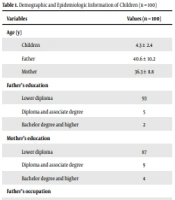
The means of age for mothers in the intervention and control groups were 25.42 ± 5.00 and 25.80 ± 6.24, respectively; and the means of age for children in the intervention and control groups were 4.60 ± 2.06 and 4.34 ± 2.02, respectively. In addition, 32.7 % of the mothers in the intervention group and 29.1% of them in the control group had undergraduate education. And 78.2% of mothers in the intervention group and 70.9% of them in the control group reported to have had basic information about cardiopulmonary resuscitation.
According to the study results, the knowledge of mothers about the proper age for chewing and smashing solid food in the intervention group increased from 10.9% before intervention to 72.7% after training; and it increased from 14.5% before intervention to 9.1% after training in the control group. Furthermore, the knowledge about the most common food causing injury before training were 7.3% and 3.6% in the intervention and control groups, respectively, which reached 56.4% and 10.9% in the intervention and control group after training, respectively. As for the riskiness of the objects, 12.7% of mothers in the intervention group and 5.5% of them in the control group had prior knowledge about how to measure the risk created by an object in suffocation, which increased by 69.1% and 12.5% in the intervention group and control group after training, respectively. Table 1 shows the correct answers offered by mothers about the risk factors for choking in children.
Table 1.
Correct Answers of Mothers About the Risk Factors for Choking in Children in Both Groups Before and After Video Presentation a
| Questions | Correct Answers | Correct Answers of Mothers in the Intervention Group | Correct Answers of Mothers in the Control Group | ||
|---|---|---|---|---|---|
| Before Video Presentation | After Video Presentation | Before Video Presentation | After Video Presentation | ||
| Age of chewing and smash solid foods in children | 4 years | 6 (10.9) | 40 (72.7) | 8 (14.5) | 5 (9.1) |
| The most dangerous food with the potential risk of choking | Hot dog | 10 (18.2) | 35 (63.6) | 9 (16.4) | 11 (20) |
| Reason of dangers of 20 mm lithium “button” batteries | They get stuck in the upper esophagus and may cause a hole leading to death or permanent injury. | 24 (43.6) | 32 (58.2) | 4 (7.3) | 4 (7.3) |
| Reason of hazard of latex balloons | Piece may wrap tightly over the voice box blocking the ability to breathe. | 13 (23.6) | 30 (54.5) | 14 (25.5) | 19 (34.5) |
| Fruit shape which is the most dangerous for kids | Whole grapes | 24 (43.6) | 43 (78.2) | 26 (47.3) | 26 (47.3) |
| The most common food leading to choking | Peanuts | 4 (7.3) | 31 (56.4) | 2 (3.6. ) | 6 (10.9) |
| The best way to measure the danger of an object in the choking event of a child under 4 years | Toilet paper roll | 7 (12.7) | 38 (69.1) | 3 (5.5) | 7 (12.5) |
a Values are expressed as No. (%).
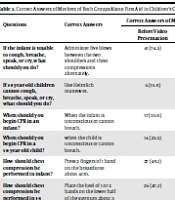
It was found that 74.5% of the mothers in the intervention group and 61.8% of those in the control group were, before the intervention, familiar with the technique of hitting the child on the back in case of choking; however, 10.9% of the mothers in the intervention group and 12.7% of those in the control group performed Heimlich maneuver. The data about Heimlich maneuver after education were 67.3% in the intervention group and 16.4% in the control group. Mothers in both groups were discovered to have insufficient knowledge about how to open the airway in the infant before the intervention; and only 16.4% of mothers in the intervention group and 18.2% in the control group knew about it. Their knowledge about the given issue reached 68.5% and 20% in the intervention and control groups, respectively, after the education. Mothers’ correct answers regarding first aid in case of choking in children are shown in Tables 2 and 3.
Table 2.
Correct Answers of Mothers of Both Groups About First Aid in Children’s Choking Before and After Video Presentation a
| Questions | Correct Answers | Correct Answers of Mothers in the Intervention Group | Correct Answers of Mothers in the Control Group | ||
|---|---|---|---|---|---|
| Before Video Presentation | After Video Presentation | Before Video Presentation | After Video Presentation | ||
| If the infant is unable to cough, breathe, speak, or cry, what should you do? | Administer five blows between the two shoulders and chest compressions alternately. | 41 (74.5) | 44 (80) | 34 (61.8) | 29 (52.7) |
| If 1-8 year-old children cannot cough, breathe, speak, or cry, what should you do? | Use Heimlich maneuver. | 6 (10.9) | 37 (67.3) | 7 (12.7) | 9 (16.4) |
| When should you begin CPR in an infant? | When the infant is unconscious or cannot breath. | 17 (30.9) | 40 (72.7) | 19 (34.5) | 17 (30.9) |
| When should you begin CPR in a 1-8-year-old child? | when the child is unconscious or cannot breath. | 14 (25.5) | 35 (63.6) | 15 (27.3) | 15 (27.3) |
| How should chest compression be performed in infant? | Press 2 fingers of 1 hand on the breastbone about 4cm. | 27 (49.1) | 40 (72.7) | 19 (34.5) | 18 (32.7) |
| How should chest compression be performed in 1-8 year-old children? | Place the heel of 1 or 2 hands on the lower half of the sternum about 5 cm. | 26 (47.3) | 37 (67.3) | 24 (43.6) | 27 (49.1) |
| What is the correct number of chest compressions in an infant? | At least 100 times per minute. | 9 (16.4) | 34 (61.8) | 20 (36.4) | 13 (23.6) |
| What is the correct number of chest compressions in 1-8 year-old children? | At least 100 to 120 times per minute. | 14 (25.5) | 34 (61.8) | 14 (25.5) | 9 (16.4) |
a Values are expressed as No. (%).
Table 3.
Correct Answers of Mothers of Both Groups About First Aid in Children’s Choking Before and After Video Presentation a
| Questions | Correct Answers | Correct Answers of Mothers in the Intervention Group | Correct Answers of Mothers in the Control Group | ||
|---|---|---|---|---|---|
| Before Video Presentation | After Video Presentation | Before Video Presentation | After Video Presentation | ||
| Which position is used for opening airway in infant? | Head tilt-chin lift | 9 (16.4) | 37 (68.5) | 10 (18.2) | 11 (20) |
| Which position is used for opening airway in 1-8-year-old children? | Head tilt-chin lift | 12 (21.8) | 38 (69.1) | 12 (21.8) | 14 (25.9) |
| How do you remove the foreign body from infant airway? | If you can see a foreign body, you remove it with your finger. If no foreign object is seen, you do not remove it. | 15 (27.3) | 43 (78.2) | 14 (25.5) | 14 (25.5) |
| How do you remove the foreign body from 1-8-year-old child’s airway? | If you can see a foreign body, you remove it with your finger. If no foreign object is seen, you do not remove it. | 19 (33.9) | 36 (67.9) | 13 (23.6) | 10 (18.2) |
| How do you give rescue breathing to an infant? | Give breaths through the mouth and nose. | 11 (20) | 37 (67.3) | 17 (30.9) | 16 (29.1) |
| How do you give rescue breathing to 1-8-year-old children | Close the child's nose, and cover the child's mouth with your mouth. | 17 (30.9) | 36 (66.7) | 17 (30.9) | 16 (29.6); |
a Values are expressed as No. (%).
The results also demonstrated that the knowledge of risk factors for choking in control group (P = 0.000) and intervention group (P = 0.001) before and after the video education was significantly different; as for providing first aid in choking, however, the result was significant only in the intervention group (P = 0.000). Table 4 shows the results from the comparison of pre and post education in the intervention and control groups.
Table 4.
Comparison of the Effect of Video Presentation on the Mothers’ Knowledge of the Two Groups About Risk Factors and First Aid in Choking Before and After the Intervention
| P-Value | ||
|---|---|---|
| Wilcoxon Test in Intervention Group | Wilcoxon Test in Control Group | |
| Choking risk factors | 0.000 | 0.001 |
| First aid in choking | 0.000 | 0.50 |
5. Discussion
Our study results showed that mothers had very limited knowledge about the proper age when a child could chew and smash solid food, the most common food leading to choking, and the best way to measure the risk of an object resulting in choking accident among children aged under four years.
Foreign body aspiration is the most common cause of death among children, and more than 7% of children aged under four years die of this aspiration (12). Several reasons have been suggested in this regard, including crying, moving, or talking while eating, playing with objects in the mouth, the tendency to put objects in the mouth, the lack of teeth, and poor protective laryngeal reflexes in the child (3).
A study investigating the dietary factors causing choking in children identified chicken and fish bones (32%), peanuts (22%), and seeds (16%) as the first, second, and third most common causes of the accident. This is important because the symptoms of aspiration of a foreign body caused by minerals could be hidden, but those of the aspiration created by organic foreign body can be the source of an inflammatory process, which leads to the stimulation of symptoms (3).
Providing mothers with information on how to assess the riskiness of a device for a child is likely a useful way to help them keep dangerous devices out of the reach of children. Using toilet paper roll may prove useful in this regard.
In control group, the maternal knowledge about hazard factors causing choking before and after the intervention was not statistically significant. This may have been due to the increased sensitivity of mothers in the control group as a result of completing the questionnaire as well as investigating the factors affecting the choking. Despite the increase in awareness in control group compared to that in intervention one, these results were not comparable.
As to the first aid in choking, hitting the back, performing Heimlich maneuver, and opening the airway were detected to be the most common methods. Mothers in the intervention group had poor knowledge about first aid for choking children before intervention; however, their knowledge of the issue was improved after the intervention. On the other hand, no significant difference was observed in the control group before and after the intervention in terms of mothers' knowledge about the given issue.
According to the results from a study, 51.4% of mothers offered water to choking person. Moreover, 29% of mothers were reported to gently tap the baby on the back with the head down and the chest up. Some mothers were observed to give the baby bananas or just hit him on the head and chest. In addition, 37.9% of women were found to believe in using salt water for inducing vomiting in case of any type of poisoning, regardless of its nature. Some mothers also argued that soapy water, egg whites, or mustard powder had proved useful for vomiting in cases of suffocation. The study concluded that mothers had poor knowledge about first aid for children aged under 15 years (13).
It is noteworthy that in this study, mothers were found to have limited knowledge about the Heimlich maneuver, which highlighted the importance education about this issue. When caregivers suspect choking or witness it, they should take immediate action, call the emergency room, and seek help if necessary. At the same time, they should perform basic life-saving maneuvers – the Heimlich maneuver, in particular (14-16). Choking could be managed in children over one year by performing first aid and combining back blow and abdominal thrust. Abdominal thrust is called the Heimlich maneuver, which has proven an effective intervention in removing a foreign object from the airway (17).
One of the simple maneuvers to open the airway and lift the patient's tongue is to perform the maneuver head tilt – chin lift, provided that the individual suffers no head or neck injury. Head-tilt–chin-lift technique has been found to be effective in opening the airway in 90.8% of patients who receive anesthesia and mouth-to-mouth resuscitation (18).
The knowledge of parents and caregivers about first aid is vital because it has been confirmed that appropriate first aid can significantly improve recovery. Therefore, possessing the required knowledge and skills to administer first aid before taking an injured child to the hospital is essential (9). The American Academy of Pediatrics offers first aid and resuscitation training for parents, teachers, and caregivers (14).
In addition, some mothers have been reported to have extremely limited knowledge about first aid despite their prior claim about possessing complete knowledge about this issue. These conflicting claims could be due to the fact that their knowledge is not often updated. In our study, therefore, it was suggested that health centers should update mothers' knowledge about first aid at various, regular intervals.
Taking into account the importance and standardization of choking handling in children, as well as the best way to offer education about performing proper maneuvers in this issue, it was also recommended that the guidelines and public bulletins should be used for dealing with choking children. It is worth mentioning that using guidelines and public bulletins in medical emergent situations has been documented to be very useful for parents and first aid caregivers to prevent taking delayed measures. Performing proper maneuvers, using medical modalities, and improving management skills to handle the difficult medical situations (eg, prescribing antibiotics) (19) have also been detected especially effective when dealing with choking children.
5.1. Limitation
The impossibility of conducting random sampling in health centers was the major limitation of this study. Another limitation was imposed due to performing the convenience sampling since most of the mothers' contact numbers recorded in the health centers were wrong or were no longer contactable, some mothers were unwilling to participate in the study, and some failed to use WhatsApp software for receiving the educational materials. This limitation may have added a bias to our estimation of our target community’s actual knowledge.
5.2. Conclusions
It was concluded that choking-focused video education may have improved mothers’ knowledge of the risk factors and the way to deal with choking children. Since mothers are the main providers of childcare, it was highly recommended that their level of knowledge about issues such as risk factors involved in choking and methods for managing obstructed airway should be assessed based on the age of the child and, accordingly, offering education about these issues should be added to duties of health centers.