
1. Background
The positive effect of resistance training (RT) on many diseases and physiological systems is well established (1). RT can increase body mass and improve body composition, improving blood pressure and insulin resistance, as well as reduce oxidative stress and improve systemic inflammation (1). Systemic inflammation has been reported to be associated with many diseases, including cardiovascular disease (CVD) (2). Plasma indices of inflammation include an increase in some pre-inflammatory cytokines (3). Interleukin-6 (IL-6), interleukin-4 (IL-4), and interleukin-1beta (IL-1beta) are cytokines that show more inflammation than normal values, and are associated with cytokines and pre-inflammatory factors (4).
However, the effect of RT on inflammation has been more or less studied, and studies have reported somewhat a reduction in inflammation systemic by RT (5, 6). Some studies suggest that RT may well improve systemic inflammatory factors (7), while several studies have suggested that RT has not been shown to improve pre-inflammatory factors (5).
Anyway, RT has many factors and variables compared to other types of exercise training mode such as aerobic training, and it seems that the change in each variable of RT has a special response and adaptation to training (8). Accordingly, this issue has been considered by studies and in this regard, some variables of RT such as intensity on changes in pre-inflammatory cytokines have been investigated (9).
However, the intensity of exercise is an important factor in influencing many biochemical changes and adaptation (8). But how to apply the intensity of the exercises, especially in RT, can also be considered. In this regard, it has been reported that the intensity of training from high to low and or from low to high during resistance training improves strength, and there is no difference in the amount of cell damage between the two types of training (10).
However, considering the aspect of the issue and the lack of information on the effect of different intensity sequences on resistance training on inflammation, it is necessary to examine the sequence effect of resistance training on systemic changes in the likelihood of systemic inflammation.
2. Objectives
The aim of the present study is to investigate the effect of resistance training intensity from high to low intensity training sequence and from low to high intensity training sequence in the form of DeLorme and Oxford resistance training on some systemic inflammatory factors and cell damage, and we attempted to answer the question of whether there is a significant difference between DeLorme and Oxford resistance training technique after eight weeks of training program on systemic inflammatory factors or not?
3. Methods
3.1. Subjects
30 overweight men (25 ≤ body mass index (BMI) ≤ 29.5) voluntary participated in the current study, and randomly assigned in the Delorme resistance training (Del; n = 10), Oxford resistance training (OXF; n = 10) and control (Con; n = 10).
All participants were required to be eligible for the following research prior to enrollment. (1) None experience in regular exercise training programs. (2) No history of common chronic health problems. (3) No smoking. (4) Have not taken any antioxidant supplements for the past 6 months. After explaining the full description of the topic, goals, study methods, and completing and obtaining the consent form health questionnaire and sports history of all volunteers after fulfilling the mentioned conditions. The present study was carried out with the approval of the ethics committee of Sport Sciences Research Institute of Iran with the ID number (IR.SSRI.REC.1399.797).
3.2. Preliminary Assessments
First, anthropometric indices were measured in the first session. Initially, the subject’s weight and height were assessed by scale and audiometer (Seca, Mod 285, Germany) according to the instruction. Then, based on the weight and height, body mass index (BMI: kg/m2), all subjects were calculated. After that, subjects were trained in a separate session on how to properly perform the resistance exercise program and safety tips. Firstly, each exercise was performed by the coach, and sufficient explanations were presented for subjects. The subjects then performed the exercise without load. During the performing exercises, the subjects were given the necessary explanation and feedback on exercise technique.
Also, the general and specific resistance training warm up were explained to the subjects. Then, in the last session of training, the measurement of maximum repetition (1RM) in leg press (LP) and bench press (BP) exercise in all three groups was estimated through the Brzycki equation (11). In this way, the subjects selected a weight by initial estimation of their maximum strength, and performed the exercise to the exhaustion (the number of exercise need to be less than 10 repetitions). Then, by including the amount of weight and the number of repetitions in the formula for the estimation equation, a 1RM was calculated by the Brzycki formula. (0278/0 × Number of repetitions to the point of fatigue) - 0278/1 [/ amount of weight transferred = one more repetition.
3.3. Resistance Training Program
The resistance training was performed three times a week in nonconsecutive days for eight weeks. All training sessions were done simultaneously in the Del and the OXF at 5 PM under the supervision of the expert coaches. The exercises for the upper limbs were chest press (CP), lat pull down (LP), bicep (BC) and triceps curls (TC) barbell. Also Leg press (LP), knee flexion (KF) and extension (EF) with machine were included in the lower limb exercises. Sit-ups exercise are also used to improve the abdominal and trunk muscles. Also, 5 - 10 minute warm-up training was included at the beginning and end of the each session. (10)
3.3.1. Delorme Resistance Training Program
Del resistance training program performed resistance training by a gradual increase in intensity, and a reduction in the number of repetitions until the exercise intensity reached to 1 RM. Thus, the subjects trained the first 2 - 3 sets at intensity of 50% of 1 RM for warm up, the second set was started at 85% of 1RM (6 repetitions), then the third set was performed at 90% of 1 RM (3 - 4 repetitions), and the fourth set was done at 95 of 1RM (2 - 3 repetitions), and finally the fifth set was performed and reached 100 1RM (10).
3.3.2. Oxford Training Program
3.4. Blood Sampling and Biochemical Analysis
In order to evaluate the biochemical variables, 5 mL blood sampling was gathered in two phase, before any intervention, and also after 2 months of resistance training in fasting status with 48 hour interval with the last exercise training session. Subjects were first asked to avoid any physical activity 2 days before the test. Then 5 mL of blood sample was gathered from the antecubital vein in setting position after 15 rests at 8 - 10 am. After that, the serum was separated from the cell by centrifuging (Hitek, Germany) in the 2500 rpm for 7-10 min. IL-4 concentration serum IL-4 and IL-1beta were determined by an enzyme-linked immunosorbent assay (ELISA) with special kits according to the specifications of the manufacturer (abcam, Co, UK). Kits [(ab215089, UK); (Sensitivity: 1.08 pg/mL; Intra-assay: 6 %; and Inter-assay: 7%] and [(ab46052, UK) (Sensitivity: 6.5 pg/mL; Intra-assay: 4.5%; and Inter-assay: 8.7%] were used for IL-4 and IL-1beta assay; respectively. Also, the CK activity of enzyme was measured by the kit (Pishtaz Teb, Iran). The activity of CK in the (U/L) and the concentration values of interleukin-4 and interleukin-1beta were expressed as (pg/mL).
3.5. Statistical Methods
All data were expressed as (Mean ± SD). Kolmogorov-Smirnov test was first used to test the normality of data distribution. For the comparison of before and after the intervention, ANOVA with repeated measure was used. All statistical analyzing were performed at a significance level of P ≤ 0.05 using SPSS-16 software.
4. Results
The anthropometric characteristics of the subjects are presented in Table 1.
Table 1.
Characteristics of the Subjects Before Resistance Training Intervention a
| Groups | Age (y) | Height (cm) | Weight (kg) | BMI (kg/m2) |
|---|---|---|---|---|
| Del | 20.5 ± 2.1 | 174.8 ± 1.5 | 97.4 ± 7.4 | 28.2 ± 1.6 |
| OXF | 22.8 ± 1.11 | 175.2 ± 4.678 | 96.3 ± 7.2 | 27.9 ± 1.4 |
| Control | 21.5 ± 2.3 | 173 ± 1.22 | 97.7 ± 6.4 | 28.3 ± 1.5 |
a Values are presented as mean ± standard deviation.
We found that BP and LP significantly were increased in the Del and OXF (P = 0.001), while there was no significant difference between Del and OXF in BP and LP (P > 0.05). Also, BMI had not significant differences between the two groups (P > 0.05).
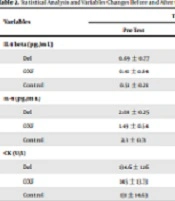
The results showed that there was no significant difference in the concentration of IL-4, IL-1 beta and also CK before the start of the RT in the three groups (P > 0.05). Also we found that IL-4 and IL-1 beta were not affected by Del and OXF, and also the changes of these cytokines were not significant considering the effect of time. Also, the results showed that the CK was not affected by Del and OXF and also the changes in this cellular damage index were not significant considering the effect of time (Table 2).
Table 2.
Statistical Analysis and Variables Changes Before and After the Resistance Training a
| Variables | Time | Time | Group × Time | |
|---|---|---|---|---|
| Pre Test | Post Test | |||
| IL-1 beta (pg./mL) | 0.849 | 0.407 | ||
| Del | 0.69 ± 0.77 | o.45 ± 0.76 | ||
| OXF | 0.41 ± o.84 | 0.46 ± 0.90 | ||
| Control | 0.51 ± 0.21 | 0.61 ± 0.19 | ||
| IL-4 (pg./mL) | 0.654 | 0.155 | ||
| Del | 2.08 ± 0.25 | 1.98 ± 0.82 | ||
| OXF | 1.49 ± 0.54 | 2 ± 0.73 | ||
| Control | 2.3 ± 0.71 | 131 ± 11.65 | ||
| CK (U/L) | 0.12 | 0.250 | ||
| Del | 134.6 ± 1.16 | 1.47 ± 0.19 | ||
| OXF | 145 ± 13.73 | 135.9 ± 11.13 | ||
| Control | 131 ± 14.63 | 128.8 ± 11.07 | ||
Abbreviations: Del, Delorme; OXF, Oxford; IL-1beta, Interluekin-1beta; IL-4, Interluekin-4; CK, creatine kinase; BP, bench press; LP, leg press.
a Values are presented as mean ± standard deviation.
5. Discussion
The aim of the present study was to investigate the effect of DeLorme and Oxford resistance training techniques on changes in IL-4, IL-1 beta and CK in overweight men.
Accordingly, 20 overweight male underwent DeLorme and Oxford resistance training techniques for eight weeks to investigate the effectiveness of the mentioned resistance training techniques on IL-4, IL-1 beta and CK and physiological and functional variables.
We found that the strength increased significantly after eight week of RT in the Del and OXF. We found that 1RM was significantly increased in CP and SQ exercises in the Del as well as in OXF; however, there were no significant difference between groups. This showed that both RT protocol were similar efficient in strength increment.
The strength changes indicate that resistance training protocol in the current study could challenge the physiological systems, and therefore it has been effective on stress and stimulate systems.
Results showed that there was no significant difference in BMI between the Del and OXF before and after eight weeks resistance training.
The results showed that both Del and OXF did not significantly change IL-4 and IL-1beta concentration after 48 hours of the last session of resistance training. Also, we found that intra-group changes (time effect) were not statistically significant; this means that, regardless of the resistance training technique, both RT protocols had not a significant effect on IL-4 and IL-1beta. Therefore, it seems that the oxidative stress and damage caused by both protocols is similar, because the amount of these cytokines as inflammatory systemic indices had similarly behavior after both resistance exercises. It has been reported that exercise leads to a robust inflammatory response mainly characterized by the mobilization of leukocytes and an increase in circulating inflammatory mediators produced by immune cells and directly from the active muscle tissue (12). However, the relationship between CK and inflammatory responses to exercise and physical activity suggests that resistance training will disrupt myofibrils (13), especially during the eccentric phase. The rupture of the fibers leads to inflammatory responses that are modulated by cytokines (14). Cytokines have been shown to play an important role in muscle repair and repair processes (15). Consistent with the results of the present study it has been reported that resistance training for four months did not affect on IL-6 and TNF-alpha levels in healthy middle-aged men (16). However, it has recently been reported that moderate to high resistance training improve inflammatory factors in inactive elderly women (17). With considering the intensity of resistance training, the present resistance training protocol is similar with the resistance training protocols mentioned in the study, however, it seems that some other factors such as subject’s sex, age and resistance training duration may affect the discrepancy of these results (18, 19), because gender hormones such as estrogen may affect inflammatory factors (20). It doesn't seem reasonable to introduce that the duration of the current resistance training (8 week) is the main cause for the unchanging IL-6 and IL-1beta (21). However, in refuting this issue, it should be noted that studies that have used the same duration (10-12 weeks) have reported a significant reduction in IL-6 and TNF-alpha (22). Therefore, the different cytokines behaviors do not appear to be due to the different of the training protocols used in the studies, and physiological factors such as body fat percentage should be considered.
In the present study, both Del and OXF resistance training technique did not effect on body fat percentage. It seems that the only studies that have reported a reduction in body fat, they have reported reduction of concentrations of pre-inflammatory cytokines after resistance training (20).
However, in comparison between the effects of exercise training on changes in inflammatory indices, some inconsistencies are related to the type of sample from which the cytokine was measured (tissue sample vs. plasma samples). On the other hand, biochemical methods of measuring cytokines (ELISA vs. Flow Cytometry) and human factors are also involved. However, because IL-4 and IL-1beta, as well as the activity of CK, were not affected by resistance training, it was difficult to compare intergroup and the susceptibility of these cytokines to the two types of resistance training technique with varying sequences intensity, it will be inexplicable.
5.1. Conclusions
Finally it can been concluded that Delorme and Oxford resistance training technique did not have favorable effects on systemic inflammatory factors, and it can be said that the sequence of resistance training intensity did not influence on the inflammation and injury and there is a need for further research in this context.