



1. Background
Addiction can damage and affect the financial, social, cognitive, health, and emotional aspects of families, causing tension and anxiety in their main members (1, 2). Drug addiction renders abusers incapable of abandoning consumption and forces them to use drugs at any time for normal e functions (3). Studies have shown methamphetamine to be the second or third most abused substance in Iran. Considered a substance disorder in psychiatric classifications, drug addiction is the second most widespread mental disorder (4).
Young adults are experiencing growing rates of substance abuse with some having trouble in rehabilitation (5). Despite undergoing various treatments, many addicts of stimulants, including methamphetamine, cannot sustain rehabilitation. Without protective treatment, they will be forced to live a life revolving around the procurement and consumption of substances (6). In therapy, associative learning-based interventions and reinforcement aim to alleviate substance abuse by altering the relationship between drug craving and drug use, something which is achieved by promoting craving management skills (e.g., mindfulness) and avoiding unhelpful strategies of emotion regulation (e.g., avoidance or suppression) (7). Advanced dependence and abuse of opioids, especially stimulants such as methamphetamine, is very risky to abusers, their families, and society (8).
Emotion regulation is the ability to supervise, evaluate, perceive, and correct emotional reactions to help normal functions. In this process, people consciously or unconsciously regulate their emotions by correcting experiences or changing situations that evoke emotions (9). Another addiction variable is emotion regulation. It is an attempt to regulate the emotions of oneself and those of others. People adopt healthy and unhealthy strategies to gain this ability (10). Regulation has a positive effect with healthy strategies but a negative effect with unhealthy strategies. Although they are most useful, emotions can be detrimental (11). In the face of negative emotions, people need to recognize and accept emotions to be able to control impulses and move toward their specified goals and use emotion regulation strategies to achieve personal goals and environmental needs. A deficiency in one or all of these abilities is a symptom of emotion regulation problems (12, 13).
Therefore, non-drug therapies and relapse alleviation are important subjects that have piqued the interests of therapists and patients. Many substance abusers suffer uncontrollable symptoms of extreme stress and cannot regulate their emotions after a traumatic experience. Mindfulness-based relapse prevention (MBRP) is another approach that improves awareness of internal cues leading to craving and relapse (14, 15). According to Mallik et al. (16), enhancing the recognition of cravings and reactive impulses could reduce cravings-induced behaviors. Drug cravings often include psychologically inflexible and neglected internal response patterns that support the goals of mindfulness-based therapy and third-wave interventions (17). To target addiction, mindfulness-based interventions improve knowledge and distress tolerance of craving by enabling the person to maintain momentary awareness of positive and negative internal experiences (18, 19). Recurring encounters with present experiences, maintaining awareness, and accepting and tolerating craving-induced distress can lead to habituation of distress and disrupt negative reinforcement cycles of substance abuse in response to drug cravings (20). Therefore, substance abuse therapies that promote normal interoceptive awareness could target flexibility and focus on the separation of drug craving from substance abuse (21). Studies have found that dispositional mindfulness is associated with reducing drug cravings, especially in negative emotional states (6). They have also discovered that MBRP therapies are effective in addressing cravings and emotional processing in drug addicts (22-24).
According to these arguments and since substance abuse disorders significantly increase the global burden with wide-ranging impact on health and well-being and that substance abuse leads to shorter life expectancy and diseases, it is essential to use MBRP to analyze and address these factors in drug addicts. The results can guide researchers and therapists of drug addiction.
2. Objectives
The main aim of this study was to evaluate the effects of MBRP therapy on drug craving and emotion regulation of therapeutic community (TC) center clients.
3. Methods
3.1. Study Design and Implementation Method
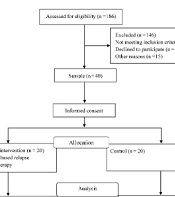
This quasi-experimental research adopted a pretest-posttest control group design. The statistical population included all stimulant-related (methamphetamine) visitors to treatment centers (TCs) of Khuzestan Province (Iran) in 2022. The convenience sampling method was employed to select 40 participants (20 females and 20 males) with stimulant (methamphetamine) addiction. They were then randomly assigned to an experimental group and a control group (20 participants per group) by a simple random method (Figure 1). In this research, the adequacy of the sample size was confirmed through G*Power software (effect size = 0.96 and ɑ = 0.05). The inclusion criteria were written informed consent, 20 – 55 years of age, no concurrent interventions or treatments, and literacy, whereas the exclusion criteria were having a psychiatric disease, taking medications at the time of research, relapsing, revoking consent, and over two sessions of absence. To meet the ethical principles, after the training sessions and the posttest on the experimental and control groups, the control group received the summary of MBRP sessions. This research was approved by the ethics committee of the Islamic Azad University of Ahvaz branch (code: IR.IAU.AHVAZ.REC.1401.028).
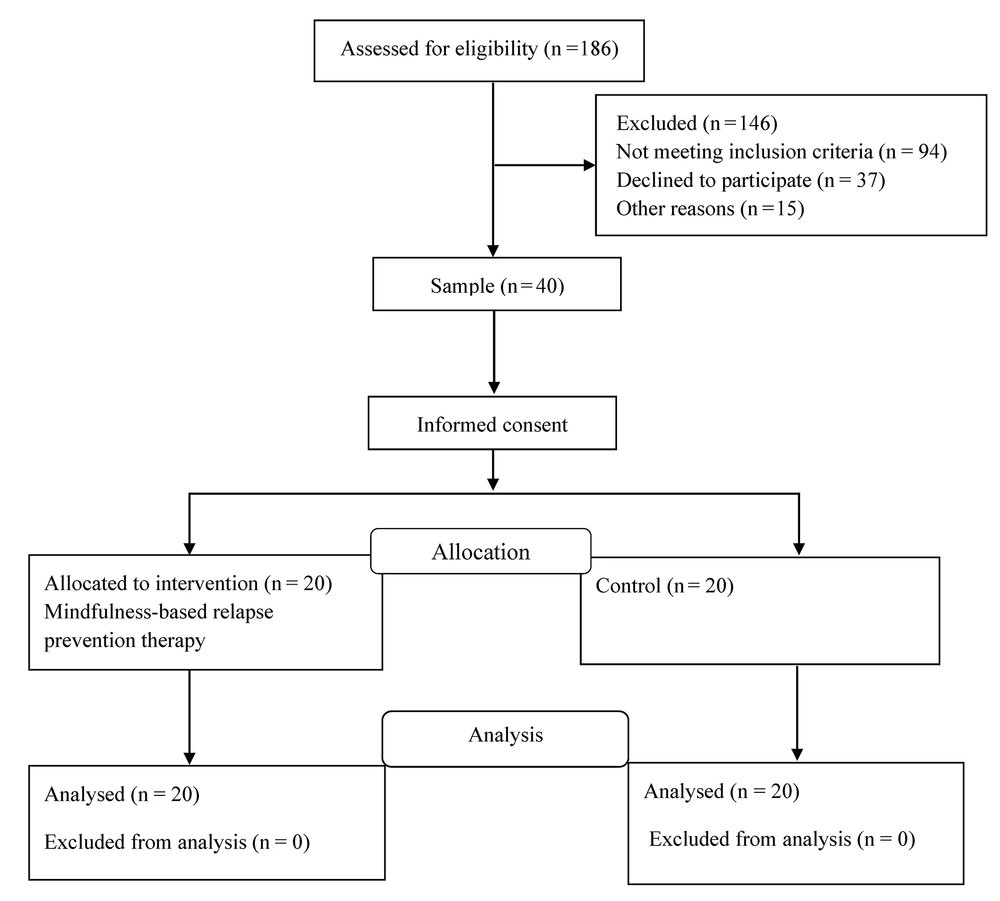
Figure 1.
Flow-chart of the participants selection
3.2. Measurement Tools
Drug Craving Questionnaire: Designed by Franken et al. (25), this questionnaire has 14 items for measuring current drug cravings. Items 1, 2, 12, and 14 concern the craving and intention component, questions 4, 5, 7, 9, and 11 relate to the negative reinforcement and pleasure component, and items 3, 6, 8, 10, and 13 address the severity of lack of control. The items are scored on a 7-point Likert scale from “completely disagree” (1) to “completely agree” (7), with higher scores representing more craving. The range of obtainable scores in this questionnaire is 14 to 98. Amiri et al. (26) reported a Cronbach's alpha of 0.85 for the questionnaire. In this study, Cronbach's alpha for this questionnaire was 0.88.
Emotion Regulation Questionnaire: Created by Gross and John (27), this questionnaire has 10 items concerning emotion regulation strategies. It has two subscales, namely re-evaluation with 6 items and suppression with 4 items. Participants responded to the items on a 7-point Likert scale from “strongly disagree” (1) to “strongly agree” (7) with respective minimum and maximum scores of 10 and 70. A higher score in this questionnaire indicates more re-evaluation and suppression in the participants. Foroughi et al. (28) reported a Cronbach's alpha of 0.76 for the questionnaire. In this study, Cronbach's alpha for this questionnaire was 0.83.
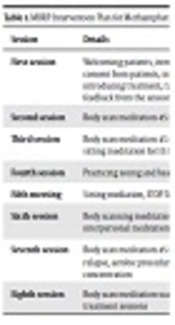
Mindfulness-Based Relapse Prevention (MBRP) Protocol: Bowen et al.’s (29) MBRP intervention structure was held in eight 90-minute sessions, which are summarized in the following. The intervention program was implemented in one session a week by the first author at Ahvaz TC Center.
Session one: Introducing group members and pre-test, explaining the intervention philosophy based on the approach, introducing the disease and the physical, psychological, and social side-effects of drug use, identifying craving-related triggers/common side-effects and psychological disorders/introducing physical symptoms of anxiety, stress, and depression/introducing the automatic navigation system/awareness of present bodily sensations, thoughts, and emotions to reduce stress/raisin exercise followed by feedback and discussion/three-minute breathing space exercise. Session two: Body scan medication/overcoming obstacles (anger, fear, resentment, restlessness, confusion, sleepiness, and fatigue)/knowledge of triggers, feedback, and discussion on body scan medication/reviewing last-week triggers and accepting safe obstacles to rehabilitation/evaluating the role of the family/avoiding struggle/knowledge of triggers and temptations/mindfulness breathing meditation/yoga stretching exercise. Session three: Mindful sitting with breathing (sitting meditation) /mindfulness in routine life/mindfulness of movements/yoga exercise/three-minute breathing space exercise. Session four: Coping with and working on problems/absolute acceptance/guidance for conscious problem management/urge surfing meditation/the effect of fear and hope and reactivity and calm/repeating the body scan meditation/mindfulness yoga exercises/five-minute “see or hear” exercise/repeating mindfulness sitting with body and breathing awareness. Session five: Breathing exercise/repeating mindfulness sitting (awareness of breathing, body, sounds, thoughts)/explanations on stress and determining the reactions of participants to stress/checking awareness of desirable and undesirable events on feelings, thoughts, and bodily sensations/mindfulness yoga exercises/three-minute breathing space exercise. Session six: Mindfulness yoga exercise/sitting meditation (mindfulness of sounds and thoughts)/reflections on silence and words/benefits of silence/kindness. Session seven: Open space meditation/sleep health/repeating exercises from previous sessions/listing enjoyable activities/self-care/hints and recommendations for healthy living/reflection on spirituality. Session eight: End/release and the rest of life/mindfulness exercise tips/formal exercise tips/tips for sustaining mindfulness every day/body scan meditation/overview of treatment/overview and discussion on treatment.
3.3. Statistical Analyses
Descriptive statistics (i.e., mean and standard deviation) and inferential statistics (i.e., ANCOVA) were employed to analyze the pretest and posttest data. In this study, the Kolmogorov-Smirnov test was used to check the normality of the data. Moreover, Levene’s test was used to check the homogeneity of variances. The collected data were analyzed in SPSS software version 26.
4. Results
The participants included 40 men and women with an average age of 34.65 ± 7.31 years. The comparison of the demographic variables of the participants in the experimental and control groups is presented in Table 1. Table 2 reports the mean and standard deviation of the pretest and posttest research variables in the experimental group and the control group.
Table 1.Demographic Variables of the Participants a
| Groups | Age, y | Duration of Addiction, y | Education | Gender | |||
|---|---|---|---|---|---|---|---|
| Middle Education | High School | University Education | Male | Female | |||
| MBRP | 35.19 ± 6.71 | 6.35 ± 3.17 | 11 (55.0) | 5 (2.05) | 4 (20.0) | 12 (60.0) | 8 (40.0) |
| Control | 34.82 ± 7.38 | 5.29 ± 2.83 | 10 (50.0) | 7 (35.0) | 3 (15.0) | 8 (40.0) | 12 (60.0) |
| P-value | 0.869 | 0.272 | 0.769 | 0.212 | |||
a Values are expressed as mean ± SD or No. (%).
Table 2.Mean and Standard Deviation (SD) of Drug Cravings and Emotion Regulation in Experimental and Control Groups a
| Variables and Phases | MBRP Group | Control Group | P-Value |
|---|---|---|---|
| Drug cravings | |||
| Pretest | 69.60 ± 3.26 | 68.80 ± 4.29 | 0.511 |
| Posttest | 46.85 ± 4.47 | 69.30 ± 7.25 | 0.001 |
| Emotion regulation | |||
| Pretest | 29.45 ± 2.47 | 29.25 ± 1.31 | 0.751 |
| Posttest | 27.50 ± 2.72 | 29.60 ± 2.16 | 0.010 |
a Values are expressed as mean ± SD.
Before the data analysis of hypotheses, the assumptions of covariance were examined to ensure that they were met by the data. Given the insignificant Kolmogorov–Smirnov Z statistic, the normality of data showed that emotion regulation and drug craving had a normal distribution. The results of Levene's test showed the homogeneity of variances in the variables of emotional regulation (F = 1.871, P = 0.360) and craving (F = 3.815, P = 0.058). The findings suggest that the ANCOVA results can be employed to compare experimental and control groups based on posttest scores. The pretest effect was controlled, and multivariate ANCOVA was used to evaluate the effect of MBRP on emotion regulation and drug cravings of people in rehabilitation. The results of multivariate ANCOVA suggested significant differences in at least one dependent variable (P < 0.001).
Table 3 indicates the univariate ANCOVA results for posttest scores of dependent variables. The results demonstrated a significant difference in drug craving and emotion regulation of the MBRP and control groups (P < 0.001). In other words, MBRP alleviated drug cravings and improved emotion regulation in TC visitors.
Table 3.The Results of Univariate Analysis of Covariance on Research Variables in Experimental and Control Groups
| Variables | SS | df | MS | F | P-Value | η2 | Power |
|---|---|---|---|---|---|---|---|
| Drug cravings | 4683.13 | 1 | 4683.13 | 61.66 | 0.001 | 0.63 | 1.00 |
| Emotion regulation | 3429.35 | 1 | 3429.35 | 60.74 | 0.001 | 0.62 | 1.00 |
5. Discussion
This study aimed to investigate the effects of MBRP therapy on drug craving and emotion regulation of TC center clients. The results indicated that MBRP helped mitigate drug cravings in TC visitors. This is consistent with the findings of previous studies (17, 20). In explaining the findings of the current research, it can be said that the purpose of MBRP is to create awareness and accept thoughts, emotions and feelings through practicing mindfulness and using mindfulness skills as a coping strategy in facing high-risk situations (29). Education about desire and temptation and the application of mindfulness skills to experience desire and craving is one of the main tools for promoting awareness and accepting psychological and physiological reactions in drug withdrawal (22). Those who practice mindfulness learn to intentionally observe and accept their emotional states, which reduced habitual urges and tendencies (ruminations) while improving the adaptive processing of emotional data (27). Mindfulness improves early awareness and nonjudgmental acceptance of emotional stimuli and allows people to regulate emotions early in the stimulus-processing period before emotional responses are intensified (23). Therefore, mindfulness is a unique method of regulation for people with drug cravings and can help with behaving responsibly and reducing drug cravings and relapse (17).
According to the results, MBRP improved emotion regulation in TC visitors. This is consistent with the findings of previous studies (30, 31). Since emotions can address stresses, challenges, and routine problems, emotion management, regulation, and processing assisted by psychological therapies such as MBRP could help with destructive behavior (30). In other words, since emotions are essential to life, mindfulness exercises (as an emotion regulation therapy) to regulate emotions in people with substance abuse produce desirable social acceptance and interaction outcomes. This creates an effective meditation with enticing and stressful conditions and improves response to social situations (20). Since mindfulness-based intervention training educates addicts about negative and positive emotions and their timely expression and acceptance, it is important to reduce destructive behaviors and increase desirable behaviors to minimize the tendency toward drug use (31).
Cognitive approaches are generally based on the principle that good or bad moods depend on people’s thoughts and interpretations of events and other factors and disrupted thinking causes mental disorders (31). Therefore, distorted interpretations of events are of tremendous importance to the etiology of disorders such as depression and anxiety. People in relapse training see their thoughts and behaviors and, therefore, their feelings under their own control, leading to greater accountability and improved cognitive process (26). This helps to reduce negative thoughts and drug cravings and improve emotional regulation.
5.1. Limitations
This study had certain limitations. Due to the limited statistical population (visitors to TCs of Khuzestan Province), caution should be taken into account while generalizing the results. Another limitation was the lack of control over the educational/economic/social backgrounds of families. In this study, the follow-up period was not implemented. It is suggested that in future studies, the continuity of the effectiveness of MBRP in the follow-up period should be examined.
5.2. Conclusions
Overall, the results emphasized the importance of MBRP in mitigating drug cravings and improving the emotional regulation of substance abusers. Therefore, proposing practical strategies to psychotherapists, counselors, and the State Welfare Organization of Iran on the effect and importance of MBRP will significantly alleviate drug cravings and improve emotion regulation in substance abusers.