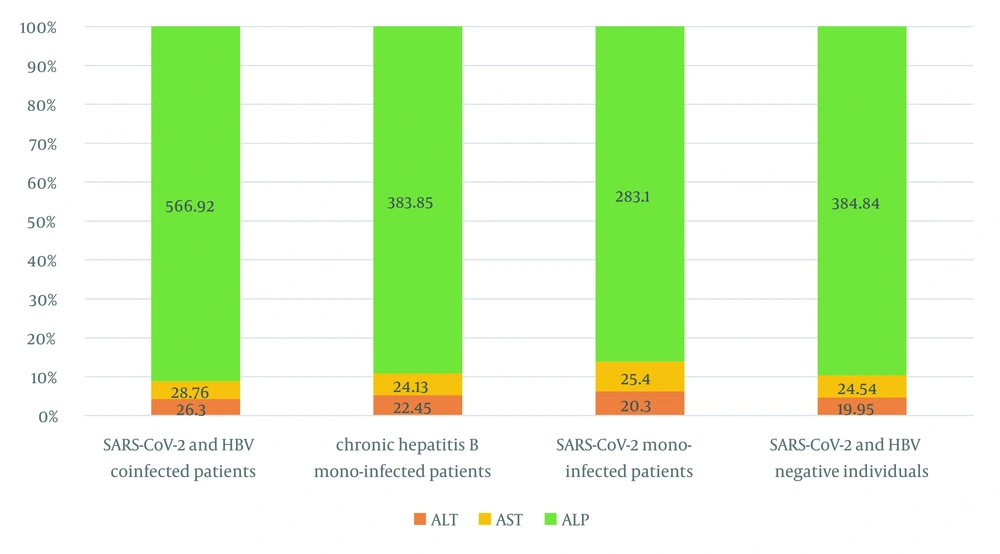
The COVID-19-related hepatic complications are particularly troublesome among patients with HCV, HBV, or HBV/HCV coinfection with preexisting liver complications. Considering the high pressure brought about by hepatitis B worldwide, the effect of SARS-CoV-2 infection on HBV patients should be evaluated. This study summarized the data of 93 chronic HBV patients and 62 patients with SARS-CoV-2/HBV superinfection and without HBV. This study showed that the mean values of ALT and AST in superinfected HBV/SARS-CoV-2 patients were 26.30 ± 11.79 and 28.76 ± 9.33, respectively, and higher than HBV/COVID-19 monoinfected patients (> 30). Li et al. reported that out of seven COVID-19 patients aged 33 - 49 years with chronic HBV infection, six patients were male, two patients had HBV-related cirrhosis, and 1 patient was positive for serum HBe-Ag (
29). However, in the present study, most participants were female, with a mean age of 35.77 ± 20.27 years. In addition, 13.93% of all the cases were superinfected with HBV/SARS-CoV-2.
Zou et al. reported that 14 patients with simultaneous conditions of SARS-CoV-2 and chronic HBV suffered from liver complications with severe COVID-19 witnessed in patients suffering from a liver injury (
30). However, this study did not observe more severe outcomes of COVID-19 infection in patients with HBV infection; nevertheless, 13.93% of all the cases were SARS-CoV-2 and chronic HBV coinfected patients, which is not in line with the results of the study by Zou et al. (
30). The HBV superinfection did not increase the risk of disease severity or lead to a worse prognosis in COVID-19 infection. Kang et al. reported that in 204,418 patients tested for SARS-CoV-2, the occurrence of CHB was observed to be at a lower rate in those suffering from COVID-19 infection than in those who were SARS-CoV-2 negative (i.e., controls) (
1). Kang et al. also mentioned that the occurrence of CHB led to a lower rate of SARS-CoV-2 positivity and was responsible for the appearance of severe clinical consequences of COVID-19 infection; however, it should be noted that this value was observed to be insignificant (
1). In the present study, the percentage of SARS-CoV-2 positive patients was lower than SARS-CoV-2 negative in CHB patients, which is consistent with the results of the study by Kang et al. (
1).
He et al. reported that out of 571 COVID-19 patients, 15 cases (2.6%) were observed to be HBV infected; nonetheless, only 3 cases (20%) were given an anti-HBV treatment (entecavir) (
31). He et al. also witnessed milder manifestations of severe events; however, they did not analyze the effect of antiviral treatment on prognosis (
31). The aforementioned results are consistent with the results of the current study regarding the anti-HBV therapy (34.40%) in HBV patients. Additionally, in a cohort study by Chen et al., out of 326 confirmed COVID-19 patients, 20 cases (6.1%) were reported to be HBV superinfected (
32), which is in accordance with the results of the present study. However, in numerous other articles, HBV superinfection in the patients under study was not considerable, which is likely due to the fact that a smaller number of the patients were given antiviral medications, which might have influenced the results. In the present study, 35.40% of CHB patients had received antiviral treatment, and 5.4% of HBV- positive patients were HBV/SARS-CoV-2 superinfected. A recently published cohort investigation carried out on a larger scale in Spain indicated that the occurrence of COVID-19 infection in patients with CHB who were given tenofovir was reduced (0.4%), which shows the positive influence of tenofovir on SARS-CoV-2 (
33).
The present study showed that AST and ALT levels in HBV/SARS-CoV-2 superinfected patients were higher than in other participants. Liu et al. reported that some of the COVID-19 patients that had or did not have the infection brought about by HBV experienced a higher occurrence of AST (
9). Similar observations have reported impaired liver function in SARS patients, which is not in line with the results of the present study. Superinfection has a possible effect on the elevation of morbidity and mortality when pandemics occur. The estimated viral superinfection was reported as 12.58% (95% CI: 7.31 - 18.96). Blood viruses (95% CI: 8.57 - 16.93) had the most frequent viral superinfection; however, respiratory viruses (95% CI: 2.78 - 6.15) had less frequent viral superinfection (
12).
Another study reported that 11.6% of COVID-19 patients had superinfection, and superinfection with respiratory viruses is common among COVID-19 patients (
34). Superinfection with hepatitis viruses and SARS-CoV-2 is also quite controversial. A study demonstrated that SARS-CoV-2-HBV cases had mortality rates of 4.7% and 15% in cross-sectional and case report investigations, respectively; nevertheless, the occurrence of SARS-CoV-2-HCV cases showed an 8.3% mortality (
7), which is not in line with the findings of the current study. The percentage of HBV/COVID-19 superinfection was reported to be 13.93%; nonetheless, the rates of SARS-CoV-2 or HBV alone were 20.62% and 80.93%, respectively.
Mirzaie et al. reported a 4.7% mortality rate among the reported cases of SARS-CoV-2-HBV coinfection and the hospitalization of 86.4% (19 of 22) cases in the SARS-CoV-2-HCV group (
7). Although this finding can be considered an indication of higher hospitalization risk among these patients, it also revealed that this condition is mainly observed among patients suffering from severe COVID-19 with hepatic comorbidities (
7). Another study conducted by Mirzaie et al. indicated that 235 and 22 patients with SARS-CoV-2 were infected with HBV and HCV, respectively, and the majority of patients were male (
7). The mean age of HBV patients was 49.8 years, and the mortality rate was 6%; however, the mean age in SARS-CoV-2-HCV patients was 62.8 years. This was further apparent in Mirzaie et al.’s findings, where 14.1% in the HBV group and 21.4% in the HCV group were transferred to the ICU, and severe COVID-19 was reported in 38.8% and 21.4% of HBV and HCV patients, respectively (
7,
35).
The results of the above-mentioned studies were somewhat consistent with the findings of the present study. Of all of the patients in the SARS-CoV-2-HBV infected group, only three patients (9%) were hospitalized, and one of two cases in the SARS-CoV-2-HBV-HCV group were hospitalized for 2 days in the ICU. In other words, 18.2% of the SARS-CoV-2-HBV infected group were positive for HCV coinfection. In addition, 30% of CHB patients who were infected with SARS-CoV-2 were not hospitalized, which was higher than the group of SARS-CoV-2 single infected (27%). Nevertheless, in all 155 participants in the current study, no mortalities occurred during the entire study period. As a result, it was observed that having a hepatitis virus infection somewhat reduced the chances of getting COVID-19 and the hospitalization process; nonetheless, it was not statistically significant (95% CI: 0.051 - 1.17).
5.1. Conclusions
Due to the COVID-19 pandemic, there has been plausible negligence in mitigating viral hepatitis. On the other hand, the hepatic manifestations of COVID-19 are frequently observed among HBV patients. The results of this study revealed that the abnormalities detected in liver function could occur in COVID-19 patients suffering from the infection caused by CHB. Nevertheless, no patient showed severe liver injury when tested in hospitalization. In addition, the results indicated that the occurrence of COVID-19 infection in those suffering from CHB was not as much as that in public and that an antiviral treatment using tenofovir might reduce the risk of COVID-19 infection. The aforementioned findings showed that the immune condition of the host is to some extent influenced by CHB, which might affect the consequences of the infection brought about by SARS-CoV-2.