


1. Background
2. Objectives
3. Methods
3.1. Study Design
3.2. Patient Selection and Setting
3.3. Intervention
3.4. Outcomes
3.5. Sample Size
3.6. Interim Analysis
3.7. Statistical Analysis
4. Results
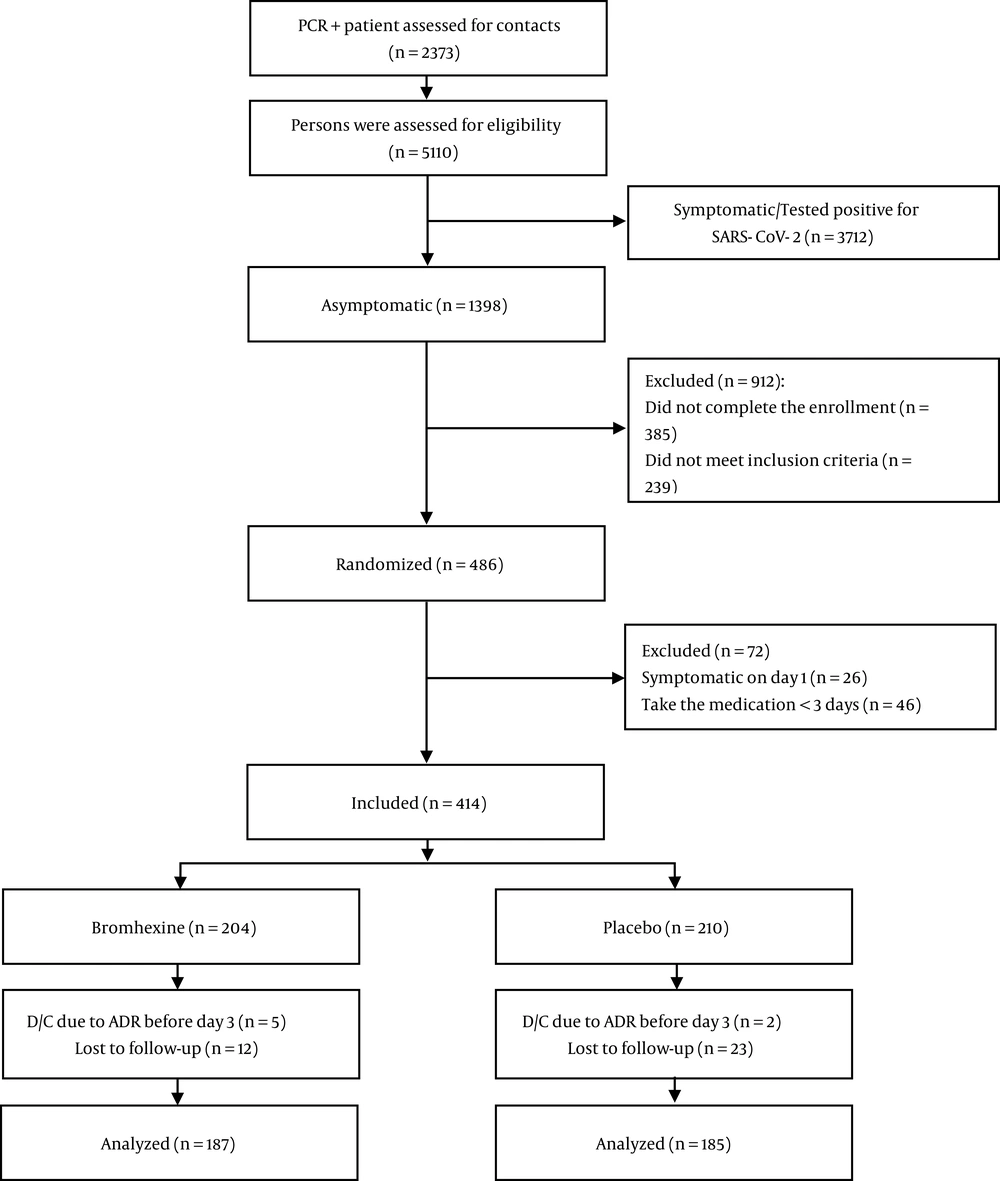
Study flow diagram
| Characteristics | Bromhexine (n = 187) | Placebo (n = 185) |
|---|---|---|
| Age, y (IQR) [Min, Max] | 40 (21) [19, 82] | 41 (20) [18, 86] |
| Time from exposure variable (IQR) [min, max] | 1.0 (2) [0, 4] | 2.00 (2) [0, 4] |
| Body mass index (kg/m2) | ||
| < 30 | 162 (86.7) | 155 (83.8) |
| ≥ 30 | 25 (13.4) | 30 (16.2) |
| Sex | ||
| Female | 80 (42.8.0) | 94:91 (50.8) |
| Male | 107 (57.2) | 91 (49.2) |
| Habits | ||
| Current smoker | 26 (13.9) | 20 (10.8) |
| Opioid user | 6 (3.2) | 5 (2.7) |
| Alcohol | 3 (1.6) | 1 (0.5) |
| Past medical history | ||
| Hypertension | 19 (10.2) | 14 (7.6) |
| Diabetes mellitus | 14 (7.5) | 20 (10.8) |
| Coronary artery disease | 17 (9.1) | 14 (7.6) |
| Chronic kidney disease | 2 (1.1) | 4 (2.2) |
| Asthma | 2 (1.1) | 2 (1.1) |
| COPD | 2 (1.1) | 0 (0.0) |
| Immunocompromised | 0 (0.0) | 3 (1.6) |
| Malignancy | 1 (0.5) | 1 (0.5) |
| Past medication history | ||
| ARB/ACEi | 16 (8.6) | 14 (7.6) |
| Aspirin | 21 (11.2) | 18 (9.7) |
| Non-steroidal anti-inflammatory drugs | 6 (3.2) | 9 (4.9) |
| Other | 47 (25.1) | 40 (21.6) |
| Risk of exposure | ||
| High | 72 (38.5) | 59 (31.9) |
| Intermediate | 115 (61.5) | 126 (68.1) |
Abbreviation: IQR, interquartile range.
a Values are expressed as No. (%).
![Symptomatic COVID-19 infection in the bromhexine and placebo groups. The cumulative number of symptomatic COVID-19 cases [50 patients] over two weeks of follow-up in both bromhexine and placebo groups.](https://brieflands.com/journals/jjm/articles/130198/figures/jjm-130198-i002-F2-preview.webp "Symptomatic COVID-19 infection in the bromhexine and placebo groups. The cumulative number of symptomatic COVID-19 cases [50 patients] over two weeks of follow-up in both bromhexine and placebo groups.")
Symptomatic COVID-19 infection in the bromhexine and placebo groups. The cumulative number of symptomatic COVID-19 cases [50 patients] over two weeks of follow-up in both bromhexine and placebo groups.
| Outcome | Events in Bromhexine Arm | Events in Placebo Arm | OR | 97% Confidence Interval | P-Value |
|---|---|---|---|---|---|
| Symptomatic case of COVID-19 | 16 | 34 | 0.42† | 0.21 - 0.84 | 0.007 |
| PCR-confirmed case of COVID-19 | 13 | 26 | 0.46† | 0.21 - 0.99 | 0.028 |
| Admission to a medical center | 1 | 6 | 0.29* | 0.05 - 1.83 | 0.145 |
| Death | 0 | 1 | 0.67‡ | 0.04 - 11.03 | 0.759 |
a Absolute numbers of outcome events are presented by the study arm. †Unadjusted. *Adjusted for the patient's sex, diabetes, and smoking using logistic regression with Firth's penalized maximum likelihood estimation. ‡ Adjusted for the patient's sex, diabetes, and hypertension using logistic regression with Firth's penalized maximum likelihood estimation.
| Variables | Bromhexine (n = 187) | Placebo (n = 185) | P-Value |
|---|---|---|---|
| Median duration of study participation in days (IQR)*[Range] | 14 (6) [3 - 14] | 10 (7) [3 - 14] | 0.007 |
| Adherence to trial intervention** | 140 (74.9) | 131 (70.8) | 0.379 |
| Average cumulative trial intervention adherence, % | 88.00 | 83.24 | <0.001 |
| Reasons for medication discontinuation | |||
| Adverse drug reactions | 5 (2.7) | 3 (1.6) | 0.724 |
| Felt no longer at risk | 38 (20.3) | 40 (21.6) | 0.758 |
| Advised not to take the medication | 7 (3.7) | 5 (2.7) | 0.570 |
| Adverse Drug Reactions | |||
| Any | 27 (14.4) | 19 (10.3) | 0.222 |
| Nausea/Vomiting | 6 (3.2) | 4 (2.2) | 0.751 |
| Upset stomach | 5 (2.7) | 3 (1.6) | 0.724 |
| Abdominal discomfort | 12 (6.4) | 8 (4.3) | 0.371 |
| Diarrhea | 8 (4.3) | 4 (2.2) | 0.248 |
| Constipation | 0 (0.0) | 1 (0.5) | 0.497 |
| Irritability | 1 (0.5) | 0 (0.0) | 1.000 |
| Paresthesia | 1 (0.5) | 0 (0.0) | 1.000 |
| Myalgia | 0 (0.0) | 1 (0.5) | 0.497 |
| Dizziness | 3 (1.6) | 2 (1.1) | 1.000 |
| Headache | 4 (2.1) | 1 (0.5) | 0.372 |
| Vertigo | 2.0 (1.1) | 0 (0.0) | 0.499 |
| Dry throat | 2 (1.1) | 1 (0.5) | 1.000 |
| Increased respiratory secretion | 2 (1.1.) | 0 (0.0) | 0.499 |
| Skin sensitivity/rash | 0 (0.0) | 1 (0.5) | 0.497 |
a Values are expressed as No. (%) unless otherwise indicated. *IQR, interquartile range; ** Participants who consumed ≥ 80% of assigned medication were considered adherent to the medication regimen.


