The AMPs are considered a promising novel class of naturally derived therapeutic agents with broad antibacterial activities that can be advocated as possible replacements for antibiotics. The AMPs are polypeptides having cationic characteristics and fewer than 100 amino acids (
28). The cationic AMPs interact with LPS in the outer membrane of Gram-negative bacteria to have a direct effect on the bacterial membrane. The destabilization of bacterial structure caused by the binding of AMP permits the intracellular absorption of antibiotics (
29). There are a number of studies in the scientific literature on AMPs indicating synergistic effects with commercial antibiotics against MDR bacterial strains (
13,
30).
To explore alternative therapies against
A. baumannii, the pharmacokinetics and synergistic effects of LL-37 and oncorhyncin II recombinants were studied for the first time in the current investigation. LL-37 and oncorhyncin II are strong AMPs with diverse antimicrobial activities against Gram-positive and Gram-negative bacteria (
31). In the current study, recombinant LL-37 and oncorhyncin II were effectively generated using the
E. coli DE3 subspecies of BL21 as the expression host. Following purification processes, the recombinant proteins were readily recovered by nickel affinity chromatography with a purity of more than 70% (
32). It has been confirmed in previous studies that the amino acids arginine and proline might increase the performance of proteins that have been reassembled utilizing a dialysis technique (
15,
18). It is considered very valuable that the final produced recombinant LL-37 and oncorhyncin II in this study were effective against Gram-negative bacteria, including
A. baumannii.
Several investigations have shown that LL-37 or its truncated analogs have antimicrobial activity against
A. baumannii clinical and reference strains, consistent with the findings of the present study (
30,
33,
34) Antibacterial, antibiofilm, and kinetics activities of LL-37 and its fragments (i.e., KR-12, KR-20, and KS-30) against
A. baumannii reference strain were tested by Feng et al. In contrast to the findings of the present study, the MIC for ATCC 19606 in the aforementioned study was lower (16 μg/mL vs. 30.6 μg/mL) (
14). Additionally, numerous investigations have indicated that ATCC 19606 strains of
A. baumannii were more susceptible to LL-37 than clinical strains (
30,
34,
35). Although oncorhyncin II’s antibacterial activity on
A. baumannii has not yet been reported, numerous investigations have proven that histone-like proteins and peptides are effective against a wide range of significant fish diseases, including certain species of
Vibrio and
Aeromonas genera (e.g.,
Aeromonas salmonicida,
A. hydrophila,
V. anguillarum,
V. alginolyticus, and
V. salmonicida) (
36-
38).
According to a study conducted by Jacobsen et al., histone H1.2 had antimicrobial activity against the
Pseudomonas aeruginosa reference strain and the burn wounds bacterial isolates (
39). Moreover, Gram-negative bacteria, such as
E. coli and
L. anguillarum, were sensitive to a histone H1-derived oncorhyncin II protein that was isolated from the skin of rainbow trout (
6). In another study, histone H1 was isolated as an AMP from the Atlantic salmon (
Salmo salar) liver and was found to be effective against
E. coli D31 (
40). Synergy therapy could be used to enhance the antibacterial efficiencies of AMP against bacteria to expand the reducing cytotoxicity, the emergence inhibition of resistant bacterial mutants during therapy, antimicrobial or bactericidal spectrum, and achieving synergistic antimicrobial activity. For this purpose, the FICI was calculated using the checkerboard format and assessed synergy between LL-37 and oncorhyncin II. This technique yielded a FICI = 1 against
A. baumannii (ATCC19606), which is indicative of an additive effect.
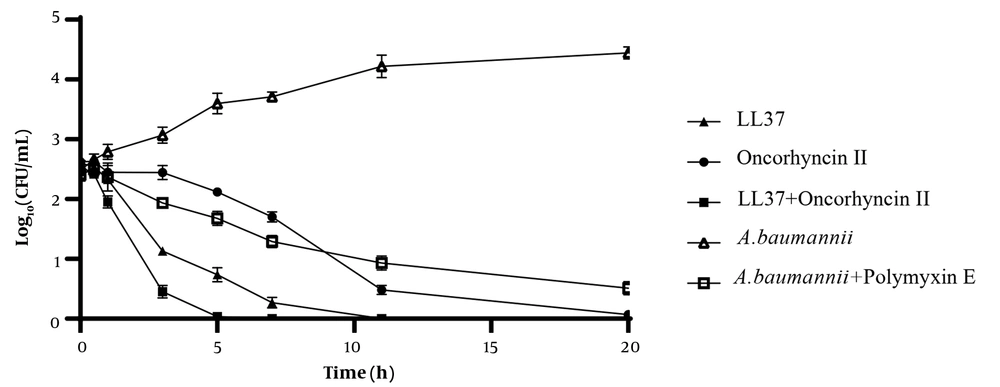
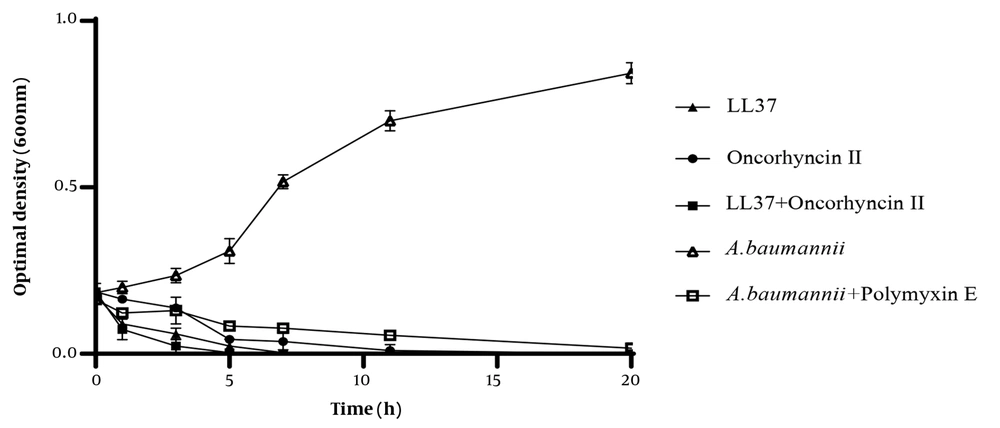
The outcomes of time-kill and growth-kinetic studies particularly validated the results of the checkerboard assay, revealing that the combination of recombinant peptides LL-37/oncorhyncin II is more efficient than either peptide alone and causes the death of
A. baumannii in a shorter time. On
A. baumannii, LL-37 was surprisingly more effective than oncorhyncin II. The use of polymyxin E as a control in these trials showed that the combination of LL-37 and oncorhyncin II is more effective than commercial antibiotics in killing
A. baumannii in a shorter time. Furthermore, polymyxin E works better than oncorhyncin II on the desired bacterium in the early hours, although its effectiveness decreases over time. In agreement with the findings of the current study, the findings of prior investigations in this area have proven that the combination of LL-37 with other AMPs (7) or conventional antibiotics (
30) has synergistic activity against
A. baumannii (MDR) and sensitive and resistant
P. aeruginosa strains.
5.1. Conclusions
LL-37 and oncorhyncin II recombinants were examined for the first time in this study for their pharmacokinetics and synergistic effects on A. baumannii. The findings of MIC, checkerboard, time-kill, and growth kinetics tests revealed that these peptides have potentially strong and quick antibacterial action against A. baumannii. Therefore, AMPs could be used as novel antibiotics, either alone or in combination with each other or as an adjunct to known antibiotics, to control and treat A. baumannii infections. The aforementioned findings should be taken into consideration when optimizing antibiotic therapy. Furthermore, clinical trials are required to determine the genuine worth of these peptides’ alternative therapies and therapeutic potential.