3.1. Collecting and Identifying the Medicinal Leech
Hirudo orientalis was grown in the Bio-factory of the College of Science, University of Tehran. All leeches (n = 5 per 100 mL cream) weighing 0.9 - 1 g with 9-month age had not eaten any blood for 3 months. Leaches were starved for at least four months because this period of starvation is necessary for synthesis saliva content (
8). Active leech ingredients were prepared from lyophilized leech and their antitrypsin and anticoagulation activities were measured by using Choudhary and Thomsen bioassay techniques and quagula meter (
17).
Male Wistar rats (n = 30) considering 270 ± 30 g were purchased from Tehran University, Iran. The experimental rats were classified into five collections, each covering 6 rats. This animal investigation was based on National lnstitute of Health Guide in Laboratory Animals considerations (NIH publications no.: 80-23) and was confirmed by Ethics Committee of Tehran University, Iran. The rats were anesthetized using ketamine and xylazine mixture (80 and 100 mg/kg of body weight, respectively). The source of human blood (n = 6) was provided from department of blood bank - Pasteur Institute of Iran and the ethics approval consent was given according to the ethical code 9321427001.
3.2. Lyophilizing and Preparation of Biological Active Substance
Leeches were pulverized after lyophilization at -80°C for 48 hours. Pulverized leeches were mixed with 10 mL solution Sodium chloride 0.9% in deionized water and incubated for 45 min. Then, the sample was centrifuged at 15000 g for 30 min. Finally, the supernatant was used as the biological active substance (BAS) in the later stages of the study.
3.3. Trypsin Inhibition Assay
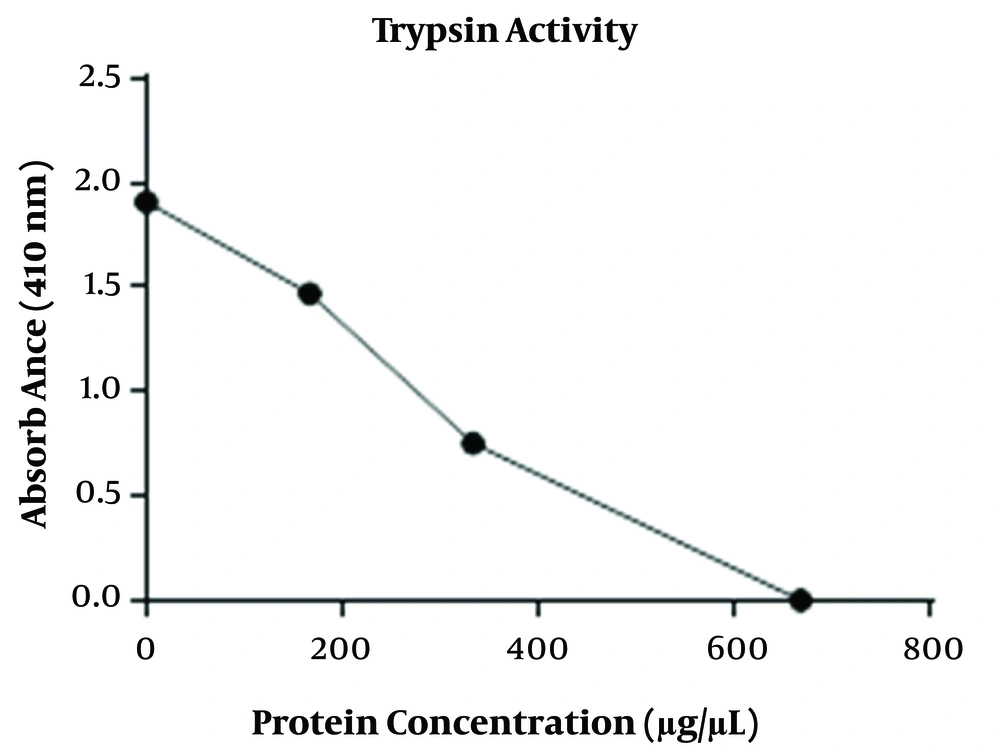
Trypsin inhibition assay was conducted to evaluate one of the salivary proteins of leech having antitrypsin effect. First, 121.14 g of hydroxylmethyl-aminomethne (Sigma) were melted in deionized water and the final volume of 1000 mL was prepared with pH = 7.5. In the next procedure, Substrate (1M Na-Benzoyl-L-arginine 4-nitroanilide; Sigma-Aldrich, St. Louis, Missouri, United States) and enzyme (trypsin; 2500U USP) were prepared as described previously (
17). The overall chemical reaction is as follow:
Trypsin + Na-benzoyl-L-arginine 4-nitroanilide - hydrochloride (in the presence of Tris; pH = 7.5) → Nitroanilide hydrochloride
The yellow color of the resultant reaction product was analyzed by UV-Visible using a spectrophotometer device (Pharmacia ultraspec III LKB- Biochrom England) at a 410 nm wavelength. Our experimental layout of the whole chemical reaction for primary active ingredient from leech (PAIL) is as follows.
1) Trypsin + Na-benzoyl- L- arginine- 4- nitroanilide hydrochloride in Tris (pH = 7.5);
2) Trypsin + Na-benzoyl- L- arginine- 4- nitroanilide - hydrochloride + leech extract or BAS (10, 20, 30 and 40 µL);
3) Blank (10, 20, 30, 40 µL leech extract) + tris (pH = 7.5).
The whole chemical reaction for final product is described below.
1) Trypsin + Na-benzoyl- L- arginine- 4- nitroanilide hydrochloride in Tris (pH = 7.5);
2) Trypsin + Na-benzoyl- L- arginine- 4- nitroanilide hydrochloride + 5% leech cream (100, 200 and 300 mg);
3) Blank (100, 200, 300 mg of 5% leech cream) + tris (pH = 7.5).
3.4. Coagulation Assay in Leech Product
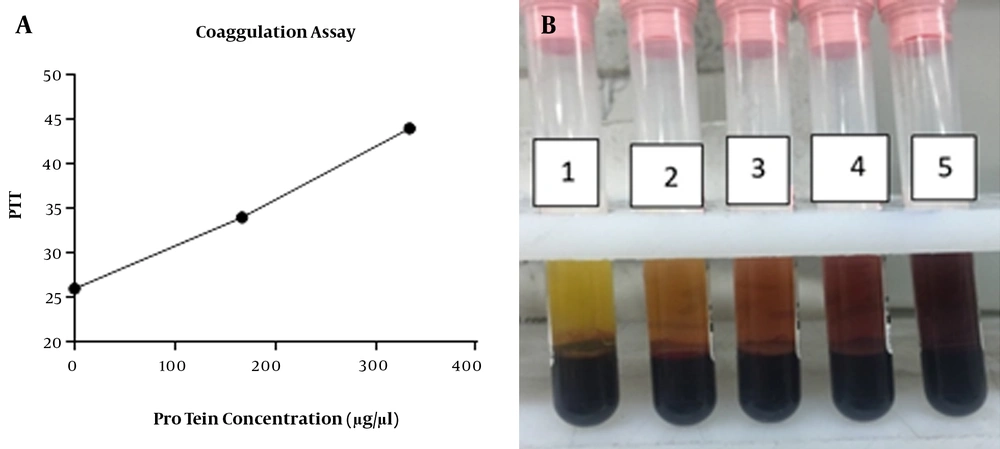
Coagulation activity assay was performed to study the effectiveness of anticoagulant proteins of SGS. First, 3.2 µL in 3.8% (w/v) sodium citrate (Sigma-Aldrich, St. Louis, Missouri, United States) was poured in each test tube, and 2.3 mL of fresh human blood was added to it. The whole mixture was centrifuged at 5000 × g for 20 min at 4°C and 5% leech cream (at the concentration of 0, 100, and 200 mg) was separately added to each test tube and rotated for 45 min. Then, prothrombin time (PT) and partial thromboplastin time (PTT) were analyzed by Coagulometer (Elite 9000) to observe the coagulation activity of leech product when the anticoagulant proteins in SGS such as Hirudin change the normal value of PT and PTT.
3.5. Formulation and Evaluation of 5% Leech
Regarding the base cream formulation, it was decided that the base cream should be Oil/water since the active ingredient is protein and soluble in water. The ingredients used for the cream formulation were Eucerin (3%), methyl paraben (0.02%), propyl paraben (0.02%), vaseline (20%) , propylenglycol (4%), cetylalcohol (4%), hard fat (4%), Tween 40 (0.15%), 80 (0.2%), BAS (5%), and distilled water (59.61%).
1) The amount of 100, 200, and 300 mg of 5% leech cream with the viscosity range of 65000 - 75000 cP were weighted and poured in the micro-tubes. Then, 1 mL of “solution A” (Tris buffer, pH = 7.5) and 500 µL of “solution B” (Urea 9M, 3-[(3-cholamidopropyl) dimethylammonio]-2-hydroxy-1-propanesulfonate 4%, triton 0.2%) was vortexed well and added to the mentioned micro-tube containing leech cream. The resultant solution was kept at room temperature overnight and its 500 µL was added to 1000 µL Na-benzoyl- L- arginine- 4- nitroanilide - hydrochloride, 500 µL trypsin at 37°C for 30 min, and this complex was analyzed spectrophotometrically at 410 nm.
2) leech cream (1g of 5% (w/v)) was poured in micro tube, 2000 µL solution A and 1000 µL of solution B were added, vortexed well, kept overnight at room temperature. For hirudin enzyme separation from leech product, 12% SDS-PAGE analysis was performed. The Hirudin band around 7 kDa was incised for elution procedure (
18). To the eluted protein, 500 µL solution B was added (solution C). In another test tube, 3.2 µL of 3.8% sodium citrate, and 2.3 mL of fresh human blood were added to it and centrifuged at 5000 × g for 20 min at 4°C, then 80 µL of solution C was added to the resultant mixture, rotated for 45 min, and underwent PT and PTT analysis through coagulometer.
3.6. Franz Cell Analysis of Skin Absorption Capacity
Phosphate buffer pH = 7.5, stock A, 2.4 g NaH
2PO
4/100 mL ultra-pure water; stock B, 2.84 Na
2HPO
4/100 mL ultra-pure water, 27.7 A + 97.5 B + ultra-pure water (UPW) up to 250 mL, 1.5 gr 5% leech cream, 32 mL of buffer in cell at 37°C, and dialysis tubing 12 KD were prepared. The molecular weight of trypsin inhibitor enzyme in leech and Hirudin is 4.6 and 7 KD, respectively (
19).
To evaluate skin absorption capacity and rheology, 5% leech cream was applied into the dialysis tubing of 12 KD diameter. The dialysis membrane was placed into the buffer filled tank at 37°C. The temperature of the experimental tank was adjusted to 37°C. After 12 h, the whole buffer was lyophilized and trypsinized to investigate whether the active leech ingredient could pass through the dialyzing membrane or not.
3.7. In Vivo Wound Healing Model
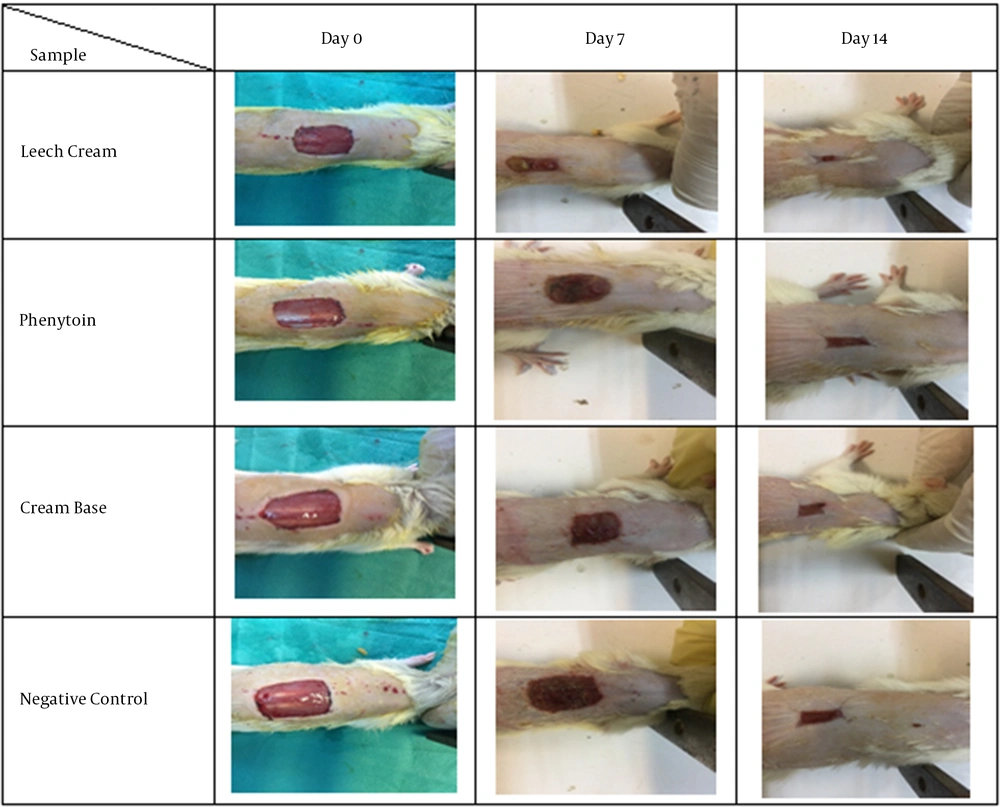
Rat model was used for in vivo evaluation of active leech product. The rats considered for experiment were separated into five collections, each holding 6 rats. The antral region of the rats was shaved and 1 × 1 cm2 wound was created by cutting the skin using a scalpel. The wounds were treated every other day by applying 1 g of the sample, phenytoin (positive control), or cream without active ingredient (negative control) to the injured sites. Sterile bandage was placed onto the treatment areas. Before each treatment, a photo was taken from the injured sites. Finally, skin samples were collected for histopathological analysis.
3.8. Histopathology of Wounds
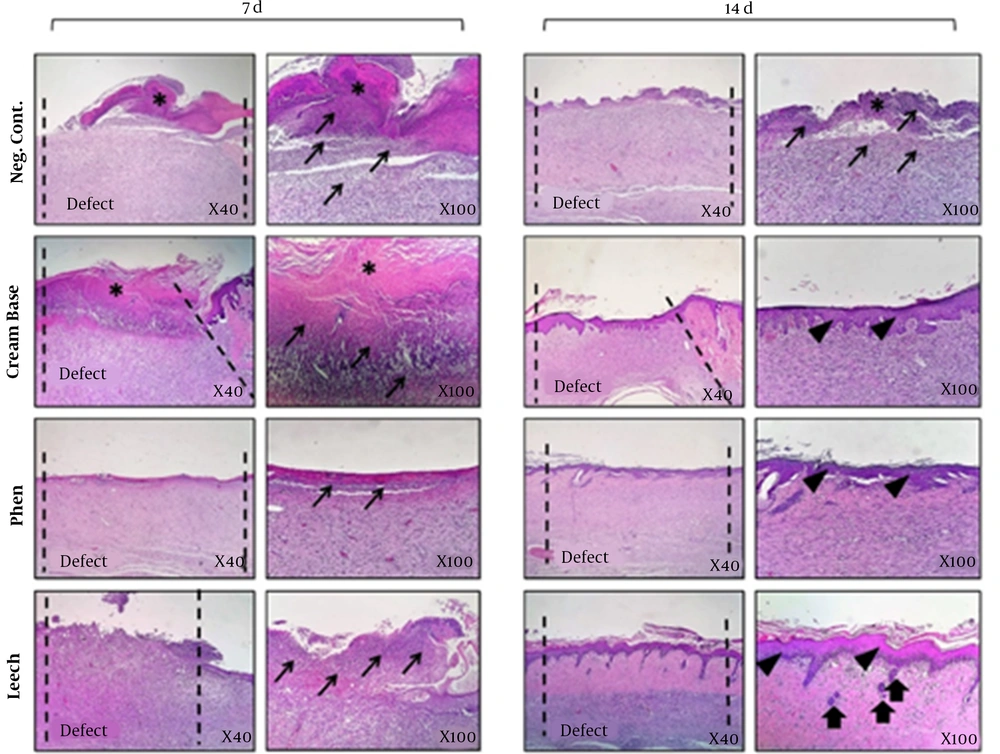
Four animals from each group were euthanized every 7th and 14th day in healing management and the samples were proximately stabled and collected in the 10% formalin buffer (pH = 7.26) for 48 h. Then, the collected samples were fixed in paraffin, and divided into five µm thick slices. Finally, they were stained with haematoxylin and eosin (H & E). The prepared histological slides were evaluated by light Microscope (Ollympus BX51; Tokyo, Japan). Restoring skin stratums, corruptive cell penetration, and granular matter formati1on were evaluated in all treatment and control groups.
3.9. Histomorphometirc Assay
Restoring skin stratums at 14th day was assessed semi-quantitatively on five-point scale (O: without new repairing in skin, 1: 25%, 2: 50%, 3: 75%, and 4: 100%) in recovery percentage. Histological evaluation, angiogenesis, and collagen mass were performed with Image-Pro Plus® V.6 (Media Cybernetics, Inc., Silver Spring, USA). Kruskall Wallis test was used for data analysis.
3.10. Quality (Microbial) Control Test
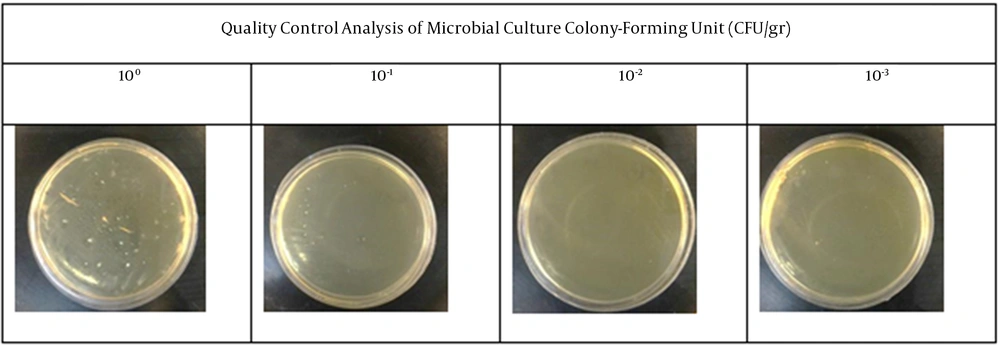
The microbial test of leech cream on the nutrient medium in the laboratory was performed to ensure that there is no microbial contamination of the final product. Then, Mueller Hinton agar in petri dishes and serial dilutions of the sample in Ringer solution were prepared. In addition, 20 µL of each sample-dilution with different concentrations including 100, 10-1, 10-2, and 10-3 colony-forming unit (CFU/g) was administered onto the growth medium and incubation at 37°C for 48 h, and finally total colony count (TCC) was determined.
3.11. Statistical Analysis
All results were compared using Kruskal Wallis test in SPSS software, version 20.0. P < 0.05 was considered as statistically significant. All graphs were drawn with GraphPad Prism v6 software. The experiments were performed triplicate and were reported as mean ± SEM.