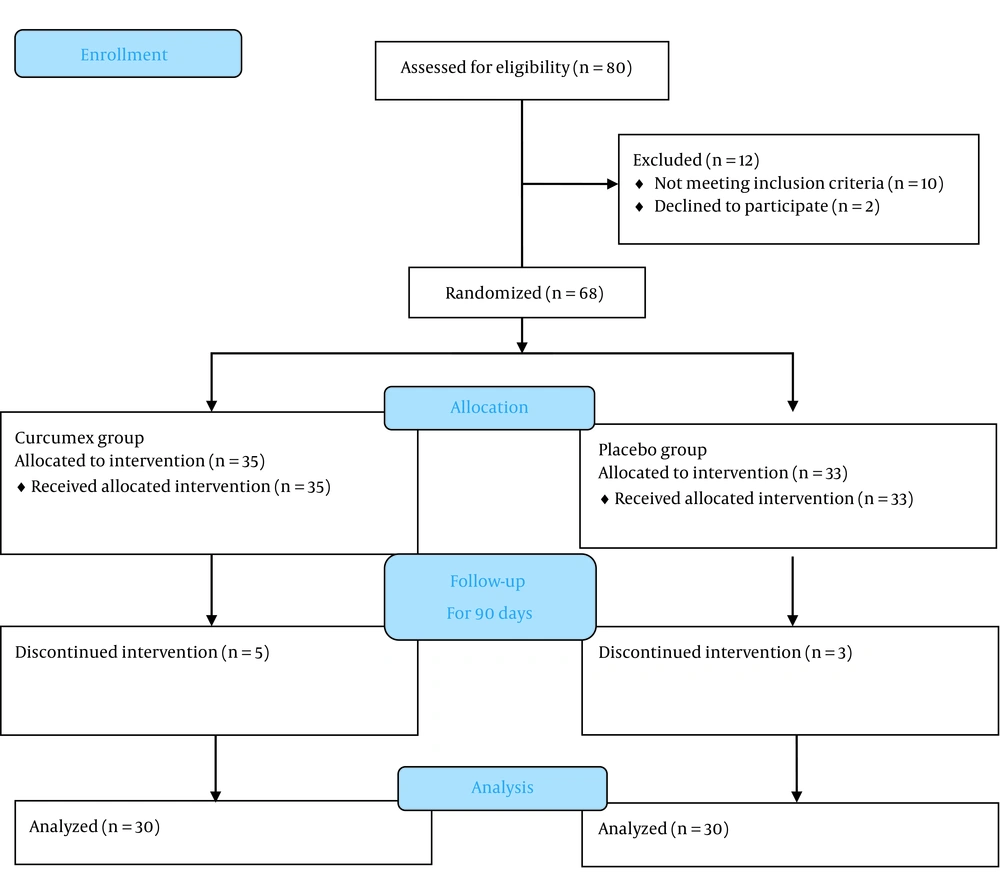
Despite numerous reports on the beneficial effects of turmeric, ginger, and black pepper in glucose metabolism and blood fat reduction, no study has been conducted on the simultaneous effect of the mixture of these three supplements on glycemic status and lipid profile in type 2 diabetes. Also, more studies have been conducted on curcumin and animal models (
32). Therefore, this study aimed to investigate the effect of curcumex (including the above three supplements) on fasting blood glucose, Hb A1C, insulin resistance, and serum lipid profile in type 2 diabetic patients.
In a study done by Sukandar et al. on type 2 diabetic patients in Indonesia, the results showed that ethanol extract of garlic and turmeric for 12 weeks significantly decreased BMI and plasma TG, total Chol, LDL, fasting blood glucose, and HbA1C levels. There was also a significant increase in serum HDL levels (
33). Although in this study, the decrease in fasting blood glucose and HbA1C levels and BMI is consistent with our study, it is not consistent with our results regarding lipid profile. The reason can be the presence of garlic in the study.
Alwi et al. assessed 75 patients with acute coronary syndrome who consumed curcumin at 3 different doses for 2 months. The results showed that low-dose curcumin decreased Chol and LDL and increased HDL levels (
34).
In another study done by Jang et al. on rats with a high-fat diet, curcumin supplementation significantly decreased plasma insulin levels and insulin resistance index (HOMA). It also decreased the concentrations of free fatty acids, TG, and Chol compared to the control group and increased plasma HDL levels (
35).
Finally, aligned with the results of our study, in a study done by Baum et al. on healthy people, consumption of 1 to 4 g of curcumin once a day for 6 months showed no significant change in blood lipid profile (
36).
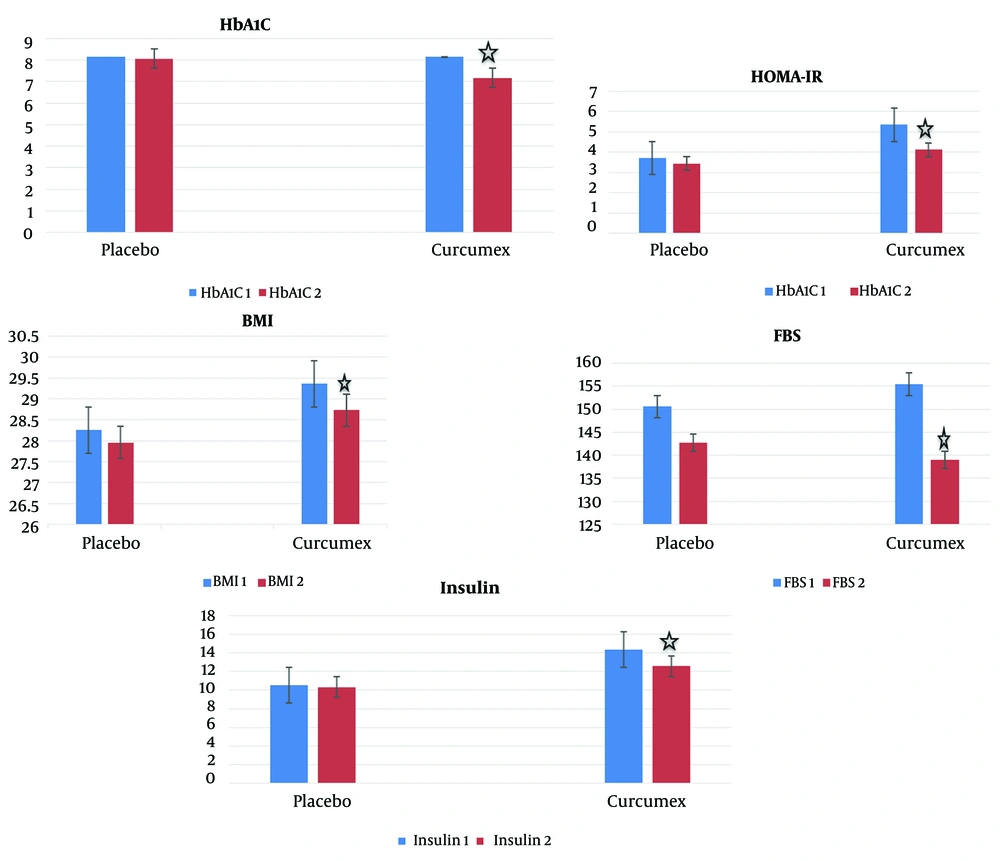
In the present study, administering curcumex supplement capsules twice daily for 90 days to patients with type 2 diabetes significantly reduced BMI and HbA1C, insulin serum, HOMA-IR, and fasting blood glucose levels.
According to the literature, tetrahydro curcumin is one of the most important metabolites of curcumin as a biologically active component of turmeric, which has been identified in the cytosol of intestinal and liver cells of rats (
37). This compound has antioxidant properties in both in vivo and in vitro conditions and improves insulin secretion and thereby reducing blood glucose levels by increasing glycolysis and inhibiting gluconeogenesis in the liver.
Also, several studies have been done on the effect of ginger on lipids profile and blood sugar with different results (
38-
40). In this regard, in a double-blind, randomized controlled trial by Talaei et al. on 81 patients with type 2 diabetes, daily intake of 3 capsules containing 1 g of ginger powder for 8 weeks in the intervention group significantly reduced the mean LDL levels after the intervention. Also, the mean fasting blood glucose after the intervention decreased by 10.5% in the intervention group and increased by 21% in the placebo group. Changes in mean HbA1C levels were similar to fasting blood glucose. However, mean HDL, TG, and Chol levels were not significantly different (
39).
In another double-blind, randomized controlled trial by Aryaeian et al. on patients with type 2 diabetes, daily consumption of 1600 mg of ginger in 2 capsules of 800 mg ginger for 12 weeks significantly reduced FBS, serum insulin, HBA1C, and HOMA levels in the intervention group compared to the placebo group (
41). The results of this study were consistent with our results.
Treatment with antioxidants improves glycemic control in patients with type 2 diabetes and animals. Ginger contains many antioxidants, including gingerol, shogaol, and paradol. The precise mechanism of action of these compounds needs to be better understood. These compounds may increase the GLUT protein of insulin receptors and improve pancreatic β-cell function (
27).
Also, little research has been done on the effect of black pepper on lipid profiles and blood sugar indices. In this regard, Garmkhany et al. examined the effect of red and black pepper oral powder on serum levels of blood Chol in rats. Contrary to the results of our study, black pepper significantly decreased serum total Chol and LDL levels. This study also showed that the mean weight of animals in the red and black pepper groups significantly decreased compared to the control groups (
42). Capsaicin has anti-obesity effects by limiting the production of white adipose cells and activating lipoprotein lipase (LPL) to reduce body fat levels (
43,
44).
Since there are sesquiterpenoid terpene compounds, the antioxidant effects of black pepper are significant in the composition of the black pepper plant (
45). Therefore, it can be used as a natural antioxidant and nutritional supplement in people susceptible to diabetes (
46).
Accordingly, it can be concluded that the mixture of the three mentioned supplements should have significant beneficial effects in controlling glycemic indices and lipid profiles in type 2 diabetic patients. A subject that was proven at least in part during the present study. Fasting blood glucose, HBA1C, insulin resistance, and BMI are among the indicators that showed a significant decrease in the group receiving the supplement at the end of the study compared to baseline, which was not observed in the placebo group.
One of the limitations of this study was its length and the number of patients. In future studies, better effectiveness and the profile of possible side effects can be investigated by increasing the duration of the study and the number of patients, as well as the use of higher doses. An issue that is associated with the better effect of this supplement on glycemic indices and lipid profile with the least side effects.
5.1. Conclusions
Generally, the consumption of curcumex supplement capsule two times a day every 12 hours for 90 days in patients with type 2 diabetes decreases BMI and blood sugar indicators, including serum levels of HbA1C, insulin, HOMA-IR, and fasting blood sugar, but had no effect on the lipid profile of these patients. Considering the effectiveness of this supplement and its low complication rate (in this study, no specific side effect was reported by its users), it can be used in newly diagnosed type 2 diabetic patients (for whom lifestyle modification alone cannot lead to proper disease control). It can also be recommended for patients who use one or two oral antihyperglycemic drugs and still have not achieved proper control of glycemic indices, and especially patients who have a high BMI can benefit more.