
1. Background
Gastric ulcers, the most common and serious gastrointestinal diseases with 4% - 5% prevalence in the world’s population, affect approximately 14.5 million in the United States (1). The gastric ulcer is the result of imbalance between defense mechanisms (mucus alkaline secretion, mucosal microcirculation and motility, prostaglandins, and nitric oxide (NO) and offensive factors (acid and pepsin secretions, infections), nutritional deficiencies, and alcohol consumption (2). The impairment in gastric mucosal resistance may lead to mucosal irritation and ulceration (3). Many factors can cause mucosal injury such as alcohol consumption, Helicobacter pylori infection, taking non-steroidal anti-inflammatory drugs, and stress (4).
Ethanol-induced gastric ulcer is a common model used to screen the antiulcer activity of compounds and their possible protective mechanisms (5). Previous studies indicated that oxidative stress and lipid peroxidation of unsaturated fatty acids are involved in the pathogenesis of acute gastric lesions model by ethanol (6). Hence, ethanol aggravates the production of reactive oxygen species (ROS) and malondialdehyde (MDA) level in the mucus of the stomach (7). In this, context administration of antioxidant compounds has the potential to prevent gastric ulcers (8).
Many studies reported that nitric oxide (NO) plays a critical role in wound relief (9). NO produced by cNOS and iNOS is involved in several physiological functions of gastrointestinal tract such as maintenance of gastric mucosal integrity, modulation of gastric acid secretion, blood flow, and neutrophil adhesion (9). It is documented that administration of the NO donor commonly protects against gastric ulceration, and inhibition of NO production leads to increased risk of gastric mucosal lesions formation (10).
Recently, natural pigments are at the center of much attention due to their potent antioxidant activity and positive effects in the treatment of cancer and other diseases (11). Water-soluble nitrogen-containing pigments divide in two classes, red/purple betacyanins and yellow betaxanthins, both known as betalains (12). It is reported that betalains and other components responsible for the red color of beetroot are among the 10 most potent antioxidants of vegetables (12). Betanin is the most abundant betacyanin in beetroot (Beta vulgarism L.) used as a natural color in the food industry (12). A number of studies demonstrated that betanin has a wide range of pharmacological activities including antioxidant, anti-hyperlipidemic, antihypertensive, anti-inflammatory, cardioprotective, hepatoprotective, anti-microbial, anti-diabetic, anti-proliferative, and anticancer (11, 12). Betanin due to possessing phenolic and cyclic amine groups acts as a highly effective scavenger of ROS (13). It is demonstrated that betanin can inhibit lipid peroxidation and induce endogenous antioxidant defense systems by gene regulatory mechanisms at lower concentrations (12).
2. Objectives
To the best of authors’ knowledge, no research is performed so far on gastroprotective effect of betanin in gastric ulceration models. Therefore, the present study aimed at evaluating the gastroprotective effect of betanin against ethanol-induced gastric ulcer in rats.
3. Methods
3.1. Animals
Male Wistar rats, aged 8 - 10 weeks, weighing 200 - 250 g, provided by the Research Center and Experimental Animal House of Ahvaz Jundishapur University of Medical Sciences, Ahvaz, Iran, were housed in standard and individual cages and maintained at room temperature (22 ± 4ºC) with food and water ad libitum and a 12:12 hour light/dark cycle. The animals left to acclimatize for one week before the experiments. The experimental protocol was approved by the Ethics Committee of School of Medicine, Ahvaz Jundiahapur University of Medical Sciences and was in accordance with the guidelines for animal care and use; all the experiments were conducted in accordance with international guidelines for care and use of laboratory animals.
3.2. Drugs and Chemicals
Betanin (Sigma Chemical Company, USA), ethanol (Kimia Alcohol, Iran), ranitidine (Sigma Chemical Company, USA) were used in the current study. Betanin and ranitidine was dissolved in normal saline. All drug solutions and suspensions were freshly prepared.
3.3. Experimental Design
Forty two rats were assigned randomly into seven groups: sham (n = 6) received normal saline (5 mL/kg, p.o) as betanin vehicle, control negative (n = 6) received normal saline (5 mL/kg, p.o) followed by ethanol one hour later, betanin treatment (n = 24) received betanin (50, 100, and 200 mg/kg, p.o) followed by ethanol one hour later (The doses were selected based on preliminary experiments that showed pharmacological effects in animals), positive control (n = 6) received ranitidine (50 mg/kg, p.o.) followed by ethanol one hour later, and drug control (n = 6) received betanin (200 mg/kg, p.o) without ethanol administration (14).
3.4. Induction of Acute Gastric Lesions by Ethanol
Acute peptic ulcers were induced by oral administration of 96% ethanol (5 mL/kg). The animals were fasted for 24 hour before ulcer induction in mesh-bottomed cages to prevent coprophagia, but they had free access to water (15). One hour after ethanol administration, all the animals were anesthetized by ketamine (50 mg/kg) and xylazine (10 mg/kg). The stomachs were removed, opened along the greater curvature and their contents were washed by normal saline. Then, the number and length of gastric hemorrhagic or ulcerative lesions were measured (14). A sample of glandular tissue of each stomach was fixed in 10% neutral-buffered formalin solution for subsequent histopathological assessment. Other full-thickness sections of the gastric samples were then weighed, frozen, and stored at -70ºC until MDA and NO evaluations.
3.5. Detection of Malondialdehyde and Nitric Oxide in Rat Gastric Tissue
Tissue samples were homogenized in same volumes of ice-cold potassium phosphate buffer (0.05 M, pH 7.4) using a microhomogenizer (Heidolph crusher M, Germany) at 25,000 rpm for five minutes. The homogenates were centrifuged at 5000 rpm for 10 minutes at 4ºC and the supernatant was used for MDA and NO measurements. The level of MDA (µM/mg of tissue) was measured using colorimetric assay kits according to the instructions of the manufacturer (Zell bio, Germany) based on the amount of thiobarbituric acid (TBA)-reactive substance at 532 nm. Total nitrite content (µM/mg of tissue), as the end product of NO, was measured by commercial kits according to the manufacturers’ instructions (Zell bio, Germany).
3.6. Histopathological Analysis
The fixed portion of each stomach was dehydrated and embedded in paraffin. Five-micrometer sections were cut using a microtome, and stained with hematoxylin-eosin solution (H&E). Tissue samples were prepared for histopathological examinations. Five different fields of the tissue were microscopically observed in order to assess the degree of changes caused by the treatments in rats.
3.7. Statistical Analysis
Results were expressed as mean ± standard deviation (SD). The significant differences between the groups were determined by one-way analysis of variance (ANOVA) followed by Tukey’s post hoc test for multiple comparisons. P < 0.05 was considered the level of significance.
4. Results
4.1. Effect of Betanin on Ethanol-Induced Gastric Lesions
As shown in Figure 1C, oral administration of ethanol (5 mg/kg) induced several linear hemorrhagic ulcers compared to the vehicle-treated control group. Administration of betanin significantly reduced (P < 0.05) the size (Figure 2A) and number of gastric lesions (Figure 2B) induced by ethanol in a dose dependent manner. There was a significant difference between the betanin doses of 100 and 200 mg/kg and the ethanol control group in terms of the number and size of lesions. Betanin 200 mg/kg had the maximum inhibitory effect on the size and number of gastric lesions. The gastroprotective activity of 200 mg/kg betanin was similar to that of ranitidine as the reference drug (Figure 2). Also, there were no gastric lesions in the betanin (200 mg/kg) and ranitidine groups per se.
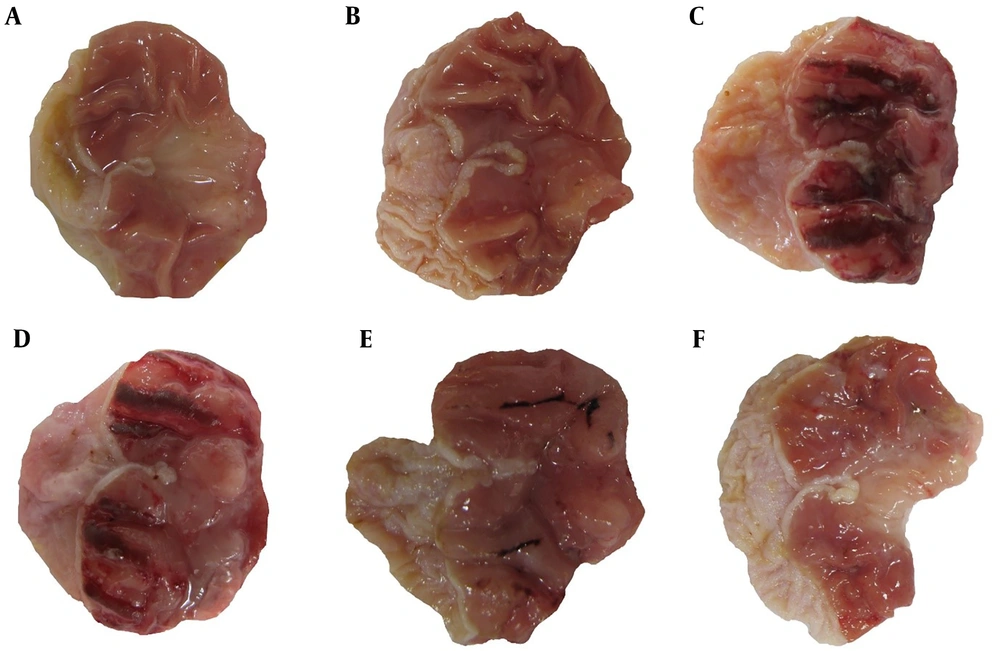
Figure 1.
Gross evaluation of the stomach in the control (A), ethanol + ranitidine (50 mg/kg) (B), ethanol (C), ethanol + betanin (50 mg/kg) (D), ethanol + betanin (100 mg/kg) (E), and ethanol + betanin (200 mg/kg) (F) groups. Results showed that pretreatment with 100 and 200 mg/kg of batanin and 50 mg/kg of ranitidine could decrease gastric ulcers.
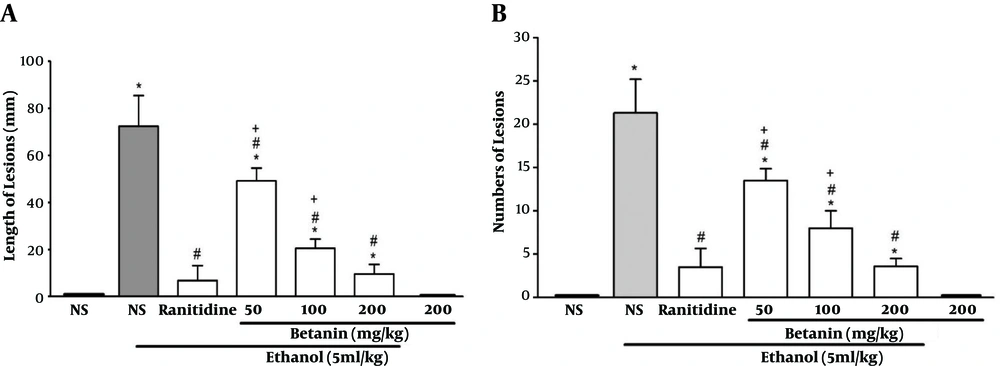
Figure 2.
Betanin inhibits ethanol-induced gastric ulcer. The rats were treated with normal saline (NS), and betanin or ranitidine (50 mg/kg). One hour later, absolute ethanol (5 mL/kg) was administered. The control group was treated with normal saline only. The total length (A) and number (B) of macroscopic gastric lesions were determined after one hour. The results are expressed as the mean ± SEM for six animals. *P < 0.05 compared to the control group; #P < 0.05 compared to the ethanol group; +P < 0.05 compared to the ranitidine group
4.2. Effect of Betanin on NO Content in Stomach Tissue
The level of NO in the gastric tissue is shown in Figure 3. The administration of ethanol significantly decreased the NO content in the gastric tissue as compared to the negative control group (P < 0.5). The results as shown in Figure 3 indicated that NO content in the betanin-treated groups (100, 200 mg/kg) were significantly higher than that of the ethanol-treated group (P < 0.05). There was no significant difference between the 200 mg/kg betanin-treated and ranitidine groups.
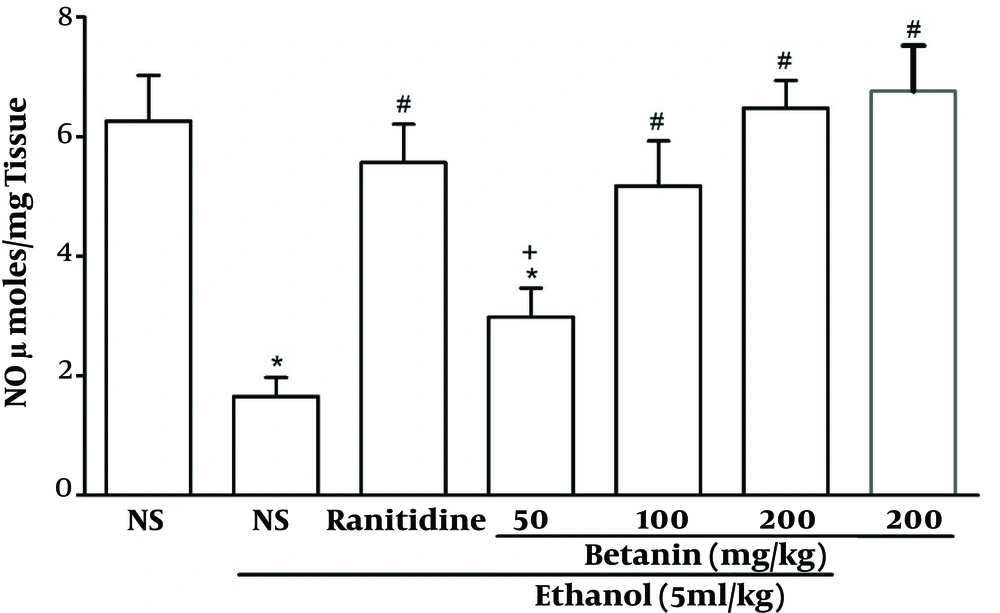
Figure 3.
Effects of betanin on gastric NO. The results are expressed as the mean ± SEM for six animals. *P < 0.05 compared to the normal saline (NS); #P < 0.05 compared to the ethanol group; +P < 0.05 compared to the ranitidine group
4.3. Effect of Betanin on Malondialdehyde Level in the Stomach Tissue
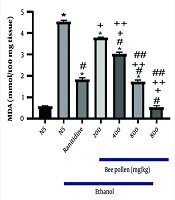
MDA level was used as an indicator of lipid peroxidation in the current study. As showed in Figure 4, stomach MDA level in the ethanol-treated group was significantly higher than that of the control group (P < 0.05). Pretreatment with 100 and 200 mg/kg of betanin significantly and dose dependently decreased the stomach MDA levels (Figure 4).
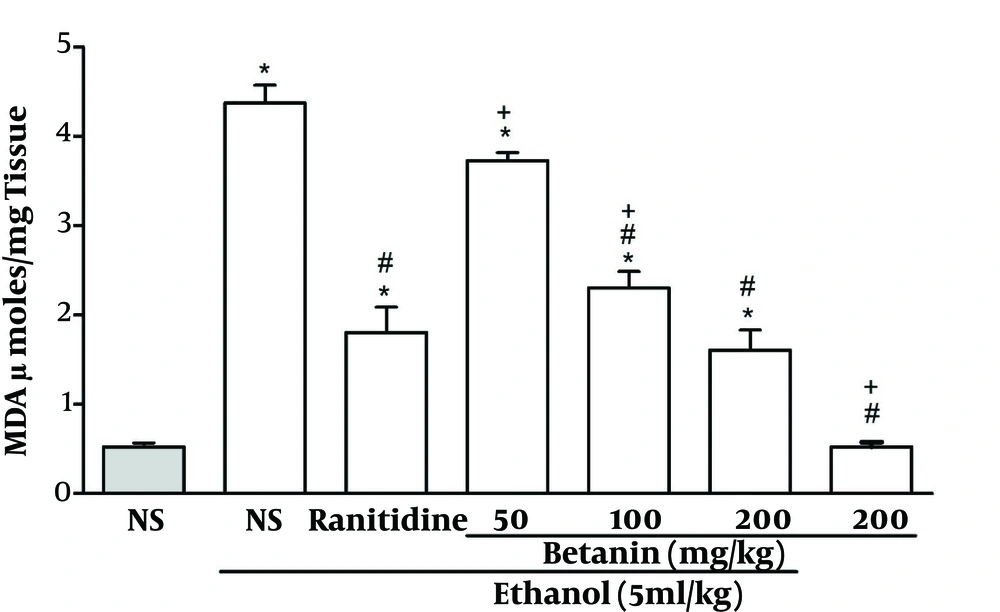
Figure 4.
Effects of betanin on gastric MDA. The results are expressed as the mean ± SEM for six animals. *P < 0.05 compared to the normal saline (NS) group; #P < 0.05 compared to the ethanol group; +P < 0.05 compared to the ranitidine group
4.4. Histopathological Findings
Figure 5 shows the histopathological alterations in the stomach of the experimental groups. Microscopic examinations revealed different ulcers in the mucosal layer of the stomach. The administration of absolute ethanol induced massive ulcers. Necrosis of mucosal cells and mucosal gland cells were obvious. They had eosinophilic cytoplasm and dark basophilic nuclei. Hemorrhage and hyperemia were observed (Figure 5A). In the betanin-treated groups, histopathological lesions induced by ethanol were decreased in a dose dependent manner. In the betanin-treated (50 mg/kg) group, ulcers were similar to those of the ethanol group. They had massive ulcers with glandular necrosis (Figure 5B). In the betanin-treated (100 and 200 mg/kg) groups, the ulcers were decreased. They were smaller and limited to epithelium (Figure 5C and D). The ranitidine and control groups had normal structures (Figure 5E and F).
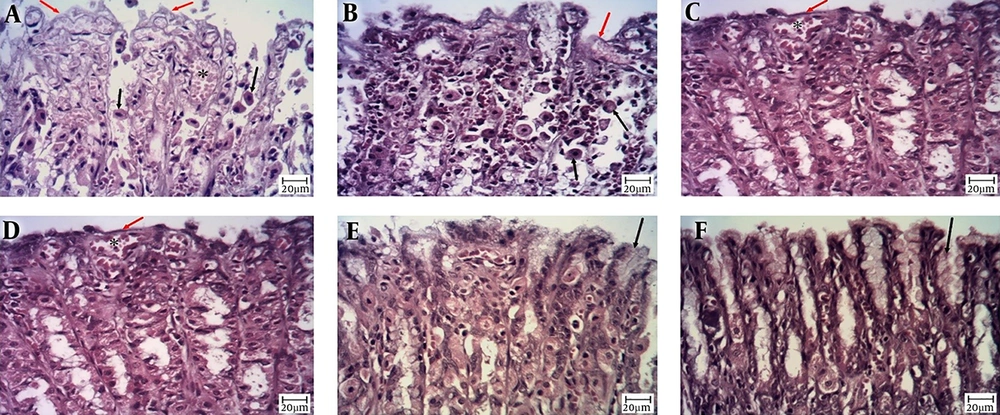
Figure 5.
The effect of betanin on the histology of ethanol-induced gastric mucosal damage in rats; (A) the ethanol group. See desquamated mucosal cells (red arrows) from the surface of epithelium and hyperemia and hemorrhage (black asterisk). Necrotic cells with eosinophilic cytoplasm and dark basophilic nuclei (black arrows) are obvious. (B) The betanin (50 mg/kg) group received ethanol. Desquamation of mucosal cells (red arrow) and necrotic glandular cells (black arrows) are obvious. (C) The betanin (100 mg/kg) group received ethanol. See necrotic mucosal cells (red arrow) and hyperemia (white asterisk). Gastric glands are normal. (D) The betanin (200 mg/kg) group received ethanol. See hyperemia (black asterisk) and desquamation of mucosal cells (red arrow). (E) The ranitidine group. See mucosal cells (black arrow) and hyperemia. (F) The control group. See normal structure of gastric mucosal cells (arrow) and mucosal gland (H&E staining; ×20).
5. Discussion
The role of antioxidant of herbal medicine is well recognized (16). Beetroot is considered as one of the potent antioxidant vegetables due to its high bioactive pigments known as betalains (11). The protective effect of betanin on heart, kidney, liver, and lung is documented, but its role in the stomach is not understood yet (12). For the first time the current study showed that betanin significantly reduced the ethanol-induced gastric ulcers in a dose-dependent manner and this gastroprotective effect was associated with decrease of lipid peroxidation and increase of NO level in gastric tissue.
In the present study, the ethanol-induced gastric ulceration was used as model in rats and remarkable gastric ulcers were showed one hour after the administration of ethanol. Ethanol-induced gastric ulcer as a reliable model is widely used to induce experimental gastric ulcers in order to assess gastroprotective activity of medicines (17). Evidence indicates that gastric mucosal lesions induced by ethanol are significantly linked to increased oxidative stress (18). Ethanol administration elevates generation of superoxide anions and reduces antioxidant enzymes activity (19). Excessive free radicals production resulted from ethanol administration by exaggerated neutrophil activation leads to damage to cellular essentials constituents of stomach as well as lipids and proteins. Superoxide radical anion increases MDA level and common oxidative stress markers; it is also an indicator of the oxidative stress severity (10).
In the present study, ethanol administration induced significant increase in MDA level compared with the control group that was in agreement with previous studies findings (10) However, prevention of neutrophil infiltration and oxidative stress in ethanol-induced gastric ulcers are considered as the major mechanisms of antiulcer compounds against mucosal lesions (20). The current study revealed that pretreatment with betanin could ameliorate ethanol-induced gastric ulcer formation in a dose-dependent manner. Also, evaluation of MDA level in gastric tissue indicated that the oral administration of betanin attenuated lipid peroxidation. Therefore, this finding indicated that gastroprotective effect of betanin is, at least partly, related to its antioxidant activity against free radical species. The current study result was in accordance with earlier reports that betanin exhibited anti-oxidant activity both in vitro and in vivo models. Han et al., found that betanin alleviated the paraquat-induced stress and modulated the MDA and GHS levels in liver injury (21). Previous investigations reported that betanin exhibited radical scavenging activity against DPPH, galvinoxyl, superoxide, and hydroxyl radicals; so that in comparison to some anthocyanins (i e, cyanidin-3-O-glucoside, ascorbic acid, catechin, and rutin), betanin was a potent scavenger of reactive free radicals (22).
The results of the current study showed that the gastric NO level is decreased after the administration of ethanol and pretreatment with betanin reestablished gastric NO levels. NO plays an important role in the pathogenesis of ethanol-induced gastric ulcers (23). It is indicated that gastric NO levels are decreased in ethanol-induced gastric ulcers (24). It is widely shown in the gastrointestinal systems that NO is a gas mediator with vasodilator activity that has cytoprotective effects (9). NO is involved in several elements of defensive gastric mucosa by modulating blood flow, neutrophil adhesion, and mucus secretion (25). It is well known that keeping the normal level of NO markedly reduces ethanol-induced gastric ulcers (26). In agreement with the current study findings, Kujawska et al., reported in a study that betanin may increase NO level via scavenging of superoxide radical scavenges that may inhibit the reaction of NO with superoxide radicals to form peroxynitrite (12). The current study results showed that NO is involved in the gastroprotective effects of betanin, but further research is required to explore the precise role of NO in gastroprotective effect of betanin.
In conclusion, the results of the current study indicated the gastroprotective effects of betanin on ethanol-induced gastric ulcers. The protective effect of betanin against gastric ulcers may be due to inhibition of lipid peroxidation and maintaining NO at its normal level. However, more studies are required to determine exact mechanisms of action involved in gastroprotective effect of betanin.