1. Background
Apigenin 7-O-glucoside is amongst very important secondary metabolites, which is produced by Cosmos bipinnatus. Cosmos bipinnatus has been used in phytomedicine for numerous diseases, such as jaundice, spasmodic fever, and anti-inflammatory activity (1). Jang et al. (2008) reported antioxidative and antigenotoxic activity for C. bipinnatus extracts (2). They suggested that it has important antioxidant activity and protecting effect against oxidative DNA damage. Olajuyigbe and Ashafa (2014) reported the chemical composition of essential oils of C. bipinnatus and its antibacterial activity (3). Zheng et al. (2005) suggested that the hepatoprotective activity of apigenin is due to its antioxidant properties, performing as an ROS scavengers (4). Sohn et al. (2013) reported that a sesquiterpene lactone isolated from the roots of C. bipinnatus demonstrates an anti-inflammatory effect (1). It exhibits anti-inflammatory, anti-mutagenic, antiviral, and purgative effects (5, 6).
Pharmaceutical secondary metabolites have been used for the cure of numerous illnesses and are becoming a significant research area for drug discovery (7-11). Choi et al. (2009) reported that it may be a very useful anticancer drug candidate for chemotherapy and cancer prevention (12). Way et al. (2004) revealed anti-proliferative properties of apigenin on some cell lines of human breast cancer (13). It strongly inhibited tumor cell invasion in a breast tumor cell line (14). Zheng et al. (2005) reported that apigenin inhibited the growth of HeLa cells by inducing apoptosis (15). Wang et al. (2000) reported that the use of apigenin in colon carcinoma cell lines caused G2/M cell cycle arrest and cell growth inhibition (16). Wang et al. (1999) reported that apigenin is very effective in inducing apoptosis on human leukemia cells (17). In another study, Budhraja et al. (2011) reported that Akt signaling pathways are possible objectives for inducing apoptosis in leukemia cells, using apigenin (18). Li et al. (2007) reported that it could inhibit lung cancer cell proliferation (19). Gupta et al. (2001) assessed the growth inhibitory properties of apigenin on human prostate cancer (20). Shukla and Gupta (2010) demonstrated that apigenin could support the improvement of cardiovascular disorders, excite immune system and deliver some defense alongside skin, thyroid, endometrial, gastric, liver, and adrenal cortical cancers (21). Patel et al. (2007) suggested that in the future, apigenin owns high possibility for progress as a capable cancer chemopreventive factor (22).
Root-based culture technology has become a sustainable production platform for producing specific pharmaceutical secondary metabolites. Agrobacterium rhizogenes are gram negative bacteria, which induce hairy roots in plants. The T-DNA from its Ri plasmid can be transferred to the plant genome. T-DNA encodes the enzymes for phytohormone auxin control and biosynthesis of cytokinin. Root-inducing (Ri) plasmid contains rol (root loci) genes harbored by A. rhisogenes. The rol genes are integrated into the genome of the host plant, producing a hairy root. The rol genes are believed to influence transformed roots growth and development, and prompt synthesis of secondary metabolite via turning on the transcription defense genes. The rolB gene is very crucial for genetically transformed root production (23). Genetically transformed roots are mostly used as a transgenic tool for secondary metabolites production and evaluation of key genes in secondary metabolite pathway studies. Hairy roots are both genetically and biochemically stable over long culture periods in comparison to cell suspension cultures. The biosynthesis of secondary metabolites is induced by increasing plant defense genes expression. Fast growth of hairy roots offers an additional benefit to use as a continuous source for valuable secondary metabolite production in the absence of growth regulators (which are usually expensive) in a sterile culture medium (24-26). For increasing the production of pharmaceutical compounds in hairy root cultures, the identification of key genes, which are involved in regulating secondary metabolic pathway stages can aid in secondary metabolic engineering. Fortunately, over the past decades, much information about the biochemistry and genetics of biosynthetic pathways involved in plant natural products creation has been illustrated (27, 28). Gene-coding committed enzymes and strategic transcription factors should be used for increasing preferred secondary metabolites production by overexpressing them in genetically transformed root cultures (25, 29). Genetically transformed root culture as a green factory has biotechnological potential for producing high-value plant-derived metabolites and recombinant pharmaceutical proteins (30).
Numerous features effect the frequency of A. rhizogenes mediated transformation. Sharafi et al. (2014a) used liquid inoculation and solid co-cultivation media in absence of macro elements, such as KH2PO4, NH4NO3, KNO3 and CaCl2, to transform medicinal plant Dracocephalum kotschyi with high efficiency (31). In another study, Henzi et al. (2000) indicated that the usage of acetosyringone and arginine in the agar solidified co-cultivation medium, which revealed major enhancement in transformation rate of Brassica by Agrobacterium (32).
2. Objectives
The present study evaluated 4 strains of A. rhizogenes, 2 co-cultivation media and explants for improvement of an efficient protocol for genetically transformed roots induction from C. bipinnatus. This study, as the first report, demonstrated a simple, well-organized, and reliable transformation method for C. bipinnatus.
3. Methods
3.1. Seed Sterilization and Germination
Cosmos bipinnatus seeds (provided from Chiba university, Japan) were sterilized in 70% v/v ethanol followed by 25% (w/v) sodium hypochlorite for 12 minutes and germinated on hormone-free MS medium containing 3% (w/v) sucrose and 0.7% agar (Phytotechnology Co., USA) at 24 ± 1°C under a 16-hour photoperiod regime with fluorescent light in a culture room. Germination was started within 5 days and 4-week-old in vitro grown seedlings were used for hairy root induction.
3.2. Agrobacterium Rhizogenes Strains Preparation
Five strains of A. rhizogenes (ATCC 15834, ATCC 31798, A7, MAFF-02-10266, and MSU440) were used. From each strain, a single colony was inoculated in 15 mL of liquid Luria- Bertani medium, pH 7.2, to an optical density of 0.7, at 28°C, 160 rpm on a rotary shaker incubator for 24 hours. The bacterial suspensions were centrifuged at 4000 rpm for 10 minutes. The pellets were suspended in 25 mL MS liquid medium complemented with 150 μM acetocyringone after sterilization using 0.22 μm syringe filters (Sartorius, USA) (inoculation medium) at 28°C in the dark.
3.3. Co-Cultivation and Hairy Root Production
Leaf and stem explants from 1-month-old plants were cultured for one day on MS medium supplemented with 1 mgL-1 6-Benzyl-Aminopurine (BA). The explants were dipped in bacterial inoculation medium (immersion method) for 8 minutes and blotted on sterile filter paper. The inoculated explants were incubated in a co-cultivation medium containing MS or ½ MS salts and vitamins accompanied by 45 mgL-1 sucrose and 100 μM acetocyringone at 24°C in the dark.
After 48 hours, the explants moved to phytohormone-free MS media supplemented with 350 mgL-1 cefotaxime to remove the bacteria. Similarly, some explants as controls were processed yet without any bacterial inoculation. Explants were sub-cultured every week until bacterial colonies vanished. The concentration of antibiotics was decreased in subsequent sub-culture. After 3 weeks, hairy roots appeared on the explants and were cut out from the explants and moved to a liquid MS medium containing antibiotics. After 6 subcultures, hairy roots were transferred to an antibiotic-free MS medium. Hairy root cultures were grown in Erlenmeyer flasks with constant shaking (121 rpm) at 24°C in the dark.
3.4. Detection of rolB Gene in Transgenic Roots by Polymerase Chain Reaction
The genomic DNA was isolated from the genetically transformed roots (100 mg) of each clone and control roots based on the CTAB method. The pellets of DNA were air dried, dissolved in 50 μL of water, and then stored at -20°C. Isolated DNA was used in PCR analysis for detecting the rolB gene. Fragments of the rolB gene were PCR-amplified by the following primer pairs: 5’-GCTCTTGCAGTGCTAGATTT-3’ and 5’-GAAGGTGCAAGCTACCTCTC-3’.
The PCR was performed as follows: at 94°C for 5 minutes, 30 cycles in 3 steps (94°C for 1 minute (denaturation), 58°C for 1 minute (annealing) and 72°C for 1 minute (elongation)), and 72°C for 10 minutes for final extension. The PCR amplified DNA were run by electrophoresis on 0.8% agarose gel , stained with EtBr and visualized by a UV trans-illuminator.
3.5. Statistical Analysis
The experiments were laid on a CRD with 3 replications and 10 explants cultivated in each Petri dish. After analysis of variance, the means were compared by the Duncan test using the SPSS software version 16.
4. Results
4.1. Effect of Agrobacterium rhizogenes Strains and Co-Cultivation Medium
Seeds were germinated in 5 days and leaf explants from 4-week old C. bipinnatus seedlings were used for co-cultivation (in vitro flowering occured for this plant after 7 to 8 weeks) (Figure 1A, B). Five different A. rhizogenes strains (ATCC 15834, ATCC 31798, A7, MAFF-02-10266, and MSU440) were examined for transformation ability. In all tests, acetosyringone was used to prompt A. rhizogenes T-DNA transduction. Hairy roots of C. bipinnatus originated from stem and leaf explants after 3 weeks (Figure 2A-E).
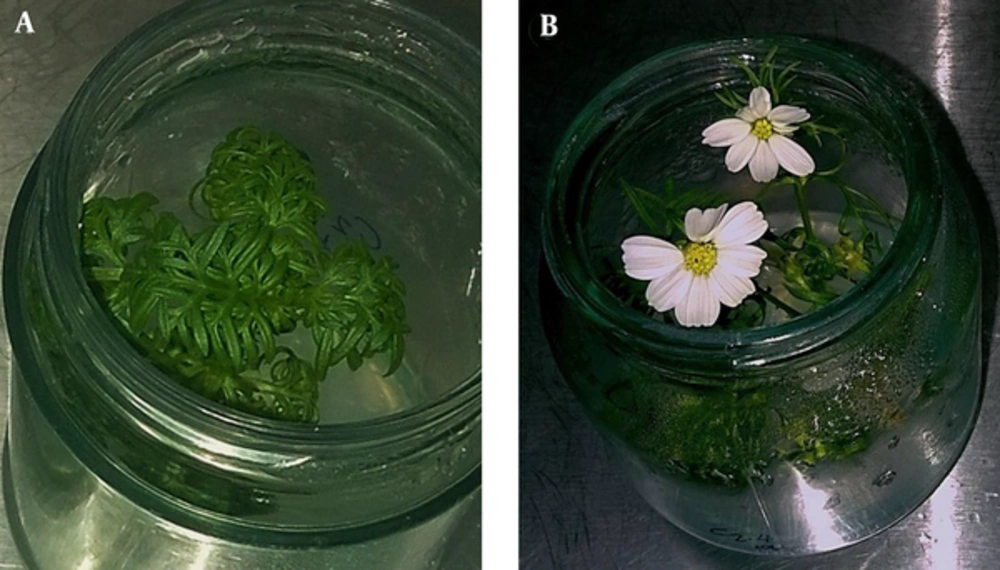
Figure 1.
A, Four Weeks Old C. bipinnatus Plants in MS Medium; B, In Vitro Flowering After 7 Weeks
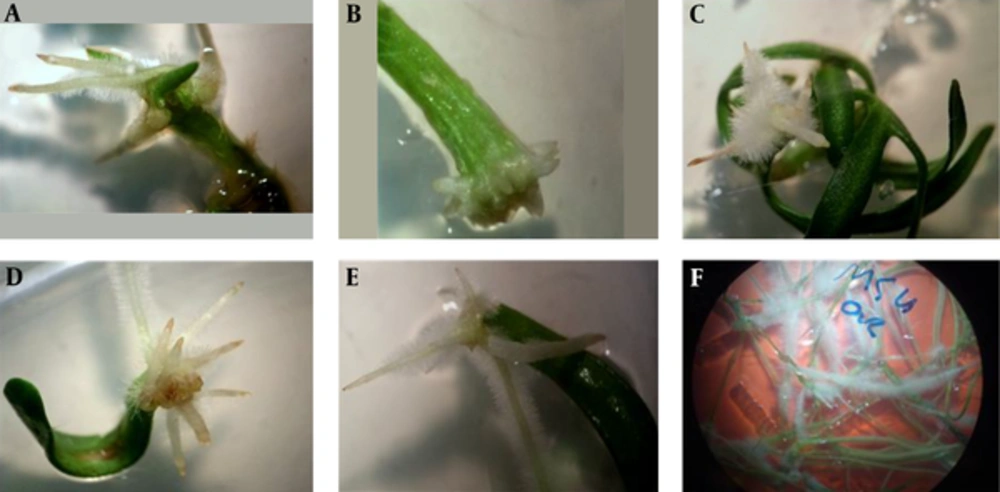
Figure 2.
A, hairy root induction on leaf explant after 3 weeks using strain ATCC 15834; B, hairy root induction on leaf explant after 3 weeks using strain ATCC 31798; C, hairy root induction on leaf explant after 3 weeks using strain MSU440; D, hairy root induction on leaf explant using strain MAFF-02-10266; E, hairy root induction on leaf explant using strain A7; F, Hairy root growth in agar solidified ½ MS medium.
The obtained hairy roots were moved to liquid ½ MS medium for further growth after 1 month. The color of media after inoculating the hairy roots turned yellow, which indicated that secondary metabolites are secreted in the culture medium (Figure 3). Also, the hairy roots showed plagiogeotropism (lack of geotropism) in liquid medium as expected (Figure 3). In this period, roots propagated by three means: meristematic cell propagation at the tip, cell elongation, and branching via side root production (33).
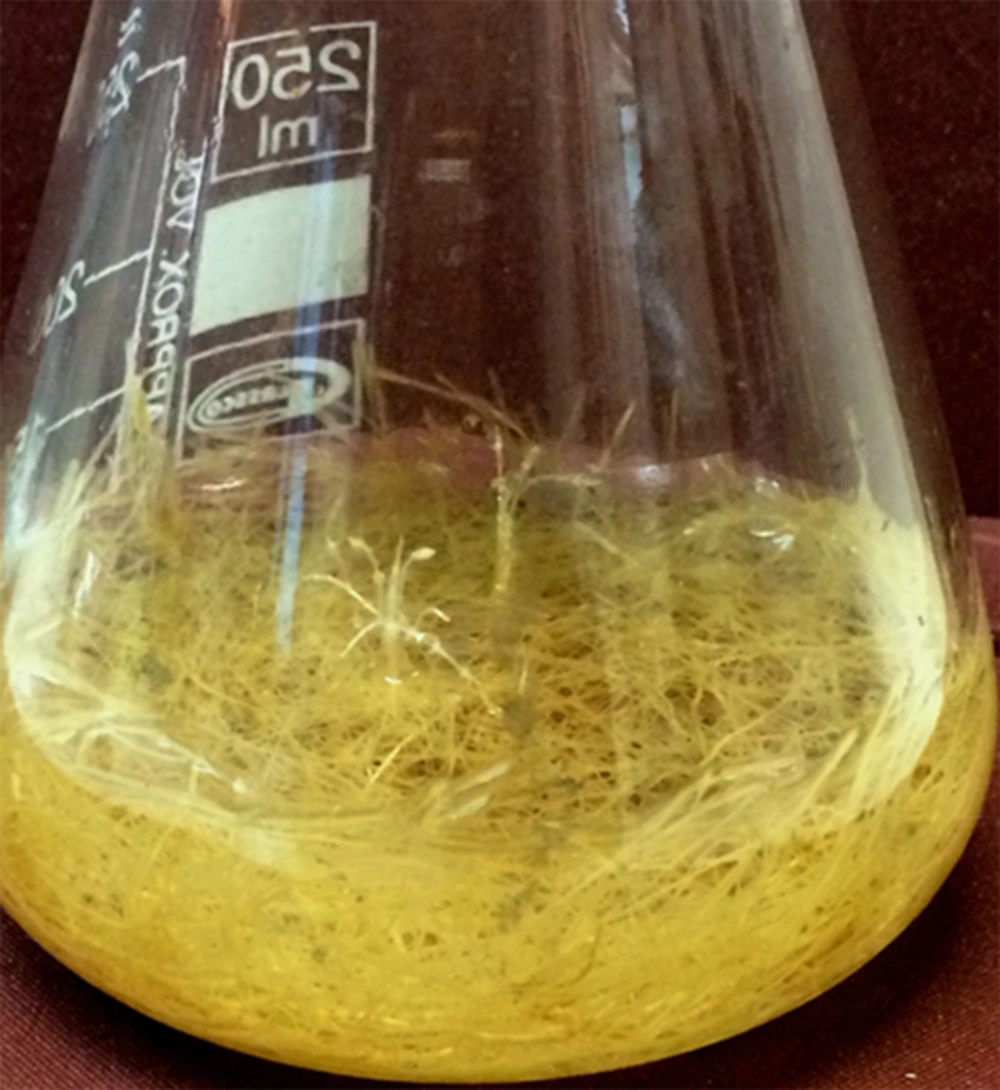
Figure 3.
Hairy Root Culture in Liquid ½ MS Medium After One Month
All of the bacterial strains used in this study resulted in hairy root induction at the wound site of explants and in some cases caused the formation of tumorigenic calli. Tumor induction appeared on the explants by all strains with differing rates (data not shown). The results revealed that the leaf explants were the best explant for A. rhizogenes mediated transformation in C. bipinnatus (Figure 4). The leaf explants were considerably vulnerable to infection by each strain of A. rhizogenes. The highest rate of transformation occurred in MSU440 and ATCC15834 in the leaf explants with 72% and 73%, respectively, within 3 weeks; while, the MAFF-02-10266 strain transfected only 30% of the excised leaf explants (Figure 4). Stem explants showed lower rate of genetically transformed root generation in comparison to leaf explants. To determine the optimal co-cultivation medium for A. rhizogenes mediated transformation of C. bipinnatus, full MS and ½ MS co-cultivation media were evaluated using leaf explant and A. rhizogenes MSU440, which was considered as the best choice in a previous trial. In the full strength, in the MS medium as a co-cultivation medium, the rate of transformation was 69.6% and in the ½ MS co-cultivation medium, this was 85.6% (Figure 5).
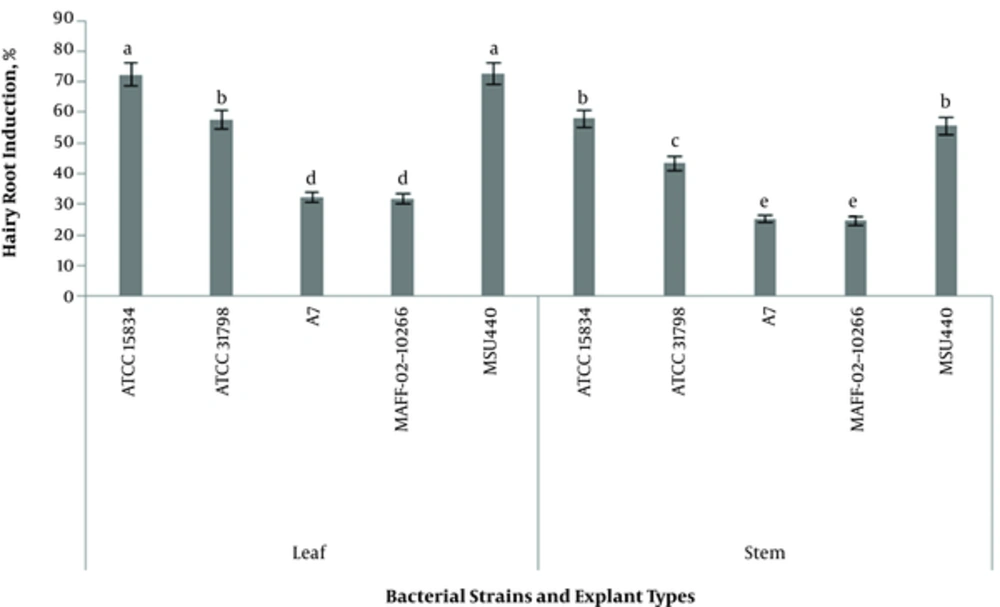
Figure 4.
Effect of different A. rhizogenes strains on frequency of hairy root induction in C. bipinnatus; the data were obtained as a mean of three replications. The different letters denote a statistically significant difference at P ≤ 0.05, as determined by Duncan’s multiple range test. Vertical lines represent standard errors
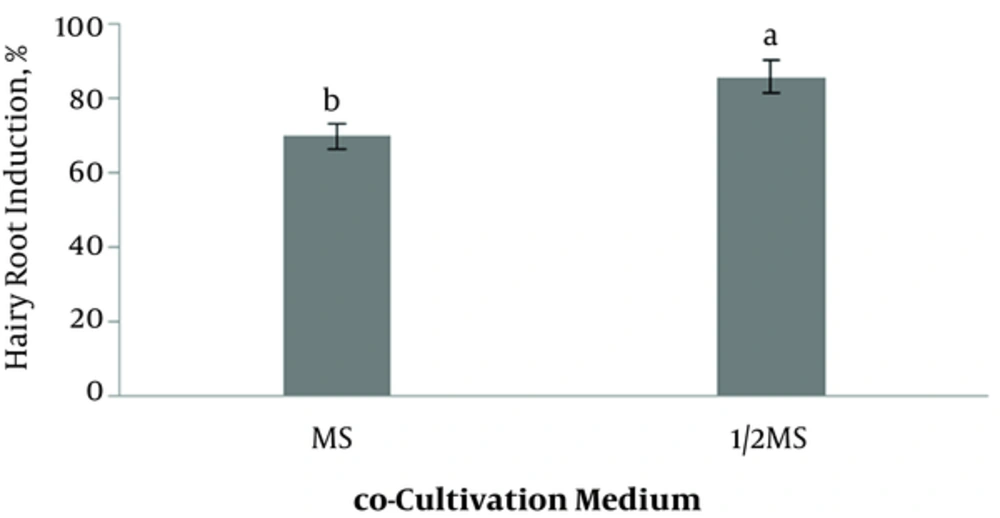
Figure 5.
Effect of co-cultivation media on frequency of hairy root induction in C. bipinnatus; the data were obtained as a mean of three replications. The different letters denote a statistically significant difference at P ≤ 0.05, as determined by Duncan’s multiple range test. Vertical lines represent standard errors.
4.2. Polymerase Chain Reaction Analysis
Total Genomic DNA was extracted from putative transgenic hairy root lines and control root line with the CTAB protocol (26). The PCR analysis of hairy roots and controls resulted in the amplification of expected fragment in hairy root lines similar to that of the positive control, while there was no extension in the DNA isolated from normal roots (Figure 6). The PCR with rolB primers resulted in rolB fragment amplification in all putative transgenic hairy root lines. Five transgenic hairy root lines among 55 obtained lines are presented in Figure 6. The PCR analysis using virG primers was done to approve that the obtained genetically transformed roots were not contaminated by A. rhizogenes, and virG amplification was not observed (data not shown). This result shows transformation of T-DNA in genetically transformed root lines.
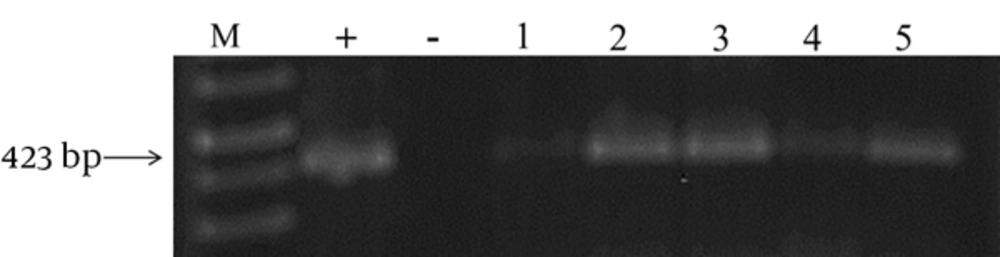
Figure 6.
A, PCR analysis for detection of the rolB gene in hairy root lines of C. bipinnatus; M: Molecular size marker (1 kb ladder); 1 - 5: hairy root lines, (-): negative control (non-transformed root); (+): positive control (Ri plasmid).
5. Discussion
This study, for the first time, established a reliable protocol for induction of hairy roots of the important C. bipinnatus. Secondary metabolites, probably apigenin, were released in ½ MS liquid culture medium after inoculation with hairy roots compared to control as indicated by the color of the medium (Figure 3). Former reports showed that A. rhizogenes strain and form of explants could influence hairy root initiation (26, 32, 34). In some explants, tumorigenic calli (galls) were induced. Tumorigenic calli formed at the infection spot of explants might be because of TR-DNA transferring iaaM and iaaH genes, which are accountable for auxins biosynthesis (23). This might be prompted by the special effects of endogenous hormone combined with the interface between explant and bacterial strain in reaction to the rol gene products (35). As tumorigenic calli is not appropriate for large scale productions, the results indicated that strain MSU440, inducing high frequency of genetically transformed roots and low amount tumorigenic calli, is more capable than the other bacterial strains used in this study. Some studies described that a proper application of acetosyringone in the culture medium through hairy root induction phase, supported hairy root production (32, 34). The difference in virulence, morphology, and growth level could be partially described by the diversity of plasmids harbored by the bacterial strains. Also, some studies described that a proper application of acetosyringone in the culture medium through hairy root induction phase, supported hairy root production (32, 34).
This research suggests that a medium with lacking mineral compounds is a better co-cultivation medium to achieve the highest rate of transformation. Prior studies indicated that vir G expression can be triggered by low levels of PO4 and proposed that PO4 deficiency could be a helpful signal to prompt genetic transformation. Similar results were described in transformation by A. tumefaciens in Lilium (36) and genetically transformed root generation of Papaver bracteatum, Nepeta pogonosperma, Dracocephalum kotschyi, and Artemisia aucheri (26, 31, 34, 37). Among the different strains evaluated for induction of transformed hairy roots in D. kotschyi, the MSU440 and ATCC15834 strains showed the highest rates of hairy root induction in each tested co-cultivation medium (31). In N. pogonosperma, the highest rate of hairy root induction was found using strain MSU440 followed by strains A13 and ATCC15834, respectively (26). In the present study, as the transformation efficiency was significantly increased by decreasing MS salts, the results suggest that extra macro-elements in co-cultivation media have inhibitory effects on A. rhizogenes mediated transformation of C. bipinnatus. Further studies on the role of these components are necessary to clarify how T-DNA transfer is controlled by mineral compounds.
When the produced metabolites are veiled into the culture medium, a catching system can improve their biosynthesis, opening the way to design uninterruptedly producing culture systems (23). The use of genetically transformed root could have a decent potential in exploring the molecular regulation of genes encoding apigenin biosynthetic enzymes. The hairy root culture system is a potential method for the production of apigenin, since it has several good potentials, such as fast growth frequency, easy culture and genetic manipulation, and an increased capability to synthesize by elicitation (23). This objective is additional accompanying with the rise of private companies interpreting this technology to marketable scales. The attention of the industry to genetically transformed roots will probably lead to more extensive research devoted to this model, to adapt it to different scales and various objectives. Advances in plant transcriptomics and metabolomics combined with modeling of metabolic fluxes via in silico methods and genetic engineering will allow genetically transformed root cultures to develop a great and maintainable phytochemical production scheme.
The current study was dedicated to developing an effective procedure for high frequency transformation of C. bipinnatus through genetically transformed roots induction. This improved transformation method succeeded by adapting to the co-cultivation medium. Also, different strains of A. rhizogenes and types of C. bipinnatus explants were valued. The maximum ratio of hairy root induction was found from leaf explants using MSU440 and ATCC15834 bacterial strains (72% to 73%). A significant increase in transformation frequency (84%) was observed when ½ MS medium was used as the co-cultivation medium. This is the first report considering the influence of different factors on genetic transformation of C. bipinnatus by A. rhizogenes.