In the period from 2006 to 2011, 2250 outbreaks of food-borne diseases were reported in Iran. Statistical analysis showed that the number of these individuals increased from 0.07 (2006) to 1.38 (2011) in 100,000 people (
27). The use of antibiotics led to an excessive increase in some pathogenic bacteria that are not only resistant to antibiotics but also are resistant to certain food preservation and processing methods. In addition, due to increased consumer awareness about the negative effects of artificial preservatives on human health and the benefits of natural additives, researchers have been more inclined to produce and apply natural products in foods. These factors led the food industry to search for natural preservatives that can increase the health and quality of food (
28). One of the best methods for preventing and controlling pathogenic bacteria is the use of lactic acid bacteria (
29).
Some studies on the health benefits of probiotics were published, and some researchers reported antibacterial activity of probiotics against pathogens (
30,
31). Turgay and Erbilir (
31) showed that isolates of
L. casei and
L. bulgaricus exhibited weak antibacterial activity against
E. coli and
S. aureus, which was in contrast to our results.
Among lactobacilli that were isolated from kefir,
Lactobacillus K1C strain showed a wide antibacterial activity against
E. coli ATCC 11303 and
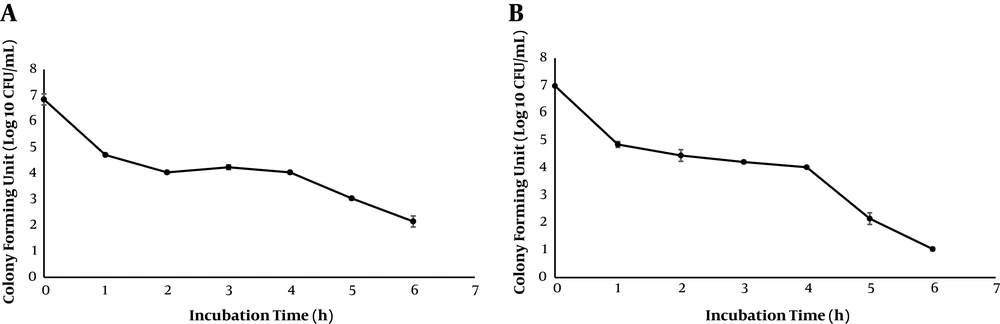
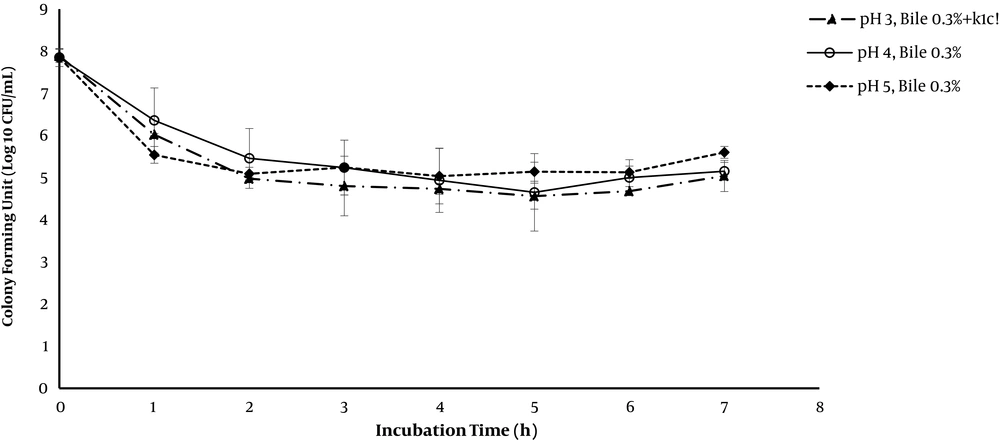
S. aureus ATCC 6538. This strain has a white colony of 2 to 3 mm in size. Under the microscope, long bacilli were seen with the pair and the chain arrangements. Growth inhibition due to superoxide anions produced by Paraquat was not observed in the case of the K1C strain, and it showed a weak growth at 42°C. It grows at different sodium chloride concentrations and 1% of some tasted sugars (Mannitol, sorbitol, sorbose, sucrose, glucose, galactose, melesitose, trehalose). The probiotic properties of this strain were shown in
Figures 2 and
3.
A, Survival of Lactobacillus strain K1C in the presence of hydrogen peroxide. The cultures of the isolates were suspended at 107 CFU/mL in saline phosphate buffer and heated with 0.4 Mm hydrogen peroxide; B, survival of Lactobacillus strain K1C in the presence of radical hydroxyl. The strains were suspended at 107 CFU/mL in a salt buffer and heated by a solution containing THA of 10 mM in saline phosphate buffer and copper sulfate 0.01 mM. Hydroxyl radicals are generated by the reaction of Fenton and by adding hydrogen peroxide 1 mM in solution. These experiments were repeated for three times.
Viability of L. casei strain K1C anaerobically cultured in presence of 0.3 % bile salts and different pH levels (3, 4 and 5) in MRS broth at 37°C.
The antioxidant traits increased significantly in minimum culture media and anaerobic condition (492.1 ± 0.25 µg/mL) compared to the similar condition in MRS broth (880.96 ± 0.05 µg/mL). The highest antioxidant production was observed in the stationary growth phase of the aerobically fermented minimum medium (266.82 ± 0.17 µg/mL).
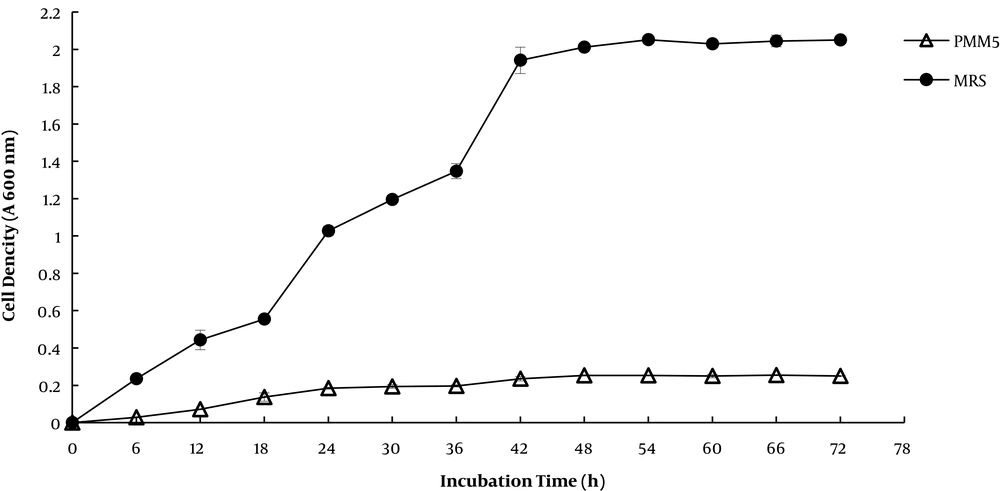
The growth phase of lactobacilli during the fermentation process could have effects on antibacterial and antioxidant production. Based on the results (
Figure 4), the maximum antibacterial activity was observed in the middle of the logarithmic stage until the beginning of the stationary growth phase. The maximum antioxidant activity in the stationary phase is in agreement with the previous reports by Wang et al. (
10). Kuliisar et al. (
20) stated that more aeration gave more free radicals, which would increase the antioxidant properties of lactobacilli. According to the results, antioxidant activity was elevated at aerobic conditions, but antibacterial activity was decreased by aeration that was approximately in agreement with the results of Abbasiliasi et al. (
32).
Growth curve of L. casei strain K1C anaerobically cultured in MRS broth and PMM5 at 37°C.
The results showed that the antibacterial activity of
Lactobacillus strain K1C increased in a minimal medium, but aerobic conditions have no effect on the production of antibacterial agents (
Figure 5). Antibacterial activity (MIC) of cellular free methanol extract of MRS medium fermented with
Lactobacillus casei strain K1C against
E. coli ATCC 11303 and
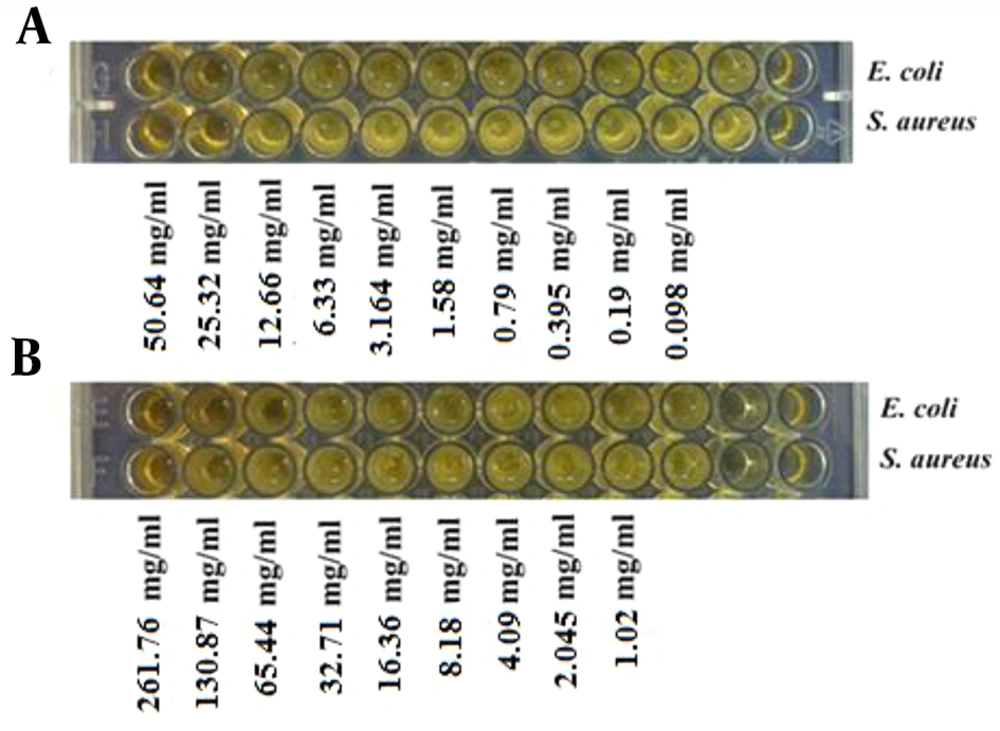
S. aureus ATCC 6538 were 32 and 128 mg/µL, respectively. The antibacterial activity of cellular free methanol extract of PMM5 medium fermented with
Lactobacillus casei strain K1C towards
E. coli ATCC 11303 and
S. aureus ATCC 6538 were 25.32 and 50.64 mg/µL.
A, MIC of the methanol extract of MMP5 supernatant cultured by L. casei strain K1C under anaerobic conditions for 48 hours against S. aureus ATCC 6538 (MIC 25.33 mg/mL) and E. coli ATCC 11303 (MIC 50.64 mg/mL); B, MIC of the methanol extract of MMP5 supernatant cultured by L. casei strain K1C under aerobic conditions for 48 hours towards S. aureus ATCC 6538 (MIC 261.76 mg/mL) and E. coli ATCC 11303 (MIC 130.87 mg/mL).
After fractionation of extracellular methanol extract of a minimal medium by TLC and using of TLC-DPPH bioautography method, only 3 antioxidant fractions were isolated that their Rf were 0.03, 0.20, and 0.34 by a solvent system of methanol: chloroform (2:3). Fraction number 1 with an Rf value of 0.03 showed antibacterial activity. The MIC of this fraction was evaluated against some pathogenic bacteria such as S. aureus (1,000 µg/mL), E. coli (500 µg/mL), Sal. Typhi (31.25 µg/mL), S. pyogenes (250 µg/mL), Y. entrolitica (1,000 µg/mL), S. epidermidis (500 µg/mL), B. licheniformis (250 µg/mL), and K. pneumonia (250 µg/mL).
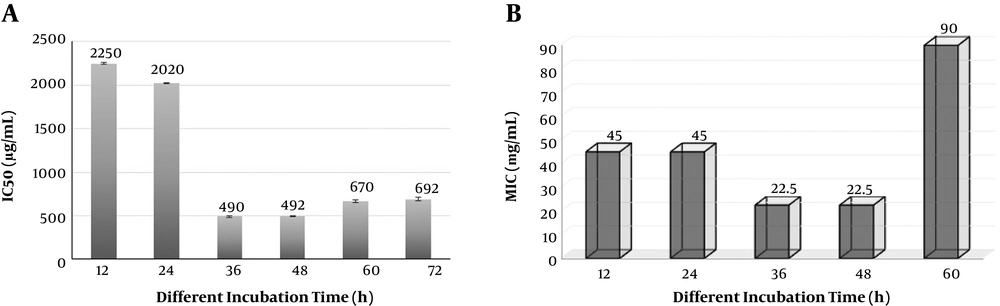
For determination of antioxidant and antibacterial production at different times of growth phase, MIC and DPPH assay of cell-free supernatants of
L. casei strain K1C were monitored at different hours that its results presented in
Figure 6.
Determination of antioxidant and antibacterial production in PMM5 medium at different times of growth phase: A, IC50 of L. casei strain K1C supernatants harvested at different hours and determined by DPPH assay; B, MIC of L. casei strain K1C supernatants harvested at different hours and monitored by broth microdilution susceptibility method against E. coli ATCC 11303. Note: Lower IC50 and MIC values indicate stronger antioxidant and antibacterial activities.
As expected, with the relative purification of fractions by TLC, the antioxidant and antibacterial activity of the fractions increased compared to the crude methanol extract of the same supernatant, which indicates that the purification and separation steps are carried out carefully, and there is an effective ingredient within the separated fraction. MIC of fraction number 1 derived from aerobically fermented PMM5 by L. casei strain K1C is 1,000 µg/mL against S. aureus and 500 µg/mL towards E. coli, whereas the crude methanol extract of the same supernatant has a MIC of 25.32 mg/mL against both indicator bacteria.
According to the biochemical tests for identification of fraction number 1 with Rf value of 0.03, the fraction has amine bonds and includes phenolic compounds, but no sugar and flavonoids compounds were detected.
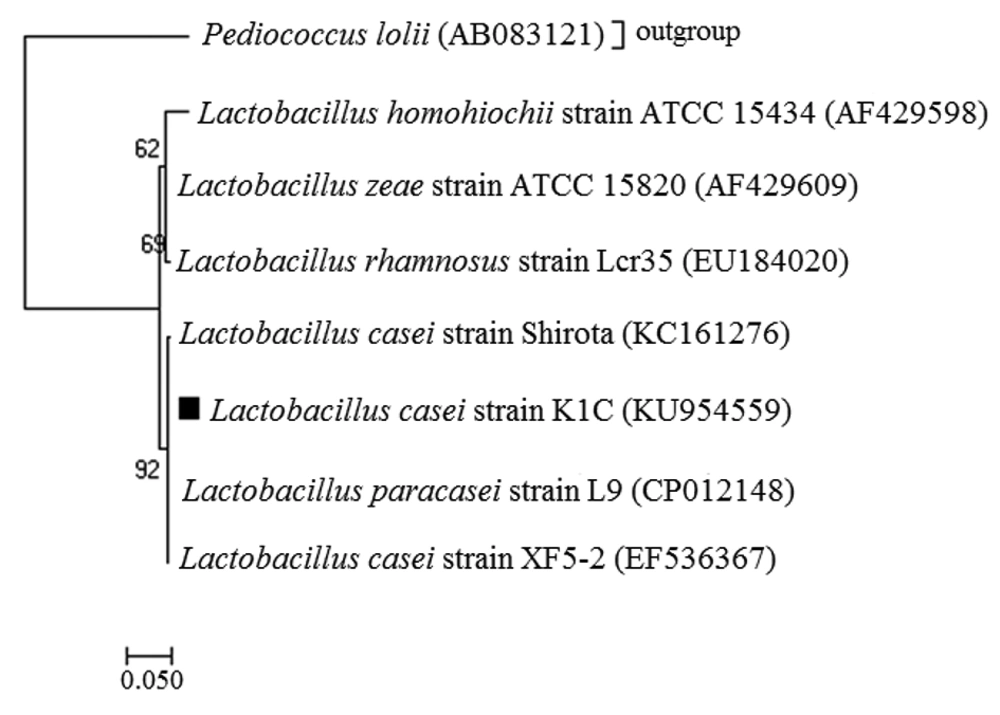
According to the phylogenetic tree of
L. casei K1C strain (
Figure 7), K1C isolate showed the most similarity (92%) to the probiotic bacteria known as
L. casei strain Shirota, which were recorded under the access number KU954559 in the GenBank database.
Phylogenetic tree based on nucleotide sequence of variable regions V2-V3 of 16S rRNA gene and 16S-23S ITS of Lactobacillus strain K1C, which is drawn using the neighbor-joining (NJ) method of MEGA software version 7.0.14. The scale line represents an alternative 0.01 for each nucleotide position. Bootstrap has been shown in 1000 splashes per cent in all splits.
4.1. Conclusions
There is no fractionation report on
Lactobacillus supernatant by TLC, and this is the first published data about this procedure and the proper solvent system that was methanol: chloroform (2:3). Based on the results, the supernatant extract of
Lactobacillus strain K1C exhibits strong antibacterial activity against pathogenic bacteria; therefore, it could be useful as a starter culture to equip antioxidants in food or as a natural preservative to the packaging food. This strain has the highest genetic similarity with
L. casei strain Shirota, which is considered to be food additives authorized by the food industries (
33). However, its impact on the microbiota and sensory characteristics of the food product should be investigated.