
1. Context
As the knowledge-based economy emerged, the prevailing understanding of innovation shifted over time. Universities and research institutes evolved and became key institutions in the emergence and expansion of innovation (1).
There is no single 'unique' approach (2). Educational institutions can either promote or limit innovative behaviors (3). To foster innovation, universities must exhibit creativity in their structure, processes, members, products, and performance (4). The three primary missions of universities, namely education, research, and services, have been emphasized for this purpose.
Universities are among the best places to foster innovation and provide services because they directly contact clients. To deliver the best possible services, universities need to exhibit innovation and creativity in their respective fields.
The discussion of service activities is often confusing (5) because the service sector encompasses a broad range of activities. These activities include consumer services such as hotels and banks, business services such as information technology, and large-scale public sector services such as health and education.
As a result of this diversity, service innovation encompasses evolution in various aspects. This evolution includes changes in the way services are designed, developed, provided, and managed.
The concept of service innovation is key to avoiding stagnation and routine and is a strategy for growth and a source of competitive advantage for companies (6).
Service innovation, which includes "new ways that service systems" - including higher education institutions - can adopt to improve services and increase customer satisfaction, is recognized as one of the three strategic research priorities of service institutions (7). However, despite being considered the engine of growth and competition for institutions, research in this field needs to be improved, and knowledge about the real impact of service innovation lags behind (8).
Edvardsson and Olsson (9) stated, "We are in the initial stages of identifying concepts and prerequisites for service development, and we need special tools and frameworks for service development and innovation." Similarly, Ganz (10) claimed, "there is not enough knowledge regarding how the service innovation process is designed, developed, and modeled."
Given the importance of service innovation, a major priority is to expand our understanding of service innovation and the framework in which it is understood (7).
The multidimensionality of service innovation is a defining characteristic that makes it a complex phenomenon to study. Service innovation involves not only its multidimensional nature but also the abundance of services available in the markets. As a result, it encompasses various models and can be examined from both technological and non-technological perspectives (6).
One of the problems related to service innovation and its management is the misconception that innovation is solely technological. Service innovation and its underlying processes are at least partially unique and multidimensional, encompassing numerous organizational dimensions beyond technology. It involves various disciplines and departments distributed throughout the organization and beyond (7).
As a result, management models and technology innovation support tools may not be suitable for managing service innovation and its processes (10). By creating a service innovation framework, we can address the first problem of the lack of understanding of service innovation and, to some extent, the lack of identity of service innovation. This framework can also be used to accurately define service innovation and identify and mention its different components (8).
As mentioned in the introduction, service innovation comprises various dimensions and components, and no comprehensive model encompasses them all. In fact, service innovation has been viewed from multiple perspectives. This article delves into different service innovation models, each presented with a unique perspective. Furthermore, this paper puts forth a comprehensive service innovation model by compiling and critically evaluating existing models and identifying the critical elements of each model. By comparing these models and highlighting the value and shared value, this paper contributes to research and practice in service innovation.
2. Evidence Acquisition
This study is based on the framework proposed by Carnwell and Daly, which includes the following steps and phases:
a. Definition of the scope and extent of the review
b. Identification and selection of relevant information sources, including determining entry and exit criteria
c. Review of texts
d. Critique of every study, and writing and recording a critical review
e. Application of the texts in the study to compare them in terms of agreement or differences of opinion between them (11).
Given that the ultimate goal of this study is to design and provide a comprehensive model of service innovation for the transfer of medical sciences universities to entrepreneurial universities, a systematic literature search was conducted to obtain models related to service innovation.
The texts were comprehensively searched in related databases and websites, including Google Scholar, Web of Science, Scopus, and Magiran, without any time limit. The primary keywords used in the search included "service innovation," "service innovation concept," "service innovation framework," and "service innovation model."
According to the scope of the research, the concepts of entrepreneurship and university were also searched using the operators "OR" and "AND" in combination with the main concepts.
A total of 1,504 models were identified in the search. After screening the titles and abstracts of the articles, duplicate and irrelevant texts, articles in languages other than English and Persian, and those with unavailable full text were excluded. Finally, 61 articles were selected for full-text review.
Out of the 61 texts, 10 articles presented a model and were studied as the basis for interpretation, synthesis, and abstraction of the dimensions, concepts, and effective factors of service innovation. These articles were used to reference the components of our model. The other texts were examined as evidence to criticize and review the main models (see Figure 1).
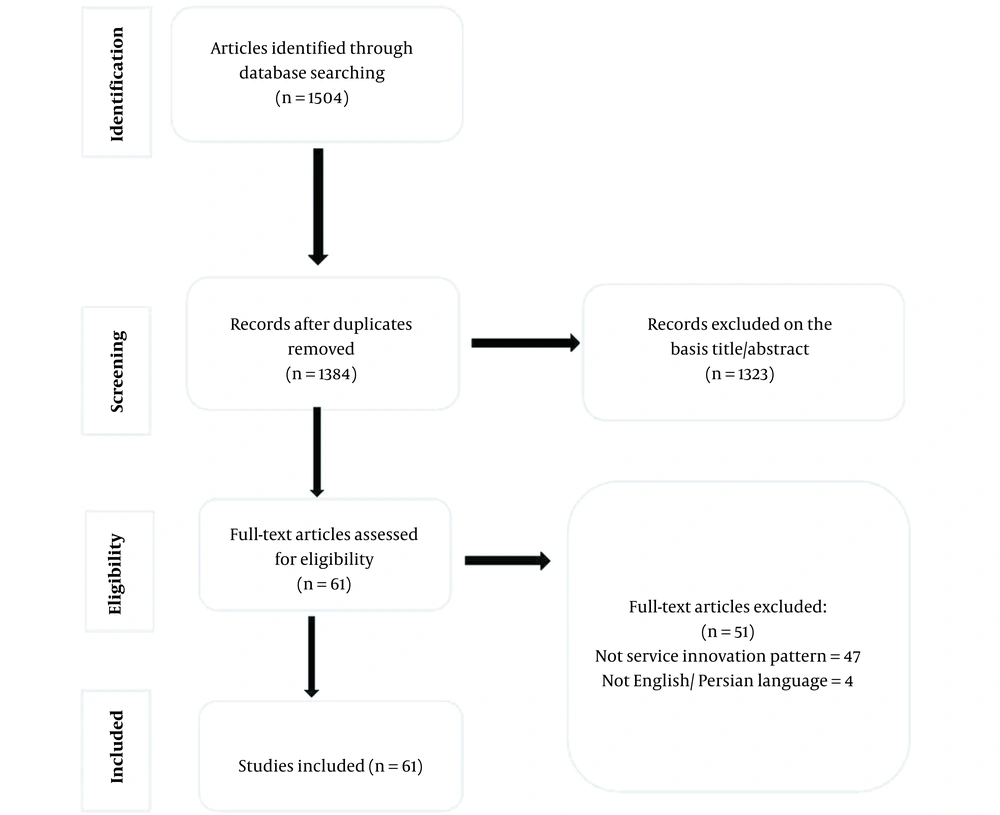
Figure 1.
The PRISMA diagram of the study selection results
The research team independently examined the selected studies using a critical review. In this review, each model was analyzed, and the criticisms presented in the texts were reviewed. The research team also provided their own criticisms of each model. Based on this analysis, the dimensions and components of service innovation were extracted. Finally, a comprehensive service innovation model was provided by integrating and combining these dimensions and components.
The limitations of this search include the restriction to English and Persian language articles and the inability to access certain databases.
3. Results and Discussion
Different studies have examined and presented service innovation from various perspectives. Therefore, in this study, we aim to examine the main related studies and models (see Table 1) and then present a comprehensive service innovation model based on integrating the obtained findings (Table 1).
Table 1.
A Description of Service Innovation Models
| Model Name/Publication Year | Author’s Name | Focus of Model | Description of the Model |
|---|---|---|---|
| Toward a theory of innovation in services (1986) | Barras (12) | Use of information and communication technology | The author presents a theoretical model of the service innovation process based on the idea of a "reverse product cycle" in service industries, using research on financial services. This model considers information technology as a driver of service activities and argues that developing service innovation theory is necessary to understand this role. According to Baras, based on the role of technology in service activities, the stages of service innovation can be described as follows: 1. Increasing the efficiency of existing service design; 2. Improving service quality; 3. Creating completely new services. |
| A proposed model for new service development (1989) | Scheuing and Johnson (13) | Service development process | In this model, the authors used the product development framework and stages (idea generation, idea development and screening, market opportunity analysis, product design and development, product testing, and product launch). They specified a service development model with a continuum of 15 stages of activities. While the main stages of product development were preserved, the proposed model's sequence of activities goes beyond traditional product development models. This model describes the stages of service development in four phases, including Direction, Design, Testing, and Introduction. |
| Key concepts for new service development (1996) | Edvardsson and Olsson (9) | Service development dimensions and processes | This model describes the service development process in terms of three essential components: Service concept, service process, and service system. Therefore, the NSD process is divided into three sub-processes: Service concept development, service system development, and service process development. Furthermore, this model outlines numerous detailed tasks for each sub-process. Essentially, the NSD process is presented as tasks rather than as sequential steps in this model. |
| Innovation in services (1997) | Gallouj and Weinstein (14) | Change in service features | The author's model describes how service characteristics can serve as a starting point for analyzing and defining potential forms of innovation. Gallouj defines innovation as any alteration in one or more service characteristics (application, technical, or process) that can result from various basic mechanisms. Based on this definition, he describes different modes and models of innovation, including radical innovation, improvement innovation, incremental innovation, ad hoc innovation, recombination innovation, and formalization innovation. |
| Conceptualizing service innovation and service innovation models (1999) | den Hertog and Bilderbeek (15) | Dimensions of service innovation | The author explains that service innovation is a multidimensional phenomenon and combines the following dimensions: The service concept, the customer interface, the service delivery system/organization, and technological options. In practice, the importance of each dimension and the different links between them differ based on the specific characteristics of different services and institutions, and service innovation can involve changes in all dimensions. |
| A resource-process framework of new service development (2007) | Froehle and Roth (16) | Service development process and resources | This model describes the NSD process in four generalized stages: Design, Analysis, Development, and Launch. In this model, NSD performance is based on intellectual, organizational, and physical resources. The ability to compete based on a company's ability to develop new services depends to a certain extent on a network of internal and external resources that evolve and change. Therefore, resources and the consequences associated with its resource-oriented NSD practices should be addressed. |
| An integrated framework for managing service innovation (2007) | Chen et al. (17) | Service development process and value production | Chen, considering the main focus of service innovation at the industry level, which includes value proposition, value establishment, and value allocation (referred to as the 3V innovation model), and the main emphasis at the company level, the key processes of designing, developing, and delivering new services (referred to as the 3D innovation model), presents a three-dimensional model of service innovation. |
| Capabilities for managing service innovation: Toward a conceptual framework (2010) | den Hertog et al. (18) | Dimensions and capabilities of service innovation | The author has developed a four-dimensional model and states that service innovation is a multidimensional phenomenon comprising six dimensions. In this model, Hertog addresses the problem of service innovation management at the company level and provides six dynamic capabilities for managing service innovation. |
| Service innovation viewed through a service-dominant logic lens: A conceptual framework and empirical analysis (2011) | Ordanini A, and Parasuraman (19) | Capabilities and results of innovation | The author describes the events and consequences of service innovation based on the principles governing services and their integration with the insight of innovation. The events of service innovation include the ability to participate, the dynamic ability of customer orientation, and knowledge interfaces. Ordanini states that these events are expected to affect the results of service innovation in terms of volume (width) and radicalness (depth). |
| A framework for service innovation capability maturity model (2010) | Li et al. (20) | Process and maturity level of service innovation capabilities | The author proposes that service innovation involves changing service systems to create value. They also present a new model for service commercialization consisting of two process models and two process groups aimed at supporting a service innovation environment and creating value for customers. In this model, six capability maturity levels are defined for each process area, ranging from level zero to level five, and each process area can attain a different level of capability within an organization. |
3.1. Author’s Model
The ten models discussed above each refer to certain components of service innovation. The key components of each model for successfully designing and implementing service innovation were extracted and integrated into a new model. This comprehensive model includes six components: (1) process; (2) focus of service innovation; (3) type of innovation; (4) results of innovation; (5) capabilities; and (6) infrastructures of service innovation.
The first component of the service innovation process includes several steps:
- Idea generation: Identifying problems and needs and searching for solutions both inside and outside the organization.
- Idea development: Examining the current situation, obtaining the necessary resources, identifying internal and environmental limitations and opportunities, systematically and critically evaluating the new service idea internally and externally, accurately defining policies, procedures, and performance standards, and analyzing and acquiring resources, talents, and competencies.
- Idea testing: Examining the opinions of future users and operational personnel regarding the provision of benefits and solutions related to needs and problems.
- Market analysis: Thoroughly evaluating the market, creating accurate forecasts of capacity and growth potential for a new service, and obtaining diagnostic information about market variables.
- Operational design: Designing to support services, including installation, modification, and debugging of the mechanism of providing what is needed, by whom, and with what skills.
- Personnel training: Empowering employees to interact and communicate with customers and provide appropriate services, inviting related and expert people to provide training.
- Executive testing: Determining the level of acceptance of new services by customers, making any necessary corrections regarding the service, and evaluating alternative options.
- Launching: Officially advertising new services, customer training, and collecting data and customer feedback to ensure the suitability of services and meet customer needs, and discovering any unforeseen defects in the service process or system.
The process employed by a company is a critical element in the development of new services, and it must proceed systematically through a series of steps. This begins with examining the company's goals and constraints and continues through product introduction (13, 21).
The second component is the focus of service innovation. According to the models that have addressed the dimensions of service innovation, this model considers the service innovation focus to include:
- Service organization: Organizational structure and culture, human resources, internal management systems and performance, infrastructure, regulations, and norms
- Service provider: Frontline employees, service development, and innovation teams in departments and units
- Service provision: Improving organizational structure, promoting an organizational culture based on shared values with customers, creating an organizational unit to design a new service delivery system based on customer needs, determining and designing internal and external arrangements for service delivery
- Service: Meeting customer needs and solving problems, proposing new solutions
- Service Consumer: Service recipients, organizations, people at the community level, organization employees
- Service market: New societal needs and opportunities for service provision.
Service innovation is a multidimensional phenomenon, where the importance of each dimension may vary depending on the service, innovation, and institution (9, 15, 22).
The third component is the type of service innovation. Based on the above dimensions, we have identified the types of service innovation as follows:
- Service organization innovation: This involves changes in management performance, creating a culture of innovation, altering organizational processes, and gaining access to appropriate resources and infrastructure.
- Service provider innovation: This type of innovation involves recognizing opportunities for innovation through customer and competitor contacts, changing communication and interaction development, and creating new organizational roles and responsibilities.
- Service provision innovation: This type of innovation includes changes in delivery and functional methods, as well as changes in existing systems and routines.
- Service consumer innovation: This type of innovation involves creating new collaborative roles for service consumers in the stages of production, development, and presentation of ideas and services.
- Service market innovation: This type of innovation includes creating new demands and expectations from the organization and conducting market analysis to understand customer needs and desires.
Innovation can occur in multiple dimensions, and service innovation may involve changes in one or more of these dimensions (14, 23, 24).
The fourth component of service innovation is the results. Based on the dimensions and types of innovation, the changes and expected results can include a new service organization, a new service provider, a new form of service delivery, a new type of service, a new service consumer, and a new market (25, 26).
We have determined the fifth component of service innovation to be capabilities, which includes the ability to respond to user demands and technology options, effective conceptualization, efficient knowledge management, effective market management, robust research and development, and entrepreneurial awareness.
A collection of organizational skills, knowledge, and experiences that enable the formulation and implementation of an innovation strategy is known as innovation capability. Success in innovation is not a coincidence. An organization can only innovate if it possesses the capacity to innovate (5, 18, 24, 27, 28).
The sixth component is infrastructure, which includes human capital, structural capital, physical capital, and communication capital.
If a service company wishes to establish a more sustainable strategic position based on innovation, it must also evaluate how it manages its physical, organizational, and intellectual resources. Intellectual resources encompass human capital, which includes, but is not limited to, the educational, cultural, and experiential knowledge and skills of employees. Employees are typically considered the key resource of a service organization. Thus, it is crucial to plan for human capital by training the appropriate number of qualified individuals to provide services and avoid wasting resources.
Organizational resources include management systems, attitudes, and informal relationships within and outside the organization. Physical resources consist of facilities, equipment, units, and physical space owned by the organization (16, 29-31) (see Figure 2).
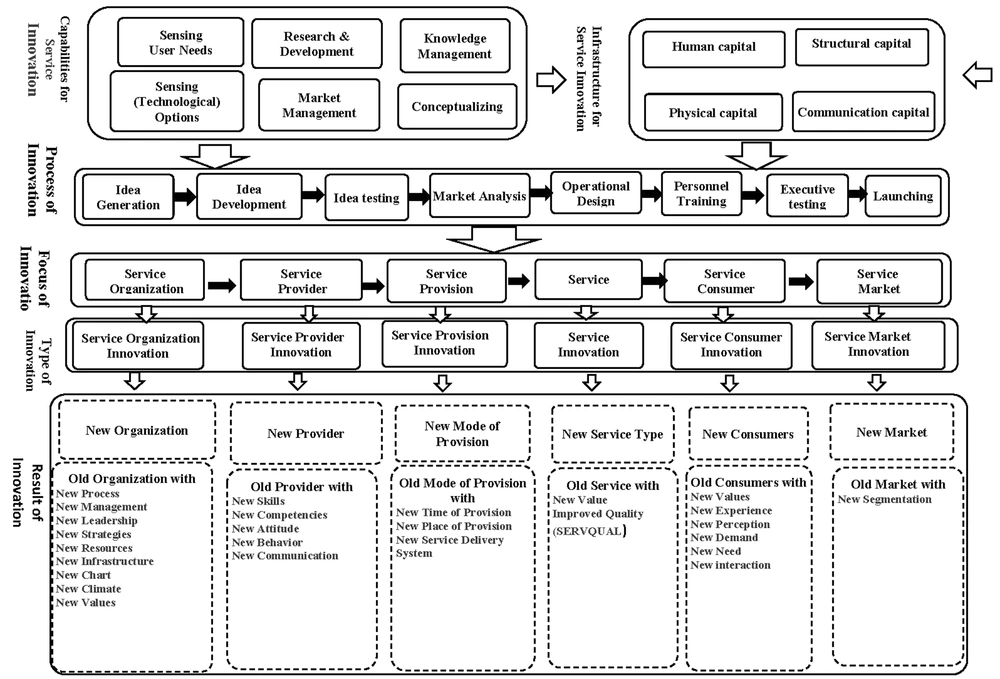
Figure 2.
The new pattern of service innovation
A bold attempt to develop a theory of service innovation was provided by Barras (12). His influential model marked the first step toward theorizing service innovation. However, the "one-size-fits-all" approach of his model has been subjected to considerable criticism (32). The main criticism of Barras's model is related to its technological determinism and its tendency to neglect service-specific features. In particular, considering only the technical and logical aspects of the innovation may lead to underestimating the types of non-technological innovations in services (33).
In fact, the Barras model is based on the dominant view of innovation, that is, innovation through technology, and other dimensions of service innovation have yet to be considered in this model.
Johnson et al. (2000) describe the NSD process in the second model. Although they present a descriptive model of the current processes, this sequential development model suffers from three major weaknesses. First, "stage" systems often lead to time-consuming and overly bureaucratic processes that slow down projects (13).
Secondly, the NSD process is based on cross-functional teams specifically created for this task, and the model does not include how the company's development team is organized. Thirdly, sequential models do not assist in defining what needs to be produced at each stage (34).
This model does not mention the required features and capabilities or their impact on each stage of the service development process, nor does it discuss the consequences of service development.
In the third model, Edwardson et al. (1996) do not use the term "innovation" in their model and do not discuss the relationship between NSD and service innovation. The absence of an innovation perspective means that this model focuses only on new services to the company and does not address the issue of introducing new services in markets. Therefore, this model falls short of addressing the ways in which incremental innovations can be created (35).
Edwardson's model helps identify various sub-components in service innovation, but it needs to fully develop an essential element, the necessary resources, and the infrastructure involved in developing new services.
In the fourth model, Gallouj argues that service innovation rarely follows a technological path and instead follows "professional service paths." The positive aspect of Gallouj's model is that it needs to differentiate between product and process innovation as two distinct types of innovation. It is also beneficial to examine more closely innovations that do not result in the emergence of entirely new services.
Gallouj identifies one type of innovation: Ad hoc innovation. This type of innovation is both important and ambiguous, and scholars have justifiably criticized it. Some have argued that it does not constitute an innovation because temporary innovations cannot be replicated (36).
Gallouj's classification helps analyze different types of service innovations. However, to provide a more comprehensive explanation of the potential areas for innovation, it is also essential to consider the non-technical characteristics of services, which needs to be further considered by Gallouj.
The four-dimensional model of service innovation was developed in 1999 by den Hertog and Bilderbeek (15). Hertog argued that in services, it is often necessary to make many changes in different parts of the service and its organization to create innovation and motivation instead of just changing some details of the final service delivery (37).
An unanswered question in Den Hertog's study is how to integrate customers as co-creators into the service innovation process to positively influence service innovation practices within an organization and deliver exceptional customer service (38).
Hertog's model has confirmed the non-technological dimension of service innovation by presenting one technological and three non-technological dimensions. As a result, it is a suitable model for identifying and comprehending the dimensions of service innovation. It emphasizes the importance of non-technical dimensions in service innovation and encourages attention to these aspects (15).
The sixth model, the resource-process model of service development presented by Froehle and Roth (16), as its name suggests, focuses exclusively on NSD.
Service innovation is a broader concept that should include strategic aspects such as service innovation capabilities.
Secondly, we propose modifying Froehle's model by explicitly distinguishing relational capital as a separate resource on the resource side. Issues related to more effective management of these relationships should be added, along with the need to define them as innovation capabilities (39).
Froehle's model emphasizes the selection of internal and external resources but does not explain how to manage these resources toward service innovation. Additionally, the model lacks a causal relationship between NSD functions and organizational performance, as well as between resources and how to enhance these relationships. The relationships between inputs and outputs have also not been specified in the model.
The seventh model, the 3V-3D model, was presented in 2007 and emphasizes providing value to the customer through service innovation.
Value creation is the ultimate goal of service providers, and it will remain sustainable only if it includes the value of all stakeholders, such as customers, service providers, and suppliers. However, customers from various sectors may have different needs in value creation. The key drivers of value-based innovation in services may differ significantly in each of these sectors. Thus, it is crucial to evaluate various scenarios for services across different industries and address the following questions: Who will be the future customers? What kind of experiences will customers expect? How should companies provide necessary service systems? What does value mean in this context? (40).
This model does not mention the resources, drivers, capabilities, and necessary organizational actions a company must possess to deliver value.
Regarding the eighth model, Gryszkiewicz et al. states that Den Hertog provides many contributions to service innovation. Hertog suggests six dynamic service innovation capabilities, which are very insightful propositions. However, it should be noted that they are only conceptual and do not help us understand the content of innovation capabilities (39).
Den Hertog's perspective is that, despite specific differences in detail, there are common elements in key features that facilitate the development of frameworks for comparison purposes and enhance service innovation capabilities (41).
Den Hertog's model (2010) provides managers with insights that they should focus on to manage service innovation (18). While the dimensions and capabilities identified in this model are important determinants of competitiveness in service-oriented institutions, a question arises: Which of these capabilities are more critical than others for competitiveness at the company level and for creating added value? Hertog has not addressed this question in his model.
In the ninth model, Ordanini and Parasuraman (19) explains that services are usually conceptualized as physical goods. The innovation process is typically analyzed only by extending or adapting some insights developed for physical goods.
In addition, service innovation is often associated with new actor-oriented ways of integrating, using, or capturing value in service systems. Ordanini's model shows the need for an integrated or hybrid approach to studying service innovation (42).
This model presents a new and different perspective on service innovation. While focusing on resources and actors, it ignores the forces and capabilities institutionalized in the organization's structures.
Li et al. (20) presented the maturity model of service innovation capabilities.
A capability maturity model describes a set of stages that represent the projected path from an organization's current state to maturity or success in a discipline.
There are two primary objectives of maturity models. The first is to determine the maturity of an organization's capability in terms of a specific area or practice. The second objective is to facilitate the creation of an improvement path that best suits the company based on the results of the first objective and is in accordance with the best practices proposed in the field (43).
By examining NSD success factors, this study provides a conceptual framework to facilitate the development of new proposed services and a deeper understanding of NSD project implementation and management-related insights. Service companies can use NSDMM as a roadmap to achieve higher NSD competencies.
Service innovation has been studied from multiple perspectives in various studies, including the dimensions of service innovation (den Hertog et al. (18)), service development (Edvardsson and Olsson (9); Chen et al. (17)), service innovation capabilities (den Hertog et al. (18)), service innovation process (Barras (12); Chen et al. (17)), and service development process (Scheuing and Johnson (13); Edvardsson and Olsson (9); Froehle and Roth (16); Li et al. (20)), sources of service development (Froehle and Roth (16)), drivers of service innovation (Ordanini and Parasuraman (19)), the degree of change in service characteristics (Gallouj and Weinstein (14)), and determining the level of service innovation (Li et al. (20)). These studies suggest that no single service innovation model can be applied independently and that they should complement each other. As a result, a comprehensive model is needed.
The author proposes a comprehensive model of service innovation, which is the result of extracting and integrating the components and dimensions of service innovation provided in other studies. However, it is important to note that service innovation is context-dependent. Thus, it is necessary to consider the requirements and challenges of the specific context to implement and operationalize the model successfully. If necessary, the model should be revised according to the context.
A summary of the strengths and weaknesses of the service innovation models explained above is presented in Table 2.
Table 2.
Strengths and Weaknesses of Service Innovation Models
| Author’s Name/Year | Strengths | Weaknesses |
|---|---|---|
| Barras (1986) (12) | The first step toward service innovation theorization | It presents innovation clearly depending on the different stages of adoption of information and communication technology; however, services are considered merely consumers of new technology with only a minor contribution to innovation. |
| Scheuing and Johnson (1989) (13) | It specifies a description of the new service development processes and the organizational components involved in the process; emphasizes the interdependence of design and development and the cyclical stages of the new service creation process and adds non-linear elements to the new service development model. | The types of services, their corresponding stages of development, and their impact on the development of new services have yet to be mentioned. The required features, capabilities, and factors such as company size, a culture of innovation, and their impact on each stage of the service development process have not been considered. The necessary resources required to develop new services have yet to be mentioned. |
| Edvardsson and Olsson (1996) (9) | The goal of developing new services is "creating prerequisites for services that have an attractive added value from the customer's point of view." it reflects the practices that deal with the sequence of NSD activities; it helps in identifying different sub-components in services | The necessary resources involved in the development of new services and how to manage physical, organizational, and intellectual resources are not mentioned; it emphasizes what the service is, but it does not explain how to design the service; the NSD process is described in the form of tasks, but the sequential steps and the process of the NSD are not clearly discussed. |
| Gallouj and Weinstein (1997) (14) | It refers to the technological, final, and process features of service innovation. Based on that, it provides detailed classifications to distinguish different types of service innovations; it is valuable in that it expresses the degree of change in both product and process innovation and serves as a tool for analyzing different types of service innovations. | On the one hand, the text suggests that service innovation is a professional discipline. On the other hand, it attempts to classify service innovation based on technical characteristics. The category of technical specifications is very broad, as it includes both the systems used in service production and the actual service process. It could be argued that innovations only occur in this category, and the benefits provided to the customer result from technological advancements. |
| den Hertog and Bilderbeek (1999) (15) | The presentation of one technological dimension and three non-technological dimensions in service innovation confirms the non-technological aspect of service innovation; it emphasizes that service innovation often requires significant changes in different parts of the service and its organization rather than just minor adjustments to the final service delivery. | The service innovation process, the role of dimensions in each innovation stage, and the required resources related to dimensions for service innovation have not been clearly stated; the level of customer participation as co-creators in service innovation has not been addressed. |
| Chen et al. (2007) (17) | It examines how to produce, expand and allocate value as the goal of service innovation and its relationship with the service development process. It, therefore, provides an integrated framework to help policymakers and executives identify and realize the benefits of service innovation. | A service company operates in a dynamic environment characterized by various social, technological, economic, environmental, and political changes. As a result, the value proposition of the company may change to accommodate the evolving customer needs. However, the model does not take into account the fact that each department or institution may have a unique process, key drivers, and necessary capabilities for value-based innovation in services, as customer needs and experiences may vary across different contexts. |
| Froehle and Roth (2007) (16) | Emphasizing the selection of internal and external resources can assist managers of service organizations in thinking differently about their resources for NSD and improving them. | It focuses solely on the process and resources related to NSD. It does not address strategic aspects such as service innovation capabilities, practical resource and process management, and how to sustain the relationship between resources and the service development process; the ideal combination of internal versus external resources that leads to service innovation should be mentioned. |
| den Hertog et al. (2010) (18) | It presents a set of service innovation capabilities as part of a multidimensional structure and provides managers with insights that they should focus on to manage service innovation. | The capabilities mentioned in this model are purely conceptual and do not help us understand the content of innovation capabilities. Furthermore, it does not clarify which capabilities are more critical for competitiveness at the company level and creating added value. Additionally, it does not specify the prerequisites and structures necessary to achieve these capabilities. |
| Ordanini and Parasuraman (2011) (19) | By highlighting the significance of actors as the crucial element that impacts both the extent and the magnitude of innovation, the new notion of service innovation offers a fresh perspective compared to past viewpoints. | It ignores the capabilities institutionalized in the organization's structures and has not been mentioned. |
| Li et al. (2010) (20) | This model illustrates the anticipated journey from an organization's current state to the stage of maturity or success, with two primary objectives: Assessing the organization's capability maturity level in a particular field and facilitating the development of a roadmap for improvement; it provides a comprehensive view of the various stages of service innovation and serves as a roadmap for achieving higher levels of service innovation. | This model does not consider the interdependence between dimensions, and achieving maturity in one dimension is likely dependent on other dimensions. |
4. Conclusions
As mentioned, each of the examined models explains some of the components and dimensions of service innovation. However, the comprehensive model presented in this research outlines the dimensions and components, and effective factors in service innovation structurally. It includes six main components: (1) process, (2) focus, (3) type, (4) results, (5) capability, and (6) infrastructure.
Paying attention to the elements of this model can play a fundamental role in understanding service innovation and changing the innovation policies of universities as service institutions. Examining the status of each component in universities to transition to entrepreneurial and innovative universities should be included in their plans and policies.
4.1. Strengths and Limitations
One of the most significant limitations of this study is its subjectivity due to the critical review method used, which can impact the reproducibility of the results or the resulting model. Another limitation is the reliance on English and Persian texts, which limited the use of authentic texts in other languages. However, the study also has its strengths, the most significant being the development of a new and comprehensive model that can be implemented in service institutions, such as universities.
4.2. Future Research
According to the identified components, future research can examine and identify the requirements and challenges of service innovation in universities as service institutions.