1. Background
Academic burnout in university students refers to “a feeling of exhaustion caused by homework assignments, having a pessimistic attitude towards university affairs, and a feeling of incompetence as a student” (1). In addition to affecting different aspects of students' personal lives, academic burnout can have many negative impacts on their academic and family conditions, including various psychological complaints, maladjustment, intra-family conflicts, and academic problems. These impacts may affect the quality of the future workforce in society (2). Academic burnout is one of the chief problems of medical students who encounter multiple stresses, including excessive academic pressure, scarce leisure time, emotional pressure to receive higher grades and special conditions of learning complex medical procedures during the long course of their medical program (3). This, in turn, may give rise to a feeling of exhaustion and negative attitudes toward their study (4). Studies have shown that female students are more affected by academic burnout than male students due to their different psychological states (5). Smith and Emerson (6) reported that psychological distress had significant positive associations with academic burnout in undergraduate students.
Academic burnout among university students involves a feeling of tiredness resulting from study demands and requirements (exhaustion), pessimistic and uninterested attitudes towards tasks (cynicism), and a feeling of incompetence as a student (inefficacy) (7). Kordzanganeh et al. (8) reported that students suffering from academic burnout usually experienced a lack of participation in class activities, apathy toward the course materials, and a feeling of incompetence in learning course materials. The topic has received increased attention in academia as many researchers believe that academic burnout is a crucial research topic in universities (1, 5). In their view, one of the reasons behind the increased research attention given to academic burnout among students is the fact that it can affect their relationship with universities and their interest and enthusiasm for continuing their academic studies. In addition, academic burnout can be a key factor in understanding students’ actions - their academic performance, in particular - during their education.
Hope for the future seems to be one of the various factors contributing to academic burnout in medical students (9). Mohammadi et al. (9) reported that there was a negative, significant relationship between hope and academic burnout among medical sciences students. Many people enter the university and study particular disciplines in order to get a decent and rewarding job in the future or increase their chances of employment. Not all disciplines enjoy a similar employment rate, and some may even have a saturated labor market. The main objective of all educational institutions-schools and universities, in particular-is to train a workforce specialized enough to carry the social responsibilities (10). This requires motivated students who can make informed decisions about their academic discipline (11). In this respect, positive attitudes toward the disciplines and career prospects can motivate students, bring them job satisfaction, and facilitate their progress in society (12, 13). Studies have confirmed the correlation between academic attitudes, career prospects, and success with academic involvement/diligence and the absence of academic burnout (14, 15).
Another factor involved in academic burnout among medical students seems to be stress which refers to individuals’ assessment of stressful situations in life and how much they perceive them as controllable or uncontrollable phenomena (16). Stress includes the inability to cope with stressful situations, resulting in real threats to the vital mental and physical balance in individuals (17, 18). Studies have shown that the stress level is higher in women than in men (19). Since medicine is a stressful profession, high levels of stressful professional experiences might cause feelings of incompetence, self-doubt, low self-confidence, irritability, physical discomfort, and sleep disorders for medical students (20). Therefore, the clinical internship is an important stress-causing factor for medical students who may encounter challenges or threats in the dynamic clinical space when, for instance, using medical equipment, communicating with the staff, teachers, and patients' families, and managing the patients’ acute problems (21).
The most important sources of stress for medical students are academic studies (e.g., heavy study load and study-related problems) and the clinical environment (e.g., fear of unknown situations and errors when caring for patients and using equipment). Student life causes high levels of stress due to the parental expectations, challenges of independence, and financial problems, leading to an increased academic burnout among medical students (22).
2. Objectives
Given the above discussion, the present study aimed to investigate the relationships between academic burnout and hope for the future through examining the mediating role of stress in medical students.
3. Methods
3.1. Design and Participants
Structural equation modeling (SEM) was used in this correlational study. The statistical population included all medical students in Ahvaz, Iran, in 2022. A multistage cluster method was adopted to perform sampling, which lasted from April 16 to May 21, 2022. Two faculties were randomly selected out of five faculties of health, nursing-midwifery, paramedicine, medicine, and dentistry, and then a total of 310 students were randomly considered as the study samples after obtaining informed consent. The inclusion criteria of the study were being a student at Ahvaz University of medical sciences and willingness to participate in the research. The exclusion criteria, on the other hand, were having psychiatric disorders and failure to respond to all the items of the research questionnaires. The sample size was determined based on the number of variables and the statistical model. In SEM, the number of parameters is calculated based on the number of direct paths, exogenous variables, and error variances. According to Loehlin and Beaujean (23), as well as considering the number of paths and variables, 250 to 300 participants were sufficient to test the proposed model and the study hypotheses. To predict the participant attrition, a total of 310 participants were initially selected through convenience sampling. The instruments were given to the participants, out of whom 301 answered the items completely and entered the study. In order to comply with the ethical considerations, the participants were assured of the confidentiality of their data. The study was approved by the Ethical Committee of the Islamic Azad University, Ahvaz Branch (code: IR.IAU.AHVAZ.REC.1402.006).
3.2. Research Instruments
Academic Burnout Questionnaire: Developed by Bresó et al. (24), the Academic Burnout Questionnaire has 15 items, scored based on a 5-point Likert scale ranging from 0 (strongly disagree) to 6 (strongly agree). The scale has three subscales, namely exhaustion (5 items), cynicism (4 items), and academic efficacy (6 items). Higher scores on the first two subscales and lower scores on the last subscale indicate the presence of burnout. Reverse scoring is used for items 3, 6, 8, 9, 12, and 15. Kordzanganeh et al. (8) reported a Cronbach's alpha coefficient of 0.87 for the questionnaire. In the present study, Cronbach's alpha was 0.89 for the questionnaire.
Attitudes towards Education and Career Prospects Scale: Designed and developed by Talverdi et al. (25), this scale is used for measuring students’ attitudes toward education and career prospects. It measures three components of the interest in study discipline, career prospects, and career planning included in 17 items. The scale is scored based on a 5-point Likert scale (from 1 to 5). The total score, ranging from 17 to 85, is calculated by the sum of the scores of the items. A higher score on this scale indicates more hope. Talverdi et al. (25) reported a Cronbach's alpha of 0.92. In this study, the reliability of the instrument was confirmed by a Cronbach's alpha of 0.83.
Medical Student Stressor Questionnaire (MSSQ): Developed by Yusoff et al. (26), the MSSQ has 40 items. Items 1 to 11 plus 16 and 17 are categorized under the subscale “academic related stressors (ARS)”, items 25 to 31 are grouped under the subscale “Interpersonal and intrapersonal related stressors (IRS)”, items 19, 20, 22, 34, 35, 36, and 37 are under the subscale “teaching and learning related stressors (TLRS)”, items 18, 21, 23, 24, 38, and 39 are under the subscale “social related stressors (SRS)”, items 32, 33, 40 are under the subscale “drive and desire related stressors (DRS)”, and items 12 to 15 are categorized under the subscale “group activities related stressors (GARS). All items are scored based on a 5-point Likert scale (from 0: Causing no stress at all to 4: Causing severe stress), and higher scores (both in total and for each subscale) indicate higher levels of stress. Jayarajah et al. (27) reported a Cronbach's alpha coefficient of 0.95 for the questionnaire. In the present study, Cronbach's alpha was 0.87 for the MSSQ.
3.3. Data Analysis
Data were analyzed using descriptive and inferential statistics, including mean, standard deviation (SD), and Pearson correlation coefficient. The proposed model was analyzed by performing structural equation modeling (SEM) in IBM® SPSS® Statistics 27 and AMOS 25. The significance level of the study was set at α = 0.05. The theoretical model of the study is presented in Figure 1.
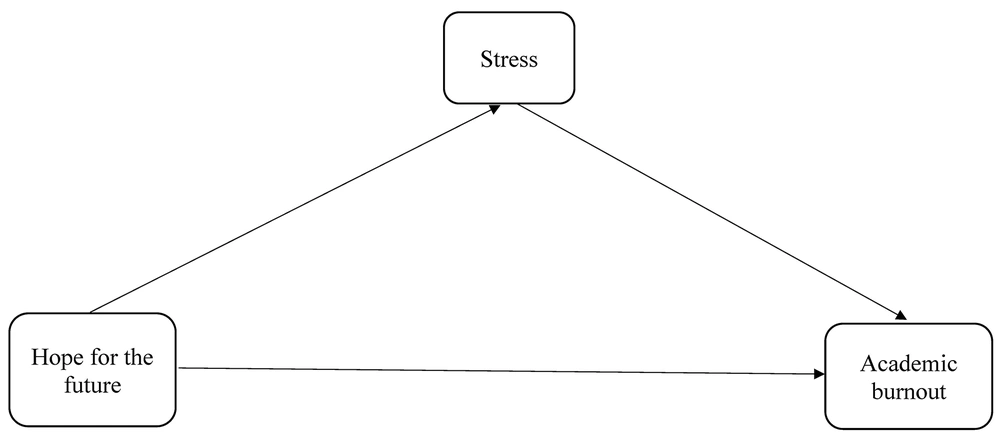
Figure 1.
The theoretical model of the study
4. Results
Examination of the demographic variables revealed that 52.16 and 47.84 percent of the participants were undergraduate and graduate students, respectively. Moreover, 48.83 and 51.17 percent of them were female and male, respectively. Table 1 shows the mean, SD, and correlation matrix for the study variables. Figure 2 depicts the initial model proposed to explain academic burnout based on hope for the future and stress.
Table 1.
Mean, Standard Deviation (SD), and Pearson Correlation Coefficients of the Study Variables
| Variables | Mean ± SD | 1 | 2 | 3 |
|---|---|---|---|---|
| Academic burnout | 45.63 ± 7.64 | 1 | ||
| Hope for the future | 50.01 ± 11.29 | - 0.29 a | 1 | |
| Stress | 122.57 ± 14.27 | 0.61 a | - 0.48 a | 1 |
a P < 0.01.
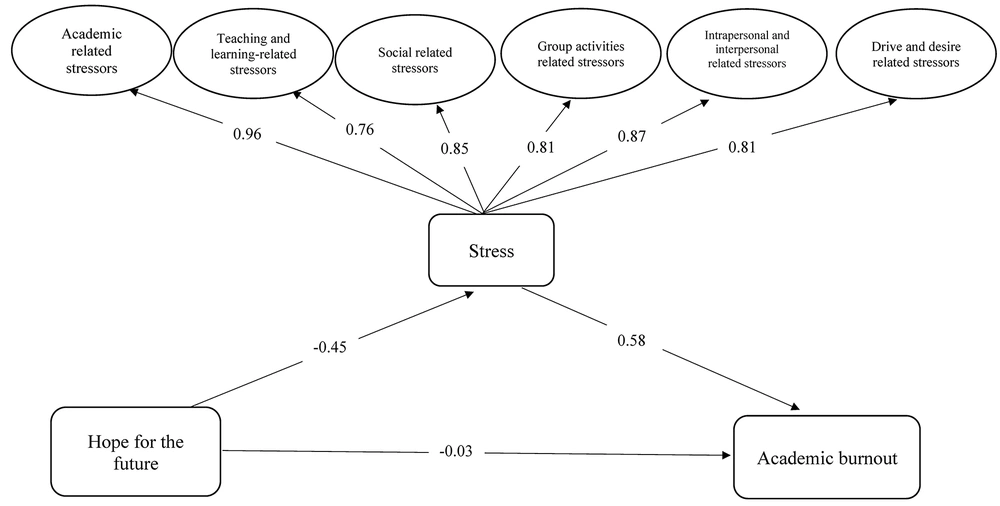
Figure 2.
Initial model for the mediating role of stress in the relationships between hope for future and academic burnout
Kurtosis and skewness tests were used to examine the normality of the data. According to the results, the kurtosis and skewness of all variables fell in the - 2 to + 2 range, and the hypothesis of normality of data was confirmed. According to the data in Table 2, the root mean square error of the approximation (RMSEA) was 0.461, suggesting that the initial model needed some modifications. When one of the paths (i.e., hope for the future to academic burnout) was removed, the RMSEA of the final model was 0.076, indicating its good fit (Figure 3).
Table 2.
Initial and Final Models Fit Indicators
| Fit indicators | χ2 | df | (χ2/df) | IFI | RFI | TLI | CFI | NFI | RMSEA |
|---|---|---|---|---|---|---|---|---|---|
| Initial model | 105.16 | 19 | 5.53 | 0.95 | 0.91 | 0.92 | 0.95 | 0.94 | 0.461 |
| Final modified model | 46.07 | 17 | 2.71 | 0.98 | 0.95 | 0.97 | 0.98 | 0.97 | 0.076 |
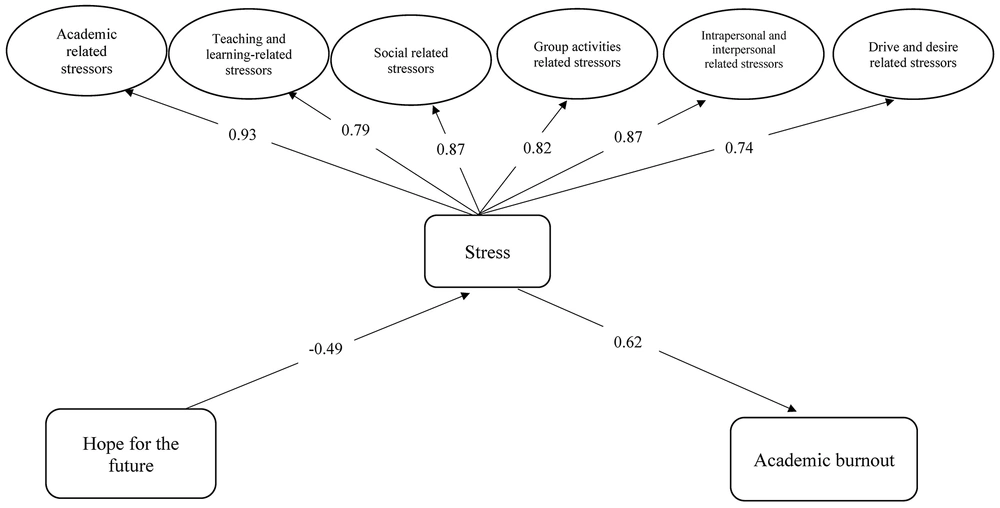
Figure 3.
Final modified model of the mediating role of stress in the relationships between hope for the future and academic burnout
Table 3 presents the findings about the estimates for path coefficients to examine the direct and indirect paths. According to these findings, the path from hope for the future to academic burnout was not significant and, therefore, was removed from the final model (β = - 0.03, P = 0.576). The path from hope for the future to stress was significant among the participating medical students (β = - 0.49, P < 0.001). Additionally, the path from stress to academic burnout was significant (β = 0.62, P < 0.001). The significance of the indirect relationships was determined by employing the bootstrap method. The results demonstrated that the indirect path from hope for the future to academic burnout mediated by stress was significant (β = - 0.20, P < 0.001).
Table 3.
Path Coefficients of Direct and Indirect Relationships Between Variables in the Final Modified Model
| Paths | Path Type | β | P |
|---|---|---|---|
| Hope for the future to academic burnout | Direct | - 0.03 | 0.576 |
| Hope for the future to stress | Direct | - 0.49 | 0.001 |
| Stress to academic burnout | Direct | 0.62 | 0.001 |
| Hope for the future to academic burnout through the mediating role of stress | Indirect | - 0.20 | 0.001 |
5. Discussion
The present study aimed to investigate the relationships between academic burnout and hope for the future through examining the mediating role of stress in medical students. The results showed that the direct path from hope for the future to stress was significant. The indirect path from hope for the future to academic burnout with the mediation of stress was also significant, whereas the direct path was not significant.
Our first study finding showed that there was no significant relationship between hope for the future and academic burnout, which was inconsistent with the results from previous studies (14, 15). However, studies by Hadjar and Niedermoser (14) and Mokgwathi et al. (15) found a correlation of academic attitudes, career prospects, and success with academic involvement and diligence but not with academic burnout. In these studies, the relationship between hope for the future and academic burnout was mainly examined by performing the correlation coefficient tests and regression analysis; in the present study, however, the hypotheses were tested using SEM analysis. In our study, in a similar fashion to the given studies, the relationship between hope for the future and academic burnout was examined by performing Pearson’s test; due to the presence of a mediator in the model, however, the share and effect of hope for the future on academic burnout was explained through discussing the mediator variables (indirect relationship). In other words, hope for the future was indirectly correlated with academic burnout in this model. Seemingly, the high career prospects reduce students’ academic burnout and can improve the performance regarding academic activities. Accordingly, students who are apathetic and unmotivated towards their studies may not do their utmost to study, which consequently can result in academic burnout. Thus, reducing the factors involved in academic burnout and enhancing the motivation and interest in one’s courses and academic discipline can improve academic motivation in students (1).
Our second study finding suggested a positive direct relationship between stress and academic burnout among the study participants so that the higher levels of stress increased the risk of academic burnout in students. This finding was consistent with the research results from previous studies (28, 29). Liu and Cao (28) reported a positive correlation between medical students' stress in the context of online learning. Chen et al. (29) discovered a relationship between psychological distress and academic burnout in students of medical universities. Generally, it can be argued that a primary goal of academic centers is to improve and develop the learners’ academic performance, which is considered an individual’s success and progress at any academic level. Experts in education and pedagogy have long explored the issue of academic failure and performance and have offered suggestions, solutions, and policies in this regard in order to deal with this cultural issue and optimally utilize the limited financial resources of the countries. Good academic performance is one of the chief goals of education systems worldwide (28). In this respect, it is essential to identify, regulate, and direct factors influencing academic performance for further development and learning in students. It is also necessary to include more learners, encourage students' active participation in classes, and achieve greater success. Burnout as a mental experience means a diminished ability to cope with stress factors. It is a syndrome characterized by emotional exhaustion, cynicism, and reduced individual success that affects people in different occupational, academic, or other situations. Accordingly, academic burnout is associated with exhaustion resulting from the demands of study, cynical attitudes towards study, and relative disappointment about the individual success in performing academic tasks. People with academic burnout are often uninterested in studying the materials, unable to attend the classes regularly, unwilling to participate in classroom activities, unable to perceive the meaning of study activities, and unable to learn their course materials (29). Academic or job burnout can be caused by exposure to prolonged and constant academic or job pressures. Therefore, students studying or people employed for a long time are more likely to experience burnout than those newly starting their educations or occupations.
Furthermore, the results indicated that stress had a mediating role in the relationship between hope for the future and academic burnout. The direct path from hope for the future to academic burnout was not significant, whereas the indirect path was significant, suggesting that hope for the future may have reduced academic burnout if it first decreased the stress in students. Stress is often caused by an individual's perception of the increasing academic demands and insufficient time to fulfill those demands. When an individual is under stress for a long period, s/he may lose motivation and energy to carry out academic tasks. Stress is usually followed by academic burnout since it is the major obstacle to improving academic performance (2). The increased rate of unemployment in Iran in recent years, the negative attitudes of students toward their career prospects and job search frustration, the failure to fulfill academic tasks and projects, and the high cost of living have caused Iranian university students chronic stress. As a result, it is expected to observe lower levels of academic commitment/satisfaction but greater levels of academic performance disruption among students, leading to academic burnout. University students with higher levels of hope do not suffer from exhaustion when facing academic demands like tasks and exams. This means that they are not likely to experience academic burnout. Therefore, it can be argued that stress plays a major mediating role in the relationship between hope for the future and academic burnout.
This study faced a few limitations. First, its statistical population size was small since it only included medical students in Ahvaz, Iran. Thus, it was recommended that the study results should be generalized to other contexts with some caution. Second, self-report instruments were used in this study, which may have resulted in biased results. Therefore, it was suggested that further studies with different sample populations should be conducted to increase the generalizability of the results.
5.1. Conclusions
In sum, stress mediated the relationship between hope for the future and academic burnout. The proposed model, which had an acceptable goodness of fit, may have been considered a major step in identifying the factors responsible for academic burnout among medical students. Given that stress was a central factor in academic burnout, it was suggested that policymakers should appreciate the necessity of providing the stressed students with support from family members and instructors. The results also highlighted the importance of providing students with constructive advice about their favorite academic disciplines. Moreover, it was found that developing an educational and governmental plan was required to help students find jobs related to their degrees. This may have improved university students' motivation and, therefore, reduced academic burnout.