
1. Background
Despite the continuous efforts made by students and education officials to gain the best academic results and achievements, a variety of factors may sometimes prevent them from achieving the expected academic results (1). Procrastination is one of the issues that education systems and individuals, particularly students, face at present. Procrastination is a type of failure in self-regulation characterized by an unwarranted delay in tasks that people intend to complete despite the likelihood of negative outcomes (2, 3). Due to the complexity of its cognitive, emotional, and behavioral components, procrastination manifests itself in a variety of ways in the fields of education and daily affairs and, in a disturbed or uncontrollable form as well as obsessively, in decision-making (4). According to researchers, excessive procrastination makes students unable to organize their academic affairs in order to achieve their academic goals. This will make them depressed and anxious and will lower their self-confidence (5, 6). Procrastination can be accompanied by undesirable and irremediable consequences because it impedes progress and prevents the realization of goals (7).
Academic burnout is one of the factors that influence student academic procrastination. It is defined as being exhausted by homework and studying, having a pessimistic attitude towards education, and feeling academically incompetent (8). Academic burnout can result in non-participation, and a lack of the required energy for engaging in, academic activities (9). Students with academic burnout have no motivation to participate in class activities and exhibit behavioral characteristics such as absenteeism, tardiness, and early departure (10). Moreover, they do not attentively listen to their teachers, do not participate in group work activities in class, and do not value their classes and teachers. Instead, they make excuses for their poor academic performance (11, 12). Such students feel no sense of responsibility and accountability for their poor performance. It is hence critical to investigate academic burnout because students’ passion and enthusiasm for studying is the foundation needed to understand their poor academic performance (13, 14).
In addition to academic burnout, attitude toward the future career is another important factor affecting academic procrastination. Many individuals choose a particular major or university to find a more suitable job and profession or to increase their chances of employment. However, not all fields of study have the same job opportunities, and some of them even have saturated job markets (15). Any educational system, particularly schools and universities, seeks to train specialized human resources to pass on social responsibilities to them (16). To achieve this goal, individuals should consciously select their fields of study based on their interests and motives in addition to having a proper attitude towards and a perception of the fields of study and their future job opportunities (17). Positive attitudes towards academic majors and future career not only cause occupational satisfaction and success but also lead to the advancement of the society in which these individuals will work (18). Mokgwathi et al. (19), and Hadjar and Niedermoser (20) showed that attitude towards education and future career and success is related to students’ hard work and academic involvement.
Another factor that can affect the academic performance of students is academic support. Studies have shown that academic support helps students resolve many academic problems and tensions (21). Academic support is defined as any resource that directly or indirectly increases students’ enthusiasm and interest in education and improves their academic performance (22). Emotional support, instrumental support, and cognitive support are the most important dimensions of academic support (23). There are four main sources of academic support: Father, mother, peers, and teachers, each playing a unique role in this regard (24). Studies have shown that social support and hope have significant negative relationship with academic procrastination (25).
Considering the negative outcomes of procrastination on various aspects of student’s academic and personal lives, it seems that programs and interventions are needed to address this issue. However, the predisposing and preceding factors of student academic procrastination must be studied because their identification makes it possible to take suitable preventive and interventional measures for resolving this problem.
2. Objectives
The present study aimed to investigate the mediating role of academic burnout in the relationship between academic support and attitude toward future careers with academic procrastination in high school students.
3. Methods
The statistical population in this descriptive correlational study consisted of all male senior high school students in Gachsaran County, Iran, in the academic year 2021 - 2022, of whom 240 were selected as the study sample using cluster sampling, based on the number of variables. The participants were chosen in the following manner: First, four schools were randomly selected from a list of all-boys senior high schools, and 60 students from each school were selected from grades 10, 11, and 12. Approximately 20 students from each of these three grades completed the research questionnaires. Finally, 234 questionnaires were included in the analysis after discarding the distorted or incomplete questionnaires. The inclusion criteria were high school students aged 16 to 18, informed consent to participate in the study, and no serious psychological disorder or physical disability. In addition, delivery of distorted or incomplete questionnaires were exclusion criteria. All participants were assured that their personal information would be kept confidential and also, they were psychologically prepared to enter the research. In this research, informed consent was obtained from the students and their parents.
3.1. Measurement Tools
3.1.1. Attitude to Future Career Questionnaire
Developed by Talverdi et al. (26), this 17-item questionnaire measures attitude to education and future career in three components: Interest in the major, future career, and career planning. The items are scored based on a 5-point Likert scale, and the total score on this questionnaire ranges between 17 and 85. Talverdi et al. (26) reported an alpha Cronbach coefficient of 0.92 for the Attitude to Future Career Questionnaire. In this study, Cronbach’s alpha for this tool was 0.85.
3.1.2. Academic Support Scale
This 24-item scale was developed by Sands and Plunkett (27) to measure academic support in four subscales: Academic support from (1) peers; (2) father; (3) mother; and (4) teachers, each of which includes 6 items. The items are scored based on a 4-point Likert scale (from 1: Totally disagree to 4: Totally agree). Hamedi et al. (22) reported an alpha Cronbach coefficient of 0.79 for the ASS. In the current study, Cronbach’s alpha for the Academic Support Scale (ASS) was 0.80.
3.1.3. Academic Procrastination Scale
Developed by Solomon and Rothblum (28), this 27-item scale measures academic procrastination in three areas: Delaying completing homework (11 items), preparing for exams (8 items), and finishing essays at the last moment of the due date (8 items). Respondents select one of the options “never = 1,” “rarely = 2,” “occasionally = 3,” “often = 4,” or “always = 5” to indicate their level of agreement with each item. Zarean and Karami Isheqlou (29) reported an alpha Cronbach coefficient of 0.82 for the Academic Procrastination Scale (APS). In this study, Cronbach’s alpha for this tool was 0.79.
3.1.4. School Burnout Inventory
This 15-item tool was developed by Bresó et al. (30) to measure academic burnout in three areas of academic exhaustion (5 items), academic cynicism (4 items), and academic inadequacy (6 items). The items are scored based on a 5-point Likert scale. Kordzanganeh et al. (31), reported a Cronbach’s alpha coefficient of 0.87 for the School Burnout Inventory (SBI). In the current study, Cronbach’s alpha for the SBI was 0.84.
3.2. Data Analysis
In this study descriptive statistics (mean and standard deviation), Pearson correlation coefficient and path analysis were used for data analysis in SPSS-22 and AMOS. The goodness of fit indices, including chi-square (χ2), chi-square/degree of freedom (χ2/df), goodness of fit index (GFI), adjusted goodness of fit index (AGFI), comparative fit index (CFI), normed fit index (NFI), and root mean square error of approximation (RMSEA), were calculated to measure the model’s goodness of fit.
4. Results
Among the participants, 87 (37.2%), 63 (26.9%), and 84 (35.9%) were in grades 10, 11, and 12, respectively. In addition, 101 (43.2%), 73 (31.2%), and 60 (25.6%) were aged 16, 17, and 18, respectively. The results in Table 1 show that the mean scores of academic procrastination, academic burnout, academic support, and attitude towards future career were 71.99 ± 12.30, 40.31 ± 7.39, 66.96 ± 7.85, and 57.41 ± 10.12, respectively.
Table 1.
Descriptive Data and Correlation Coefficients of the Research Variables
| Variables | Mean ± SD | Min. | Max. | 1 | 2 | 3 | 4 |
|---|---|---|---|---|---|---|---|
| 1- Academic procrastination | 71.99 ± 12.30 | 27 | 122 | 1 | |||
| 2- Academic burnout | 40.31 ± 7.39 | 21 | 60 | 0.21 a | 1 | ||
| 3- Academic support | 66.96 ± 7.85 | 37 | 91 | -0.18 a | -0.05 | 1 | |
| 4- Attitude toward the future career | 57.41 ± 10.12 | 30 | 85 | 0.11 | 0.14 b | -0.09 | 1 |
a P < 0.01
b P < 0.05
Skewness and kurtosis tests were used to check the normality of the data. Considering that the skewness and kurtosis statistics of the research variables were all between (-2) and (2), the assumption of normality of the data was confirmed. As shown in Table 1, academic burnout had a positive significant correlation with academic procrastination and attitude toward a future career. However, there was no significant correlation between academic burnout and academic support. There was also a significant negative correlation between academic support and academic procrastination, whereas there was no significant correlation between attitude toward the future career and academic procrastination. In addition, attitude towards the future career exhibited a significant positive correlation with academic burnout.
A hypothetical model was designed based on the theoretical and empirical background to investigate the direct and indirect effects of academic support and attitude toward the future career on academic procrastination mediated by academic burnout. First, the maximum likelihood method (MLM) was used to estimate the parameters in order to evaluate the model. The coefficients of the direct and indirect effects, and all the exogenous, mediating, and dependent variables are shown in Table 2. Considering the data related to the lower and upper limits of the variables, it can be stated that although the direct effect of academic support on academic procrastination was significant, its indirect effect on academic procrastination was not. On the other hand, attitude towards the future career showed a non-significant direct effect on academic procrastination but a significant indirect effect on this variable. Furthermore, academic burnout was significantly and directly affected by attitude towards the future career; however, academic support had no significant relationship with academic burnout.
Table 2.
Direct and Indirect Path in the Model
| Paths | Β | P | Lower Limit | Upper Limit | Total Effect |
|---|---|---|---|---|---|
| Academic support → academic procrastination | -0.167 | 0.001 | -0.262 | -0.048 | - |
| Attitude toward the future career → academic procrastination | -0.031 | 0.209 | -0.137 | -0.092 | - |
| Academic burnout → academic procrastination | 0.198 | 0.001 | 0.097 | 0.294 | - |
| Academic support → academic burnout | -0.034 | 0.192 | -0.140 | 0.094 | - |
| Attitude toward the future career → academic burnout | 0.133 | 0.001 | 0.027 | 0.231 | - |
| Attitude toward the future career → academic procrastination through academic burnout | 0.026 | 0.001 | 0.007 | 0.019 | 0.026 |
| Academic support → academic procrastination through academic burnout | -0.007 | 0.326 | 0.027 | 0.019 | -0.174 |
The results also showed that the model fitted the data well (Table 3). Figure 1 presents the standardized path coefficients of the variables.
Table 3.
Fit Indices of the Tested Research Model
| Fit Indicators | χ2 | df | (χ2/df) | GFI | AGFI | CFI | NFI | RMSEA |
|---|---|---|---|---|---|---|---|---|
| Model | 1.33 | 1 | 1.33 | 0.98 | 0.98 | 0.98 | 0.94 | 0.04 |
Abbreviations: χ2, chi-square; df, degree of freedom; χ2/df, chi-square/degree of freedom; GFI, goodness of fit index; AGFI, adjusted goodness of fit index; CFI, comparative fit index; NFI, normed fit index; RMSEA, root mean square error of approximation.
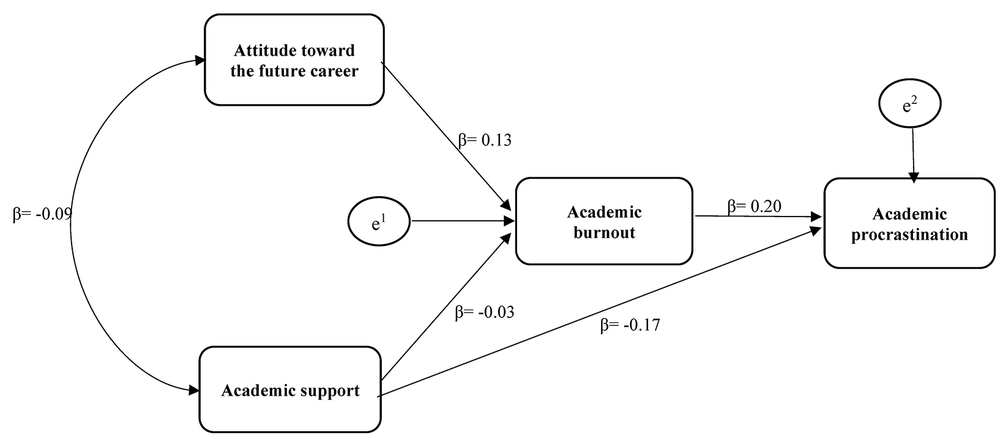
Figure 1.
Path coefficients of research variables in standard mode
5. Discussion
The present study aimed to investigate the mediating role of academic burnout in the relationship between academic support and attitude toward future careers with academic procrastination in high school students. The results showed that academic burnout could not mediate the relationship between academic support and academic procrastination. This finding is not consistent with those of previous studies on this subject. For example, Meschitti (32) reported that academic support from parents, peers, and teachers, as well as teaching self-regulation learning, were effective in reducing academic burnout and improving the academic performance and engagement of the students. Therefore, academic support from parents, peers, and teachers is expected to play an effective role in increasing academic performance and engagement and decreasing academic procrastination. In another study, Nelson et al. (33) demonstrated that academic support from parents and teachers for students’ independence and spontaneity was effective in strengthening their optimism, motivation for progress, and self-efficacy, which resulted in their overall satisfaction and adaptation. Eventually, it influenced academic success, predicted high academic performance, and reduced academic procrastination.
Before explaining the non-significant mediating role of academic burnout in the relationship between academic support and academic procrastination, we can point to the nonsignificant relationship between academic support and academic burnout. The results showed that there was no significant relationship between academic support and academic burnout. This could influence the results of the current hypothesis. Accordingly, it can be concluded that, although academic support plays a major in the other aspects of students’ academic lives, it may not be able to directly affect student burnout as an external variable. In other words, the non-significant relationship between academic support and academic burnout may be attributed to the fact that academic support must influence other internal variables, such as self-confidence and self-efficacy, in order to moderate students’ academic burnout. This was confirmed by Safaee et al. (34) who showed that the direct effect of support from others on academic performance was not significant; however, other variables such as academic self-efficacy, academic resilience, and academic attraction mediated this variable to significantly affect prediction of academic performance. Furthermore, academic burnout is caused by exposure to stressful factors in academic settings. If students continue to study under these conditions, this burnout will remain stable and permanent (8). Therefore, the non-significant relationship between academic support and academic burnout in this study may result from the fact that longitudinal studies are needed in order to make conclusions about the relationship between these two variables in the long run.
Another study finding indicated that although attitude toward the future career was not directly related to academic procrastination, it could indirectly decrease academic procrastination by reducing academic burnout. This result is consistent with those of Dedar et al. (35) who concluded that academic burnout had a positive relationship with the total score of sleep quality and loneliness and an inverse relationship with attitude towards education and future career. Unlike other studies, this research demonstrated that attitude toward the future career had a positive relationship with academic burnout and academic procrastination. This discrepancy can be attributed to differences in the characteristics of the participants and experimental conditions. Since the participants in this study were senior high school students or, in other words, adolescents, the attitude they exhibited toward their future careers may have been influenced by their dreams and fantasies instead of indicating their perception of realities. In this case, if high school students adopt an overly optimistic attitude toward their future careers, they may experience academic disappointment and frustration in the face of the problems and challenges of real academic life. This situation causes them to develop a pessimistic attitude toward school and academic affairs, feel less competent, and lack a sense of success in doing their tasks. These are all among the main components of academic burnout (10). Moreover, academic burnout can increase students’ psychological distress and academic stress thereby causing them to avoid academic and educational situations.
Since this research was conducted on high school students, it is suggested to generalize its results to other groups with caution. Another limitation of the research was the use of the self-report method as a tool for collecting information, which is influenced by cultural, individual, and family values. Therefore, it is suggested that further research should be done in different societies with different cultural backgrounds and different educational levels.
5.1. Conclusions
The study findings demonstrated that academic burnout was able to fully mediate the relationships between academic support and attitude toward a future career with academic procrastination. Moreover, the research model fitted the data well. School counselors and child and adolescent psychologists are recommended to pay special attention to the factors affecting academic burnout when developing educational and therapeutic interventions aimed at reducing academic procrastination among students.