Among the available treatments, L-DOPA and APO administration are widely used for managing PD. This study provides a comparative analysis of the therapeutic effects of L-DOPA and APO on behavioral and histopathological changes, as well as the expression of alpha-synuclein and TH, in a rotenone-induced PD rat model. In rat models of PD, the duration of studies varies according to the specific model employed and the research objectives. Some investigations utilize 8 or 16 days after PD induction (
18), while others consider 4 weeks or more after PD induction to assess the effects of pharmacological interventions (
19). However, in this study, the animals were investigated for 4 weeks post-PD induction.
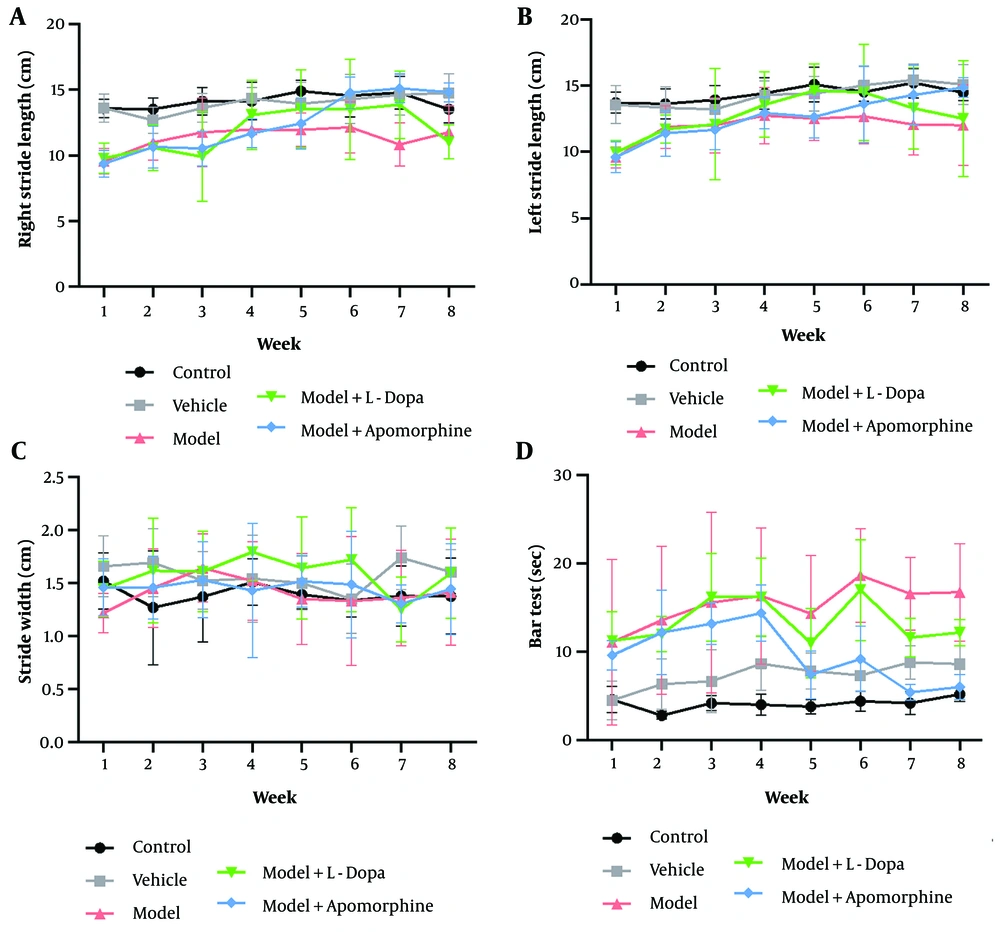
The absence of differences between the treatment groups (APO and L-Dopa) and the control group in terms of right stride length, a motor function indicator, during weeks five to eight post-induction suggests that both treatments effectively improved the rotenone-induced impairment in right stride length. Conversely, the left stride length remained unaffected from the second week post-induction through the treatment period. A significant increase in bar scores, indicative of catalepsy (
20), was observed in all groups compared to the control group during the second week following PD induction. By the fifth week post-induction, corresponding to one week after treatment initiation, the elevated bar scores in the model and treatment groups, compared to the control group, suggest that none of the treatments effectively improved bar scores within this timeframe. However, the lower bar scores in the model + APO group compared to the model group during weeks six to eight suggest that APO administration may be a more effective strategy for addressing catalepsy in the PD model. The APO is commonly used in the management of PD to alleviate motor fluctuations and reduce “off” episodes. The APO may improve overall motor function, potentially mitigating symptoms associated with cataleptic states (
21). In this study, APO treatment significantly improved performance in the bar test as a measure of cataleptic behavior, yet failed to improve stride length, a parameter of ambulatory gait patterns in rats. These findings suggest that APO could selectively improve certain motor deficits associated with PD, but not others. Considering that catalepsy predominantly arises from impaired dopaminergic signaling, the observed effects of APO as a dopamine agonist align with its expected pharmacodynamic properties. In contrast, locomotor parameters like stride length are modulated by more integrative neural pathways encompassing not only dopaminergic circuits but also cerebellar, spinal, and sensorimotor networks (
22,
23). This differential response underscores the heterogeneous neurophysiological basis of motor impairments in PD.
Recent studies have demonstrated that L-Dopa effectively alleviates behavioral deficits in mice with PD symptoms (
24). Although L-Dopa and APO are the two most effective therapies for PD in a rat model (
7,
25), it remains unknown whether these drugs have any effect on the formation of pathogenic abnormal α-synuclein in vivo. There is a discrepancy in the reported efficacy of L-Dopa treatment in SNc-lesioned rodents overexpressing α-synuclein. While acute L-Dopa treatment has been found to possess rewarding properties in rodents overexpressing α-synuclein in rodent PD models (
26), other studies indicate that L-Dopa fails to condition a rat model of PD (
27). It has been recently shown that L-DOPA regulates α-synuclein accumulation in a 1-methyl-4-phenyl-1,2,3,6-tetrahydropyridine non-human primate model of PD (
28). Conversely, APO has been shown to inhibit α-synuclein fibrillation, leading to the formation of large oligomeric species in primary cell cultures (
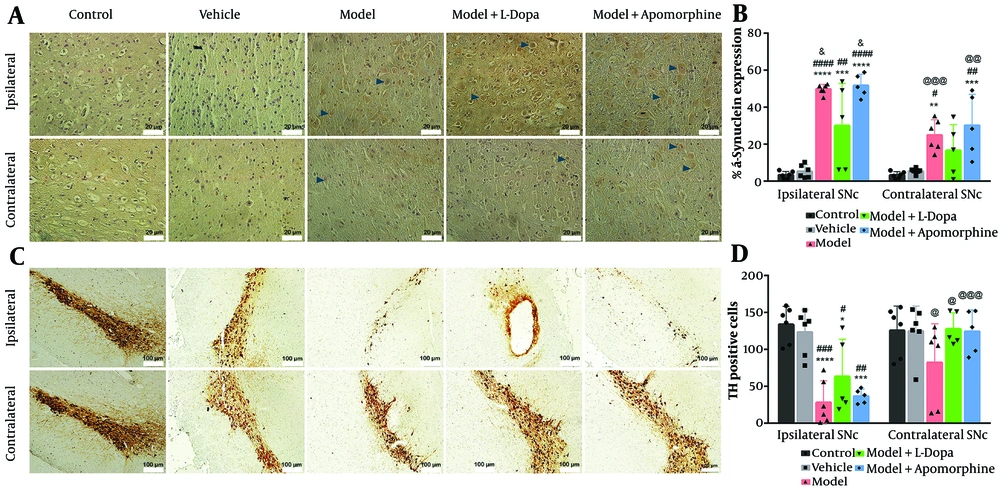
29). In this study, the administration of L-Dopa and APO did not alleviate the overexpression of α-synuclein induced by rotenone in the ipsilateral and contralateral regions of the SNc in the rat PD model.
Loss of TH in rotenone-induced rat models of PD has been widely documented (
30,
31). Rotenone has been well established to reduce TH-positive neurons and dopamine receptor-expressing neurons throughout the central nervous system (CNS) (
32). Interestingly, drugs that inhibit TH have demonstrated protective effects against neurodegeneration in various animal models of PD (
33). In this study, similar immunoreactivity for TH was observed in the contralateral SNc across all groups. However, in the ipsilateral SNc, a significant reduction in TH-positive cells was observed in the model, model + L-Dopa, and model + APO groups compared to the control group, indicating that neither treatment was able to restore the decreased TH-positive cell population in the PD model.
This result contrasts with the findings of a previous study reporting elevated TH levels in the striatum and substantia nigra following L-DOPA treatment in a mouse model of PD (
24). In that study, PD was induced by administering 1-methyl-4-phenyl-1,2,3,6-tetrahydropyridine at a dose of 25 mg/kg/day directly into the substantia nigra and striatum, followed by L-DOPA treatment at 8 mg/kg/day. The discrepancy between the findings may be attributed to differences in PD induction methods, L-DOPA dosing regimens, and the duration of the experimental protocols.
Amyloid-like deposits have been observed in the brains of rat models of PD induced by rotenone injection. It has been shown that rotenone exposure can lead to amyloidogenic changes, including the formation of amyloid fibrils and protein aggregates in regions like the SNc (
34,
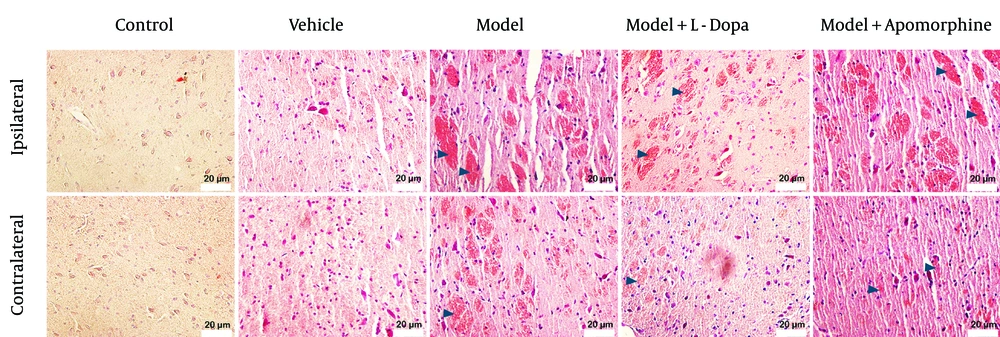
35). The severe amyloid deposition observed in the ipsilateral SNc of the model and model + APO groups, along with the moderate deposition of amyloid in the ipsilateral SNc of the model + L-Dopa group, suggests that L-Dopa is more effective than APO in reducing amyloid formation in the ipsilateral region of the PD model. Furthermore, the severe beta-amyloid formation in the contralateral SNc of the model group, compared to the mild amyloid deposition in the contralateral SNc of the model + L-Dopa and model + APO groups, indicates that both treatment approaches can reduce amyloid deposition.
Amyloid reduction may occur without changes in the levels of TH and alpha-synuclein due to a few potential mechanisms. One possibility is that the reduction in amyloid is due to the removal or destabilization of pre-existing oligomers or seeds, which are the initial nucleation sites for amyloid fibril formation, rather than a change in the overall levels of alpha-synuclein (
36). Moreover, other factors like changes in the conformation or modification of alpha-synuclein, or altered amyloid fibril formation kinetics, could lead to a decrease in amyloid deposition without affecting the total amount of alpha-synuclein (
37). In addition, increased oxidative stress has been shown to accelerate the aggregation of alpha-synuclein into amyloid fibrils (
38). However, further investigation is needed to unravel the exact mechanism of the reduction of amyloid deposition by the administration of L-Dopa/APO in the developed PD model.
In summary, while L-DOPA and APO are among the most effective drugs for the symptomatic treatment of PD in humans, in this study, their administration led to only partial improvement in the behavioral abnormalities and some levels of reduction in amyloid deposition in the contralateral SNc region. The differences in drug effects between humans and animal models arise from a complex interplay of biological, physiological, and methodological factors. Notably, absorption, distribution, metabolism, and excretion (ADME) profiles can vary significantly across species (
39). For example, a drug may be rapidly metabolized in rodents but exhibit prolonged retention in humans. Additionally, differences in receptor binding affinities and downstream signaling pathways may influence both drug efficacy and toxicity (
40). Another critical factor is the method of animal model development. In this case, the model was chemically induced, which fails to fully replicate the multifactorial and progressive nature of human pathophysiology.
5.1. Conclusions
Although APO and L-Dopa are among the most conventional treatments for PD, they could only improve some behavioral changes of PD in the rotenone-induced rat model of PD. Both treatment approaches could reduce amyloid deposition in the contralateral SNc of the PD model without affecting the alpha-synuclein and TH levels. These findings underscore a key translational gap, highlighting the limitations of animal models in drug development. Although animal models have played a pivotal role in drug development for decades, they may fail to reliably predict clinical outcomes in humans. The limitations of animal testing stem from a combination of interspecies biological differences and artificially controlled experimental conditions.