Details of the characteristics of the study subjects were described in our previous report (
29). Originally there were 2,712 men aged between 40 and 64 years who had received annual health check-ups at workplaces including the measurement of serum creatinine (Cr) concentration and thus estimated glomerular filtration rate (eGFR) during both 2003 and 2009, performed by an occupational health service organization. Further, exclusion of 109 men because of the lack of critical data, mainly body weight or urinalyses, resulted in 2,603 men being enrolled as the final subjects.
In the health check-ups, body height (m) and weight (kg) were measured with jacket and shoes removed, and 0.5 kg was subtracted during spring to summer and 1.0 kg during autumn to winter for the net body weight. Body mass index (BMI) was calculated as the net body weight divided by the height squared. Blood pressure (mmHg) was measured using an automatic manometer in the sitting position with a cuff maintained at heart level after resting on a chair for five minutes or longer. Urinary protein was detected in the spot samples collected in the morning with a dipstick and defined semi-quantitatively. From age (year) and serum Cr concentration (mg/dL) measured enzymatically, eGFR (mL/min/1.73 m
2) was calculated using the equation proposed by the Japanese society of nephrology (JSN) (
30). Concentrations of total cholesterol (Tchol), triglycerides (TG), HDL-cholesterol (HDLc), LDL-cholesterol (LDLc), and uric acid (UA) in serum were measured in the fasting venous blood, as well as serum hepatic enzymes activities including GGT using an automatic analyzer. At the same time, the concentration of fasting plasma glucose (FPG) and hemoglobin A1c (HbA1c) were measured using automatic analyzers.
Hypertension was defined as being present when the subject was being treated with antihypertensive agents and/or when the blood pressure measured in the health check-ups was 140/90 mmHg or higher. DM was considered present when the subject was being treated with hypoglycemic agents and/or had a FPG of 126 mg/dL or HbA1c of 6.5% (NGSP) or higher. Subjects were defined to have dyslipidemia such as hypercholesterolemia when they showed a Tchol of 220 mg/dL or a LDLc of 140 mg/dL or above, hypertriglyceridemia when they showed a TG of 150 mg/dL or above, and low HDL-cholesterolemia when they showed a HDLc of less than 40 mg/dL. Use of medications for dyslipidemia was not considered in the definitions because of the vagueness of the subjects’ answers. Hyperuricemia was defined as present when the subject was being treated with medicines and/or had a serum UA of 7.5 mg/dL or higher. Serum GGT activity in the subjects was divided into 3 categories of less than 40 U/L (the upper 95% value in non-obese male non-drinkers), 40~89 U/L, and 90 U/L (the upper 95% value in generally healthy men) or higher which was defined as elevated serum GGT. Smoking habit was classified into non-smokers including ex-smokers, smokers consuming up to 1 pack of cigarettes per day and those consuming more. For alcohol consumption, the subjects were classified into nondrinkers, drinkers consuming up to 59 mL of ethanol per day, and those consuming 60 mL per day or more and subjects were scored from 0 to 2 for statistical analyses.
The levels of eGFR (G) were classified into G1: 90 mL/min/1.73 m
2 or higher, G2: 60-89.9, G3a: 45-59.9, G3b: 30-44.9, G4: 15-29.9, and G5: less than 15.0. Although the amount of 24 h albumin excretion in urine (A) is required in the criteria of CKD severity proposed by KDIGO (
31), it could not be determined by a dipstick measurement in spot urine samples in the health check-ups. In the present study, therefore, the dipstick proteinuria (-/±) was tentatively assumed to accord with normal (A1), dipstick (1+) with mild proteinuria (A2), and dipstick (2+ or above) with marked proteinuria (A3) (
32). The subjects were then defined as being free of CKD when they had eGFR of G1 or G2 without proteinuria (A1). The subjects were defined to have mild CKD when eGFR was G1 or G2 with mild proteinuria (A2) or eGFR was G3a without proteinuria (A1), and defined to have moderate CKD when their eGFR was G1 or G2 with marked proteinuria (A3) or eGFR of G3a with mild proteinuria (A2) or eGFR was G3b without proteinuria (A1). The subjects were defined to have severe CKD when they had eGFR of G3a with marked proteinuria (A3), eGFR of G3b with proteinuria (A2 or 3), or eGFR of G4 or G5 regardless of proteinuria. The cause of kidney damage (C) could not be determined in the present study. Moderate and severe CKD were defined as high-risk CKD in the present study because of the high future risk of end stage kidney disease (ESKD) and CVD associated with these levels of renal dysfunction (
31).
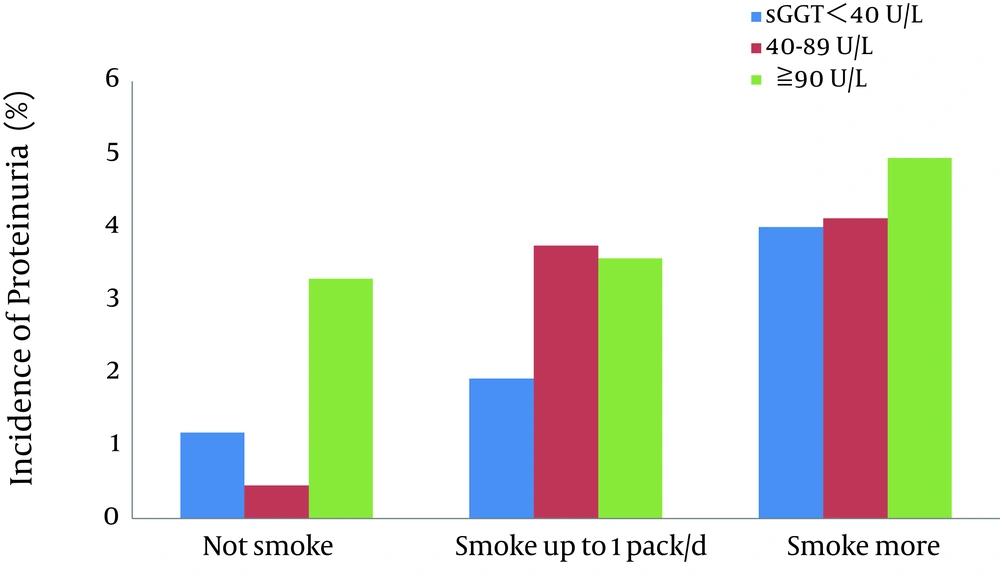
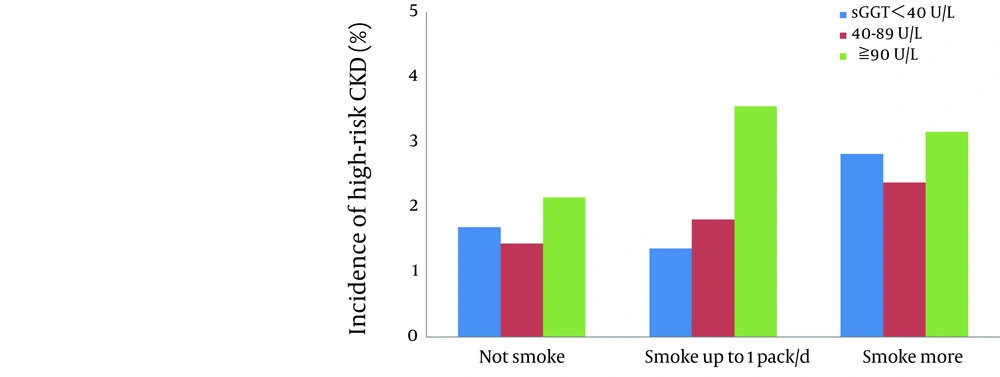
The incidences of proteinuria and total CKD comprising any degree of severity in 2009 were determined in the subjects who were free of all CKD signs at baseline in 2003, and the incidence of high-risk CKD was determined in the subjects including those having mild CKD with mild proteinuria or reduced eGFR of G3a in 2003 according to the 3 x 3 categories of cigarette smoking and serum GGT activity. Next, multiple logistic regression analysis was conducted to test the significance of the contributions of smoking and serum GGT to the development of proteinuria, total CKD and high-risk CKD, first in a model including only current smokers but not elevated serum GGT as an independent variable, second in a model including both smoking and elevated serum GGT as additive variables, and finally in a model including the two variables with an interactive effect, adjusting for major CV risk factors in the analyses on proteinuria and total CKD, and adjusting for preceding proteinuria and reduced eGFR as well as the CV risk factors in the analyses on high-risk CKD.
Written informed consent was obtained from all the subjects by the health service organization regarding the use of data collected in the health check-ups for academic purpose in anonymous forms, and the present study was designed to analyze the data anonymously in an unlinkable fashion that was provided by the health service organization and approved by the ethics committee of Kanazawa Medical University.