


1. Background
Aluminum phosphide (ALP) poisoning is a common cause of acute poisoning and death in Asian countries, especially in India and Iran, with a high mortality rate of 60% to 90% (1). Metal phosphides like ALP are potent pesticides that, in contact with moisture, water, and gastric acid, produce phosphine gas (PH3). Phosphine is a colorless toxic gas with a garlic or fish smell that gets absorbed into the bloodstream from the gastrointestinal tract. It has toxic effects on the heart, liver, kidneys, and lungs, and there is no effective antidote, leading to many patients dying despite intensive care (2). These highly toxic materials are used to protect rice and nuts and are referred to as "rice tablets" in Iran. The product is not produced domestically but is imported under brands like Phostoxine (3). Due to its toxic capacity and easy accessibility, and despite the implementation of a ban and limitation policy, it is widely used as a means of suicide (4). Recent studies have shown that poisoning has increased significantly in Iran (5, 6). Research has estimated that from 2006 to 2013, the incidence of the death rate due to ALP increased from 5.22 to 37.02 per million population in Tehran, the capital of Iran (7). From 2006 to 2011, a high admission rate of ALP poisoning was reported in a specific hospital for poisoning in Karaj, the center of Alborz province, with 44% of patients dying (8). Alborz province is located in the center of Iran and includes seven cities, with a population of 2,712,400 based on the 2016 census (9). Because studies have shown that deaths due to ALP have increased in different parts of the country, the purpose of the current study is to determine the incidence in our province, identify who and with what characteristics died due to this toxic substance, and ascertain whether the deaths were accidental or intentional. Based on the results, we aim to suggest solutions to address this issue.
2. Objectives
This study aims to investigate death-related phosphine poisoning cases referred to forensic medicine in Alborz province over six years. The study includes trends, demographic features, and toxicological results, and suggests ways to decrease the incidence of such cases.
3. Methods
We conducted this cross-sectional study by collecting all death records with ALP poisoning referred to the Alborz Forensic Medicine Organization from 2013 to 2018. We reviewed the literature and consulted experts to extract data on sociodemographic factors, history of mental disorders, clinical manifestations, and toxicological analysis results from forensic records. Using an Excel sheet, we collected data on all variables, including age, gender, education level, occupation, place of birth, address, season, and month of death. The history of mental disorders included psychiatric disorders, suicidal history, and addiction. Other variables included the chief complaint, time from admission to death, poison analysis in organs and tissues, and the coexistence of other poisons. Forensic medicine specialists diagnosed poisoning (X68, X69) due to ALP based on information from relatives, hospital reports, autopsy, and toxicological analysis. Toxicological analyses were performed using the silver nitrate test on specimens from stomach content, bile, liver, and vitreous.
Excel 2013 and SPSS software version 22 were utilized to analyze quantitative variables. This included the calculation of the mean, crude mortality rate, and frequency. We calculated the annual percentage change (APC) for each year using the formula ((Final value - Start value) / Start value) × 100 and the average annual percentage change (AAPC). The AAPC provides a smoothed view of growth over multiple years by averaging the annual changes. To perform analytical normality of data, chi-square, one-way ANOVA, t-test, and Mann-Whitney tests were used. A P-value < 0.05 was considered the level of significance. Data on mortality were kept confidential. The Ethics Committee approved the study with ethics code IR.ABZUMS.REC.1398.098.
4. Results
The number of records of ALP poisoning deaths was 140 cases in forensic medicine organizations from 2013 to 2018. The number of males was 85 (62.7%), and the number of females was 55 (37.3%). The male/female ratio was 1.5. The mean (standard deviation) age of cases was 32.1 (11.1), with an age range between 2.5 and 67 years. The mean age of men was 34.29 (11.26), and the mean age of women was 29.24 (9.93). The education level of 74 (53.6%) cases who died from ALP poisoning was below a diploma. Additionally, more than half of the people who committed suicide with ALP, 78 (55.5%), were employed. Among them, workers were the dominant group, with 45 (36.2%) individuals (Table 1). The chi-Square test indicated that the employment rate among males was significantly higher than that of females, with a P-value of < 0.001 (Table 2). Furthermore, there was a significant relation between education levels and occupation among the cases, with a P-value of 0.01, indicating that more employed individuals had a lower level of education.
Table 1.Demographic Variable Distribution Among Fatal Aluminum Phosphide Poisoning Cases from 2013 to 2018 a
| Variables | Values |
|---|---|
| Age group (y) | |
| < 21 | 18 (12.9) |
| 21 - 30 | 52 (37.1) |
| 31 - 40 | 46 (32.9) |
| > 40 | 24 (17.1) |
| Education | |
| Undergraduate | 75 (53.5) |
| Diploma | 46 (32.9) |
| College | 19 (13.6) |
| Occupation | |
| Worker | 46 (32.8) |
| Employee | 11 (7.9) |
| Housewife | 29 (20.7) |
| Student and soldier | 13 (9.3) |
| Freelance job | 23 (16.4) |
| Unemployed | 18 (12.9) |
| Suicidal history | |
| Yes | 15 (10.7) |
| No | 125 (89.2) |
| Psychiatric disorder | |
| Yes | 19 (13.6) |
| No | 121 (86.4) |
| Addiction | |
| Yes | 19 (13.6) |
| No | 121 (86.4) |
a Values are expressed as No. (%).
Table 2.Age and Test Results Relationships with Sex in Fatal Aluminum Phosphide Poisoning Cases from 2013 to 2018 a
| Variables | Gender | P-Value | |
|---|---|---|---|
| Male | Female | ||
| Mean age | 34.3 (12) | 29.2 (9.9) | < 0.001 |
| Test result | 0.06 | ||
| Positive | 67 (65.7) | 35 (34.3) | |
| Negative | 15 (45.5) | 18 (54.5) | |
| Occupation | < 0.001 | ||
| Unemployed | 23 (39.7) | 35 (60.3) | |
| Employed | 60 (75.9) | 19 (24.1) | |
a Values are expressed as No. (%).
The mean crude mortality rate of death due to ALP poisoning was 8.3 cases per million referred to forensic medicine in Alborz province from 2013 to 2018. The highest and lowest mortality rates were 12.53 per million in 2014 and 5.42 per million in 2015, respectively (Figure 1).
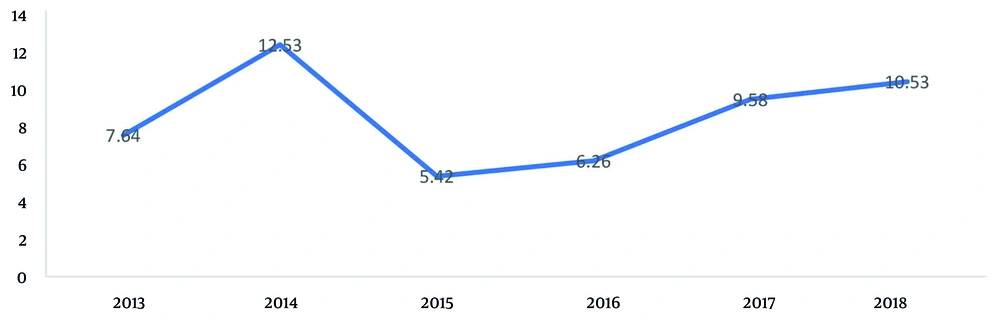
Figure 1.
Incidence of referred cases for phosphine analysis in Alborz province from 2013 to 2018 (per million of population)
The APCs were as follows: From 2013 to 2014, there was a high increase of 64.47%; from 2014 to 2015, a significant drop to -56.8%; from 2015 to 2016, an increase to 14.81%; from 2016 to 2017, a further increase to 53.23%; and from 2017 to 2018, a notable decline back down to 10.53%. The AAPC for the five years was calculated to be 17.25. The fluctuating APCs (e.g., moving from +64.47% to -56.80% to +14.81%) suggest instability in the incidence rates over the years, which may call for a deeper investigation into underlying causes or external factors affecting these rates. An AAPC of approximately 17.25% indicates an overall increasing trend in incidence rates over the 5-year period, despite fluctuations in individual years.
All of the deaths were due to intentional self-poisoning and suicide, except for a 2.5-year-old child whose stepmother poisoned her deliberately. Self-poisoning occurred at higher ages in men than in women, which was significant (P < 0.05, Table 2).
Toxicological analysis showed that 102 (72.9%) cases of fatal ALP poisoning were positive for ALP in their specimens. In 33 (23.5%) cases, the ALP analysis result was negative, and it was unknown in five (3.4%) cases. The relation between cases referred to forensic medicine and test results was not significant (P = 0.13, Figure 2). Toxicological analysis for other drugs revealed that six samples had some coexistence of alcohol, methadone, and methamphetamine.
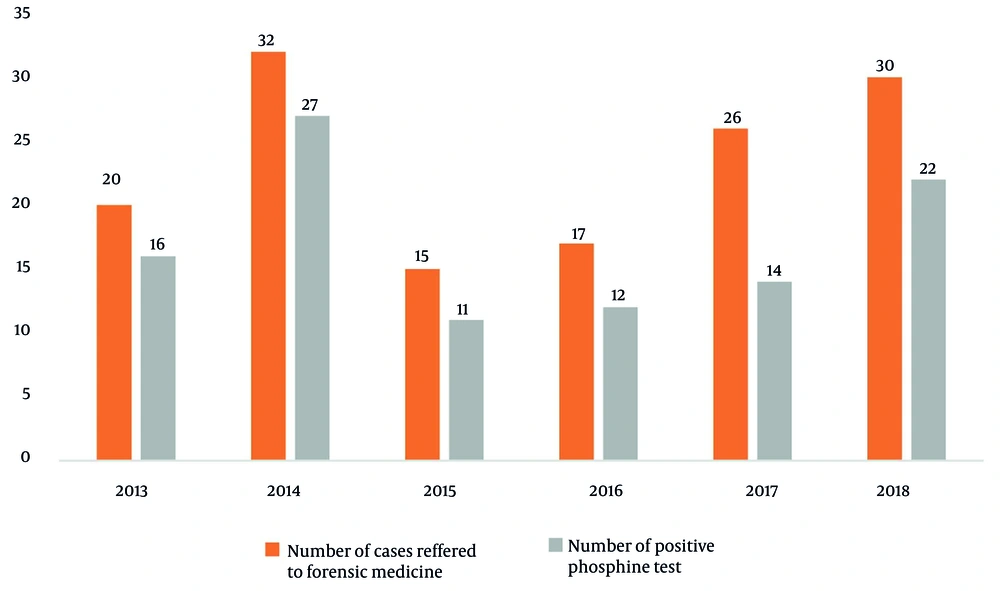
Figure 2.
Total cases referred for phosphine analysis, total number of positive phosphine tests in Alborz province, 2013 - 2018
The variables of birthplace and address were significant (P < 0.001, Figure 3). In other words, many cases who lived in Alborz province were not born there.
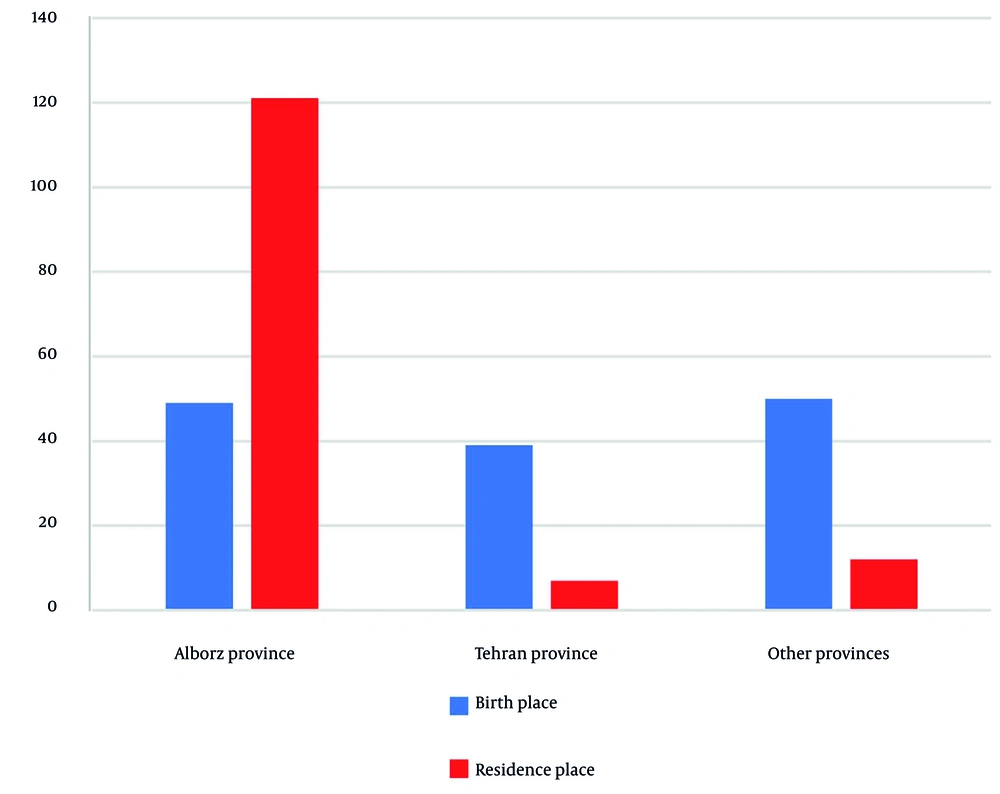
Figure 3.
Birthplace and residence place of fatal aluminum phosphide (ALP) poisoning cases 2013 - 2018
The ALP poisoning occurred more frequently in the summer (40 cases) and less in the spring (29 deaths). It happened more in July and January (16 deaths each) and less in March (5 deaths), although the difference was not significant (P = 0.25). In most cases, 136 (97%) individuals lived in urban and suburban areas. Forensic medicine records of 50 ALP poisoning cases (37.5%) indicated clinical signs and symptoms. Nausea (19 patients), dyspnea (15), and abdominal pain (11) were the most common complaints documented in their records.
The mean hospitalization period in 89 cases was 19.2 ± 32.3 hours, with a median of eight hours. Hospitalization time ranged from half an hour to ten days. In other words, 80 cases died in less than 24 hours, and eight subjects passed away after more than 24 hours following admission to hospitals. The relation between hospitalization time, gender, and the toxicological result was not significant. We found that almost 11% of cases had a history of suicidal attempts (Table 1).
5. Discussion
Poisoning occurred more frequently in men, with an average age of 34.2, who were educated below a diploma level and were primarily workers. Except for one case, all used ALP for suicide. Self-poisoning was more prevalent in urban and marginalized populations, and many of the deceased were not born in Alborz province. Studies have shown that death-related ALP poisoning has increased in Iran (5, 7). This study demonstrated that the death trend initially fluctuated, but from 2015 to 2018, the death trend increased. The APC and AAPC indicated fluctuations and an overall increasing trend in mortality from ALP poisoning.
In a study in Tehran, the trend of ALP poisoning deaths rose from 2006 to 2013, increasing from 5.22 to 37.02 per million (7). In another study in Tehran, the self-poisoning suicidal death rate due to all poisons fluctuated between 3.53 per million and 18.3 per million from 2011 to 2015 (10). A review article in Iran showed that the incidence of poisoning and death rate related to ALP has increased since 2007, with poisoning due to pesticides, including ALP, being more common in agricultural fields, especially in the north of Iran (5). In a study conducted in Alborz province from 2006 to 2011, 67 cases were admitted to hospitals due to ALP (8). In the present study, 140 death-related ALP cases occurred over six years. Other researchers investigated 2007 deaths related to ALP (7). Another study showed 105 death-related ALP cases in Golestan, north of Iran, over six years (4). This type of poisoning is common in Iran, although its sale has been banned since 2007 (7). It is also a common poison in India; however, poisoning has decreased significantly since 2001 after governmental regulations to limit its sale (11).
In this study, all deaths were due to suicide except for a two-year-old child who was killed. Studies show that the incidence rate of self-poisoning has increased in recent years, especially with ALP (4, 6). Self-poisoning with pesticides is a common method of attempting suicide in Iran, India, and Morocco. In contrast, ALP poisoning is unintentional in England and Germany, where access to ALP is restricted to particular users and limited for the general population (1).
Several factors contribute to the increase in self-poisoning with pesticides like ALP. Regulatory policies on chemical substances are often insufficient, and existing rules are sometimes not enforced. Easy access to medicines and insecticides, coupled with the lack of a surveillance system for poisoning, leads to increased poisoning incidents in the country. Despite the prohibition of ALP marketing and the imposition of penalties by the government in 2007, the poisoning trend has continued to rise (7). Limiting access to shotguns and poisons can reduce suicide rates related to these means (12).
Data analysis of deaths from 2013 to 2016 in the province is not available, but in 2017, the crude death rate due to traffic accidents was 10.7 per hundred thousand people, suicide was 4.45 per hundred thousand, and poisoning was 1.74 per hundred thousand. In 2018, the crude death rate due to traffic accidents was 10.5 per hundred thousand, suicide was 6.43 per hundred thousand, and poisoning was 2.34 per hundred thousand. Although the crude death rate from ALP poisoning is lower than these causes, it is significant enough to warrant consideration and intervention as a subset of suicide causes (13).
In the present study, the rate of self-poisoning by ALP in men was 1.5 times higher than in women. Previous studies have also shown that the rate of self-poisoning is higher in men than in women (4, 6, 8). In a study investigating self-poisoning with all kinds of poisons, the male-to-female ratio was twofold. Generally, men tend to use more fatal methods to commit suicide (10).
In our study, most cases were in the middle age group, between 30 and 40 years old, with six cases involving adolescents. The mean age of men was significantly higher than that of women. In a previous study in this area, between 2006 and 2011, most ALP self-poisoning cases admitted to the hospital were below 21 years old (8). In similar studies, the mean age of cases was between 21 and 30 years (7, 14). Other studies have noted that the mean age of non-survivors was higher than that of survivors (6, 15, 16). In this study, ALP poisoning was committed in a baby aged 2.5 years, similar to a study in Golestan (4). Suicide attempts tend to occur at a younger age, while completed suicides occur at an older age. In other words, age is a risk factor for suicide (10).
A comparison of studies over time shows that the mean age of the deceased due to ALP has increased. In the present study, most cases had a low level of education (undergraduate). Other studies show similar results (4, 14). Another study indicates that in most cases, individuals who self-poisoned with various types of poisons had a diploma (10). Addressing illiteracy and low literacy can be effective in preventing suicide (17). In other words, higher education plays a protective role in suicide prevention.
In this study, more than half of the ALP poisoning cases were employed, with most of the employed individuals being male workers. Similar studies have shown that most cases were employed (4, 14), although some studies indicated that most participants were unemployed (5, 10). Workers exposed to job insecurity and income poverty, those with lower incomes or bank loans, and those whose companies made less profit were at risk of developing anxiety and depression. Depression and anxiety increased among employees affected by the economic crisis, with the private sector being more impacted (18). Economic and financial problems were critical factors for men who attempted suicide. An analysis of the time trend of suicide in 54 countries showed that in 2009, suicide rates exceeded the trend from 2000 - 2007, with excessive suicides associated with the economic crisis (19). Business owners with fixed incomes faced decreased purchasing power due to increased inflation rates, leading to insufficient income to support their lives, which resulted in mental crises and, in some cases, suicide (20).
In the present study, most cases were city residents, which was significant. Similar studies showed the same results (4, 14). Contrary to the expectation that poisoning would be limited to rural areas, the availability of poison and poisoning with ALP also increased in urban areas. City residents experience many business failures and social harms that play an essential role in committing suicide (14).
Most ALP poisoning cases were residents of Alborz province, although they were born outside the province; in other words, most cases were not native to the province, and the relationship between these two variables was significant (P < 0.001). Alborz province is the second province in Iran that accepts immigrants from other parts of the country and abroad. Many immigrants live in the marginalized areas of the province (9). Studies have shown that the number of suicides is high among immigrants residing in marginalized areas. Migration has a profound effect on the lives of migrants, contributing to an unhealthy environment, poverty, social harm prevalence, tension in family relationships, diseases, and mental and behavioral disorders (21). Migration to Alborz province has been increasing over the past two decades, making it the country’s second most densely populated province (9).
Most deaths due to ALP poisoning occurred in the summer, but seasonal variations were insignificant. Similar to our study, seasonal variations were not significant in other studies (7, 14), although some studies reported that most deaths occurred in winter (4, 7).
Toxicology results showed that phosphine was positive in two-thirds of the autopsy samples. In a previous study, half of the toxicological samples were positive for phosphine (7). In another study, 80% of cases had positive phosphine tests (10). Phosphine is a volatile chemical substance, and its concentration decreases during detoxification in hospitals and when it changes to gas after death up to the time of autopsy. Additionally, some causes other than phosphine may contribute to negative phosphine tests (10).
In the present study, the most common symptom reported was nausea. Similar studies have shown that the most common symptoms of ALP poisoning cases are gastrointestinal (6, 22). Clinical findings vary according to the dosage, the method of use, and the time elapsed since poisoning (7). In this study, most ALP death cases had a hospitalization period of less than twenty-four hours from admission to the hospital until death. Various studies have reported that the hospitalization period for most cases was less than 24 hours from admission to demise (3, 16, 22). Some reasons for this include the high fatality power of ALP tablets and the lack of specific antidotes, which lead to a poor prognosis (7).
A history of suicide attempts, mental disorders, and drug abuse are important risk factors for committing suicide (23). In this study, a history of suicide attempts existed in one-tenth of cases. However, this ratio may be affected by the mental condition of relatives during the filing of forensic records, incomplete information about the history of the case, and the stigma of suicide, which may lead to an underestimation of the history of suicide attempts. People with a history of attempted suicide have a 12% to 30% probability of attempting it again, and the risk of death from suicide increases in the first year after a suicide attempt (24).
In this study, 13.6% of cases had a history of mental disorders, and 12.9% had a history of drug abuse. In another study, 2.1% of cases had a history of mental disorders, and 10.6% were addicted (7). Treatment and follow-up of patients with mental disorders is an effective way to address suicide prevention (24). Suicide is a problem with psychological, social, economic, and cultural roots, so prevention strategies should be widely considered (25).
Here are several strategies that can be implemented to prevent ALP poisoning:
1. Limit access to ALP tablets: Although the law prohibiting the sale of ALP tablets has been in place since 2007, it is not well enforced, necessitating stronger supervision. It is advisable to sell these tablets only with permission and restrictions, limiting sales to licensed individuals for grain storage (1, 4, 7).
2. Control import and prevent smuggling: Efforts should be made to limit the import of ALP into the country and prevent smuggling.
3. Strengthen law enforcement: To reinforce the law’s implementation, continuous monitoring of pharmacies and herbal drug stores by inspectors from the Food and Drug Organization and the police is essential.
4. Gather information for legal proceedings: Obtaining a history from the patient's relatives and, if possible, from the patient regarding the source of rice tablets is crucial for legal proceedings.
5. Promote safer alternatives: Replacing ALP with lower-hazard materials, such as garlic, would promote safer storage for small-volume grains.
Strengthening social support systems for high-risk groups, particularly those with low socioeconomic status such as low-income male workers and immigrants, involves a multifaceted approach:
1. Establish community centers or online platforms: These should provide information on job opportunities, legal aid, healthcare, and social services. They can also raise awareness about available support services, such as the Social Emergency hotline with the telephone number 123.
2. Improve access to services: Provide transportation options to help individuals access services and support networks.
3. Enhance mental health interventions: Although mental health screening is part of periodic examinations for workers, there is a need for interventions to strengthen workers' ability to cope with problems, especially during economic difficulties. This includes stress management and problem-solving skills.
4. Public education campaigns: Educate the public about prevention, severe poisoning, and the painful consequences of poisoning through the production and distribution of educational content via mass media (8). During poisoning prevention week, which occurs in the last week of October, educational campaigns aim to raise public awareness about types of poisoning, symptoms, and prevention methods.
5. Emergency response guidance: In case of poisoning, individuals should call the emergency phone number 115 or the drug information center at 190 for guidance on how to deal with the poisoned person. Drug and poison information centers in all provinces, under the supervision of the Ministry of Health's Food and Drug Deputy, provide educational and advisory services regarding poisoning.
6. Rapid medical response: Emphasize the importance of rapid transfer to the hospital even if the patient is asymptomatic (8). Although poison control centers are not available everywhere and the treatment of poisonings has become more complicated in recent decades, it is essential to keep health professionals up-to-date regarding the early management of phosphide poisoning. This includes the compilation, application, and updating of treatment and training guidelines for physicians by toxicologists.
7. Research on antidotes: Conduct more research on effective ALP antidotes (26).
8. Improve data recording and reporting: Increase the quality of accurate recording and reporting of suicide poisoning data, especially for metal phosphides.
5.1. Limitations of the Study
This study faced several limitations, including a lack of data regarding the number of pills consumed and the family status of the cases, such as marital status. We acknowledge the importance of accurate data collection in forensic studies, especially concerning sensitive topics like suicide. Biases can significantly affect the validity of the findings. In some cultures, suicide may be stigmatized, leading to underreporting of the cause of death. Concomitant toxins are not well identified because forensic medicine often focuses on identifying the main cause of death, and tests for other substances are not mandatory. Relatives of the deceased may have underreported the history of addiction, mental illness, and suicide due to cultural and social issues and a lack of information.
The ALP, a deadly toxic substance, should be removed from public access through proper policy and management. In this study, males in the subgroup of 30 - 40 years old, with low education and working-class status, and non-natives of Alborz province used ALP for suicide more than other sub-groups. Addressing suicide as a public health concern and planning to prevent it as a public health emergency is crucial in reducing the burden of premature deaths, especially in young and middle-aged groups. One way to prevent suicide is to identify high-risk social and economic conditions and make timely and effective decisions to reduce economic and social inequalities.

