1. Background
As a matter of fact, health policy-making is a complex process in all communities regardless of their economic situation (1). Environmental factors such as socio-economic and geopolitical context could aggravate this complexity in middle-income countries (MICs) (2). For instance, health in these countries is often perceived as a technical field with limited political gravity; therefore, it is not at the top politicians’ priority. On the other hand, heavy triple burden of diseases (i.e. communicable and non-communicable diseases, and socio-behavioral illness) along with high transition of the population health needs, and their technical and technological dependency on abroad make this process more complex (3). Low equity, quality, service utilization, and responsiveness of health system are some consequences of the existing health policy-making in such countries (1), since most of MICs target universal health coverage without improvement in their policy-making processes (4). Based on the aforementioned issues, the current study aimed at presenting a very brief situational analysis of the health policy-making and its outcomes in the MICs and accordingly some strategic suggestions to improve this process.
2. Methods
The current study was a brief review including an integrated and descriptive summary of the existing evidence on challenges of health policy-making in MICs and its combating solutions. To search the literatures, an unlimited time review was conducted in medical databases including PubMed, Medline, Scopus, and Google Scholar. Based on the World Health Organization (WHO) health systems framework, the six building blocks including governance; healthcare financing, health workforce; medical products, technologies; information and research; and service delivery were applied to describe and analyze the health policy-making in the MICs. The algorithm of the searching strategy for those aspects is illustrated in Figure 1. Considering the above-mentioned aspects, and with the focus on the outcome of each aspect, keywords used in the searches were policy-making and health system, or health sector and middle-income country and process, as well as challenges or strategy or suggestion, or information technology, governance, service delivery, financing, or health technology. To further access some topics, WHO, World Bank, and United Nations official websites were also considered.
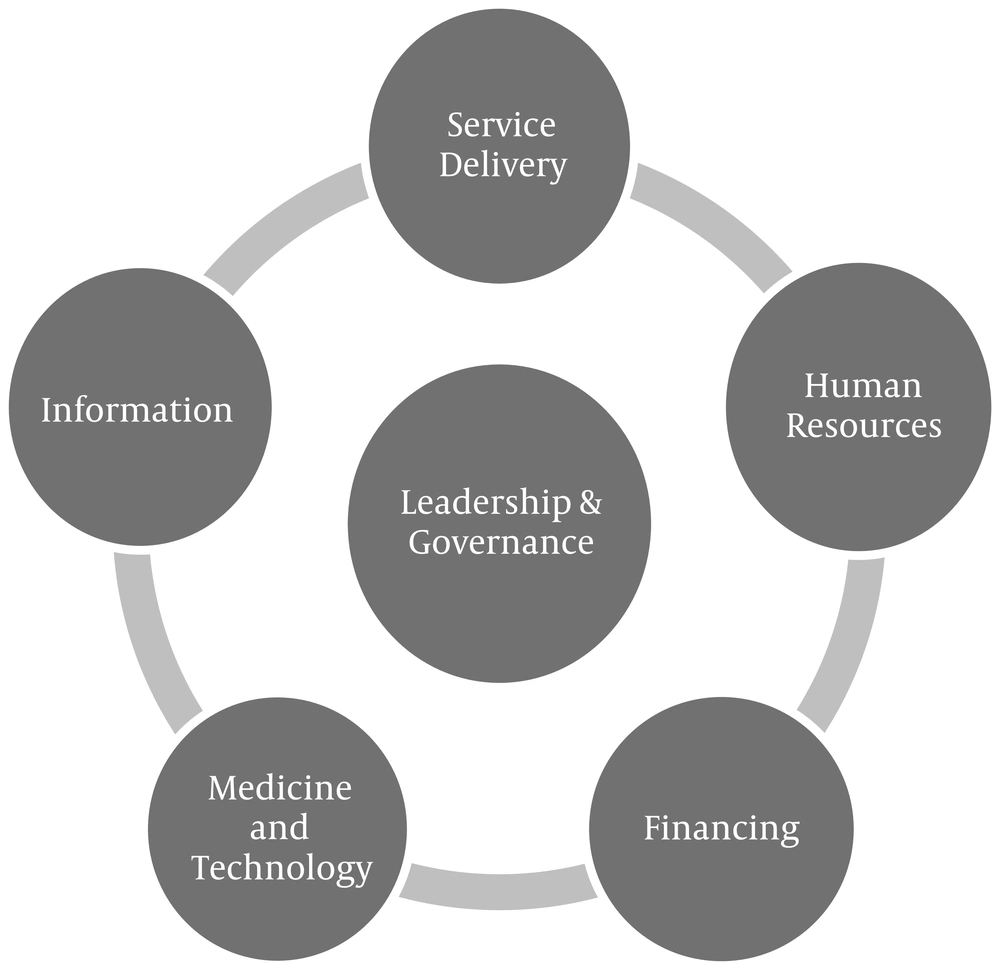
Figure 1.
The World Health Organization health systems framework
3. Results
Reviewing literatures conducted the researchers to the barriers of a well-established health policy-making process in the MICs summarized on the basis of WHO health system framework to six categories in Table 1.
Table 1.
The Barriers of a Well Evidenced-Based Health Policy-Making Process in the MICs
| Building Block | ||||||
|---|---|---|---|---|---|---|
| Barrier | Governance | Information | Financing | Service Delivery | Human Resources | Medicine and Technology |
| 1 | Market rules governing the health system | Lack of performance based multi- dimensional research | Low share of GDP | Low attention paid to PHC | Lack of proper training and management of managers in the health structure | The desire to buy and use expensive technology |
| 2 | Strong dependency between evolution of existing frameworks and institutions and their historical, cultural, and political genesis | Fragmented and duplicated national health information system | Inequitable and ineffective financing system | Lack of clear definition for public- private partnership | Brain drain | Imperfect drug supply system |
| 3 | Multiple and closed reforms | Low-quality data and information | Inequitable financial contributions | Low service performance | Lack of a national HRHa strategic plan | Politicized decision-making |
| 4 | Politicized decision-making instead of evidenced-based decision-making | Poor infra-structure for effective health information system | Chaotic risk pooling policy | Inequity of health services utilization | Shortage of the number of human resources | Low-quality and -quality data |
| 5 | Difficult adaptation to globalization | High dependency on external technical support | Shortage of public funding | Low-efficacy health interventions | High staff turn-over | Lack of experts and capabilities |
| 6 | Fragmentation of health system | Low investment in NHIS | Lack of strategic purchasing in health care | Epidemiological transition in diseases pattern | Unequal distribution in rural/ urban areas | Poor structure |
| 7 | Centralized decision-making system | Limited managerial and healthcare providers skills | High level of out of pocket | Low quality of care | High workloads | Shortage of frameworks and guidelines |
| 8 | Consolidated purchaser- provider | Unstable financial resources due to geopolitical issues | Lack of skill in supervision | Limited access to new medicines and technology due to the budget constraint | ||
| 9 | Administrative complexity/ inefficiency | Health insurance problems | Low-motivated human resources | |||
| 10 | Poor inter-sectorial collaboration | Low-performance healthcare staff | ||||
| 11 | Low commitment on NHS | Inappropriate ratios of healthcare workers | ||||
aHuman Resources for Health
4. Discussion
Through an abstract approach on Table 1, there are five main challenges to improve the health systems in MICs including inappropriate informed policy-making process, lack of a customized and inclusive national plan to frame the health policies, low efficient and equitable healthcare system resulted from long-term flawed public policies, shortage and misallocation of resources, and poor governance. Hence, to combat these five struggling areas, it is recommended that health policy-makers in MICs apply the following suggestions:
(1) Passive problem-solving is the common approach to policy-making in MICs, while it should be switched to active informed policy-making. Obviously, this change should be accompanied by building capacity such as accurate processing information system, training policy-makers to apply robust evidence, applying national evidence as well as international ones, and finally establishing a good health system research beside the routine monitoring and evaluation reports (5, 6).
(2) There are too much short-term piecemeal plans for the MICs health system that most of the times are in conflict with each other (7). This phenomenon could be simultaneously a cause of wrong policy-making as well as its effect. This shortcoming could be solved through applying a three-pillar approach including (A) choosing long-term, sustainable, and realistic policies, (B) prediction power of the future events and risks regarding geopolitical or socioeconomic issues, (C) encouraging the active participation of all stakeholders including community (2).
(3) The accompanying of the long-term flawed policies in health and public sectors result in low efficiency and equity in the health systems of MICs (8). In this regard, the first and foremost strategy is to establish primary health care with focus on marginalized, deprived, and vulnerable groups to guarantee equity and efficiency (9). The second strategy should be leveling the health services with an appropriate referral system that leads to the reduction of the service cost and enhancement of service utilization (10). Evidently, the other strategy is to integrate healthcare vertically and horizontally through team working with focus on primary prevention (11). The last, but not least, strategy is to consider quality as well as quantity of health services in all levels (12).
(4) Resource limitation and misallocation is another common challenge of MICs (2). In response, including effective health interventions into the basic service package, reducing corruption, managing the employment of private beside the public sector, and improvement of their contracting system are suggested operative strategies to combat shortage of resources (2). However, misallocation of resources provokes its limitation (13); therefore, equitable distribution of all resources regardless of the socioeconomic status of the target population should be considered in all health policies. In many cases, health policy makers in the MICs allocate huge amount of money to import advanced health technology from the abroad and provide access to privileged people, based on the political purposes. Therefore, establishing and/or strengthening health technology assessment (HTA) committee is crucial to use appropriate technology (14).
(5) Poor governance is prominent over the other health policy-making challenges in MICs. The foremost problem is free market approach to health system that should be replaced by legitimate/managed market, since health system is a failure rather than perfect market. Despite some controversies, in general, decentralization of policy-making is a good strategy to overcome challenges such as inefficiency and inequity in MICs health systems (2). In addition, community participation in policy-making process could enhance social capital in health sector and improve the effectiveness of health policy-making (15). Finally, health attachment to all public policies should become mandatory by the governance to make all policies in line with restoring and promoting health (16).