
1. Background
Without question, occupation plays a vital role in any individual’s life. However, it can become a hazard if carried out in an inappropriate way (1). Among different occupational groups, teaching is considered to be one of the healthiest professions. It is generally assumed that teachers lead healthy lifestyles. Meanwhile, due to their specific working conditions, they stand among occupational groups exposed to a wide variety of health hazards associated with their profession, such as mental or physical health problems.
To date, several studies have been conducted evaluating the mental health status of teachers (2-4). In this regard, it is widely believed that teachers have poorer mental health compared to other occupational groups. A lot is demanded from teachers as they are required to meet the diverse learning needs of their students. However, that claim is not as indisputable as often thought (5, 6). Results from a study carried out in France (7) showed that teachers do not have poor mental health; instead, they observed a higher prevalence of physical health problems related to the ears, nose and the throat tracts, and to a lesser extent depending on gender, related to skin, eyes, legs, and the lower urinary tract. Therefore, in addition to mental health problems, teachers are also exposed to a variety of physical health issues, such as musculoskeletal disorders, respiratory problems and contact dermatitis.
Among different high-risk groups, the teaching profession stands out in terms of voice problems (8). Voice disorders have negative impact on the quality of life, which means teachers who complain from voice problems, endure poorer health-related quality of life (9). Numerous studies have been carried out with the aim to investigate the prevalence of voice problems in teachers (10-13). However, there is still limited awareness among teachers regarding the potential risks associated with vocal health or the specialized health services (14). In addition, female teachers reported a higher prevalence of voice problems than their male counterparts (15). Furthermore, teachers are at a high risk of musculoskeletal disorders (MSDs), especially in the back, neck and shoulders (16, 17). Shoulder and back pain in teachers might be due to incorrect working posture, while grading homework at their pupils’ desks or prolonged periods of writing on the board (18). Chalkboards are still used in developing countries as traditional teaching aids. Teachers using chalkboards are indeed at an increased risk of developing occupational respiratory illnesses and contact dermatitis (18-20).
Despite the principal role of teachers in shaping the future generation, less attention has been paid to the occupational health problems associated with the teaching profession. Most studies conducted among teachers have merely focused on mental health problems or a single category of physical health issues, such as MSDs or voice problems (9, 21, 22).
2. Objectives
This study aimed to investigate a wide array of work-related health problems, not limited to MSDs or voice disorders, among school teachers in Shiraz, Iran.
3. Methods
This comprehensive cross-sectional study was conducted among primary and secondary school teachers in Shiraz. It was carried out to evaluate the prevalence of work-related health problems in this population. A two-stage sampling method was employed in this research stratified and cluster sampling were used. To do so, about 20 primary and secondary schools were randomly selected from each of the four main districts comprising the educational departments of the city of Shiraz. In each cluster (in this study, each school was considered as a cluster), the participants were informed of the study objectives and of the voluntary nature of the study. Besides, they were asked to attend the study according to their teaching experience and their willingness to take part in our study. Sample size was determined using the formula for a single population proportion, considering 95% CI, a prevalence of 50%, as we could not find any similar study on this subject in Iran, and error equal to 0.2 of prevalence rate. To collect data, a standard multi-section questionnaire consisting of demographic and occupational characteristics (age, gender, body mass index (BMI), teaching experience, etc.) and subjective health complaints (SHCs) was distributed among a random sample of primary and secondary school teachers. All teachers with one year or longer work experience were included in the study.
SHC inventory, previously known as the Ursin health inventory (UHI), covers a wide range of health problems experienced within the previous 30 days (23). In the version proposed by Chong and Chan (18), the most common health related complaints associated with the teaching profession, including eye problems, contact dermatitis, voice disorders and varicose veins of the lower extremities, had been added to the original version.
In our study, three extra health problems were added to the modified questionnaire, including hypertension, high blood cholesterol and diabetes. Consequently, health complaints were categorized into 10 subscales, namely musculoskeletal pain, pseudoneurology, gastrointestinal complaints, allergy, flu, eye problems, health problems common to teachers, hypertension, high blood cholesterol, and diabetes. Experts were consulted to analyze the validity of the questionnaire, and its reliability was verified with a Cronbach’s alpha of 0.729. In this study, the severity of health complaints was also investigated as well as their prevalence. For this purpose, the severity of each complaint was scored based on a scale of 0 - 3 (0- none, 1- mild, 2- moderate, 3- severe).
All data were statistically analyzed using SPSS Statistics 19.0. Chi-squared test was used to examine if demographic and occupational characteristics had any statistical association with each complaint. P value < 0.05 was considered to be statistically significant.
4. Results
4.1. Subjects
A total of 508 questionnaires were collected. Out of that, 179 (35.2%) were primary teachers and 329 (64.8%) were secondary school teachers. There were 154 (30.3%) men and 354 (69.7%) women among the respondents. The overall response rate was 87.5%. The majority of respondents had over 5 years teaching experience (96.8%). Details regarding demographic and occupational characteristics are presented in Table 1.
Table 1.
Demographic and Occupational Characteristics of the Primary (N = 179) and Secondary (N = 329) School Teachers Under Studya
| Variable | Primary School Teachers | Secondary School Teachers | Overall |
|---|---|---|---|
| Gender | |||
| Male | 24 (4.7) | 130 (25.6) | 154 (30.3) |
| Female | 155 (30.5) | 199 (39.2) | 354 (69.7) |
| Total | 179 (35.2) | 329 (64.8) | 508 (100) |
| Age, y | |||
| 21 - 30 | 11 (2.2) | 20 (4) | 31 (6.1) |
| 31 - 40 | 77 (15.2) | 106 (20.9) | 183 (36.2) |
| 41 - 50 | 68 (13.4) | 173 (34.2) | 241 (47.6) |
| ≤ 50 | 23 (4.5) | 28 (5.5) | 51 (10.1) |
| Total | 179 (35.4) | 327 (64.6) | 506 (100) |
| Marital status | |||
| Single | 31 (6.1) | 43 (8.5) | 74 (14.6) |
| Married | 148 (29.1) | 286 (56.3) | 434 (85.4) |
| Total | 179 (35.2) | 329 (64.8) | 508 (100) |
| Teaching experience, y | |||
| 1 - 5 | 3 (0.6) | 13 (2.6) | 16 (3.2) |
| 6 - 10 | 19 (3.8) | 36 (7.2) | 55 (11) |
| 11 - 15 | 36 (7.2) | 32 (6.4) | 68 (13.7) |
| 16 - 20 | 26 (5.2) | 72 (14.5) | 98 (19.7) |
| 21 - 25 | 60 (12) | 106 (21.3) | 166 (33.3) |
| 26 - 30 | 31 (6.2) | 57 (11.4) | 88 (17.7) |
| > 30 | 0 (0) | 7 (1.4) | 7 (1.4) |
| Total | 175 (35.1) | 323 (64.9) | 498 (100) |
| Education | |||
| Associate degree | 37 (7.3) | 20 (3.9) | 57 (11.2) |
| Bachelor’s degree | 122 (24) | 223 (43.9) | 345 (67.9) |
| Master’s degree or higher | 20 (3.9) | 86 (16.9) | 106 (20.9) |
| Total | 179 (35.2) | 329 (64.8) | 508 (100) |
| BMI | |||
| < 18.5 | 2 (0.4) | 1 (0.2) | 3 (0.6) |
| 18.5 - 24.9 | 86 (17.3) | 170 (34.3) | 256 (51.6) |
| 25 - 29.9 | 67 (13.5) | 118 (23.8) | 185 (37.3) |
| > 29.9 | 21 (4.2) | 31 (6.3) | 52 (10.5) |
| Total | 176 (35.5) | 320 (64.5) | 496 (100) |
| Recruitment | |||
| Official | 170 (33.5) | 302 (59.4) | 472 (92.9) |
| Contractual | 9 (1.8) | 18 (3.5) | 27 (5.3) |
| Tuition | 0 (0) | 9 (1.8) | 9 (1.8) |
| Total | 179 (35.2) | 329 (64.8) | 508 (100) |
| Job satisfaction | |||
| Yes | 163 (32.1) | 265 (52.2) | 428 (84.3) |
| No | 16 (3.1) | 64 (12.6) | 80 (15.7) |
| Total | 179 (35.2) | 329 (64.8) | 508 (100) |
Abbreviation: BMI, body mass index.
aValues are expressed as No. (%).
4.2. Prevalence
Total of 94.7% (n = 468; 95% CI [91.5 - 95.8]) of the respondents were suffering from at least one type of complaint (97.7% females, 87.8% males). The 10 most frequently reported health complaints were lower back pain (68.3%), tiredness (63.1%), leg pain (60.7%), voice problems (56%), headache (52.2%), neck pain (48.4%), anxiety (41.8%), shoulder pain (41.7%), varicose veins of the lower limbs (37.6%) and sleep problems (37.3%). Figure 1 shows the prevalence of SHCs among teachers. Among the 10 subscales, MSDs were the most frequent health complaint in the studied sample (88.3%).
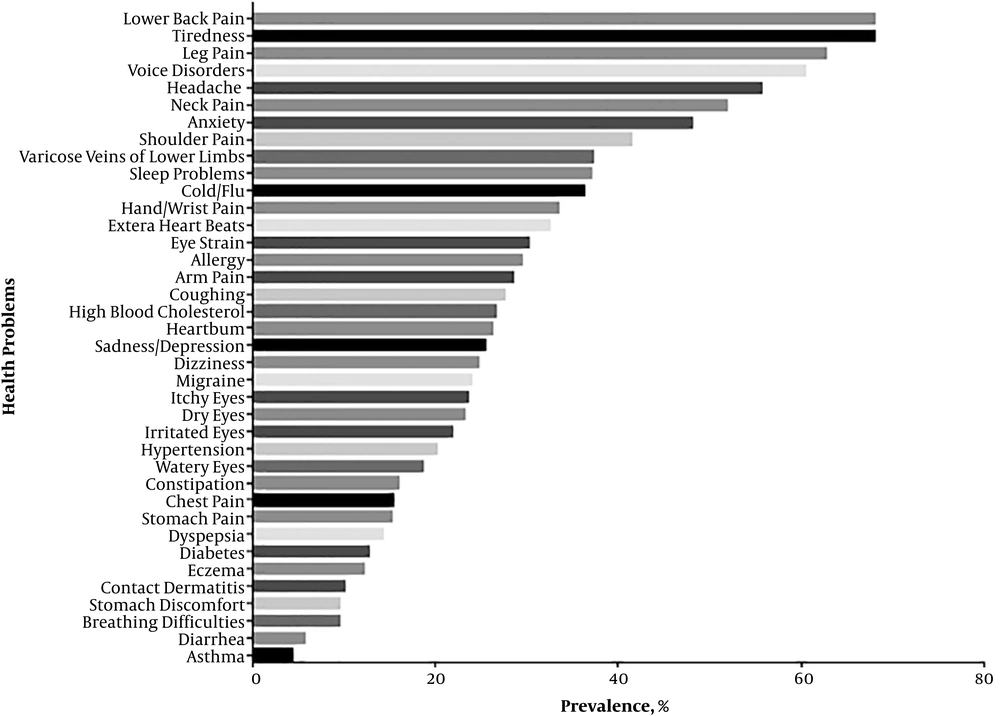
Figure 1.
Prevalence of health complaints among primary and secondary school teachers
4.2.1. Differences in Terms of Gender
Table 2 shows the numbers and proportions of school teachers with health complaints in each category.
Table 2.
Numbers and Proportions of School Teachers with Health Complaints
| Health Problem Categories | Female (N = 354) | Male (N = 154) | P Valuea |
|---|---|---|---|
| Musculoskeletal pain | 320 (92.2) | 119 (79.3) | 0.001 |
| Lower back pain | 251 (71.3) | 94 (61.4) | 0.028 |
| Neck pain | 186 (53.6) | 55 (36.4) | < 0.001 |
| Leg pain | 224 (64.4) | 79 (52.3) | 0.011 |
| Shoulder pain | 159(45.7) | 49 (32.5) | 0.006 |
| Arm pain | 113 (32.5) | 30 (20) | 0.005 |
| Hand/wrist pain | 137 (39.4) | 31 (20.7) | < 0.001 |
| Headache | 198 (56.9) | 62 (41.3) | 0.001 |
| Migraine | 92 (26.4) | 29 (19.3) | 0.090 |
| Pseudoneurology | 269 (77.3) | 97 (64.7) | 0.002 |
| Dizziness | 99 (28.4) | 25 (16.7) | 0.005 |
| Sleep problems | 140 (40.2) | 46 (30.7) | 0.043 |
| Tiredness | 234 (67.2) | 80 (53.3) | 0.003 |
| Gastrointestinal complaints | 149 (42.8) | 54 (36) | 0.137 |
| Allergy | 165 (47.6) | 50 (33.3) | 0.003 |
| Asthma | 38 (10.9) | 11 (7.3) | 0.218 |
| Breathing difficulties | 54 (15.5) | 24 (16) | 0.892 |
| Chest pain | 50 (14.4) | 12 (8) | 0.048 |
| Eye problems | 66 (44) | 187(53.7) | < 0.001 |
| Watery eyes | 75 (21.6) | 19 (12.7) | 0.020 |
| Flu | 58 (38.9) | 149 (42.8) | 0.125 |
| Voice disorders | 67 (44.7) | 212 (60.9) | < 0.001 |
| Contact dermatitis | 16 (10.7) | 36 (10.3) | 0.695 |
| Varicose veins of lower limbs | 35 (23.3) | 152 (43.7) | 0.003 |
| High blood cholesterol | 49 (32.9) | 84 (24.1) | < 0.001 |
| Diabetes | 24 (16) | 40 (11.5) | 0.092 |
| Hypertension | 34 (22.7) | 68(19.5) | 0.265 |
aChi-square test.
4.2.2. Differences in Terms of Teaching Level
No difference was found between primary and secondary school teachers related to the prevalence of musculoskeletal problems, except that the primary teachers were more likely to have headaches (59.7 vs. 48.1%; P = 0.014). In the gastrointestinal subscale, the only significant difference was in stomach discomfort. The percentage of primary school teachers reporting stomach discomfort was significantly higher than that of the secondary school teachers (13.6 vs. 7.8; P = 0.035). To our surprise, amongst common health problems, no significant differences were found between primary and secondary school teachers regarding the prevalence of voice disorders and varicose veins. However, primary teachers showed a significantly higher prevalence than the secondary ones in relation to contact dermatitis (16.5 vs. 7.1%; P = 0.001).
4.2.3. Differences in Terms of Age Group
Respondents were divided into three groups including < 31 years (n = 32), 31 - 50 years (n = 423) and > 50 years (n = 51). Apart from hand/wrist pain and headache, no significant differences were found between age groups in musculoskeletal subscale. The second age group showed a higher prevalence of hand/wrist pain (P = 0.027) and headache (P = 0.010). In terms of individual pseudoneurological complaints, an age difference was noted in the subscale of tiredness (P = 0.039). Teachers in the second age group were more likely to feel tired in comparison with the other groups. No significant differences were found between age groups in terms of subjective health problems in the categories of gastrointestinal and eye problems. Furthermore, except for allergy (P = 0.014) no significant differences were found in the allergic subscale. In the second age group, teachers showed to have the highest prevalence of allergy in our sample. In respect to flu subscale, teachers under 31 were significantly more likely than older teachers to have cold/flu (P = 0.017). Among health problems common to teachers, the only significant age difference was observed in varicose veins of the lower extremities (P = 0.001). Teachers in the second age-group had a higher prevalence of varicose veins. The age difference was also found to be significant in respect to hypertension (P = 0.010). In this regard, older teachers were significantly more likely to develop hypertension compared to younger age groups.
4.2.4. Differences in Terms of Teaching Experience
Teachers were divided into four groups according to their experience, including < 5 years (n = 16), 5 - 9 years (n = 41), 10 - 19 years (n = 131) and ≥ 20 years (n = 310). In terms of individual musculoskeletal disorders, significant differences were found in relation to leg pain, shoulder pain and hand/wrist pain. Teachers with longer teaching experience were more likely to have leg pain (P = 0.017). However, the prevalence of shoulder pain was significantly higher in teachers with 5 - 9 years teaching experience (P = 0.034). Moreover, teachers with 10 - 19 years experience were found to have a higher prevalence of hand/wrist pain compared with others (P = 0.025). Regarding individual eye complaints, the only significant difference was related to dry eyes (P = 0.049). With increased teaching experience, the development and occurrence of eye dryness increased as well. Among common health complaints, contact dermatitis had a significant prevalence in teachers with 5 - 9 years teaching experience. Furthermore, teachers with longer experience were more likely to have varicose veins in their lower limbs (P < 0.001). Similarly, high blood cholesterol (P < 0.001), diabetes (P = 0.003) and hypertension (P = 0.019) were significantly more prevalent in teachers with ≥ 20 years experience. No significant differences were found in respect to voice disorders and the categories of pseudo neurological problems, gastrointestinal complaints, allergic problems and cold/flu. No statistically significant numbers could be found with respect to relationship of health problems with job satisfaction, marital status, recruitment status, education, and BMI.
4.3. Severity
We assessed the severity of health problems by a score that was a simple sum of raw severity scores for every single complaint. The five most severe health problems reported by teachers were tiredness, leg pain, lower back pain, voice disorders, and headache. Figure 2 shows the severity of SHCs among teachers.
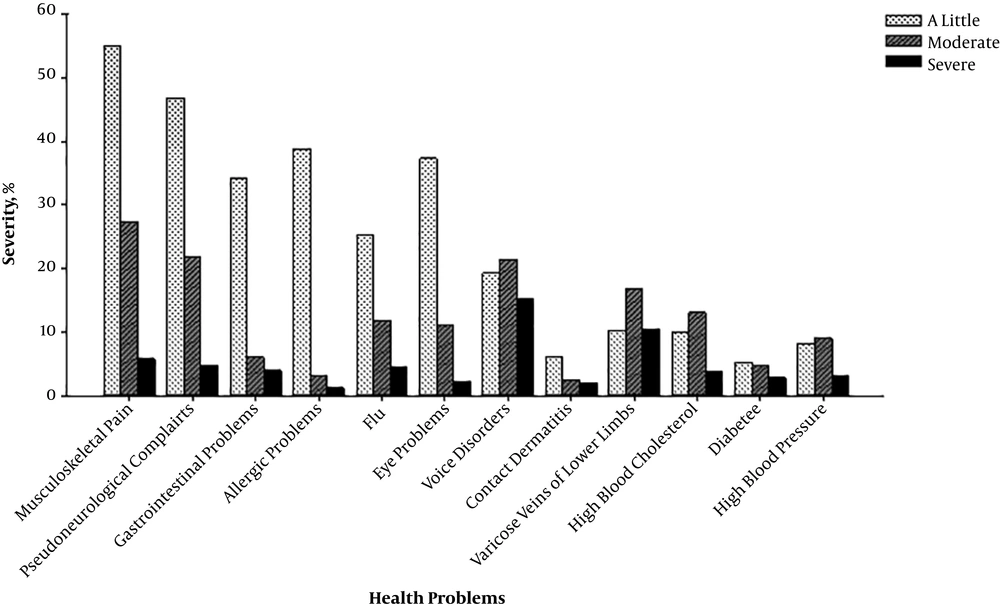
Figure 2.
Severity of health complaints among primary and secondary school teachers
5. Discussion
The aim of this study was to investigate the prevalence of work-related health problems among primary and secondary school teachers, and to evaluate how individual and occupational characteristics might affect the risk of developing health complaints. Among the categories, musculoskeletal disorders, as expected, were the most frequent ones (88.3%). This prevalence was relatively higher compared with results from other studies conducted among school teachers (16, 17, 24, 25).
Of the individual health problems, lower back pain was the most frequent one (68.3%), which was consistent with the previous research (21, 26). In the present article, female teachers were significantly more likely to experience lower back pain than their male colleagues; however, in a similar study carried out in Iran (21), gender differences were deemed statistically insignificant. The gender difference found in our study might be attributed to age. Overall, female teachers were significantly older than their male counterparts. In addition, the majority of the female population were overweight in comparison with the male teachers; although, this difference was not statistically significant. According to Ihlebaek et al. study gender differences might be due to lower physical strength of women, or simply the fact that men and women have different thresholds (27).
Other than high blood cholesterol, there was a significantly higher percentage of female teachers (n = 354) reporting health problems in comparison with male teachers (n = 154). Male teachers were significantly more likely to have high blood cholesterol in comparison with their female colleagues. This difference can be explained by the fact that female teachers often pay more attention to the principles of a healthy lifestyle, such as optimal body weight, low-fat diet and higher amounts of leisure time and physical activity (28). Results also showed that female teachers were more likely to report voice problems, which is consistent with reports from previous studies (8, 13, 14).
In our study, in contrast to the results from the Leao et al. study among New Zealand teachers (14), no significant difference was found between primary and secondary school teachers in terms of frequency of voice problems. This finding could possibly be attributed to the lower number of primary school teachers (n = 179) in our sample in comparison to secondary teachers (n = 329). In the current research, primary school teachers had a significantly higher prevalence of contact dermatitis than secondary school teachers (16.5 vs. 7.1; P = 0.001). This result is in line with the findings of Chong and Chan in their study on primary and secondary school teachers in Hong Kong (18), where the primary teachers were significantly more prone to dermatitis. Since exposure to chalk dyes is a possible cause of contact dermatitis (7), this association could be explained by the continuing use of chalkboards in some of the primary schools. In regard to the association between lower back pain and teaching level, our study failed to find any statistically significant differences between primary and secondary teachers in terms of lower back pain; however, according to the findings of a previous study conducted in Iran (21), high school teachers seemed to be more affected by lower back pain in comparison with the teachers in elementary schools.
In the present study, teachers in the second age group (31 - 50 years) showed a higher prevalence of hand/wrist pain, headache, tiredness, allergy, and varicose veins of lower limbs. Results also revealed that younger teachers were significantly more likely to have cold/flu in comparison with older ones (P = 0.017). According to the Ihlebaek et al. study (27) it seems reasonable to see higher prevalence of cold/flu in younger teachers who have children of their own, as they might have a lower threshold. Additionally, the risk of hypertension increased statistically with ageing in our study, as it was anticipated (P = 0.010).
The current study also showed that tiredness was the most severe health complaint reported by the teachers. This result is in agreement with the results from Chong and Chan’s study (18). They suggested that teachers seemed to be exhausted due to their heavy workload.
In this study there were several limitations. First off, it should be noted that our study was carried out using a self-report questionnaire, and the respondents might not have answered the questions precisely. This might maximize or minimize the effects of certain variables, thus affecting the results. Another limitation was the fact that the gender differences found between female and male teachers might have been due to the small sample size of males vs. females, and not to the effects of gender on health complaints.
In conclusion, this study covers a wide variety of somatic health problems associated with the teaching profession. We hope that our results can raise the awareness of the government and respective organizations, such as the ministry of education to focus more on preventive and rehabilitative measures rather than just treatment. In addition to formulating necessary policies and strategies to improve teachers’ working conditions, this is of key importance if we are to implement the best interventions possible.