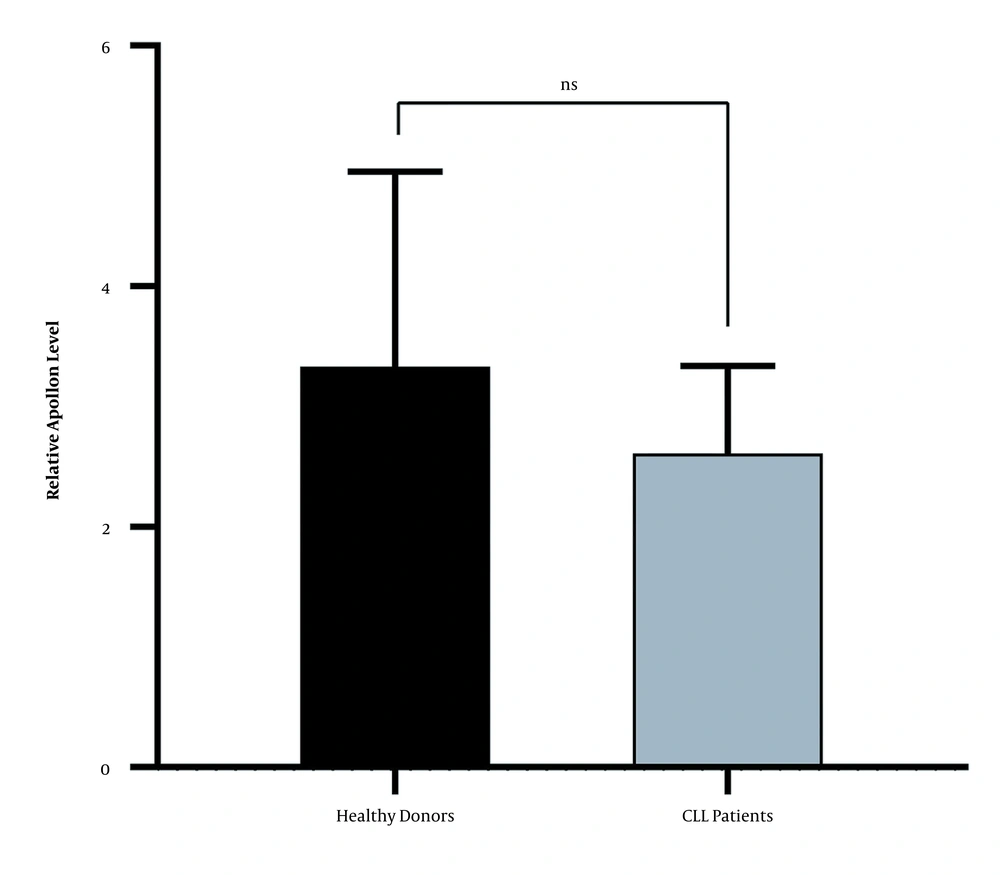
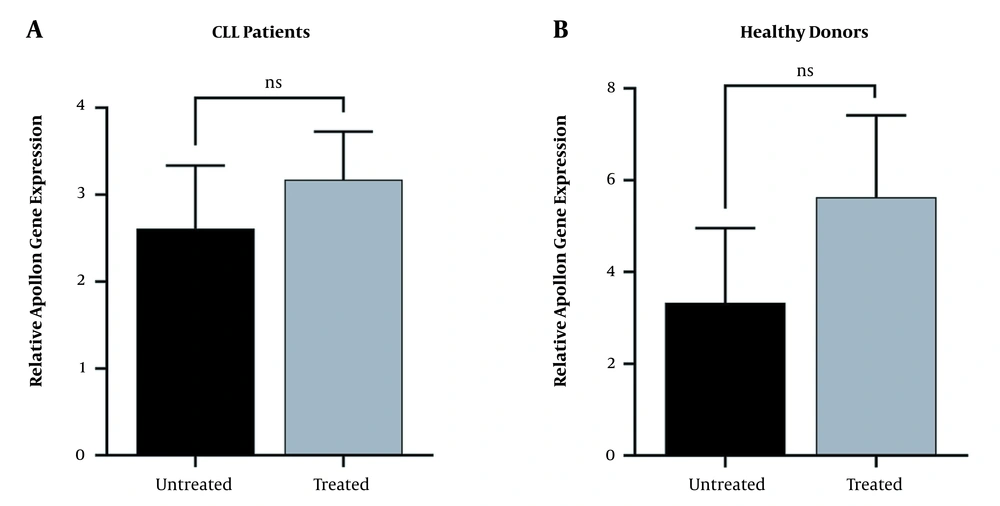
B-chronic lymphocytic leukemia (B-CLL) is characterized by the abnormal accumulation of B lymphocytes in the peripheral blood, bone marrow, and lymphoid tissues. Chronic lymphocytic leukemia is the most prevalent adult leukemia in Western countries and accounts for 11 - 15% of total hematopoietic cancers in Iran (
1). The incidence rate of this condition increases in adults with median age of 72 years. Moreover, males are more affected than females (1.7: 1) (
2). Morphologically, CLL cells are considered as long-lived, small, mature, and resting lymphocytes with the CD5+, CD19+, and CD23+ phenotypes (
3).
However, alteration in the capacity of cell apoptosis that leads to resistance to anti-tumor immune response is a principal feature of CLL (
4). There is strong consensus that defect in apoptosis regulation leads to the accumulation of malignant B cells. Apoptosis as programmed cell death is executed through the activity of caspase family and controlled by several checkpoints (
5). One of the apoptosis regulation checkpoints is the control of caspase activation through the inhibitor of apoptosis protein (IAP) family, including XIAP, cIAP1, cIAP2, ILP-2, NAIP, survivin, and BRUCE/Apollon. The Inhibitors of apoptosis protein consist of at least one baculovirus IAP repeat (BIR) domain, C-terminal RING zinc-finger domain, and caspase recruitment domain (CARD) (
6). Moreover, IAPs play a central role in the cell cycle and signal transduction.
It is demonstrated that IAPs are tightly associated with RE1-silencing transcription factor (REST) expression, as a master regulator in tumor development, progression, and metastasis (
7). Therefore, it seems that the dysregulation of IAPs may lead to tumorigenesis. In this context, Apollon/BIRC6 (BIR-containing protein 6) has been identified as a 530kDa protein that its encoding gene is located on the chromosome band 2p22. It is demonstrated that Apollon exerts its anti-apoptotic activity through promoting ubiquitination, and subsequently, the degradation of the pro-apoptotic protein Smac/DIABLO. It is also able to bind to pro-caspase-9 and inhibit its activation (
8). Accordingly, the overexpression of BIRC6 has been demonstrated in hematological malignancies, including childhood acute myeloid leukemia (AML), acute lymphoblastic leukemia (ALL), and CLL, and it has been associated with poor prognosis and chemoresistance (
9,
10).
In addition to the reported beneficial effects in various diseases, herbal medicines have long been accepted as adjunct therapeutics in cancer treatment. The growing body of evidence reveals that berberine-BBR (chemical formula: C20H18NO4, slowly soluble in water), as an isoquinoline alkaloid found in numerous types of medicinal plants such as Coptidis rhizoma,
Phellodendron chinense schneid, and
Phellodendron amurense, is able to promote apoptosis in several types of tumors through the inhibition of IAPs family and the activation of caspase-9 and mitochondrial-mediated pathways (
11,
12). Berberine may downregulate the expression of X-linked inhibitor of apoptotic proteins (XIAP), leading to the induction of apoptosis in leukocyte-depleted p53 genes. Moreover, berberine hydrochloride plays a focal role in reactive oxygen species generation, mitochondrial function, DNA topoisomerase inhibition, DNA or RNA binding, matrix metalloproteinase regulation, p53 activation, and NF-kappa B signal activation. Recently, the anti-metastatic and anti-cancer features of berberine against several cancers, including lung, prostate, breast, and gastric cancer, have been reported. In particular, the anti-proliferative and pro-apoptotic impacts of berberine have been demonstrated on leukemic cells derived from CLL patients (
13,
14).