1. Background
Acute pain management is a core ethical concept in medical practice (1). During thoracentesis and abdominocentesis, pain management is routinely managed with 1% lidocaine with a 25 gauge needle for skin and a smaller gauge needle for deeper tissue (2, 3). As the anesthetic injection is painful in and of itself (4), during these two procedures, pain management can sometimes fall short due to a lack of education and incorrect personal opinions (1, 5). One such example is “one needle insertion can cause less pain than two-needle insertions” (5). Therefore, it is essential to find an alternative method that is painless and reduces procedural pain, which does not require expertise to administer. This is particularly important in centers with a high volume of patients and a lack of expert medical staff.
Another option for administering local anesthesia is by means of a topical anesthetic. Generally, these are easily applied, tolerated better by patients, and have minimal systemic absorption resulting in fewer side effects (6, 7). A topical anesthetic can be a substitute for infiltrative lidocaine (IL) if it can be effective in reducing pain. Lidocaine-prilocaine cream (LPC) is an example of a topical anesthetic, which was introduced in 1980 for dermabrasion and minor surgery (8).
In 1988 Goodacre et al. showed that LPC, from the EMLA brand, could be as effective as infiltrative anesthesia in reducing pain for skin grafting (9). Previous research findings had noted the efficacy of LPC compared to IL in trans-radial catheterization (10), perineal tears following vaginal delivery (11, 12), and some pediatric procedures like lumbar punctures and venipunctures (13, 14). Additionally, LPC can be substituted for infiltrative prilocaine in pediatric femoral catheterization (15).
2. Objectives
Thus far, research has not been conducted on the efficacy of LPC, compared to IL, in pain reduction during thoracentesis and abdominocentesis procedures. Therefore, the aim of the current study is to evaluate the effectiveness of LPC, in comparison to IL, for pain management during the abovementioned medical procedures.
3. Methods
This parallel, randomized clinical trial was conducted at the Interventional Radiology Department of Al-Zahra Hospital in Isfahan, Iran. Ethics approval was obtained from the Ethics Committee at the Isfahan University of Medical Sciences (code: IR.MUI.MED.REC.1397.224) and registered with the Iranian Registry of Clinical Trials (code: IRCT20191204045600N1).
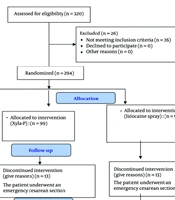
Study participants included patients who had been admitted to Al-Zahra Hospital between March and October 2019, and for whom the attending physician ordered elective thoracentesis or abdominocentesis. Elective procedures were ordered on diagnostic, curative, or palliative grounds. Patients were included in the study if they were: over 18 years of age, cognitively alert, not pregnant or breastfeeding, without a history of allergies to amides, without dermatologic conditions at procedure cite, did not have G6PD, and did not currently use systemic analgesic medications. Overall, 36 patients were included in the thoracentesis group and 33 patients in the abdominocentesis group. Using random allocation software, patients were randomly coded and divided into two groups by those codes, one group received IL (N = 35), and another received LPC (N = 34).
After explaining the procedures, hazards, and alternatives to the patients, they were free to enter our study. Written informed consent was obtained from all study participants. In addition, participants were told that they were free to withdraw their consent at any time point, and they could ask for more anesthetic if required.
Both thoracentesis and abdominocentesis ultrasound-guided procedures can minimize human errors. The best point for aspiration was determined using ultrasound imaging, which allowed medical staff to mark the point of aspiration. Next, the patients in the IL group received 5cc of lidocaine 2% (100 mg) with a 25-gauge needle, 5 minutes prior to the procedure (16). Infiltrative lidocaine was first injected subcutaneously and then deeper close to the parietal pleura in the thoracentesis procedure (3), or close to the peritoneum in the abdominocentesis procedure (2). The LPC group received 2.5 g of lidocaine-prilocaine cream. The cream that was used contained 2.5 g of lidocaine and 2.5 g of prilocaine per 100 g; it was labeled Xayla-p and made by Tehranchemie.CO. Then, 2.5 g of this cream translates to approximately a 9.5 cm strip of cream. That exact amount of cream was used to cover a 20 - 25 cm2 area around the spot marked by medical staff. Eventually, this area was covered with dressing plaster. After 30 minutes, the dressing plaster was removed, and any remaining cream was removed with the help of gauze. After this, the thoracentesis or abdominocentesis procedures started. In order to avoid systemic side effects associated with LPC, the following precautions were taken: not using an excessive amount of cream, only by using it in a determined area (20 - 25 cm2) within a short period of time, as well as not including patients who are under 18 years of age, pregnant, G6PD or those that have dermatologic disease or inflammation at the site of the procedure. Previous studies have shown the possibility of increased systemic side effects if mentioned precautions are not taken into consideration (17-19). All thoracentesis and abdominocentesis were both conducted in sterile conditions by the same radiologist. As is standard procedure, a 16 -gauge peripheral venous catheter was used in both procedures.
Immediately after the completion of the procedure, the catheter was removed, and the area was covered with sterile gauze and tape. In addition, directly after the procedure, patients were asked for their overall pain perception using a 0 - 10 numeric rating scale. Next, patients were asked their level of satisfaction using a 0 – 4 -point scale. Patients were asked to express their satisfaction by choosing between: totally satisfied (4), satisfied (3), indifferent (2), dissatisfied (1), or totally dissatisfied (0).
3.1. Statistical Analysis
Data were analyzed using SPSS software, version 23. We used independent t-test, chi-square test, and univariate analysis of variance (ANOVA) due to the normal distribution of data shown by the Kolmogorov-Smirnov test. The significance threshold was set at 0.05 for all analyses. The data were blinded before delivery to the analyzer.
4. Results
In the present study, the LPC group had a mean age of 58.21 ± 17.71 and included 34 patients; of these patients, 20 (58.8%) were male and 14 (41.2%) female (P-value > 0.05). The IL group had a mean age of 55.97 ± 18.23 and consisted of 35 patients; of these patients, 18 (51.4%) were male and 17 (48.6%) female (P-value > 0.05). These patients underwent abdominocentesis (n = 33) or thoracentesis (n = 36) due to therapeutic, diagnostic or therapeutic-diagnostic reasons. There was no significant difference between the two groups in terms of the Paracentesis type and indication (P-value > 0.05) (Table 1).
Table 1.
Baseline Patients’ Characteristicsa
| Characteristics | LPC Group (n = 34) | IL Group (n = 35) | P-Value |
|---|---|---|---|
| Sex | 0.631 | ||
| Male | 20 (58.8) | 18 (51.4) | |
| Female | 14 (41.2) | 17 (48.6) | |
| Age, y | 58.21 ± 17.71 | 55.97 ± 18.23 | 0.607 |
| Weight, kg | 68.96 ± 19.04 | 65.65 ± 17.65 | 0.460 |
| Paracentesis indication | 0.695 | ||
| Therapeutic | 5 (16.7) | 7 (20) | |
| Diagnostic | 10 (33.3) | 14 (40) | |
| Therapeutic-Diagnostic | 15 (50.0) | 14 (40) | |
| Paracentesis type | 0.900 | ||
| Abdominocentesis | 16 (47.1) | 17 (48.6) | |
| Thoracentesis | 18 (52.9) | 18 (51.4) |
aValues are presented as mean SD or No. (%).
As noted in Table 2, the number of attempts taken to perform either paracentesis procedure, abdominocentesis or thoracentesis was significantly higher in the LPC group compared to the IL group (P = 0.001). In addition, the number of attempts taken to perform abdominocentesis in the topical LPC group was significantly higher compared with the IL group (P = 0.003); however, there was no significant difference in the number of attempts taken to perform thoracentesis (P = 0.13).
Table 2.
Determination and Comparison of the Number of Attempts to Perform Paracentesis (Abdominocentesis and Thoracentesis) in the Two Groups
| Attempt | LPC Group (n = 34), Median (min-max) | IL Group (n = 35), Median (min-max) | P-Value |
|---|---|---|---|
| Total | 1.79 ± 1.02, 1 (1 - 5) | 1.14 ± 0.35, 1 (1 - 2) | 0.001 |
| Abdominocentesis | 2.06 ± 1.24, 2 (1 - 5) | 1.06 ± 0.24, 1 (1 - 2) | 0.003 |
| Thoracentesis | 1.53 ± 0.72, 1 (1 - 3) | 1.22 ± 0.43, 1 (1 - 2) | 0.131 |
In addition, self-reported pain experienced by patients both generally and separately in the abdominocentesis and thoracentesis procedures was lower in the LPC group compared with the IL group; however, there was no significant difference between the two groups. Moreover, there were no significant differences between groups after controlling for confounding variables such as age, sex, weight, or the number of procedural attempts, and Paracentesis indication, including therapeutic, diagnostic, and therapeutic-diagnostic processes (Table 3).
Table 3.
Determination and Comparison of the Mean Patients’ Pain Levels in the Two Groups
| Pain | LPC Group (n = 34) | IL Group (n = 35) | P-Valuea | P-Valueb |
|---|---|---|---|---|
| Total | 3.44 ± 2.50 | 4.49 ± 2.57 | 0.092 | 0.253 |
| Abdominocentesis | 3.69 ± 2.94 | 4.53 ± 2.65 | 0.393 | 0.884 |
| Thoracentesis | 3.22 ± 2.10 | 4.44 ± 2.57 | 0.128 | 0.246 |
aThe significance level obtained from the independent samples t-test comparing the mean patient’s pain levels in the two groups.
b The significance level obtained from the ANOVA test comparing the mean of patient pain levels in the two groups.
Lastly, analyses of the patient satisfaction levels revealed that the mean between the two groups both in general and separately in the abdominocentesis and thoracentesis procedures did not significantly differ (Table 4).
Table 4.
Determination and Comparison of the Mean Patient Satisfaction Level in the Two Groups
| Satisfaction | LPC group (n=34) | IL group (n=35) | P-Value |
|---|---|---|---|
| Total | 3.22 ± 0.83 | 3.48 ± 0.68 | 0.388 |
| Abdominocentesis | 3.20 ± 0.50 | 3.46 ± 0.78 | 0.619 |
| Thoracentesis | 3.25 ± 1.09 | 3.50 ± 0.53 | 0.517 |
5. Discussion
Pain management in thoracentesis and abdominocentesis procedures is routinely accomplished by injection of lidocaine first subcutaneously, then deeper into soft tissues prior to diagnostic and therapeutic procedures (2, 3). Lidocaine, by blocking sodium channels, can induce an analgesic effect when injected locally (20, 21). However, on occasion, medical staff neglect pain management procedures due to the belief that two needles cause more harm than one (5). In view of the systemic adverse effects associated with infiltrative analgesics, it is important to consider the efficacy of topical analgesics compared to the standard practice. Previous studies have compared the analgesic effects of lidocaine-prilocaine cream with infiltrative lidocaine on pain management, for instance, in episiotomy and its repair (12) post inguinal herniotomy (22) inferior turbinate reduction (23). This study was designed to compare the same in thoracentesis and abdominocentesis procedures. Due to ethical concerns, treatment groups were compared with each other as opposed to a control group. For patient’s safety and comfort, an expert interventional radiologist did all procedures ultrasound-guided (24).
The evaluation of the overall patient pain perception level indicated that it was lower in the LPC group compared with the IL group, but not statistically significant. In addition, in order to reduce confounding bias, the following confounding variables were controlled: age, sex, weight, the number of procedure attempts, as well as treatment purpose. After controlling the abovementioned confounding variables, the level of pain between the two groups was re-evaluated. The results indicated that there were no significant differences between the two groups in terms of the level of pain. Thus, we can conclude that LPC and IL had similar levels of efficacy in this study.
There are several benefits associated with topical anesthetic creams. For example, the administration does not require specialized training for medical staff, and as it can be applied to a large surface area, it allows for multiple procedural attempts with a single topical administration. In this study, even though the number of attempts to conduct the medical procedure was higher in the topical LPC group, the pain level was lower, but not statistically significant. It may be concluded that when there is a high probability of several attempts, LPC may be a better choice.
The results of the present study indicated that the number of attempts to perform paracentesis, either abdominocentesis or thoracentesis, was significantly higher in the LPC group than in the IL group. A closer examination revealed that this difference was more noticeable in patients undergoing abdominocentesis. In other words, the number of attempts to perform the procedure in patients undergoing abdominocentesis in the LPC group was higher than in the IL group; however, the number of attempts to perform the thoracentesis procedure did not differ significantly between the two groups. For patients in the LPC group, the cream was applied 30 minutes prior to the procedure, and they were free to move that period of time. They might have changed the accumulation position of ascetic fluid by their movements. On the other hand, the IL group received IL just five minutes before the procedure; this may explain why the procedural attempts were higher in the LPC group, especially as in abdominocentesis, the fluid can easily travel from one site to another. This study raises the question of whether using LPC in bed-ridden patients increases attempts to conduct thoracentesis and abdominocentesis compared to patients receiving IL. In a study conducted by Cozzi et al., they showed that the success rate of first attempts in needle procedures was significantly higher in the warm lidocaine-tetracaine patch group than lidocaine-prilocaine cream group (25).
The level of patient’s satisfaction both in general and with consideration to the procedures, abdominocentesis and thoracentesis procedures separately, was found to be equal and not significantly different between the LPC and IL groups. We also asked patients in the LPC group who had done a procedure by the IL method in the past to comment on LPC. One patient liked the cream more because it did not cause pain itself and had long-lasting local effects; another patient believed that the cream was more effective because he had less pain. However, one patient did not like the cream as it took time to affect and was a waste of time.
5.1. Conclusion
In the current study, we did not find a significant difference between the LPC and IL groups in terms of patient pain or satisfaction levels. Since there is a higher possibility of systemic complications associated with infiltrative compared to topical anesthesia (6, 7), we can conclude that lidocaine-prilocaine cream is an appropriate alternative for pain reduction in patients undergoing abdominocentesis or thoracentesis. Nevertheless, there is still room for further clinical trials in this field.
5.2. Limitation
In this study, we considered three distinct medical processes, such as therapeutic, diagnostic, and therapeutic-diagnostic. Alongside this, we investigated two medical procedures of abdominocentesis and thoracentesis. The limitation of the current study was the small sample size. Therefore, we recommend that future studies evaluating the patients' pain levels in each of the therapeutic-diagnostic processes and paracentesis procedures should be conducted with a larger sample size.