
1. Background
Cesarean section is a common surgery that nowadays is ordinarily performed under regional anesthesia. Considering the possibility of a difficult airway, edematous upper airways, and early desaturation during general anesthesia, this technique is usually restricted to special cases, and spinal anesthesia has become the technique of choice in cesarean section due to its reliability, cost-effectiveness, safety, and fast onset (1-3).
However, these popular neuraxial techniques are not free of complications (4). Post-dural puncture headache (PDPH) is one of the most common complications of spinal anesthesia (5), occurring in 0.38 - 6.3% of cases. The occurrence of headache depends on several factors such as sex, age, size, and type of the spinal needle, as well as procedure-related factors such as repeated dural punctures or skill level of the performer (6). PDPH can be debilitating in some patients and increase the length of hospital stay or mother suffering (7). According to a recent study on the long-term psychological outcomes of PDPH in parturients, increased incidences of depression, posttraumatic stress disorder, chronic headache, and decreased breastfeeding were observed (8). Pain is a defining feature of PDPH, appearing up to the fifth day after dural puncture, worsened by being in an upright position, and relieved by lying down (9).
Supportive measures, such as hydration and rest, nonsteroidal anti-inflammatory drugs (NSAIDs), and caffeine, are used to relieve pain, but they may be inadequate, and new pharmacological methods are needed to refrain from invasive treatments such as epidural blood patches. Some therapeutic agents such as gabapentinoids (10), sumatriptan (11), adrenocorticotropic hormone(ACTH) (12), aminophylline (13, 14), low-dose ketamine (15), and dexamethasone (16) have been proposed for this purpose, but their results (efficacy) are conflicting (17). Two major pathophysiologic mechanisms for PDPH are cerebrospinal fluid leakage resulting in the traction of intracranial structures and compensatory vasodilation in response to intracranial hypotension (18), which causes a vascular-type headache (19).
In recent years, some of the techniques (20) and drugs used to relieve pain in migraine headaches have been successfully used for PDPH management. Sumatriptan and zolmitriptan (21) are 2 antimigraine and 5-HT receptor agonists suggested to reduce the pain of PDPH by promoting vasoconstriction, a caffeine-like mechanism.
2. Objectives
The efficacy of magnesium as an antimigraine (22, 23) and analgesic adjuvant (24-26) has been proven, but its benefit in prophylaxis or treatment of PDPH has not yet been evaluated. Accordingly, we aimed to study the prophylactic effect of oral magnesium on PDPH after cesarean section under spinal anesthesia.
3. Methods
This study was approved by the Ethics Committee of Hamadan University of Medical Sciences (code: IR.UMSHA.REC.1398.029) and registered in the Iranian Clinical Trial Center (code: IRCT20120215009014N289).
Using the data of Nofal et al. (27), α probability 0.05, power of 80%, total sample size of 98 was calculated (49 patients per group) and finally 118 patients were studied for compensation of dropouts.
In this randomized, prospective, double-blind study, patients and staff involved in the study were unaware of who received the magnesium sachet. Data collection started in August 2019 and finished by March 2020. After obtaining the written informed consent, 112 eligible patients were enrolled and allocated to each study group (ie, intervention and control groups) using the sealed envelope system (Figure 1).
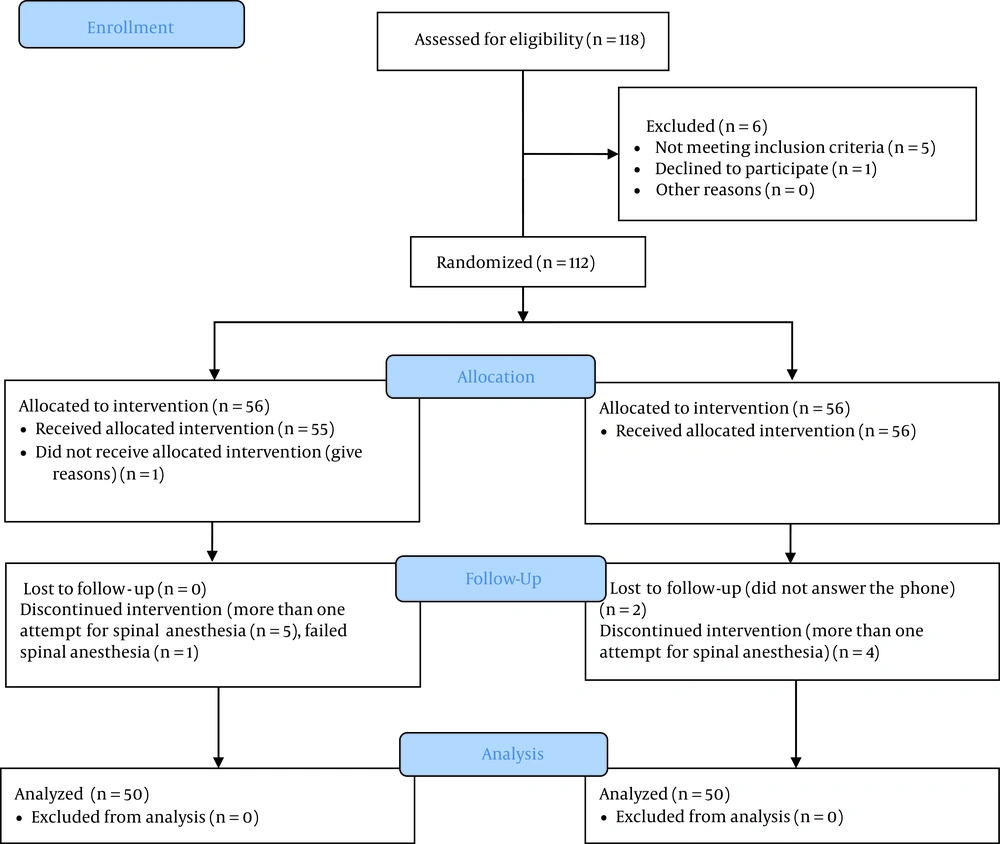
Figure 1.
Consolidated Standards of Reporting Trials flow chart
The inclusion criterion was singleton healthy term parturients (with a gestational age of > 37 weeks) who were candidates for elective cesarean section and aged between 18 - 45 years.
Patients were excluded from the study if they used psychoactive drugs and had chronic hypertension, preeclampsia, history of migraine or chronic headache, and allergy to any of the study drugs. Failed spinal block and patients with more than one attempt for spinal anesthesia were also excluded from the study.
Finally, 50 patients in each group completed the study. They received 300 mg of magnesium (Biolectra, HERMES ARZNEIMITTEL GMBH Co, Germany) and starch sachet in the intervention and control groups, respectively, poured on their tongues 2 hours before surgery. The study drug (magnesium stick) and starch powder were poured in similar little packs; both were presented as identical coded packs by an anesthesiologist who was not involved in the management of the patients. The patients, the anesthesiologists who managed the patients, and the nurses who cared for the patients were unaware of the group assignments.
Entering the operating room, a peripheral 18-gauge IV cannula was inserted, and 10 mL/kg of lactated Ringer’s solution was infused as a prehydration measure over 30 minutes. Mean arterial blood pressure, heart rate, and hemoglobin oxygen saturation (Spo2) were recorded by the noninvasive automatic device (Novin S1800, Saadat model, Iran) before anesthesia, every 2 minutes before delivery, and then every 5 minutes during surgery. Spinal anesthesia was induced by injecting hyperbaric bupivacaine 0.5% 2 mL (AstraZeneca, Austria) plus 2.5 μg sufentanil (Sufiject Aburaihan Co, Iran) after confirmation of cerebrospinal fluid flow through a 25-gauge Quincke needle (Mekon Medical Devices Co, Shanghai, China) at L4-L5 or L3-L4 interspaces with needle tip parallel to the dural fiber in the sitting position. Then, patients were immediately placed in the supine position, and after confirmation of the T4-T5 sensory level block, the operation was started. Hemodynamic monitoring was continued during surgery and in the recovery room.
Patients were followed 1, 2, and 3 days after the operation, and the occurrence of headache and its severity were assessed by the 10-point Visual Analogue Scale (VAS) with 0 = no headache and 10 = worst headache imaginable. A pain score greater than or equal to 3 not responding to rest and hydration was treated with rescue analgesics: acetaminophen or novafen (which consists of acetaminophen, caffeine, and ibuprofen); the need for rescue analgesia and also any unwanted side effects were recorded in the questionnaire. Pain scores were recorded 24 hours after spinal anesthesia with an interview by a clinician blinded to the study groups and for the next 2 days after hospital discharge by phone call.
Statistical analysis was performed using SPSS version 22 (SPSS Inc, Chicago, Ill, USA). Qualitative variables (such as headache occurrence and the need for analgesics) and their associations were analyzed using chi-square and Fisher exact tests. The Apgar score and pain score were compared using the Mann-Whitney test; other quantitative variables (such as age, weight, and height) were compared using the independent samples t-test between groups. Values were expressed as mean ± SD or median (interquartile range), and P-values less than 0.05 were considered statistically significant.
4. Results
In this study, 118 eligible women were enrolled, of whom 18 patients were excluded because of patient’s refusal, failure of spinal anesthesia, or more than one attempt spinal needle insertion (Figure 1).
Therefore, 100 women were studied in 2 groups: (i) the intervention group that received 300 mg of oral magnesium powder (n = 50) and (ii) the control group (n = 50) that received starch powder. Regarding age, weight, height, weeks of pregnancy, and Apgar score, there was no statistically significant difference between the 2 study groups (Table 1).
Table 1.
Demographic Characteristics of the 2 Study Groups
| Variables | Group | P-Value | |
|---|---|---|---|
| Mg | Placebo | ||
| Age | 30.8 ± 8.62 | 30.5 ± 5.98 | 0.79 |
| Height | 161.1 ± 5.32 | 163.14 ± 5.51 | 0.06 |
| Weight | 76.1 ± 11.69 | 79.1 ± 9.58 | 0.16 |
| Gestational age | 37.1 ± 5.69 | 37.65 ± 5.47 | 0.61 |
| Apgar score 1 min | 9.3 ± 1.2 | 9.2 ± 1.4 | 1 |
| Apgar score 5 min | 9.5 ± 1.1 | 9.5 ± 1.3 | 1 |
Compared with the control group, the incidence of headache was significantly lower in the intervention group on the first (8% vs 24%; P = 0.02) and second days (10% vs 26%; P = 0.03) after surgery. The incidence of PDPH was also lower in the intervention group on the third day (12% vs 18%), but the difference was not significant (P = 0.40; Table 2). The comparison of the mean VAS score between the 2 study groups showed that the intervention group always had lower pain scores, but the difference was only meaningful on the first (P = 0.03) and second (P = 0.05) days (Table 3). Considering the frequency of analgesia requests, no significant difference was seen between the study groups. On the first day after surgery, 8% of patients in the intervention group and 16% in the control group needed analgesia (P = 0.21), while 10% of the intervention group and 16% of the control group asked for analgesia (P = 0.37) on the second day, and the need for analgesia was equally 10% in both groups on the third day (Table 4). No adverse or unwanted effect was seen in both groups.
Table 2.
Incidence of Post-Dural Puncture Headache in the 2 Study Groups a
| Headache | Study Groups | P-Value b | |
|---|---|---|---|
| Intervention Group (N = 50) | Control Group (N = 50) | ||
| First day | 0.029 c | ||
| Yes | 4 (8) | 12 (24) | |
| No | 46 (92) | 38 (76) | |
| Second day | 0.037 c | ||
| Yes | 5 (10) | 13 (26) | |
| No | 45 (90) | 37 (74) | |
| Third day | 0.40 | ||
| Yes | 6 (12) | 9 (18) | |
| No | 44 (88) | 41 (82) | |
a Values are expressed as No. (%).
b Chi-square test
c P-values less than 0.05 were considered significant.
Table 3.
Comparison of Mean Pain Score (Visual Analogue Scale) Between the 2 Study Groups a
| Vas Pain Score | P-Value b | ||
|---|---|---|---|
| Intervention Group | Control Group | ||
| First day | 0.52 ± 1.83 | 1.5 ± 2.48 | 0.03 c |
| Second day | 0.7 ± 2.19 | 1.58 ± 2.86 | 0.05 c |
| Third day | 0.82 ± 2.32 | 1.18 ± 2.62 | 0.43 |
a Values are expressed as mean ± SD.
b Mann-Whitney test
c P-values less than 0.05 were considered significant.
Table 4.
Frequency of Analgesic Consumption in the 2 Study Groups a
| Analgesic Consumption | Study Groups | P-Value b | |
|---|---|---|---|
| Intervention Group (N = 50) N (%) | Control Group (N = 50) | ||
| First day | 0.20 | ||
| Yes | 4 (8) | 8 (24) | |
| No | 46 (92) | 42 (76) | |
| Second day | 0.13 | ||
| Yes | 5 (10) | 10 (20) | |
| No | 45 (90) | 40 (80) | |
| Third day | 1.0 | ||
| Yes | 5 (12) | 5 (12) | |
| No | 45 (88) | 45 (88) | |
a Values are expressed as No. (%). P-values less than 0.05 were considered significant.
b Fisher's exact test
5. Discussion
PDPH is a well-known complication of spinal anesthesia, particularly in obstetrics. Based on the results of the present study, prophylactic magnesium sachet administration reduces the incidence and severity of post-spinal headache in cesarean section on the first and second days after spinal anesthesia significantly.
Magnesium is the second important intracellular cation that plays a crucial role in enzymatic activity and neurochemical transmission at the synaptic junction of muscles. Besides preventing eclamptic seizures and having cardiovascular effects, a new role for this drug in anesthesia has been defined in recent years (28-30). The antinociceptive effects of magnesium in managing acute and chronic pain have been established in numerous studies (31-33). Although the basic mechanism is not yet clear, it has been suggested that N-methyl-D-aspartate (NMDA) receptors may play a role in magnesium analgesic action. Magnesium is an NMDA receptor antagonist; this receptor plays a key role in central sensitization; thus, it is believed that the analgesic action of magnesium is primarily related to the antagonism of NMDA receptors and abolishing hypersensitivity, although blockade of calcium channels is an alternative mechanism (34).
Many studies have indicated that prophylactic magnesium administration during the perioperative period decreases the acute postoperative pain and rescue analgesic dose. In the study by Hwang et al., MgSO4 (50 mg/kg) infusion during hip surgery under spinal anesthesia reduced the postoperative pain score and analgesic requirement markedly, while no significant side effect was seen (33). Davoudi et al. in a similar study found that MgSO4 infusion with the same dose during cesarean section decreased analgesic consumption and improved postoperative analgesia (31). Albrecht et al. reviewed 25 relevant studies and concluded that perioperative IV magnesium infusion reduced opioid consumption significantly and pain score to a lesser extent in the first 24 hours after surgery. No undesirable adverse effect was reported, and they suggested that magnesium should be considered as a new adjuvant in multimodal analgesia after surgery (34).
Several studies revealed that magnesium could also be effectively used as an antimigraine drug (35-37). There is considerable evidence that magnesium supplementation plays a pivotal role in migraine headache prophylaxis or management. It has been suggested that magnesium interaction in synaptic transmission, neurotransmitter secretion, and depression of cortical spreading is the reason for its analgesic effect in migraine patients. As the role of magnesium in managing migraine and tension headache is approved (38) and antimigraine drugs are successfully used in PDPH management, magnesium has received increased attention as a novel therapy for PDPH, which has no prohibition during pregnancy and childbirth.
There are only 2 similar studies investigating the effects of magnesium administration on post-spinal headache. Banach et al. carried out their study on 142 parturients undergoing spinal anesthesia for cesarean section. Patients were allocated into 4 groups receiving placebo, caffeine, caffeine plus magnesium, and caffeine plus magnesium plus aminophylline in the first 24 hours after surgery. The lowest rate of post-spinal headache was observed in the caffeine plus magnesium group (3%), but in terms of PDPH incidence, no statistically significant difference was seen between groups (39). The major difference between this study and our study is that all intervention drugs (including magnesium) were combined with caffeine, and the sole effect of magnesium was not evaluated.
However, the second study is more similar to the present research. In this regard, Mashak et al. revealed that infusion of MgSO4 during cesarean section under spinal anesthesia lowered the severity of spinal anesthesia-induced headache at all times (from 12 hours after surgery to 3 days after surgery) (40). Although the severity of PDPH was decreased in 2 studies by magnesium administration, there are some differences. For instance, in our work, instead of MgSO4 infusion, an oral magnesium sachet was utilized, and we evaluated the PDPH score and incidence every day, while they considered pain score every 12 hours. Unlike the study of Mashak et al. in which the mean pain score was significantly different between the 2 study groups at all times, the remarkable difference in pain score was only seen on the first and second days after surgery in the present study. As we mentioned, the incidence of PDPH was significantly lower on the first and second days after surgery in the intervention group compared to the control group, but Mashak et al. did not assess this variable.
In a recent review by Shin et al., it was indicated that in addition to the established role of magnesium as an analgesic adjuvant in acute and chronic pain management, increased magnesium supplementation could improve the course of some chronic diseases, including osteoarthrosis and neurological and cardiovascular diseases resulting in increased analgesia; this is a much more decisive role to treat disease. Newly oral magnesium has been successfully used for postoperative pain (41). The pain-lowering effect of oral magnesium after maxillofacial surgery was also confirmed by Jerkovic et al. (42).
Evidence of new roles of magnesium in anesthesia and pain management has accumulated over recent years, and as an essential mineral nutrient with very few and minor complications, magnesium preparations will take their place and be used in many fields. Our study is the first of its kind to evaluate the effect of oral magnesium on PDPH. Compared to intravenous magnesium sulfate, oral magnesium is more safe and available on an outpatient basis. If this drug proves to be effective in preventing and treating PDPH, it will be a revolution in the treatment of this long-lasting complication, especially in obstetric spinal anesthesia. However, further studies with a larger sample size are needed to validate this hypothesis.
The limitation of our study was that we follow our patients 72 hours after surgery, and a longer follow-up would be more helpful in getting a correct and precise result.
5.1. Conclusions
According to our findings, the use of 300 mg of oral magnesium sachet 2 hours before performing spinal anesthesia in elective cesarean section markedly decreased the incidence and severity of PDPH, but its impact on reducing analgesic consumption was not significant.