
1. Background
Postoperative pain in lumbar spine decompression and stabilization surgery is related to tissue damage that occurs during surgery and activation of various pain mechanisms, namely nociceptive, neuropathic, and inflammatory pain, which involves vertebral structures, intervertebral discs, ligaments, dura, nerve sheats, facet joint capsules, and muscles. These structures are innervated by the posterior ramus of the spinal nerves, which have close connections with the sympathetic and parasympathetic nerves. Postoperative pain also relates to mechanical irritation, compression, and postoperative inflammation (1).
Failure to treat intraoperative pain will cause sympathetic stimulation, characterized by intraoperative hemodynamic disturbances such as tachycardia, increased blood pressure, stroke volume, heart rate, and oxygen consumption. It can also trigger postoperative myocardial ischemia or even infarction in high-risk patients. In addition, acute postoperative pain not handled correctly can become chronic postoperative pain. The uncontrolled pain could promote the development of chronic persistent pain and worsen independence, mood, and quality of life (2).
Multimodal use of anesthetics, such as drug administration (3-6), addition of adjuvants (7, 8), various types of blocks (9, 10), as well as combination of intravenous anesthesia with regional analgesia during the perioperative period can provide adequate postoperative analgesia. Thoracolumbar interfascial plane (TLIP) block is an interfascial plane that provides adequate analgesia after lumbar spinal surgery. The classic TLIP block is performed by local anesthetic injection between them. multifidus and m. longissimus dorsi with ultrasound guidance (11). The classic TLIP block provides analgesia in the area of m. paraspinal nerves, which are innervated by the dorsal root of the thoracolumbar nerve. The modified TLIP block was performed by interfascial local anesthetic injection between m. iliocostalis and longissimus dorsi (12, 13). Modified TLIP block is more accessible to perform since m. iliocostalis and m. longissimus are easier to be distinguished than m. multifidus and m. longissimus on ultrasound images (11, 13). Modified TLIP blocks also provide better local anesthetics spread up to two cranial and caudal segments from its vertebral injection point (14, 15).
There is limited study comparing postoperative analgesic effect of modified and classic TLIP in lumbar spine surgery. Interleukin-6 (IL-6) level is often used to represent the activity of pain-related inflammation. IL-6 is detected within 30 - 60 minutes of surgery, then increases concentration and becomes significant 2 - 4 hours later. After major surgery, the higher level of IL-6 persists for 48 - 72 hours postoperatively.
2. Objectives
This study aimed to assess postoperative pain and serum levels of pro-inflammatory IL-6 after posterior lumbar decompression and stabilization surgery with the classical and modified techniques of TLIP block.
3. Methods
3.1. Study Design and Setting
This prospective randomized parallel single-blinded controlled trial aimed to compare TLIP block’s effectiveness and modified-TLIP block’s effectiveness in reducing postoperative pain and IL-6 level. Ethics approval was obtained from the health research ethics committee at the University of Indonesia and Dr. Cipto Mangunkusumo General Hospital (KET-1093/UN.2F1/ETIK/PPM.00.02/2020). The trial was also registered in ClinicalTrial.gov (NCT05104203).
3.2. Participants
Participants in this study were adult patients aged 18 - 65 years old, who would undergo posterior stabilization of two to three segments of the lumbar region with general anesthesia according to the American Society of Anesthesiology (ASA 1-2) criteria. Patients with a history of allergic reactions to local anesthetic agents were excluded. After obtaining informed consent, the participants were divided randomly into two groups: classic TLIP block group and modified-TLIP block group.
3.3. Study Protocol
The study was conducted in 2021. The sample size was chosen as recommended for pilot studies within the range of 8 - 20. The recruited participants were randomized using www.randomizer.org. Electrocardiogram (ECG) monitor, pulse oximetry, non-invasive blood pressure, and qNOX (Conox® Fresenius Kabi) monitor were placed when subjects arrived in the operating theatre. Before induction, the first blood sample was taken and placed in a cooler with 4°C temperature. Induction was conducted with midazolam 0.01 - 0.03 mg/kg body weight (BW) IV, fentanyl 2 - 4 mcg/kg BW as co-induction continued with propofol 2 - 3 mg/kg BW. Intubation was facilitated with rocuronium 0.8 - 1.2 mg/kg BW. Maintenance of anesthesia was performed using sevoflurane, oxygen, and compressed air. After the endotracheal tube was placed, subjects were ventilated with volume control mode with positive end-expiratory pressure (PEEP) 5 cmH2O and oxygen fraction of 30 - 50%; the respiratory rate was adapted to achieve targeted ETCO2 35 - 45 mmHg. Subjects were then positioned prone.
The same anesthesiologist performed blocks in both groups. In the classic TLIP block group, an ultrasonography (USG) scanning was performed with the linear probe at the lateral left side of the third lumbar to identify m. multifidus and m. longissimus. Then, 20 mL of bupivacaine 0.25% was injected with a 100 mm block needle from lateral to medial direction, with 15-degree direction from the skin. The spread of the local anesthetic agent was observed with the USG. The same procedure was done for the right side of the patient. In the USG guided modified-TLIP block group, the local anesthetic agent was administered between m. longissimus and m. iliocostalis both sides of the medial to the lateral direction dengan bupivacaine 20 cc 0.25%.
The hemodynamic parameter (oxygen saturation, heart rate, and blood pressure) was recorded. The noxious stimulation response level, measured by qNOX, was collected before induction, as well as 15 minutes, 30 minutes, and 45 minutes after the block was done. At the end of the surgery, the participant was extubated, and patient-controlled analgesia (PCA) morphine IV (1 mg/mL concentration, demand dose, 1 mg, lockout interval (LOI) 10 minutes with maximum dose of 10 mg/4 hours) was started. Paracetamol IV 1 gram 8 hourly were given as part of multimodal analgetic. The degree of pain was assessed using the NRS 6 and 12 hours postoperatively. Total 24 hours of morphine consumption were recorded. The second and third blood sample collections were conducted 6 and 12 hours postoperatively.
3.4. Data Analysis
Continuous variables were expressed as the means ± standard deviations (mean ± SD) and medians (25th - 75th percentiles), while categorical variables were expressed as counts (percentages).
4. Results
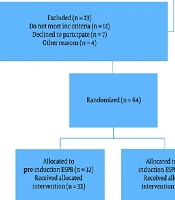
A total of eight patients were enrolled in the study: Four patients classic TLIP and four patients modified TLIP. Also, most patients were ASA-2. The characteristics of participants, intraoperative hemodynamic, and qNOX level of both groups can be seen in Table 1. IL-6 level was found to be higher in modified TLIP at preinduction (2.87 (1.47 - 4.2) vs. 1.56 (0.87 - 2.87, Table 2)) and similarly 6 hours postoperatively (54.14 (7.64 - 93.05) vs. 20.73 (8.38 - 21.79, Table 2)). However, IL-6 level was lower in modified TLIP 12 hours postoperatively compared to classic TLIP (29.91 (8.56 - 87.61) vs. 46.87 (2.87 - 92.35)).
Table 1.
Patients’ Characteristics a
| Characteristics | Classic TLIP (n = 4) | Modified TLIP (n = 4) |
|---|---|---|
| Age | 40.5 ± 11.44 | 57.75 ± 11.14 |
| Sex | ||
| Male | 2 (50) | 1 (50) |
| Female | 2 (50) | 3 (75) |
| ASA | ||
| 1 | 0 (0) | 1 (25) |
| 2 | 4 (100) | 3 (75) |
| Blood pressure | ||
| Systolic (mmHg) | ||
| Pre induction | 141.25 ± 14.0 | 137.5 ± 16.8 |
| 15 minutes | 125.5 ± 15.3 | 88 ± 17.5 |
| 30 minutes | 136.75 ± 16.9 | 100.75 ± 5.2 |
| 45 minutes | 122.75 ± 26.7 | 106.75 ± 6.2 |
| Diastolic (mmHg) | ||
| Preinduction | 75 ± 3.7 | 76.25 ± 7.2 |
| 15 minutes | 82 ± 9.5 | 65.75 ± 9.7 |
| 30 minutes | 83.25 ± 12.3 | 78 ± 8.0 |
| 45 minutes | 77.5 ± 18.4 | 79 ± 10.7 |
| Heart rate (times per minute) | ||
| Pre induction | 83.5 ± 5.2 | 87.5 ± 11.6 |
| 15 minutes | 64.5 ± 7.7 | 66.75 ± 9.9 |
| 30 minutes | 69 ± 17.1 | 75 ± 4.4 |
| 45 minutes | 68.75 ± 15.0 | 71.25 ± 8.7 |
| qNOX | ||
| Pre induction | 88.75 ± 15.3 | 91.25 ± 13.6 |
| 15 minutes | 34 ± 4.7 | 33 ± 3.5 |
| 30 minutes | 32 ± 0.8 | 42 ± 9.5 |
| 45 minutes | 31.25 ± 18.8 | 32.25 ± 21.3 |
a Values are expressed as mean ± SD or No (%).
Table 2.
IL-6, NRS, and Total 24-Hour Morphine Consumption in Classic and Modified TLIP Blocks
| Concentration of IL-6 | Classic TLIP | Modified TLIP |
|---|---|---|
| IL-6 level | ||
| Preinduction | 1.56 (0.87 – 2.87) a | 2.87 (1.47 – 4.2) a |
| 6 hours | 20.73 (8.38 – 21.79) a | 54.14 (7.64 – 93.05) a |
| 12 hours | 46.87 (2.87 – 92.35) | 29.91 (8.56 – 87.61) |
| NRS post-operative | ||
| 6 hours | 3.75 ± 1.7 b | 2.75 ± 1.5 b |
| 12 hours | 4 ± 1.6 b | 3.5 ± 1.3 b |
| Morphine/24 hours (mg) | 3.5 ± 1.3 b | 3.25 ± 1.3 b |
a Concentration in median (Min – Max)
b Concentration in Mean ± SD
The mean NRS in the modified TLIP block was comparable with the classic TLIP group, although it was lower than the classic TLIP group (2.75 ± 1.5 vs. 3.75 ± 1.7 at 6 hours and 3.5 ± 1.3 vs. 4 ± 1.6 12 hours postoperatively). There was no difference in total 24-h postoperative morphine consumption between the two groups (Table 2).
5. Discussion
Spine surgery, especially decompression and stabilization of the posterior lumbar, is excruciating, and the perioperative pain is often hard to control and needs massive opioids. TLIP block is an interfascial block of choice for perioperative pain management in spine surgery, either classic TLIP or modified TLIP (16).
The modified TLIP block was performed by interfascial local anesthetic injection between m. iliocostalis and longissimus dorsi (12, 13). Modified TLIP block is more accessible to perform since m. iliocostalis and m. longissimus are easier to be distinguished than m. multifidus and m. longissimus on ultrasound images (11, 14). There is a limited study comparing the postoperative analgesic effect of modified and classic TLIP in lumbar spine surgery. Although modified TLIP blocks provide better local anesthetics spread than the classic approach, a previous study found that the postoperative analgesic effect of both techniques was comparable (11, 14, 15).
We found lower morphine consumption in modified TLIP group with lower NRS score, which is in line with the study by Ahiskalioglu et al., who found lower fentanyl use in patients taking modified TLIP (16).
In our study, we used IL-6 to measure the postoperative analgesic effects of both techniques. There are a lot of inflammation and anti-inflammation markers that can be measured, but IL-6 can be used to reflect the inflammatory and anti-inflammatory response. IL-6 level is often used to represent the activity of pain-related inflammation, as it is considered to be the most suitable marker for assessing the severity of tissue damage due to surgical procedures. A prolonged increase in IL-6 is directly proportional to postoperative pain and morbidity (17-19).
We found that IL-6 was lower in the modified TLIP group 12 hours postoperatively. In line with this result, we found that NRS in the modified TLIP group was also lower in the modified TLIP group 12 hours postoperatively. IL-6 can be influenced by inflammation reaction and anti-inflammation response to surgery and also pain; so, IL-6 levels are higher in the modified group than the classic one. Due to the higher preinduction value in modified TLIP, after 6 hours of operation, modified TLIP still had a higher IL-6 value than the classic group. The postoperative IL-6 value is influenced by the magnitude of the surgical injury stress in all patients with the same type of surgery. Thus, we can assume that the magnitude of the stress injury is the same. Although the concentration of IL-6 in the modified TLIP group in preinduction was high, it was lower after 12 hours of surgery; this may be due to the better analgesic effect, which is in line with its NRS value.
However, we did not see any difference in 24 hours morphine consumption. The total 24-h opioid consumption postoperatively depends on many factors, despite pain level. Differences in culture and patient education often make patients reluctant to use PCA. IL-6 levels might be an additional tool to total 24-h morphine consumption and NRS value in measuring postoperative pain. These results showed that TLIP modification might have a beneficial effect on postoperative lumbar surgery pain.
IL-6 level in the modified TLIP group was higher than in the classic group 6 hours postoperatively. However, the NRS was lower in the modified TLIP group than in the classic TLIP group. This result might be due to the IL-6 preinduction level in the modified TLIP group, which was higher than in the classic TLIP group. IL-6 levels were also affected by the degree of tissue injury and inflammation. In our study, subjects in both groups underwent the same procedure so that the degree of tissue injury was comparable. The study by Rahendra et al. showed no significant difference in IL-6 concentrations between continuous epidural and quadratus lumborum (QL) blocks among living kidney donors. However, both the epidural block and QL techniques consistently demonstrated comparable postoperative analgesic properties among living kidney donors undergoing laparoscopic nephrectomy (20).
Several studies have concluded that regional blocks can improve postoperative analgesia from various surgical procedures. These studies mainly focus on decreasing opioid use and patient functionality (21, 22). Ultrasound guidance allows real-time visualization of the relevant anatomy and the added benefit of adjusting the needle while it is in the soft tissues if needed (23).
This study had several limitations. First, this was a pilot study that involved only limited subjects. Second, we did not measure other pro-and anti-inflammatory cytokines. Further studies with larger sample sizes are needed to assess the postoperative analgesic effect of classic and modified TLIP blocks.
5.1. Conclusions
According to our results, the modified TLIP block resulted in lower IL-6 level and NRS 12 hours postoperatively compared to the classic TLIP block. However, there was no difference in total postoperative morphine consumption between the two groups. Studies with larger sample sizes are required for statistical comparisons between the use of classic TLIP and modified TLIP in spine surgery.