
1. Background
The stroke incidence rate increases in men and women with age, affecting almost 50% and 30% of them over 75 and 85 years old, respectively (1-3). Cerebrovascular accident (CVA) is a neurological defect with a local vascular origin that causes death and disability worldwide and affects the lives of millions of people (4, 5). After heart disease and cancer, stroke is the third cause of death worldwide, affecting about 795,000 people in the United States yearly, of whom 185,000 experience a recurrent stroke (6, 7).
Ischemic stroke, hemorrhagic stroke, and transient ischemic attacks are caused by different types of strokes, and symptoms and location of CVA are different in each type. They can last a few hours or more or sometimes lead to the patient's death (8, 9). In these patients, symptoms include a general inability to move or decreased ability and strength of muscles to move the limbs on one side of the body, difficulty speaking, and dizziness. Also, stroke patients have difficulty regulating limb movement due to abnormal reflex activities and muscle tone. The post-stroke mechanical changes are considered a limiting factor for the patient's voluntary activities (10, 11).
In Nikbakht et al.'s meta-analysis study of 17 articles, the hospital mortality rate was 18.71%, and the one-month mortality rate was 23.43% (12). Also, in the study of Krishnamurthi et al., the global prevalence of hemorrhagic stroke was reported as 3,725,085, and the prevalence of ischemic stroke was 7,258,216 (13). Stroke complications include pain and disability, which lead to a decline in patients' quality of life and psychological state (14, 15). Reducing or relieving patients' pain is important (16-18).
Pain following stroke (PFS) affects different parts of the body, such as the shoulder, knee, and head, and negatively affects the daily activities of these patients and their return to work (19, 20). Also, depression, stress, and fatigue are other complications of this disease, which can cause short-term and long-term psychological complications and ultimately reduce the quality of life (21, 22). These symptoms and complications have caused disability in these patients. According to previous studies, about 75% of stroke survivors have reported different degrees of disability, which requires attention (23). Another complication of CVA is pain which causes various complications; the patient faces various challenges, including disruption in daily activities and psychological problems (3, 24).
2. Objectives
The present study aimed to determine the relationship between PFS and disability in stroke patients.
3. Methods
3.1. Study Design and Population
The current study was conducted on CVA patients from Ilam City in 2022. Consecutive purposive sampling was used. The study was conducted in a Hospital in Ilam City on 184 patients (92 cases and 92 controls).
3.2. Inclusion and Exclusion Criteria
3.2.1. Inclusion Criteria
The inclusion criteria included a diagnosis of CVA by a neurologist, suffering from CVA for the first time, suffering from CVA for at least six months, informed consent to participate in the study, 30 - 80 years of age, speaking ability, being hospitalized in Ilam city in the past, the physical and mental ability of the patient to complete the research instrument, and having access to make a phone call.
3.2.2. Exclusion Criteria
They included suffering from a chronic disease affecting the pain condition, psychological stress during the last three months, confirmed mental disorders, rheumatic disorders, history of trauma or shoulder involvement, bilateral brain involvement, and tumor or brain trauma.
3.3. Data Gathering
Data collection tools included a demographic questionnaire, the Visual Analog Scale (VAS) (25), and the Disabilities of the Arm Shoulder and Hand (DASH) Questionnaire (26).
3.3.1. Demographic Characteristics
3.3.1.1. Demographic Characteristics Questionnaire
This instrument included questions on age, gender, affected side, dominant side, duration of illness in months, stroke type (hemorrhagic or thrombolytic), smoking history, family history of CVA, history of diabetes, and hypertension.
3.3.2. Visual Analog Scale
The presence of shoulder pain for at least two days was rated using the VAS (27). All patients were evaluated for the presence or absence of shoulder muscle spasticity and shoulder-hand syndrome. The evaluation was stopped if the participants felt pain or discomfort during any of the evaluation stages (25). If there was pain, the patients were placed in the group with PFS; if there was no pain, they were placed in the group without PFS.
3.3.3. Disabilities of the Arm Shoulder and Hand Scale
This instrument consists of 30 questions to evaluate the function of the person's upper limb in the last week. Each question is assigned a score from 1 to 5, and the overall score is 100. If the score is closer to 100, it indicates a more severe disability (26).
3.4. Research Method
This case-control study used a case group of patients with PFS and a control group of patients without PFS. A total of 184 people were examined, 92 in the PFS group and 92 in the non-PFS group.
Based on the medical file of all patients with CVA referred to a hospital in Ilam City, eligible ones were invited to participate in the study via phone calls. The participants entered the study after obtaining their informed consent, explaining the study's objectives, and being assured about the confidentiality of their answers. It was also possible for patients to withdraw from the study at any stage. Since most patients were illiterate, the interview method was used to complete the questionnaires. The questionnaires were supposed to complete within three months after CVA. Ethical considerations in the research included obtaining informed consent and not imposing costs on the patient. Also, all ethical guidelines were followed per the Ilam University of Medical Sciences.
3.5. Data Analysis
The frequency and percentage of demographic variables were reported as descriptive indicators. Then, the ANOVA test and t-test were used to compare the disability scores between the groups. A regression test was also used to associate the patients' disability status and pain. In all analyses, the significance level was < 0.05, and SPSS 16 software was used for data analysis.
4. Results
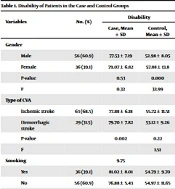
Based on Table 1, the disability rate was higher in the case group of patients with a history of hemorrhagic stroke, smoking, stroke, and diabetes (P < 0.05). The mean ± SD age was 72.45 (11.54). Also, the level of disability in patients increased with age (P = 0.000).
Table 1.
Disability of Patients in the Case and Control Groups
| Variables | No. (%) | Disability | |
|---|---|---|---|
| Case, Mean ± SD | Control, Mean ± SD | ||
| Gender | |||
| Male | 56 (60.9) | 77.53 ± 7.19 | 52.98 ± 8.05 |
| Female | 36 (39.1) | 79.07 ± 6.82 | 57.88 ± 13.8 |
| P-value | 0.53 | 0.000 | |
| F | 0.32 | 32.99 | |
| Type of CVA | |||
| Ischemic stroke | 63 (68.5) | 77.88 ± 6.18 | 55.72 ± 11.51 |
| Hemorrhagic stroke | 29 (31.5) | 79.70 ± 7.82 | 53.12 ± 9.26 |
| P-value | 0.002 | 0.22 | |
| F | 1.51 | ||
| Smoking | 9.75 | ||
| Yes | 36 (39.1) | 81.02 ± 8.01 | 54.79 ± 9.70 |
| No | 56 (60.9) | 76.88 ± 5.43 | 54.97 ± 11.65 |
| P-value | 0.000 | 0.24 | |
| F | 29.05 | 1.38 | |
| History of stroke | |||
| Yes | 43 (46.7) | 79.19 ± 7.17 | 60.86 ± 11.68 |
| No | 49 (53.3) | 75.77 ± 4.65 | 49.67 ± 6.7 |
| P-value | 0.000 | 0.001 | |
| F | 13.63 | 11.87 | |
| History of diabetes | |||
| Yes | 5 (5.4) | 80.25 ± 7.03 | 79.73 ± 3.93 |
| No | 87 (94.6) | 74.74 ± 4.85 | 53.47 ± 9.3 |
| P-value | 0.000 | 0.03 | |
| F | 16.14 | 4.75 | |
The mean ± SD disability score was 78.63 (6.92) in patients with PFS and 54.9 (10.87) in patients without PFS. Also, R = 0.795 and R2= 0.631 indicated the significance of disability severity in patients with PFS (Table 2).
Table 2.
Relationship Between Disability and Pain Following Stroke in Stroke Patients
| Model | Sum of Squares | Mean Square | F | P-Value |
|---|---|---|---|---|
| Regression | 25907.307 | 25907.307 | 311.765 | 0.000 |
| Residual | 15123.995 | 83.099 | ||
| Total | 41031.302 |
5. Discussion
Chronic patients experience many complications, including pain, reduced quality of life, and psychological problems (28-30). Pain following stroke is also a complication (31, 32). In this study, most patients were elderly (72.45 ± 11.54 years) and male. Stroke patients were in their old age and were male in various studies. For example, most patients were over 63 years of age and male in Diener et al.'s study (33), 66 years and male in Hart et al.'s study (over 60% of patients) (34), 63.6 ± 11.2 years and male (n = 85, 72%) in Stiekema et al.'s study (35), and 70.9 ± 17.3 and male (51.3%) in Al-Gibbawi et al.'s study (36).
According to the results, the prevalence of diabetes in patients was 5.4%, and the mean disability score was higher in diabetic patients. Xing et al. reported that the prevalence of diabetes in stroke patients was 24.5% (37). The prevalence of diabetes was also 18.8% in Regenhardt et al.'s study (38). Tu et al. also reported that diabetes affected 20.9% of patients (39), contrary to this study's results.
The present study also showed that the mean ± SD disability scores in PFS and non-PFS patients were 78.63 (6.92) and 54.9 (10.87), respectively. In the study by Regenhardt et al., the prevalence of disability was 49% and 56% in patients with hemorrhagic CVA and patients with ischemic CVA, respectively (38). Tu et al. also stated that the prevalence of 12-month disability was 16.6% (39). Cucchiara et al. also reported that the disability rate varied from 9.6% to 18.2% (40). In Kelly et al.'s study, the mean ± SD Rehabilitation Length of Stay (LOS) score was 33.7 ± 25.6 (41), which indicates the high level of disability in stroke patients.
The present study also revealed more disability in patients with higher pain levels. In the meta-analysis of patients with low-back pain, Alamam et al. showed a relationship between disability and pain self-efficacy and catastrophizing (42), which indicates the effect of pain on the disability of patients, consistent with the results of the present study.
A few studies have been conducted on PFS status in stroke patients, and this study was conducted for the first time in Ilam City. One of the limitations of this study is the lack of examination of other variables. Hence, it is suggested that future researchers investigate other variables related to disability in stroke patients. It is also suggested that meta-analysis studies be conducted on the difference in disability status in patients with and without PFS.
5.1. Conclusions
The prevalence of disability was higher in patients with higher pain levels in the present study. For this reason, we can use drug interventions or rehabilitation programs to reduce the disability of CVA patients.