This randomized, controlled, single-blind trial incorporated 60 women aged 18 to 40 years, with American Society of Anesthesiologists (ASA) physical status II, presenting for elective CS in Tanta University hospitals and Benha Teaching Hospital in Egypt from March 2023 to June 2023. The study was carried out with the approval of the ethics committee of the general authority for teaching hospitals and institutes on 22/03/2023 (approval code: HB000132) and registration of clinicaltrials.gov (ID: NCT05950568). All cases provided signed, informed consent.
The exclusion criteria were body mass index (BMI) ≥ 40 kg/m2, weight < 50 kg, height < 150 cm, contraindications for the use of active labor, spinal anesthesia, recent opiate intake, hypersensitivity to any used medication, or substantial cardiovascular, renal, or hepatic diseases.
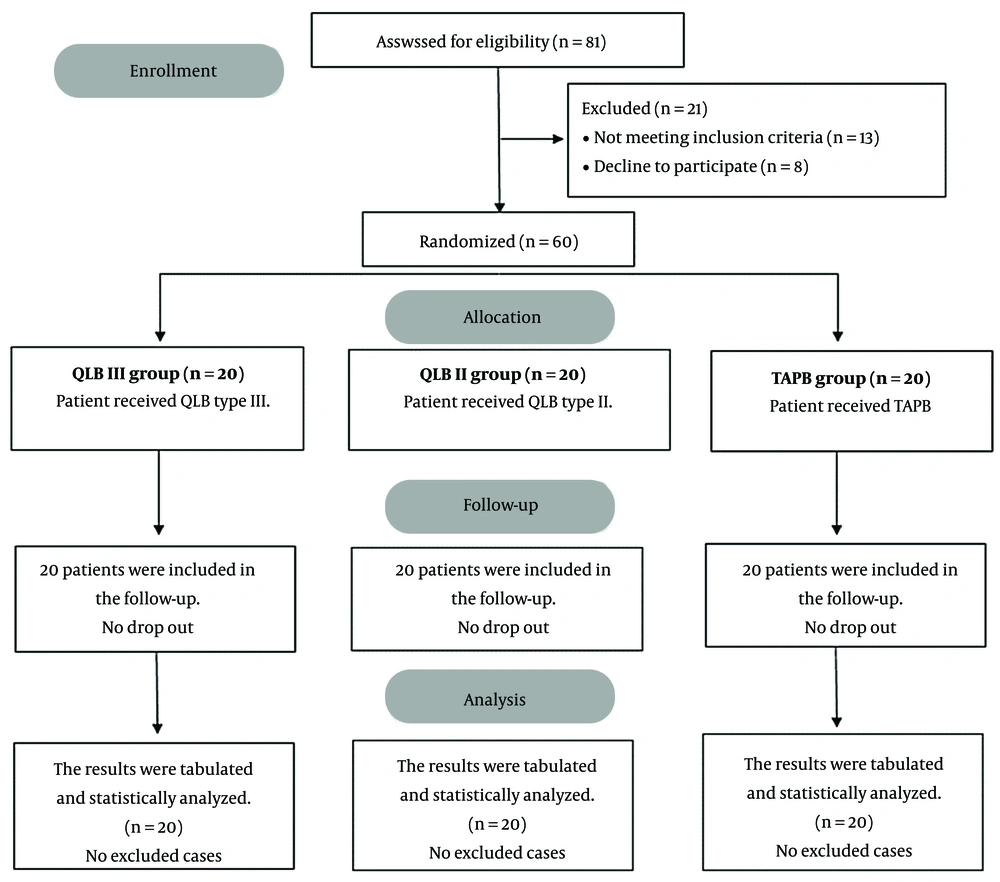
The cases were allocated randomly to either the QLB type III, QLB type II, or TAPB group on a 1: 1: 1 ratio in a parallel manner basis using a computer-generated randomization sequence. A piece of paper containing the procedure’s name was placed inside an envelope, and each envelope was assigned a number based on the arrays of numbers in the chart. The outcome assessor was blinded for group allocation.
Preoperative evaluation involves taking history, clinical examination, and routine laboratory tests. During the preoperative anesthesia visit, the participant was educated on the trial’s methodology and pain rating by the numerical rating scale (NRS).
Following cannula insertion, each patient received 500 mL of Ringer’s lactate solution in the operating room as a preload. Regular monitoring (e.g., temperature probe, noninvasive blood pressure, pulse oximetry, and 5-lead electrocardiogram [ECG]) were employed in this study. Cesarean section was performed under spinal anesthesia with 2 - 2.5 mL heavy bupivacaine 0.5% without adjuvants. Blocks were performed at the end of surgery by an anesthesiologist with comprehensive experience in ultrasound (US) guidance nerve block.
3.1. Quadratus Lumborum Block Technique
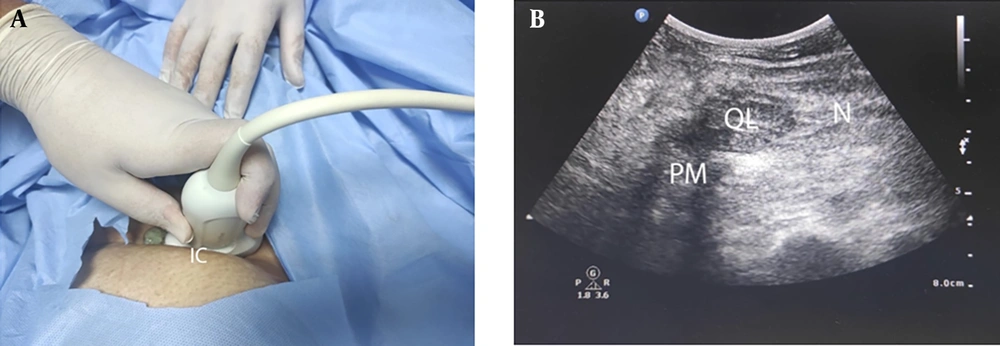
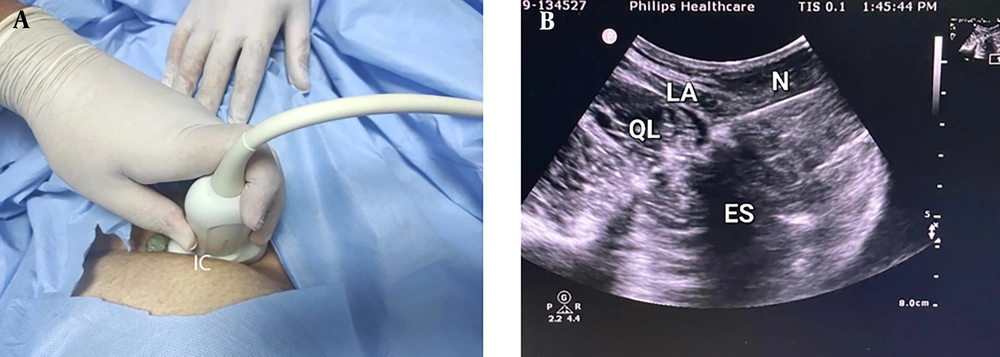
Quadratus lumborum block was performed when the patient was positioned laterally decubitus. The low-frequency convex probe (Philips CX50 Extreme edition) was put in the flanks and moved to determine the transverse processes of the L2 or L3, the erector spinae, the psoas, and the QL muscles. A 22 G needle was advanced in the plane and positioned between the psoas and QL muscles at the anterior fascia lumbosacral in QLB III and between the QL muscle posterior border and the erector spinae muscle in the thoracolumbar fascia’s middle layer in QLB II. After negative aspiration, 2 mL of saline was administered to ascertain the needle's location. Hydro-dissection of the injectate at a location of concern of lumbosacral fascia and surrounding structure was depicted in real-time. Each side was then injected with 20 mL of bupivacaine 0.25% (
Figures 1 and
2).
Quadratus lumborum block technique type III (A) position and (B) ultrasound image (IC, iliac crest; PM, psoas major; QL, quadratus lumborum; ES, erector spinae; LD, latissimus dorsi; TP, transverse process).
Quadratus lumborum block technique type II (A) position and (B) ultrasound image (IC, iliac crest; N, needle; QL, quadratus lumborum muscle).
3.2. Transversus Abdominis Plane Block Technique
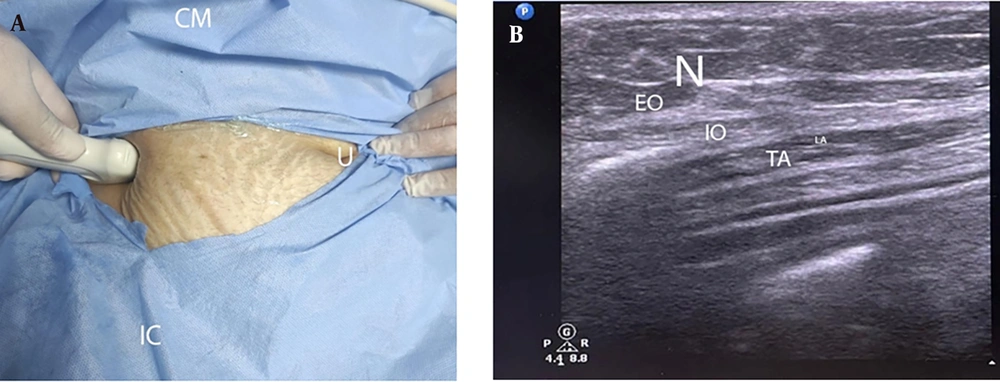
Transversus abdominis plane block was performed when the patient was positioned in the supine decubitus. A linear high-frequency transducer (Philips CX50 Extreme edition) was placed transversely on the anterolateral abdominal wall between the iliac crest and the costal margin. Under US guidance, the three layers of muscles, the external oblique, the internal oblique, and the transversus abdominis, were identified. A 22-gauge, 100-mm needle was then injected through the skin anteriorly in the plane and advanced into the fascial plane between the internal oblique and transversus abdominis muscles, with its tip lying in the mid-axillary line. To assist with identifying these structures, the probe was moved anteriorly to the rectus sheath, and the fascial planes followed laterally. Following negative aspiration, 2 mL of saline was injected to ascertain the needle location upon the visualization of the transversus abdominis. Each side was then implanted with 20 mL of bupivacaine 0.25% (
Figure 3).
Transversus abdominis plane block technique (A) position and (B) ultrasound image (CM, costal margin; IC, iliac crest; U, umbilicus; N, needle; EO, external oblique muscle; IO, internal oblique muscle; TA, transversus abdominis muscle; LA, local anesthetic).
3.3. Postoperative Management
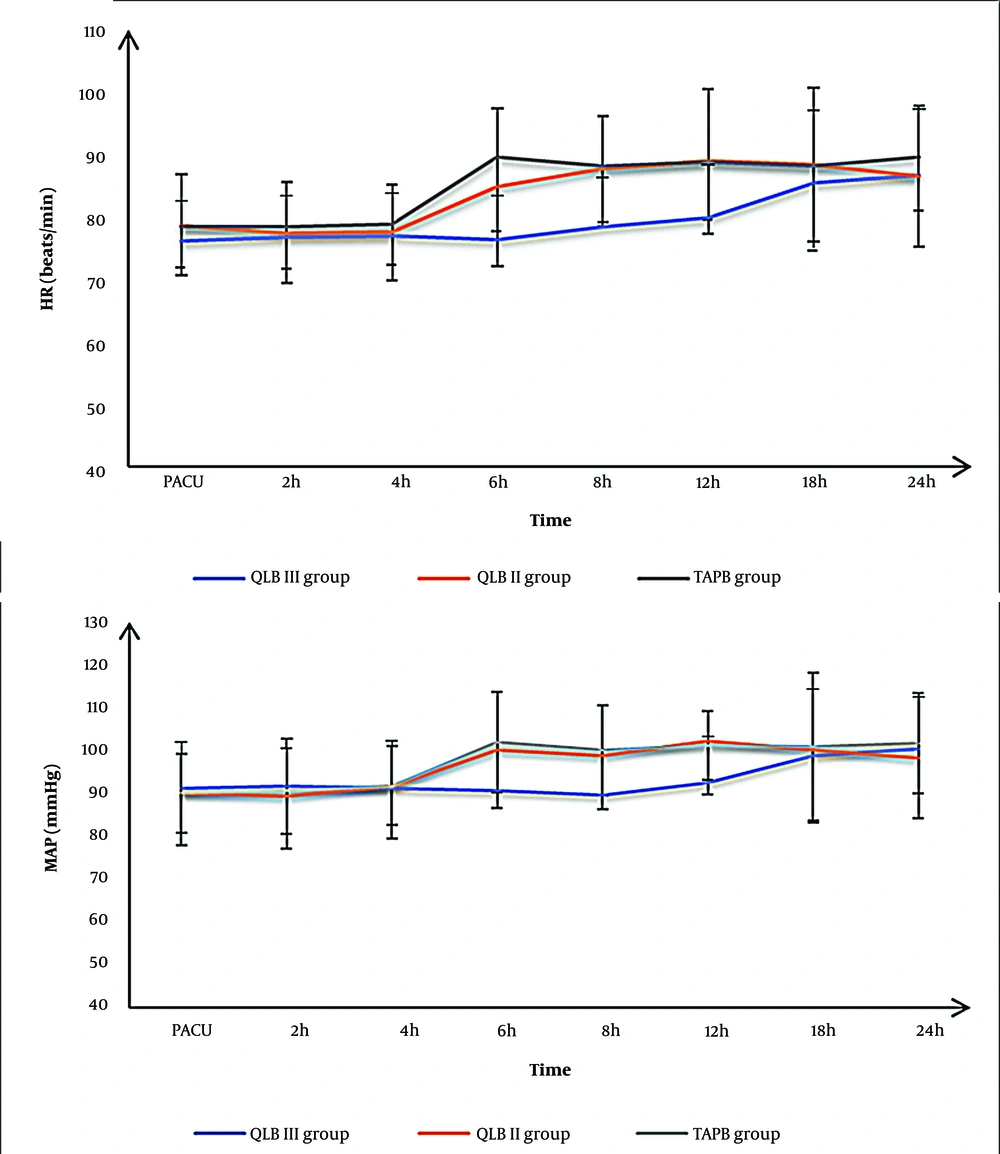
Postoperative heart rate (HR) and mean arterial blood pressure (MAP) were reported at the post-anesthesia care unit (PACU) at 2, 4, 6, 8, 12, 18, and 24 hours. All cases received paracetamol 15 mg/kg infusion/6 h as routine analgesia. The postoperative NRS score was evaluated at the PACU at 2, 4, 6, 8, 12, 18, and 24 hours. If the NRS score remained ≥ 4, a bolus of meperidine (0.5 mg/kg intravenously [IV]) was provided and repeated after 30 minutes if NRS remains ≥ 4. The onset of the first analgesia rescue and the total amount of meperidine in 1st 24 hours after the operation were also recorded.
The level of patient satisfaction was graded on a 5-point Likert scale (
24) (0 = extremely dissatisfied, 1 = dissatisfied, 2 = neither satisfied nor dissatisfied, 3 = satisfied, 4 = extremely satisfied). Side effects, such as hypotension (defined as any decrease in the MAP of > 20% of the preoperative baseline value or MAP ≤ 65 mmHg), bradycardia (HR < 60 beats/min), and postoperative nausea and vomiting (PONV), were documented. Hypotension was managed with fluid bolus ± ephedrine 5 - 10 mg IV. Bradycardia was managed with 0.01 mg/kg of atropine. The prevention of PONV was attempted using 4 mg ondansetron at the end of the operation.
The primary outcome was the total postoperative consumed meperidine in the first 24 hours. The secondary outcomes were the time of the first analgesic request, postoperative pain, and patient satisfaction.
3.4. Sample Size Calculation
The sample size calculation was made by G*Power 3.1.9.2 (Universitat Kiel, Germany). A pilot study was performed (5 cases per group), and it was observed that the mean (± standard deviation [SD]) of the total consumption of meperidine postoperatively in the first 24 hours was 48 ± 16.81, 76 ± 36.98, and 84 ± 23.02 mg in QLB III, QLB II, and TAPB groups, respectively. In this study, 20 women were recruited in each group based on a 0.6 effect size, 95% confidence limit, 95% study power, and 1: 1: 1 group ratio. Moreover, four cases were added to each group (to compensate for dropout).
3.5. Statistical Analysis
In this study, SPSS software (version 27; IBM, Chicago, IL, USA) was used for statistical analysis. The normality of the data distribution was verified by the Shapiro-Wilk test and histograms. Parametric quantitative data were expressed as mean and SD and assessed using the analysis of variance (ANOVA) (F) test with post hoc comparisons (Tukey) and repeated measures ANOVA. Quantitative non-parametric data were expressed as the median and interquartile range (IQR) and compared between groups using the Kruskal-Wallis test (with the Mann-Whitney test for pairwise comparison). The chi-square test was applied to analyze qualitative variables that were presented as frequency and percentage (%). A two-tailed P-value ≤ 0.05 was judged statistically significant.