
1. Background
Spinal anesthesia is the most common method of anesthesia for caesarean section. Administration of an appropriate dose and combination of local anesthetics could minimize the possible side effects and simultaneously improve the quality of block (1, 2). Hyperbaric bupivacaine with proper use of adjutants has been considered as acceptable common method of spinal anesthesia in caesarian section (3, 4). Several studies have reported that the combination of low dose local anesthetics and opioids in spinal anesthesia have the advantage of shorter onset times and higher quality of the blocks (5, 6).
Spinal anesthesia with any combination is likely to cause adverse effects such as hypotension, bradycardia, and shortness of breath, nausea, and vomiting. However, by adding opioids such as sufentanil to bupivacaine, the required dose of local anesthetic is decreased. This may result in lower side effects and improved quality of spinal anesthesia and postoperative analgesia (7, 8). Earlier studies have examined the effects of adding various amounts of sufentanil to a fixed dose of local anesthetic to find the optimum dose of adjuvant (9-12). This study was conducted to evaluate the effects of different doses of bupivacaine combined with a fixed acceptable dose of sufentanil to find a prescription for a safe and high quality spinal anesthesia for cesarean section.
2. Methods
2.1. Study Protocol
In this double- blind, randomized clinical trial, 126 candidates of elective cesarean section were recruited. Of them, 21 patients were excluded during the study and the remaining 105 were randomly allocated into 3 groups of spinal anesthesia with bupivacaine 8, 9, or 10 mg plus sufentanil 2.5 µg. Block randomization was used to assign equal number of patients in each group. The level of spinal block, duration of sensory and motor block, and hemodynamic variables were compared among the 3 groups. Both the patients and the assessor were blinded to the assignments. The local ethics committee approved the study protocol, and informed consent was obtained from all patients. The study was registered in clinical trials registry (IRCT2017010931852N1).
The inclusion criteria were as follow: candidates of elective cesarean section after 36 weeks of gestation, height more than 150 cm, no history of addiction, no history of pre-eclampsia, eclampsia, or hypertension, and no contraindication for spinal anesthesia. Patients with technical failure were excluded.
2.2. Intervention and Measurements
Standard monitoring was implemented, and then, the patients were hydrated with ringer’s lactate solution 5 mL.kg-1. Spinal anesthesia was performed at the fowler’s position through lower lumbar intervertebral spaces using Quinke needle size 25. Patients were randomly allocated to the spinal anesthesia with 8, 9, or 10 mL of hyperbaric Bupivacaine 0.5% (AstraZeneca Company, France) plus 2.5 µg of sufentanil (Abu Rayhan Company, Iran). Drugs were administered with a 3 mL syringe (3MED, Iran Medical Equipment, Tehran, Iran) to facilitate the dose adjustments. Injection was performed at a constant rate of 0.2 mL/sec. Afterwards, patients were immediately placed in the supine position.
Spinal anesthesia hemodynamic parameters and sensory and motor block were measured at 5, 10, 15, 20, 30, 60, 90, 120, and 150 minutes. Sensory block was evaluated with pin prick method and motor block with Bromage score (Table 1). Assessment for sensory and motor block was continued in 30- minute intervals until full regression of blockade. Side effects such as nausea, vomiting, hypotension, bradycardia, and itching were recorded. Bradycardia was defined as slowing heart rate of more than 30% of individual baseline or less than 60 beats per minute. Atropine 0.5 mg per dose was administered to treat bradycardia. Similarly, hypotension was considered when the mean arterial pressure (MAP) decreased to more than 30% of baseline or less than 70 mmHg. Hypotension was treated with incremental intravenous doses of ephedrine.
Table 1.
Description of the Bromage Score
| Grade | Criteria | Degree of Block, (%) |
|---|---|---|
| I | Free movement of legs and feet | Nil (0) |
| II | Just able to flex knees with free movement of feet | Partial (33) |
| III | Unable to flex knees, but with free movement of feet | Almost complete (66) |
| IV | Unable to move legs or feet | Complete (100) |
2.3. Statistical Analysis
Data were presented as mean (standard deviation), median (25, 75 percentile) or frequency (percentage), as appropriate. The normal distribution of quantitative variables was assessed with Kolmogorov-Smirnov test. To compare quantitative variables in the 3 groups, ANOVA or Kruskal-Wallis test were used, as appropriate. Qualitative variables were compared with chi square test. Significance level was set at P < 0.05. Data were analyzed using statistical package for social sciences software (SPSS Company, Chicago, Il) Version 22.
3. Results
The demographic variables and the ASA class of patients were comparable among the 3 groups. Patients were 37 ± 7 years on average with the mean gestational age of 37.2 ± 1.2 week. In all 3 groups, spinal block was successful and no high neuraxial block (level higher than T4) was recorded. The patients in the 10 mg group showed higher degrees of motor block. However, the difference was not statistically significant (Table 2). No significant difference was found between the maximum level of sensory block (or duration of recovery from sensory) and motor block in the 3 groups (P > 0.05) (Tables 3 and 4). The complication rates including the need for atropine or ephedrine administration, nausea, vomiting, and pruritus were not significantly different among the 3 groups (Table 4). The trend of blood pressure and heart rate was comparable in the 3 groups (P > 0.05) (Figures 1 and 2).
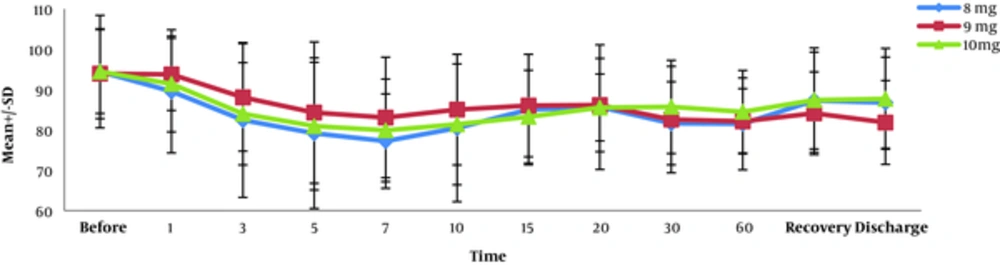
Figure 1.
The Trend of MAP in Patients in Three Groups
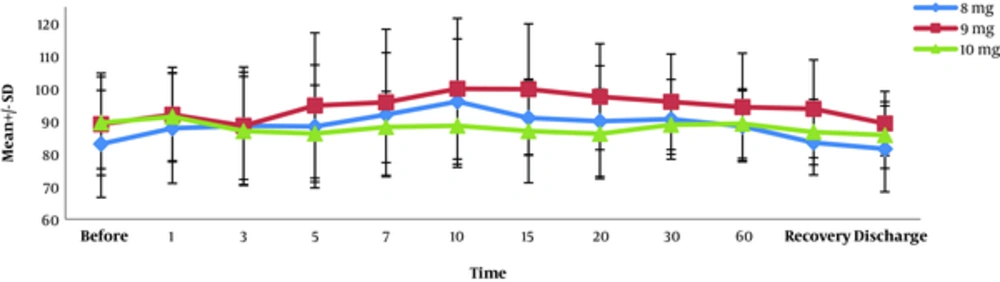
Figure 2.
The Trend of Heart Rate in Three Groups
Table 2.
Intensity of Motor Block in Three Groups from Spinal Anesthesia Until Dischargea
| Time, Min | Dose of Bupivacaine | P Value | ||
|---|---|---|---|---|
| 8 mg | 9 mg | 10 mg | ||
| Immediately after spinal anesthesia | 2 (2,3) | 2 (2,3) | 3 (2,3) | 0.733 |
| 5 | 4 (3,4) | 4 (4,4) | 4 (4,4) | 0.318 |
| 10 | 4 (4,4) | 4 (4,4) | 4 (4,4) | 0.139 |
| 15 | 4 (4,4) | 4 (4,4) | 4 (4,4) | 0.333 |
| 20 | 4 (4,4) | 4 (4,4) | 4 (4,4) | 0.333 |
| 30 | 4 (4,4) | 4 (4,4) | 4 (4,4) | 0.602 |
| 60 | 4 (4,4) | 4 (4,4) | 4 (4,4) | 0.093 |
| 90 | 4 (3,4) | 4 (4,4) | 4 (3,4) | 0.521 |
| 120 | 2 (2,3) | 2 (2,3) | 3 (2,3) | 0.389 |
| 150 | 2 (1,2) | 1 (1,2) | 3 (2.5,3.5) | 0.137 |
aData are presented as Median (25,75 percentile).
Table 3.
Maximum Level of Sensory Block in 3 Groups from Spinal Anesthesia Until Dischargea
| Time, Min | Dose of Bupivacaine | P Value | ||
|---|---|---|---|---|
| 8 mg | 9 mg | 10 mg | ||
| Immediately after spinal Anesthesia | 8 (8,10) | 8 (8,10) | 8 (8,10) | 0. 88 |
| 5 | 6 (6,6) | 6 (6,6) | 6 (6,6) | 0.982 |
| 10 | 6 (6,6) | 6 (6,6) | 6 (6,6) | 0.974 |
| 15 | 6 (6,6) | 6 (6,6) | 6 (6,6) | 0.979 |
| 20 | 6 (6,6) | 6 (6,6) | 6 (6,6) | 0.971 |
| 30 | 6 (6,6) | 6 (6,6) | 6 (6,6) | 0.845 |
| 60 | 6 (6,6) | 6 (6,6) | 6 (6,6) | 0.409 |
| 90 | 6 (6,8) | 6 (6,7) | 6 (6,8) | 0.491 |
| 120 | 10 (8,11.5) | 8 (8,10) | 8 (6,10) | 0.166 |
| 150 | 12 (10,12) | 11 (10,12) | 10 (10,12) | 0.252 |
aValues correspond to the level of spinal anesthesia (i.e., 8 represents 8th thoracic level) and presented as Median (25,75 percentile).
Table 4.
Duration of Recovery from Sensory and Motor Block, and the Rate of Complications in Three Groupsa
| Variable | Dose of Bupivacaine | P Value | ||
|---|---|---|---|---|
| 8 mg | 9 mg | 10 mg | ||
| Recovery from sensory block, min | 110 ± 17 | 116 ± 15 | 110 ± 18 | 0.875 |
| Recovery from motor block, min | 107 ± 28 | 115 ± 17 | 116 ± 20 | 0.708 |
| Atropine administration | 7 (20) | 9 (25.7) | 9 (25.7) | 0.809 |
| Ephedrine administration | 12 (34.3) | 12 (34.3) | 15 (42.9) | 0.826 |
| Nausea | 7 (20) | 7 (20) | 9 (25.7) | 0.65 |
| Vomiting | 4 (11.4) | 5 (14.3) | 4 (11.4) | 0.92 |
| Pruritus | 4 (11.4) | 8 (22.9) | 5 (14.3) | 0.826 |
aData are presented as mean ± SD or No. (%)
4. Discussion
All the 3 doses of intrathecal bupivacaine showed similar satisfactory block profiles. Generally, previous studies yielded comparable results with some trivial differences. An earlier study evaluated the effects of intrathecal bupivacaine (6, 8, and 10 mg plus sufentanil 3 µg) in cesarean section surgery; this study reported similar motor block in the 3 groups, but it was found that with the increase in the dose of bupivacaine, the level of sensory block increased and the time of reaching the maximum motor block intensity decreased. On the other hand, increasing the dose of bupivacaine resulted in higher incidence of nausea, hypotension, and the need for ephedrine (13).
An earlier study suggested that adding sufentanil to intrathecal bupivacaine will reduce the required dose of local anesthetic in parturient. Nevertheless, they examined rather higher doses of bupivacaine (14). Another study reported that the maximum level of sensory block in caesarean patients who received bupivacaine 6 mg plus sufentanil 3.3 µg is comparable to those patients that received bupivacaine 12 mg without adjuvant. This will also reduce the incidence of hypotension and the need for ephedrine administration (15). Controversies to our findings may be attributed to the lower prescribed doses of local anesthetic in our patients.
4.1. Study Limitations
Inability to blind the anesthetist who performed spinal anesthesia was a limitation. However, both the assessor and the patients were blinded to the assignments. Another limitation was that we did not evaluate the extra requirement for analgesics in the postoperative period.
Taken together, it seems that replacing a small amount of intrathecal bupivacaine with sufentanil favorably reduces the incidence of complications; namely, hypotension and nausea, while provides an acceptable profile of spinal anesthesia. The recommended dose of intrathecal bupivacaine ranged from 6 to 12.5 mg in earlier studies. In this study, increasing the dose of bupivacaine from 8 mg to 10 mg, when combined with sufentanil administration, did not considerably affect the maximum level of sensory block, intensity of motor block, or the duration of recovery from sensory and motor block. Thus, a lower dose of bupivacaine seems to be a more reasonable choice. In conclusion, bupivacaine doses of 6 to 8 mg with added sufentanil may provide the best results with minimal side effects in cesarean section surgery.