This randomized, controlled, single-blinded clinical study was conducted on 50 subjects aged 20 to 60 years, of both sexes, with American Society of Anesthesiology (ASA) grade I and II physical status, and a Body Mass Index (BMI) of ≥ 20 kg/m² and ≤ 35 kg/m², undergoing LC. The study was conducted following approval from the Ethics Committee of Helwan University Hospitals, Cairo, Egypt, and was registered with the trial ID: NCT06640062. Informed written consent was obtained from all patients. Exclusion criteria included known sensitivities or contraindications to the study medications, histories of psychological conditions and/or chronic pain syndromes, contraindications to regional anesthesia, severe respiratory, cardiac, hepatic, and renal disorders, and pregnancy.
3.1. Randomization and Blinding
The participants were randomly divided using a computer-generated randomization table into two equal groups: Group A received an US-guided ESP block, and group B received a US-guided OSTAP block. The study was single-blinded, as only the participants were blinded due to being under general anesthesia, while the researcher performing the block was aware of the group assignments. Each subject underwent a comprehensive history taking, physical examination, laboratory investigations [complete blood count (CBC), international normalized ratio, alanine transaminase, aspartate transaminase, urea, serum creatinine, and random blood sugar], and radiological investigations [electrocardiogram (ECG) and chest X-ray]. On the night before surgery, participants received instructions on how to describe pain using a Visual Analog Scale (VAS), where 0 represents no pain and 10 signifies the worst possible pain. Informed consent was obtained. Preoperative fasting was required for at least 6 hours for solid meals and at least 2 hours for water and clear fluids.
During general anesthesia in the operating room, monitoring included pulse oximetry (SpO2), non-invasive arterial blood pressure (NIBP), ECG, heart rate (HR), and capnography. Anesthesia was induced following preoxygenation with 100% oxygen (O2) using 2 mg/kg propofol and 1 μg/kg fentanyl. Endotracheal intubation was facilitated with 0.5 mg/kg atracurium, with additional doses of 0.1 mg/kg administered every 25 minutes. Each patient received intravenous (IV) dexamethasone 8 mg and ondansetron 4 mg to mitigate postoperative nausea and vomiting. Anesthesia was maintained using isoflurane in a 50% O2/air mixture, with an expired isoflurane concentration of 1.2, and ventilation settings were adjusted to maintain an end-tidal carbon dioxide (CO2) level of approximately 30 - 40 mmHg. Intravenous fentanyl was administered at a dose of 0.5 μg/kg if the HR or mean arterial pressure (MAP) of any patient exceeded a 20% increase from baseline values. Hemodynamic parameters, including HR, MAP, O2 saturation, and end-tidal CO2, were recorded prior to induction and every 15 minutes until the end of the operation. Upon completion of skin closure, isoflurane was discontinued, and reversal was achieved with an IV injection of 0.02 mg/kg atropine and 0.05 mg/kg neostigmine. After extubation, subjects were admitted to the post-anesthesia care unit (PACU).
3.2. Performing the Ultrasound-Guided Block
The two blocks were conducted under full aseptic precautions following the induction of anesthesia and 15 minutes prior to the skin incision. The blocks were performed using a Mindray Diagnostic Ultrasound System Model Z60 (Mindray Bio-Medical Electronics, Shenzhen, China) portable US machine and a high-frequency linear probe (6 - 13 MHz). A 21-gauge, 10 cm long nerve-blocking needle (Stimuplex, B-Braun Melsungen, Germany) was used to perform the regional block. The LA mixture consisted of 20 mL of 0.5% bupivacaine, 10 mL of 2% lidocaine, and 10 mL of normal saline, resulting in a total volume of 40 mL. Twenty milliliters of this mixture was administered to each side.
3.3. Oblique Subcostal Transversus Abdominis Plane Block Technique
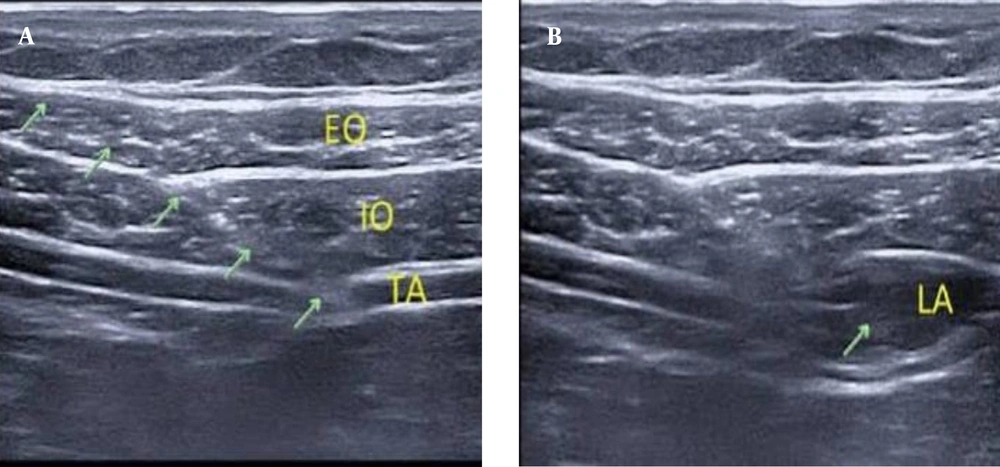
With the patient in the supine position, the linear probe is placed transversely just below the costal margin to identify the rectus abdominis, transversus abdominis, and both external and internal oblique (EO and IO) muscles from medial to lateral along the costal margin. At the lateral border of the rectus abdominis, the needle is inserted in-plane from medial to lateral, with the subsequent administration of 20 mL of the LA mixture into the fascial plane between the IO and transversus abdominis muscles along the oblique subcostal line. The block was replicated on the opposite side with the same volume (
Figure 1).
Oblique subcostal transversus abdominis plane (OSTAP) block A, with needle in place (green arrows); and B, after injection of local anesthetics. EO, external oblique muscle; TA, transversus abdominis muscle; IO, internal oblique muscle; LA, local anesthetics.
3.4. Erector Spinae Plane Block Technique
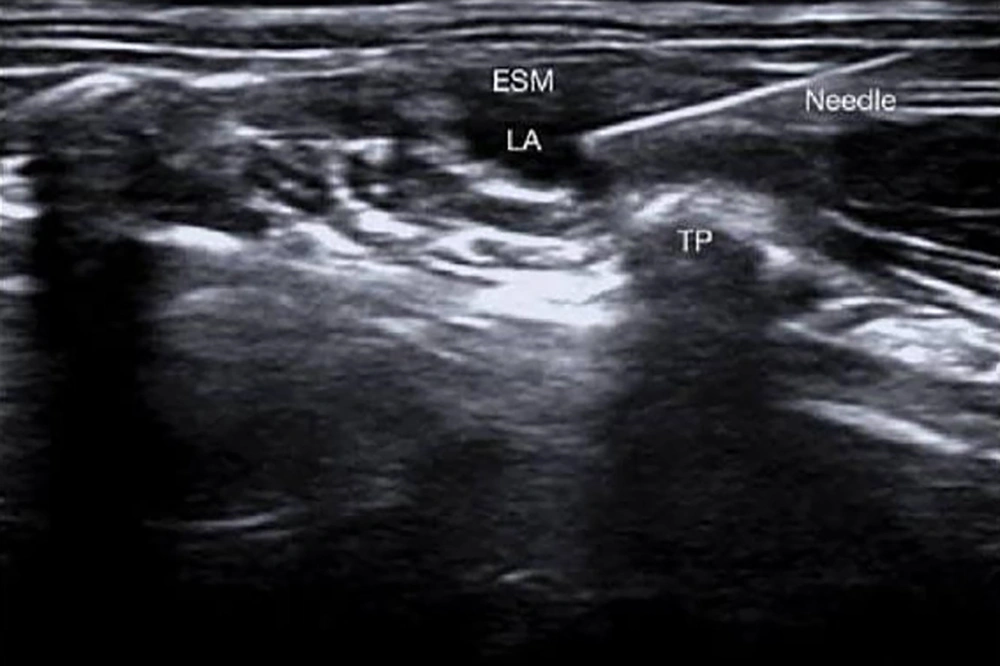
The blocks were conducted at the level of the T7 spinous process (SP) with the patient in the lateral position and the arm abducted. Using US, the T7 TP is identified by counting from the 12th rib. The US probe is positioned 2 - 3 cm laterally to the SP of T7 and situated over the TP of T7/T8 in the parasagittal longitudinal plane, with the erector spinae muscle (ESM) visualized over the TP. The needle is then inserted and advanced in-plane from cephalad to caudad until the needle tip contacts the TP of T7. Following hydrodissection with 2 mL of isotonic saline, which elevates the ESM, 20 mL of the LA mixture is administered after several negative aspirations. The same procedure was performed on the opposite side (
Figure 2).
Erector spinae block. ESM, erector spinae muscle; TP, transverse process; LA, local anesthetics.
After extubation and transfer to the PACU, standard analgesia, consisting of ketorolac 30 mg and acetaminophen 1 g, was administered to all patients via intravenous infusion every 8 hours for the first 24 hours postoperatively. Postoperative pain was assessed using the VAS at 30 minutes and at 2, 4, 6, 8, 12, 16, 20, and 24 hours. If patients reported pain with a VAS score ≥ 3, rescue analgesia in the form of morphine boluses was administered at a dose of 0.05 mg/kg as needed. The time until rescue analgesia and the total dose of morphine administered to each patient during the first 24 hours postoperatively were recorded.
The main outcomes were pain intensity measured by the VAS score at 30 minutes and at 2, 4, 6, 8, 12, 16, 20, and 24 hours after surgery, as well as the duration until the administration of rescue analgesia. The secondary outcomes included the total amount of morphine administered to each participant during the first 24 hours after surgery, in addition to morphine-related adverse effects such as the frequency of vomiting and nausea, respiratory depression [respiratory rate (RR) < 10, decreased arterial oxygen saturation < 90%, or increased arterial carbon dioxide > 50], pruritus, bradycardia (HR < 60 bpm), and urine retention.
Adverse effects of LA were also monitored, including circumoral numbness, lightheadedness, tongue paresthesia, sleepiness, irritability, muscular twitching, convulsions, hypotension (decrease in blood pressure > 20% of baseline), bradycardia, cardiac arrest, and any indications of complications from the block procedures (e.g., local site infections, hematoma formation, bowel perforations, and pneumothorax).
Complications identified by the researcher or reported by patients were treated accordingly. For example, nausea and vomiting were treated with intravenous ondansetron 4 mg once daily; respiratory depression was managed with supportive oxygen therapy up to mechanical ventilation when needed; bradycardia was treated with 0.01 mg/kg intravenous atropine; and hypotension was managed with supportive intravenous crystalloid infusion and intravenous ephedrine 5 mg bolus if required.
3.5. Sample Size Calculation
Using OpenEpi with a power of test at 80% and a confidence interval of 95%, the total sample size is 50 patients (25 in each group). The mean VAS score in the initial 24 hours after surgery in the ESP block group is 0.58, while in the OSTAP block group, it is 1.7 (
10).
3.6. Statistical Analysis
Statistical analysis was conducted using SPSS version 26 (IBM Inc., Chicago, IL, USA). The Shapiro-Wilk test and histograms were used to evaluate the normality of the data distribution. Quantitative factors were represented as mean and standard deviation (SD) and compared across the two groups using the unpaired Student's t-test. Qualitative factors were represented as frequencies and percentages (%) and analyzed using the chi-square or Fisher's exact test, as appropriate. A two-tailed P-value < 0.05 was considered statistically significant.