1. Background
Upper respiratory infection (URI) and its complications are widely studied (1-6). Conducting anesthesia in pediatric patients with URI is an ongoing dilemma (7). Respiratory adverse events are more frequent in these patients; therefore, several studies are focused on risk assessment (8). The patients anesthetized with laryngeal mask airway (LMA) experienced fewer respiratory adverse events compared to the ones with endotracheal tube (9). Topical lidocaine on LMA was also effective (vs. placebo) to lessen respiratory complications in this specific population (10).
It was hypothesized that intravenous lidocaine compared to its topical application is more effective to reduce the incidence of post-operative cough (primary outcome) in pediatric patients with mild URI undergoing general anesthesia (GA) with LMA. The other adverse events as secondary outcomes (laryngospasm, bronchospasm, apnea and vomiting) that occurred in the two studied groups were also evaluated.
2. Objectives
To assess the incidence of adverse respiratory events including cough, laryngospasm, apnea, bronchospasm following two different methods of lidocaine administration in anesthetized children with mild URI.
3. Patients and Methods
3.1. Inclusion Criteria
The Ethics Committee of Shahid Beheshti University of Medical Sciences approved the study (international registration No. IRCT138812083436N1), and informed written consent from parents or guardians of the subjects were obtained. One hundred and thirty pediatric patients were enrolled in this randomized double blind trial. The current study was conducted from January 2011 to May 2012 in Labbafinejad hospital, Tehran, Iran (an affiliated university hospital). All pediatric patients ranged one to six years whose parents reported mild URI symptoms (nasal discharge or congestion, cough, sneeze) within the last two weeks were included. Those with an evidence of axillary temperature more than 38, ill appearance evaluated by anesthesiologist in charge, purulent discharge or sputum or lower respiratory infection (crackle or wheeze), or any other medical condition (respiratory, cardiac or neurologic) were excluded. Patients underwent anesthesia to receive full ophthalmologic examination. These procedures were necessary and further delay would result in deleterious consequences.
3.2. Exclusion Criteria
Patients with a probably difficult airway or hypersensitivity to drugs were not studied. Patients who received hydrocortisone, dexamethasone, or extra atropine and vasopressor were excluded from this study; however, they were reported in Figure 1. Those who required muscle relaxant due to unpredicted surgery plan change or procedures lasting more than an hour were also excluded.
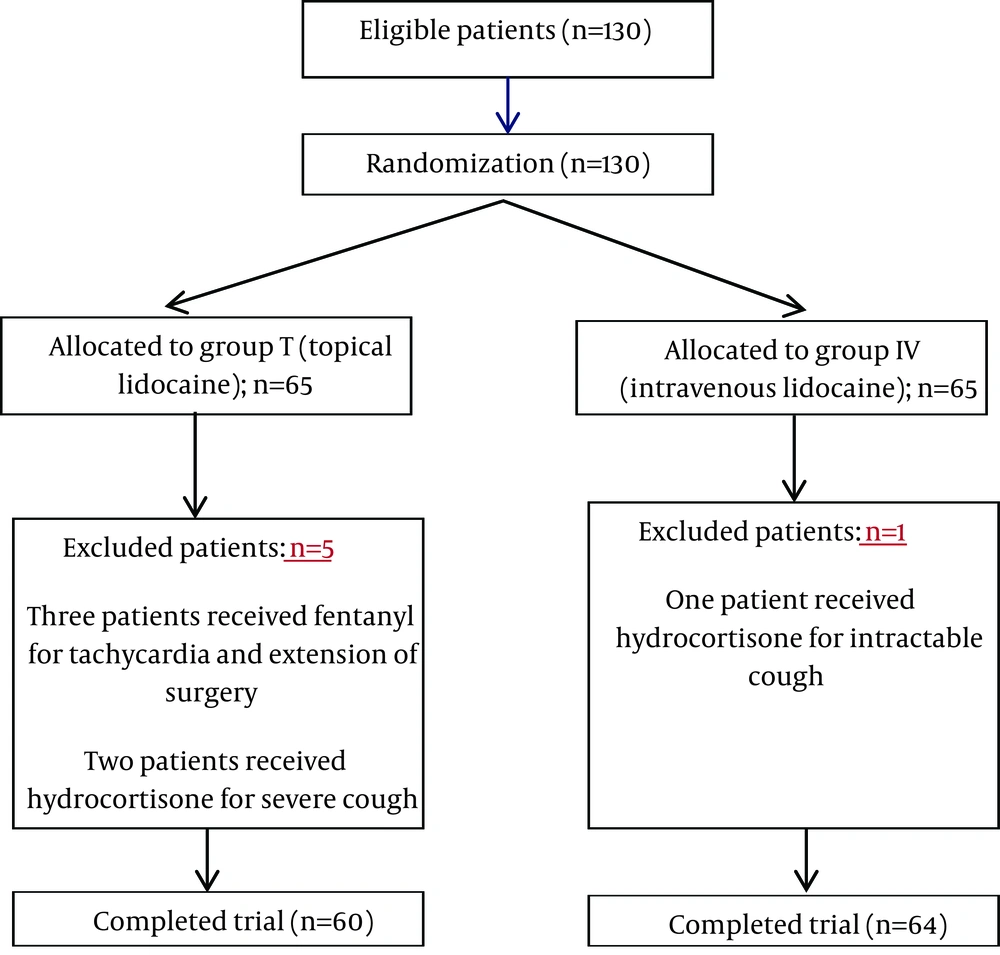
Figure 1.
Flow Diagram Showing Patient Selection, Randomization and Exclusion
3.3. Pre-Operative Evaluation
Diagnosis of URI was based on the symptoms (cough, sneeze, runny nose, nasal congestion) assessed by an anesthesiologists or the history provided by the parents or guardians if they thought that the child had a cold during the past two weeks. On the surgery day, pre-anesthesia symptoms of URI (runny nose, nasal congestion, cough, sneeze and sputum) were evaluated using a questionnaire (scored from one to four) by an anesthesiologist (Appendix 1) (11). Patients with an item scored more than two, were considered to have moderate URI and their surgery was postponed for a later date (four to six weeks later). Mild URI was defined as having all or some symptoms in the questionnaire (Appendix 1), none of which scored more than two. Passive smoking of one parent/s or guardian/s, or any close resident relative was also recorded.
3.4. Randomization and Blinding
Patients were randomly divided into two groups (using the table of random numbers) to receive topical lidocaine on LMA (Well Lead Medical Co., Guangdong, China) designated as group T (0.1 mL/kg of 2% Xylogel, Sina Darou Co. Tehran, Iran) or intravenous lidocaine (group IV) (1.5 mg/kg Lignodic, lidocaine hydrochloride, Caspian, Tamin pharmaceutical, Rasht, Iran) (Figure 1).
To make the study blinded, patients in group T received intravenous normal saline (as placebo) while patients in group IV; lubricating gel (0.1 mL/kg of Lubri-jell; Shafa, Farayand neek laboratories, Iran) was applied on the LMA (as placebo). Therefore, both groups received 0.1 mL/kg of gel (lidocaine or lubricating) on the LMA and a fixed volume of clear fluid (containing lidocaine or normal saline). All drugs were prepared in a separate room by an anesthesiologist, considering the patients’ weight, and then handed over (as a package 2 mL syringe containing 0.1 mL/kg of gel and a 5 mL syringe filled with clear fluid; with no labels) to the anesthesiologist in charge.
3.5. Study Protocol
After placing the patient on the operation table, basic monitoring (heart rate (HR), pulse rate, manual blood pressure, pulse oxymetry and electrocardiogram) was established and the values were recorded. In both groups, anesthesia was induced with sevoflurane (starting from 3% concentration and increasing by 1% every 30 seconds if needed, on discretion of anesthesiologist in charge), nitrous oxide (N2O) and oxygen (50%, 50%). An intravenous line was placed. Atropine (0.01 mg/kg) and lidocaine or placebo was injected based on the study group. Gel (lubricating or lidocaine) was applied on the tip and sides of the LMA. The LMA was inserted by an anesthesiologist, three minutes later, by achieving the following criteria ,indicating deep level of anesthesia, Cerebral Status Index (CSI) (Cerebral State Monitor, Danmeter-Goalwick Holdings Ltd, Odense, Denmark) ranged 40 - 60, regular breathing, and end expiratory sevoflurane concentration of at least 2.1% (11). The LMA size was selected based on the manufacturer’s instructions. To increase the validity of this research the six consultant anesthesiologists, with at least four years experience, who conducted the study were briefed about the methodology and study protocol.
Anesthesia was maintained with sevoflurane (2% - 3%) in oxygen and N2O (50%, 50%). Muscle relaxant was not utilized and subjects breathed spontaneously throughout the procedure. At the end of the procedure, sevoflurane and N2O were discontinued and patient received 100% oxygen. The LMA was removed while the patient was in deep anesthesia (regular breathing, CSI ranged 40 - 60, end expiratory remaining sevoflurane concentration of more than 2.15%). Suctioning of oral secretions prior or after the LMA removal was at the discretion of anesthesiologist in charge. Patients spontaneously breathed 100% oxygen through the face mask until they were fully awake, crying or opening eyes. Then they were turned to a lateral position and then transferred to the recovery room, where they received 3 - 5 L/minute oxygen via their face mask (11).
3.6. Outcome Assessments
Post-operative cough was considered the primary outcome. The severity was scored between one and four (Appendix 2) (11) and immediately assessed by an anesthesiologist when patients emerged from anesthesia, in the recovery room, and one day after discharge. The information one day post-operation was retrieved by a telephone call to the parents or guardians.
3.7. Other Outcomes (Secondary)
Bronchospasm severity was scored from one to four (Appendix 2) and assessed by anesthesiologist during induction, maintenance, emergence from anesthesia to recovery. Apnea was defined as cessation of air flow through the airway lasting more than 10 seconds.
Laryngospasm was considered when anesthesiologist heard stridor sound / seconds lasting more than 10 seconds. Desaturation was scored from one to seven (Appendix 2) and evaluated during anesthesia and recovery. Vomiting, re-admission and cardiovascular events were also recorded (Appendix 2).
3.8. Statistical Analysis
Previous studies reported a wide range of incidences for post-operative cough. The authors assume that it was due to various confounding factors, which affect the outcome. Therefore, a pilot study was conducted in line with the current study protocol. Fifty percent of the pilot study pediatric patients (20 patients) with URI (anesthetized with topical lidocaine) experienced post-operative coughs, the most common complication. Based on these findings and assuming 50% postoperative complication reduction with intravenous lidocaine and allowing for a power of 80% and α = 0.05; a sample size of 60 patients in each group was required. Allowing for drop-outs, one hundred and thirty patients were included.
Data were analyzed by SPSS software (version 16). Since the data were parametric, independent t-test or Chi-square test (2) was used; while Wilcoxon Mann-Whitney U-test applied for non-parametric parameters. Level of significance was considered as 0.05.
4. Results
One hundred and thirty subjects were enrolled; there were six drop outs and therefore 124 patients completed the trial Figure 1. Variables were normally distributed. There was no statistically significant difference between the two groups regarding the demographic data (Table 1). The presenting symptoms of patients are depicted in Table 2. There was no statistically significant difference between the presenting symptoms, onset of cold and frequency of passive smoking in the two groups.
Table 1.
Comparing Demographic Data Between the Study Groups a
| Variables | Group T b | Group IV c |
|---|---|---|
| Total number of patients | 60 | 64 |
| Age, y | 3.8 ± 1.2 | 3.8 ± 1.3 |
| Weight, kg | 17.4 ± 3.2 | 16.3 ± 3.6 |
| Gender | ||
| Male | 29 | 37 |
| Female | 31 | 27 |
| Surgery duration, min | 43 ± 4 | 44 ± 3 |
a Data are presented as mean ± SD or number of patients.
b Group T: patients who received topical lidocaine on LMA.
c Group IV: patients who received intravenous lidocaine.
Table 2.
Presenting Symptoms of Patients With URI on the Day of Surgery a
| Symptoms | Group T (n = 60) | Group IV (n = 64) |
|---|---|---|
| Runny Nose | 55 | 58 |
| Nose Congestion | 35 | 36 |
| Sneeze | 20 | 18 |
| Cough | 8 | 8 |
| Sputum | 0 | 0 |
| URI Onset Time, d | 12 ± 2 | 11 ± 3 |
| Passive Smoker | 15 | 18 |
a Data are presented as number of patients or mean ± SD.
Peri-operative adverse events are presented in Table 3. Incidence of cough in the pediatric patients was statistically higher in those who received topical lidocaine (P = 0.004). Other variables including apnea, laryngospasm, bronchospasm, desaturation, and vomiting were not statistically different. None of the subjects experienced cardiovascular events (cardiac arrest, bradycardia, arrhythmia or hypotension which required medication), and they were not re-admitted for deterioration of respiratory conditions.
Table 3.
Incidence of Perioperative Adverse Events a
| Group T (n = 60) | Group IV (n = 64) | P Value | |
|---|---|---|---|
| Cough | 0.004 b | ||
| No | 32 (54) | 47 (74) | |
| Yes, not troublesome | 20 (33) | 17 (26) | |
| Yes, with desaturation | 8 (13) | 0 | |
| Laryngospasm | 0.5 | ||
| No | 41 (68) | 47 (74) | |
| Yes | 19 (32) | 17 (26) | |
| Bronchospasm | 0.4 | ||
| No | 49 (82) | 56 (88) | |
| Yes, inspiratory wheeze | 11 (18) | 8 (12) | |
| Desaturation | 0.4 | ||
| SPO2 More than 95% | 49 (82) | 56 (88) | |
| SPO2 between 90% - 95% and Spontaneously resolved | 11 (18) | 8 (12) | |
| Apnea | 0.3 | ||
| No | 57 (95) | 63 (98) | |
| Yes | 3 (5) | 1 (2) | |
| Vomiting | 0.3 | ||
| No | 57 (95) | 63 (98) | |
| Yes, ones | 3 (5) | 1 (2) | |
| Cardiovascular Event | 0 | 0 | |
| Re-admission or worsening | 0 | 0 |
a Data are presented as No. (%).
b Statistically significant difference.
5. Discussion
Results of the current study revealed that intravenous lidocaine (1.5 mg/kg) is superior to its topical application (0.1 mL/kg of 2% lidocaine gel) in alleviating postoperative cough in pediatric patients with mild URI undergoing LMA general anesthesia. However, other outcomes were not statistically different between the groups.
von Ungern-Sternberg et al. (12) showed that adverse respiratory events in pediatric patients with URI were more pronounced and common when the symptoms presented within the last two weeks. Therefore, in this study patients with a history of URI within the last two weeks were included. Gharaei et al. (11) suggested that LMA is a better treatment option than the face mask in pediatric patients with URI undergoing anesthesia for ophthalmic examination. Henceforth, LMA was selected in the current study. Although intravenous induction of anesthesia seems to reduce the adverse events (12), authors believe that inhalational induction causes less discomfort for the child while taking venous access. For this reason anesthesia was inducted with sevoflurane in the current research. LMA insertion and removal was performed in deep anesthesia as defined in the previous studies (11).
Several factors will affect the outcomes such as presenting symptoms, kind of anesthesia and surgery, age, and the type of virus which caused URI (13). Authors stratified their patients to have mild symptoms and selected a narrow range of age. Moreover all patients were undergoing similar form of surgery and protocol for anesthesia to decrease the confounding effect of these variables. However, patients’ characteristics, medications as well as virus type are aspects which could have affected the outcomes (13). It is recommended to conduct further studies that concentrate on these confounding factors.
Although Tait et al. (14) showed that glycopyrrolate does not reduce adverse events in children with URI perioperatively; atropine was applied before anesthesia in both groups to protect against possible bradycardia during inhalation induction and to decrease secretions (13).
The incidence of adverse events varies in different studies. Orliaguet et al. (13) reviewed the incidence of laryngospasm and found them in a range of 1/1000 to 20/100. These findings probably included general population of children undergoing anesthesia. However, Schebesta et al. (10) reported that 41% of pediatric patients with URI suffered from intraoperative spasm, bronchospasm and laryngospasm, when they did not receive lidocaine, while it was reduced to 18% when topical lidocaine was administered. In the current study laryngospasm occurred in 26% and 32% of subjects in the intravenous and topical groups, respectively. The high incidence in the current study could be due to the fact that laryngospasm was defined just by hearing stridor in the current study whereas, Schebesta et al. (10) defined stridor when there was no air movement i.e. a complete stridor which was resolved with positive pressure. Moreover, the current study did not apply propofol and fentanyl whereas the aforementioned researcher utilized 5mg/kg propofol in addition to 3 μg/kg fentanyl after induction with sevoflurane (10).
Schebesta et al. (10) reported 53% postoperative cough incidence in pediatric patients with URI who had not received topical lidocaine; while 12% was reported in topical lidocaine group of the current study. In the current study, cough occurred in 26% of the IV group while it occurred in 46% in the topical group. Patients’ characteristics, viral type, method of induction and possibly the dosage of topical lidocaine may all affect the high incidence of postoperative cough in the current study.
Schebesta et al. (10) applied 0.3 mL/kg of topical 2% lidocaine gel while the current study utilized 0.1 mL/kg to cover the LMA (to avoid any wastage in the oral cavity) and to approximate its intravenous dosage. In the authors experience, to properly cover an appropriate LMA for a child (based on his weight), lower volumes of topical lidocaine (compared to that of Schebesta et al. (10)) was sufficient. Extra gel would just be unused and poured out of the mouth or cover unrelated parts of the oral cavity.
There is controversy over the usage of lidocaine in pediatric patients with URI, however, a growing body of literature focuses on this topic (13) .Topical versus intravenous lidocaine acts through different mechanisms to suppress perioperative cough (15). Plasma level of intravenous lidocaine should be more than 3 μg/mL to suppress coughing; this is done by inhibiting central nervous system in general patient undergoing intubation. The efficacy of intravenous lidocaine anti-cough effect seems to be short-lived (15). The procedure lasted less than one hour in the current study and therefore the levels of lidocaine could still induce postoperative cough suppression. Several studies advocated intravenous lidocaine in comparison with other routes, such as spray, in alleviating postoperative cough and airway symptoms (13, 16, 17). Most of the previous studies focused on general population undergoing endotracheal intubation (15-17). Authors assume that in pediatric patients with respiratory inflammation, intravenous lidocaine may have some anti-inflammatory effects (18) which affect post-operative airway symptoms.
Local effects of topical lidocaine are not dependent on its serum levels, mean of plasma level was 0.43 μg/mL, and the serum levels do not influence its efficacy. Therefore, it was unnecessary to depict the lidocaine plasma level between the groups, since the peak time and concentrations, considering inter-individual variability, would undoubtedly differ within and among groups and have no or little clinical importance (15). Some studies have advocated intravenous lidocaine over the inhalational type due to fewer incidence of bronchospasm (13, 19) especially in pediatric patients with hyper-reactive airway, which was confirmed in the current study.
Recent investigation by Serra et al. (20) focused on anti-inflammatory effects of nebulized lidocaine, by inhibiting the up-regulation of pro-inflammatory cytokines, which could be applicable for asthma therapy.
The current study did not include patients with moderate or severe URI symptoms, which was a limitation; moreover, those who received muscle relaxant or other medications such as dexamethasone were excluded. The current study evaluated short elective non-invasive surgeries and the type of virus causing URI was not determined. Therefore, future studies focusing on these caveats will promote the knowledge of safe anesthesia in pediatric patients with URI.
Different concentrations and dosages of topical lidocaine may affect post-operative outcomes; therefore, further investigations are recommended to concentrate on this aspect. Intravenous lidocaine is superior to its topical application in alleviating post-operative cough in pediatric patients with mild URI undergoing LMA anesthesia for ophthalmology examination.
Appendix 1.
This sheet was completed by an anesthesiologist on the day of surgery (before anesthesia). Patients with scores more than two in any item, were considered to have moderate uri and were excluded from this study. This sheet was previously applied and presented by same authors (11)
| Items |
|---|
| Do you think that your child has a common cold? |
| Yes |
| No |
| When did it start? |
| … Days ago |
| Does anyone of parents or close relatives smoke at home? |
| Yes |
| No |
| Does the child have any one of the following symptoms? |
| A) Runny nose |
| No |
| Sniffing occasionally |
| Continuously running/sniffing, clear |
| Continuously running/sniffing, purulent |
| B) Nasal congestion |
| No |
| Difficult breathing through nose |
| Mouth breathing |
| C) Sneezing |
| No |
| Occasional |
| Frequent |
| Continuous |
| D) Cough |
| No cough |
| Occasional cough |
| Frequent cough |
| Continuous cough |
| E) Sputum |
| Dry cough |
| Moist cough, no sputum |
| Clear sputum |
| Purulent sputum |
Appendix 2.
This Sheet was Complete by the Anesthesiologist in Charge of the Patient During , Induction and Maintenance, and After ,Recovery and one day after, Anesthesia. This Sheet was Previously Applied and Presented by Same Authors (11)
| Items |
|---|
| Does the patient have any one of the following symptoms? Please specify when it occurred (during induction, maintenance, recovery, or at home) |
| A) Cough |
| No |
| Yes, not troublesome |
| Yes, interferes with ventilation/oxygenation |
| B) Bronchospasm |
| None |
| Expiratory or inspiratory wheeze |
| Inspiratory and expiratory wheeze |
| Difficult to ventilate |
| C) Apnea (no air movement for > 10 s) |
| Yes |
| No |
| D) Laryngospasm (inspiratory stridor for > 10 s) |
| Yes |
| No |
| E) Desaturation |
| Saturation remained > 95% |
| Saturation 90% - 95% resolved spontaneously |
| Saturation 90% - 95% required treatment |
| Saturation 90% - 95% despite treatment |
| Saturation < 90% resolved spontaneously |
| Saturation < 90% resolved by CPAP (continuous positive airway pressure) |
| Saturation < 90% despite intervention |
| F) Vomiting |
| No |
| Once |
| More than once |
| G) Hypotension (mean arterial pressure decreased > 20% from base for more than 1 min) |
| Yes |
| No |
| H) Arrhythmia (any arrhythmia that needed medication to treat) |
| Yes |
| No |
| I) Cardiac arrest |
| Yes |
| No |
| Did the symptoms increase, the night after surgery? |
| Yes |
| No |
| Was the patient readmitted to hospital for respiratory problems within 24 h of anesthesia? |
| Yes |
| No |