1. Background
Millions of children underwent surgery annually and in most of these children preoperative anxiety are significant. Anxiety before surgery leading to clinical side effects, including mental and behavioral side effects, delayed recovery, increasing the need for new analgesic and associated behavioral disorders (1, 2). Different interventions on parents and children have been taken to reduce anxiety in children. The most common intervention was parental presence in the operating room and usually most interventions carried on the day of surgery (3). One of the areas studied in the pre-anesthesia treatment of children, is the impact of parental behavior on anxiety in children. Certain behaviors, such as talking about nonmedical issues (elementary and entertainment) can be effective in reducing anxiety in children for painful procedures. Children’s behavior can be influenced by the behavior of medical staff. On the other hand, the relationship between parents and medical staff is important in the role of anxiety in children (4, 5).
2. Objectives
According to studies not listed and to make recommendations to reduce anxiety in children by preoperative education, and considering the lack of preparation program before surgery in our center, we investigated the effect of preoperative education by residents (booklet containing anesthetic information) on reducing anxiety in children 8 - 10 years old and their mothers.
3. Patients and Methods
After the proposal (and the booklet prepared by researcher) was approved by the “council of medical education and research center”, and “ethics committee of the faculty of medicine” and after obtaining an informed parental consent, 36 children admitted to Tabriz Children Hospital (a referral university hospital for children) were recruited in the study. The inclusion criterion was the ASA I, II children aged 8 - 10 years old who were candidates for small surgeries. Exclusion criteria were: emergency surgery, children with chronic disease, history of hospitalization, medication, delayed growth and illiterate parents. This study was a clinical trial (the blended study, and quantitative + qualitative study). The formula used to determine sample size by taking the ratio of α = 0.05, the probability of failure of the block by taking P = 0.5, of which 29 were estimated. To increase the precision of the study, the number of 36 was evaluated D = 0.12. The patients were randomly divided into two groups using Ran List software to receive education by residents or not. General anesthesia with or without local anesthesia was performed in children. The first group (control group, without education) were prepared for surgery routinely. In the second group (educated group), preoperative visits to children and parents were performed with a booklet (about anesthesia and operating room that was prepared by the researcher) and explanation was provided by the resident anesthesiologist on the night before surgery. The second group of children and parents were asked to read the booklet. The night before surgery in both groups before any intervention, questionnaires assessing anxiety for mothers and children (self-report) were completed. Just before entering the operating room in the morning of surgery (both groups), the State-Trait Anxiety Inventory for Children (STAIC) was completed by residents (asking question from children). The STAIC containing 20 questions, each question represents three modes. To assess children’s anxiety, the questionnaire contained 20 questions that 10 was scored on the basis of direct and 10 on reverse direction of scoring (positive emotion score 1, negative emotion score 3, intermediate emotion score 2). In this way the minimum score for children was 20 and maximum score was 60. The scores equal or less than 33 represented weak anxiety, scores equal or more than 43 sever anxiety, other scores showed intermediate anxiety. Mothers’ anxiety before entering of children to the operating room was measured by STAIC and scored by them. To assess mother’s anxiety, the questionnaire contained four levels: no, mild, moderate, severe anxiety levels which scored as 1, 2, 3 and 4, respectively. The scores equal or less than 40 represented weak anxiety, scores equal or more than 60 sever anxiety, other scores showed intermediate anxiety. A few days later, the experiences of mothers, children and residents were evaluated through focus group discussions at three sessions one week apart from each other (experiences of mothers and residents in the management of anxiety of mothers and children). At the beginning they were asked to describe anxiety, their experiences and their perceptions of the factors that influence their preoperative anxiety. Also, they were asked to give examples of their experiences. At the end of the survey the ways to reduce anxiety were discussed from their perspective. The patients’ demographic data including age, gender, just before anesthesia in the operating room were recorded on the data sheet. Data were analyzed using descriptive statistics (frequency, mean and standard deviation), independent t-test, Mann-Whitney U test, chi-square test, and Fisher’s exact test or regression models with SPSS software version 11.5. A P value of 0.05 or less was considered statistically significant. For the study groups, the levels of anxiety (children and mothers) in the intervention group, in two stages (before and after reading the book) and in the control group in two stages (evening and morning) were measured using t-tests. Analysis of data from focus group discussions was manually and by thematic analysis.
4. Results
Mean baseline data of children in the control and intervention groups were not significantly different P > 0.05; so, these two groups were comparable.
From a total of 36 children participated in the study, 18 patients (54.5%) were allocated into the intervention group and 15 patients (45.5%) in the control group (3 patients in the control group refused answering question).
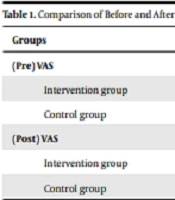
The mean age of the children in the control group was 9.5 ± 1.5 years and in the intervention group 9.8 ± 1.3 years; there was no significant difference between the two groups (P = 0.5). Nine patients (60%) in the control group and 8 patients (44.4%) in the intervention group were female. Tables 1 and 2, show the anxiety level in children and mothers.
Table 1.
Comparison of Mean ± Standard Deviation of the Anxiety Level in Children a
| Stage | Values | Test | P Value |
|---|---|---|---|
| Intervention | Paired t-test | 0.06 | |
| Before reading book (evening) | 33.1 ± 5.5 | ||
| After reading book (morning) | 30.8 ± 6 | ||
| Control | Paired t-test | 0.00 | |
| Night | 32 ± 6.5 | ||
| Morning | 34.1 ± 6.7 | ||
| First stage (night) | t-test independent groups | 0.6 | |
| Intervention group | 33.1 ± 5.5 | ||
| Control group | 32 ± 6.5 | ||
| Second stage (before operation) | t-test independent groups | 0.1 | |
| Intervention group | 30.8 ± 6 | ||
| Control group | 34.1 ± 6.7 |
a Data are presented as mean ± SD.
Table 2.
Comparison of Mean ± Standard Deviation of Anxiety Level in Mothers a
| Stage | Values | Test | P Value |
|---|---|---|---|
| Intervention | Paired t-test | 0.04 | |
| Before reading book (evening) | 41 ± 12.7 | ||
| After reading book (morning) | 35.6 ± 9.5 | ||
| Control | Paired t-test | 0.00 | |
| Night | 39.2 ± 13.1 | ||
| Morning | 42.8 ± 14 | ||
| First stage (night) | t-test independent groups | 0.7 | |
| Intervention group | 41 ± 12.7 | ||
| Control group | 39.2 ± 13.1 | ||
| Second stage (before operation) | t-test independent groups | 0.1 | |
| Intervention group | 35.6 ± 9.5 | ||
| Control group | 42.8 ± 14 |
a Data are presented as mean ± SD.
In this study, six mothers did not complete the consent form and thus were excluded from the study; 30 mothers participated in the study were divided into the control (n = 15) and intervention (n = 15) groups. The mean age of mothers in the control group was 37 ± 4 years and in the intervention group, was 36.3 ± 5.9 years. The t-test for independent groups showed no significant difference between the two groups (P = 0.8).
4.1. Qualitative Part (Focus Group Discussion) Finding
According to group discussions it appears that:
- Reading booklets and provided training by residents decrease anxiety in training recipients.
- A cause of anxiety in most parents and children was fear of surgery-anesthesia and lack of knowledge of what will happen.
- Crying and restlessness increased anxiety in children candidate for surgery.
- Sympathy and empathy of the medical team has an important role in reducing anxiety in children.
- Mother’s spiritual beliefs play a significant role in reducing anxiety in patients’ parents.
5. Discussion
In this study the effect of the preoperative education by residents (a booklet containing information about anesthesia and surgery) on reducing anxiety (caused by surgery and hospitalization) of 8 - 10 years old children and their mothers were investigated. Reading books and education by residents lead to reduced considerable anxiety in recipients (children and mothers), respectively. It is reported that most severe anxiety is during separation of children from their parents and during induction of anesthesia. There are different ways to reduce anxiety which divided into two categories: pharmaceutical and non-pharmaceutical used alone or in combination (6-12). Mother’s anxiety before surgery is important for the anesthesiologists. Increased maternal anxiety may increase children’s anxiety and eventually lead to numerous complications such as delirium-behavioral changes and increased postoperative pain in children. Different methods are used to reduce parental anxiety. Preparation programs to reduce parental anxiety before surgery can often be useful in daily practice. In this study, preoperative anxiety in children had a positive correlation with the level of anxiety of their mothers (13). The following describes that the booklet written by the author and described by residents significantly reduced levels of mothers’ anxiety. The direct relationship between maternal anxiety and children anxiety may increase the use of an effective way to reduce anxiety in mothers and children which will be very useful at the same time. Due to limited facilities at Tabriz children hospital, it seems that routine use of this technique is useful and affordable. Playing with anesthesia mask at home and parental planning to entertain the children before entering the operating room had a great impact on reducing children’s anxiety (1). Although effects of applying some systemic medications prior to, during or after surgery (local anesthesia, new surgery techniques and pain relieving techniques) have been studied for pain and anxiety control, postoperatively, there is yet no satisfactory cure for postoperative pain (11). In the present study, children who had received training by anesthesiology residents on the night before surgery had less anxiety. Although the anxiety level was not statistically significant between two groups (P = 0.06). Considering the significant impact of preoperative anxiety on postoperative clinical and psychological recovery, identifying the basic components of an intervention to reduce anxiety before surgery is needed (1). It is important that the children and mothers at this center rarely received psychologically preparation for anesthesia and surgery. Indeed, in this study it was shown that even a few minutes of preparation before surgery, by anesthesia residents on the night before surgery, is effective in reducing anxiety in children and parents. Although sedating agents, such as midazolam, are effective in reducing anxiety before surgery (1, 14). Prescription of these drugs is not always possible. Especially timing for premedication schedule in high crowded areas is problematic. However, higher costs, increased need for nursing care and prolonged stay in the post anesthesia care unit (PACU) will be the result of premedication (1). Distraction techniques and playing with anesthesia mask are the most successful methods for reducing anxiety before surgery (1, 3). Although this report demonstrates the usefulness of preoperative education and the manual shows about the anesthesia, it is not the only way to reduce anxiety. Further studies should be conducted to evaluate the combination of this method with other methods. In the conducted by Fortier et al. (1), the level of education in reducing anxiety has been reported as effective. In another study socio-economic and educational levels of mothers had no correlation with anxiety levels in children (13). Considering the possible impact of education on the anxiety level, literate parents were selected to participate in this study. It seems that oral explanations by showing images or videos for training illiterate parents are useful. The limitations of the present study were the lack of separation of parents and children in terms of education level, psychological status and anxiety background. In a study, mental preparation more than 5 days prior to surgery for children older than 6 years was beneficial. The effect of education on reducing anxiety just before surgery was minimal (5). However, in the present study due to the limited resources and lack of access to patients, few days before surgery, mental preparation was done on the night before surgery. Unlike the study mentioned even this preparation on the night before surgery was helpful in reducing anxiety in children and parents. Previous studies have shown that the behavior of health staff and parents is the essential factor in determining the level of anxiety in children (14-19). In a study by Aghajani et al. (20), an educational pamphlet and lecture can both improve some dimensions of the quality of life in patients with hypertension diagnosis. However, as pamphlets are cheap and easy to use, this method may be used as an alternative method for self-care education in health care settings in Iran, where the system is faced with nursing shortage (20). Findings of this study were in accordance with our study.
The qualitative results of this study indicate a positive impact of health staff behavior in reducing parents’ and children’s anxiety. Although this report demonstrates the usefulness of the education with booklet on reducing preoperative anxiety, this is not apparently the only way to reduce anxiety. Further studies should be conducted to evaluate the combination of this method with other methods. Psychological preparation of children and parents before surgery or oral explanations on the basis of age and parents’ education level should be done routinely in any surgery ward.