
1. Background
Inadequate airway patency may lead to brain damage and death (1). One way to maintain airway patency is by performing endotracheal intubation. Endotracheal intubation can prevent aspiration and facilitate mechanical ventilation. However, unanticipated difficult endotracheal intubation may endanger the patient and cause death (2, 3). The main factor involved in difficult intubation is difficulty in visualizing the larynx through a laryngoscope (4).
Identification of any difficulty to maintain airway patency before anesthesia is administered may facilitate optimal preparation, the use of appropriate equipment and techniques, and experience for personne (1, 2). Many studies regarding the predictors of difficult intubation have been conducted for specific population characteristics. There are many ways to identify difficult intubation, such as by using the modified Mallampati test (MMT), which measures the thyromental distance (TMD) and hyomental distance ratio (HMDR) (5, 6).
The MMT is the most common parameter used to predict difficult intubation. Shiga et al. analyzed 31 studies regarding MMT and acquired a sensitivity score of 0.49 and a specificity score of 0.86. These researchers also found that the area under the receiver operating characteristics (ROC) curve (AUC) was 0.82, with a prevalence of difficult intubation of 5.7% (7). The TMD is another score used as a predictor of difficult intubation. This was applied by measuring the distance from the thyroid notch to the tip of mandible with head extension. Based on previous studies, there have been various results exhibiting the influence of several factors, such as different induction and intubation protocols (8, 9).
The HMDR has been used to estimate the size of the submandibular space. Patients with smaller mandibles exhibit a tendency for intubation to be difficult. Huh et al. conducted a study in Korea where they reported that the HMDR was a good predictor for difficulty in visualizing the larynx, with a sensitivity of 0.88 and specificity of 0.66 (5).
Previous studies have shown that the screening tests for difficult intubation are limited if used separately. There is no single anatomical factor that can determine the ease of carrying out laryngoscopy. Therefore, a combination of various predictors is needed to increase the diagnostic value of these tests (5, 10).
Indonesia is a well-known multicultural country. Indonesians originated from both Mongoloids and Autralomelanosids, which created the Proto-Malay sub-race. Later, the Proto-Malay and Mongoloids intermixed to create the Deutero-Malay. The Malay race has different craniofacial features in comparison to those of other races. The cephalic index, which is the comparison index between the width and length of the head times 100, may show the difference between each race. In England, Scandinavia, and several areas of the Mediterranean, the median cephalic index is found to be 75 - 80. In Western and Central Europe, the cephalic indexes are above 80 and 85, respectively, while in Africa, it is below 75. In China, Korea, and Japan, the cephalic index is between 75 and 80. Indonesia and the Andaman area have cephalic indexes above 80 (11, 12). Not only the cephalic index but also the shape and size of the mandible differ in Malays compared to other races.
Due to the differences in craniofacial features among diverse races, the predictors for difficult intubation may also differ. The diagnostic value may be different if these tests are applied to Malay individuals.
2. Objectives
The purpose of the present study is to evaluate the ability to predict the visualization of the larynx among Malay people using several predictors, such as the MMT, TMD, and HMDR.
3. Patients and Methods
This research involved a cross-sectional study carried out at the central operating room at Cipto Mangunkusumo hospital, Jakarta. The study was carried out from March to May 2014. After approval was received from the ethics committee of the Cipto Mangunkusumo Hospital faculty of Medicine, universitas Indonesia, 277 patients who underwent elective surgery with general anesthesia were included in this study.
The inclusion criteria were patients aged 18 - 65 years old; an ASA score of 1 or 2; Indonesians of Malay race; and willingness to participate in this study, as indicated by signing the informed consent form. Patients with the oral opening restricted to less than 3 cm, acute burns on the face and neck, tumors on the airway, limitations on neck movement, airway trauma, protruding upper teeth, a high risk of bleeding, acute respiratory infection (Croup, epiglottitis, Ludwig’s angina), or anatomical disturbances (macroglossia, short neck, micrognathia, prognathism) were excluded from this study.
Basic demographic data, such as sex, age, body weight and height, race and body mass index, were collected before anesthesia. For each included subject, there were three consecutive predictors measured, as follows:
1. The Mallampati score or ratio of tongue and pharynx size, which was measured with the patient was sitting down, the face looking to the front, the mouth opened maximally, and the tongue stuck out. The scoring system was as follows:
Class I: The palatum molle, palatum durum, uvula, and anterior and posterior tonsils were visualized;
Class II: The palatum molle, palatum durum, and uvula were visualized;
Class III: The palatum molle and base of the uvula were visualized; and
Class IV: The palatum molle was not visualized.
2. The TMD, which is the distance from the thyroid notch to the lower margin of mandible with full head extension. A TMD less than 65 mm is associated with difficult intubation; (13) and
3. The hyomental distance, which is the distance from the hyoid bone to the lower mentum from the mandible. The HMDR is the ratio between the hyomental distance in maximal extension position and the hyomental distance in the neutral position. An HMDR ≤ 1.2 is associated with difficult intubation (5).
Following premedication with midazolam 0.05 mg/kgBW and fentanyl 3 mcg/kgBW, induction was conducted by administration of propofol 2 - 3 mg/kgBW. After eyelash reflex was diminished, mechanical ventilation using oxygen was given. Intubation was conducted by an anesthesiology resident after full relaxation using rocuronium 0.5 mg/kgBW. A Macintosh laryngoscope number 3 or 4 was inserted until the tip of the blade was on the vallecula; then, the laryngoscope was lifted until the vocal cord was visualized. The Cormack-Lehane (CL) score was measured without cricoid pressure (14). Larynx visualization was categorized as difficult with a CL score of III or IV. In contrast, larynx visualization was categorized easy with a CL score of I or II.
For analysis, the subjects were classified into two groups, namely the easy visualization of the larynx (EVL) and difficult visualization of the larynx (DVL) groups. Demographic data and research variables for both groups were analyzed using the t-test and Mann-Whitney test for numerical data and the Chi-square test and Fisher’s exact test for nominal data. Each predictor was analyzed to assess its association with visualization of the larynx using a 2 × 2 digest, the Chi-square test, and Fisher’s exact test, with significance set at P < 0.05. Statistical analysis was conducted to determine the sensitivity, specificity, positive predictive value (PPV), negative predictive value (NPV), and AUC for each variable. The ROC curve was utilized to assess discrimination ability. An AUC close to 1 showed the variables’ ability to identify patient with difficult visualization of the larynx. Statistical analysis was carried out using Statistical Package for Social Sciences (SPSS) version 16.0 (manufactured by IBM, USA).
4. Results
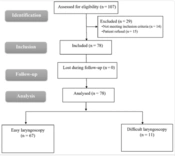
This study included 277 subjects undergoing elective surgery under general anesthesia. No subjects were excluded from the study. Basic demographic data are listed in Table 1. Most of the subjects were Javanese, followed by Sundanese, Betawi and Batak. All races presented in this study belonged to the Deutero-Malay race. Incidence of DVL was 10.1%. However, there was no significant relationship between sex, age, body weight and height, or body mass index and DVL.
Table 1.
Demographic Data of the Research Subjects
| Parameters | All Subjects (N = 277) | EVL (N = 249) | DVL (N = 28) | P Value |
|---|---|---|---|---|
| Sexa | 0.637b | |||
| Male | 104 (88.9) | 13 (11.1) | ||
| Female | 145 (90.6) | 15 (9.4) | ||
| Age, y | 40.38 ± 14.39 | 40 (18 - 65) | 47.5 (18 - 65) | 0.123c |
| Body weight, kg | 58.3 ± 9.44 | 57 (43 - 76) | 63.5 (40 - 90) | 0.074c |
| Body height, cm | 160 ± 6.78 | 160 (150 - 170) | 160 (143 - 180) | 0.649c |
| Body mass index, kg/m2 | 22.38 ± 3.088 | 22 (18 - 29) | 24 (16 - 33) | 0.066c |
aValues are expressed as No. (%).
bChi-square test.
cMann-Whitney test.
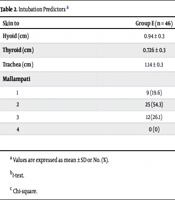
In this study, Mallampati scores and larynx visualization showed a significant association (P < 0.05). In the EVL group, the mean TMD was 70 ± 8.8 mm, while in the DVL group, the mean TMD was 61 ± 5.4 mm. Similarly, this study found a significant association between TMD and larynx visualization (P < 0.05). An HMDR < 1.2 was obtained in 18 subjects (20.2%) in the DVL group. This also generated a significant statistical association between the HMDR and larynx visualization (P < 0.05). The results are shown in Table 2.
Table 2.
Association Between the Predictors of Difficult Intubation and Larynx Visualizationa
| Predictors | EVL (N = 249) | DVL (N = 28) | P Value |
|---|---|---|---|
| Mallampati score | 0.008b | ||
| 1 and 2 | 247 (90.8) | 25 (9.2) | |
| 3 and 4 | 2 (40) | 3 (60) | |
| TMD, mm | < 0.001c | ||
| ≤ 65 | 88 (79.3) | 23 (20.7) | |
| > 65 | 161 (97) | 5 (37) | |
| HMDR | |||
| ≤ 1.20 | 71 (25.6) | 18 (25.6) | < 0.01c |
| > 1.20 | 178 (64.2) | 10 (3.6) |
aValues are expressed as No. (%).
bFisher’s exact test.
cChi-square test.
Mallampati scores of 3 and 4 were used as predictors of difficult visualization of the larynx. Among 28 subjects with Mallampati scores of 3 and 4, only 3 were shown to have difficult visualization of the larynx. The Mallampati score was shown to have specificity of 99.2% and sensitivity of 10.7%. A TMD ≤ 65 mm was also used as predictor of difficult visualization of the larynx. Among 28 subjects with prediction of difficult visualization of the larynx, there were 23 subjects with actual difficult visualization of the larynx. The TMD was showed to have sensitivity of 82.1% and specificity of 64.7%. An HMDR ≤ 1.20 was used as a predictor for difficult visualization of the larynx. Eighteen out of 28 subjects with such an HMDR exhibited actual difficult visualization of the larynx. The HMDR exhibited a specificity of 71.4% and sensitivity of 64.2%. The diagnostic values of all three predictors are shown in Table 3.
Table 3.
Diagnostic Validity of all Predictors for Difficult Intubation and Larynx Visualizationa
| Sensitivity | Specificity | PPV | NPV | |
|---|---|---|---|---|
| Mallampati score | 10.7 | 99.3 | 22 | 92.8 |
| TMD | 82.1 | 64.7 | 20.7 | 97 |
| HMDR | 64.2 | 71.4 | 60 | 91 |
| Mallampati score + HMDR | 71.4 | 70.7 | 70.9 | 71.1 |
| Mallampati score + TMD | 85.7 | 63.5 | 70.1 | 81.6 |
| TMD + HMDR | 85.7 | 63.1 | 69.9 | 81.5 |
| Mallampati score + TMD + HMDR | 60.7 | 88.8 | 84.4 | 69.9 |
aValues are expressed as percentage.
In this study, ROC was used to measure the AUC to distinguish each predictor and determine visualization of the larynx. Based on the ROC analysis, it was found that TMD and a combination of all three predictors had the best AUC (82% and 83.5%; Table 4).
Table 4.
ROC Analysis for Predictors to Visualize the Larynx
| Variables | AUC | Standard Error | P Value | OR | 95% CI | |
|---|---|---|---|---|---|---|
| Mallampati score | 0.614 | 0.057 | 14.2 | 0.503 | 0.725 | |
| HMDR | 0.743 | 0.046 | 4.5 | 0.653 | 0.833 | |
| TMD | 0.827 | 0.035 | 10.2 | 0.757 | 0.894 | |
| Mallampati score + HMDR | 0.724 | 0.053 | < 0.001 | 0.619 | 0.828 | |
| Mallampati score + TMD | 0.760 | 0.045 | < 0.001 | 0.672 | 0.849 | |
| TMD + HMDR | 0.820 | 0.038 | < 0.001 | 0.746 | 0.894 | |
| Mallampati score + TMD + HMDR | 0.835 | 0.038 | < 0.001 | 0.760 | 0.909 | |
5. Discussion
Based on the findings in this study, the incidence of DVL among Malay individuals in Indonesia was 10.1%. This was in accordance with a meta-analysis on nine studies where the researchers reported that the incidence of DVL was around 6% - 27% (15). This vast variation might be influenced by several factors, such as age, ethnicity, or the laryngoscope used (15, 16).
The Mallampati score exhibited relatively low sensitivity in this study. Lee et al. reported that the sensitivity of this score varied from 12% to 100% (15). This test only measures the proportion of tongue in relation to pharynx; it does not consider atlanto-occipital joint movement. Measurement of the atlanto-occipital joint determines the ability to move the neck during laryngoscopy to bring about alignment between the oral axis, pharyngeal axis, and laryngeal axis (4, 6). A recent study mentioned that that it is better to measure the Mallampati score in a sitting position with maximal head extension and the tongue sticking out (17). In addition, to reduce the incidence of false positive or negative results, the measurement should be carried out twice (6).
Among Malay individuals in Indonesia, a TMD profile with a cut-off point of 65 mm has been shown to be superior to another finding in the Korean population, where a cut-off point of 62 mm was used. The present study found that the TMD had 82.1% sensitivity, 64.7% specificity, 20.7% PPV, and 97% NPV; in the Korean population, Huh et al. found that it had 31% sensitivity, 92% specificity, 35% PPV, and 91% NPV.4 The TMD as a predictor for visualization of the larynx has shown a wide range of sensitivity (5% - 96%) because of the different cut-off points for different races. This shows that different races require different cut-off points. Wong and Hung mentioned that the TMD can be used as a predictor for the visualization of the larynx among women of Chinese ethnicity; in this population, the optimal TMD criterion cut-off is 55 mm. In Wong and Hung’s study, the TMD was shown to have 71% sensitivity, 83% specificity, and 7.5% PPV (14). This study showed that the Malay race requires a higher cut-off point in comparison to the Korean and Chinese populations. However, further study should be conducted to validate this. The limitation of the TMD was that it only measures the atlanto-occipital joint, without considering the tongue or pharynx (4, 6).
The sensitivity of the HMDR in this study was superior to that of the Mallampati score. This was the case because the Mallampati score does not include cervical movement, while the HMDR takes cervical movement and restriction into consideration. The HMDR had a lower sensitivity value compared to the TMD (64% vs 82.1%). This was the case because the difference in cut-off points and other cephalometric values for different races might determine the sensitivity and specificity of the predictor. The HMDR was shown to have a smaller false negative value among Malays.
As the sole predictor, the TMD had an AUC of 82%, while those of the HMDR and Mallampati score were 74% and 61%, respectively. If other predictor variables, such as the HMDR and Mallampati score, were added, no significant increase in the AUC was observed. The addition of the Mallampati score and TMD to the prediction model decreased the NPV from 97% to 69.9%. This lower NPV meant that with this combined predictor model, more subjects would be predicted to have EVL but their larynx visualization would actually be difficult. Clinically, this condition might endanger patients. Meanwhile, the PPV showed a DVL rate for the TMD of 20.7%. The cut-off points for Malays in the TMD and HMDR might fix the diagnostic profile of these tests.
5.1. Conclusion
This was a primary study that combined the Mallampati score, HMDR, and TMD as predictors for difficult intubation carried out in Malay patients in Indonesia. This study concluded that among Malays in Indonesia, a TMD with a cut-off point of 65 mm had superior diagnostic value compared with the HMDR and Mallampati score with a cut-off point of 1.2. The accuracy level of the TMD with a cut-off point of 65 mm was better than other single predictors and not far different from a combination of the TMD, HMDR, and Mallampati score. Therefore, the TMD could be used in the Malay population to predict the difficulty of larynx visualization during laryngoscopy. Further study regarding the cut-off points for the TMD and HMDR for the Malay race is required to increase the predictive values of these tests.