1. Background
Poor perioperative pain control is one of the major factors that impede recovery from anaesthesia and surgery. Unrelieved acute pain after surgery usually elicits pathophysiologic neural alterations including not only peripheral but also central sensitization that evolves into chronic pain syndromes (1, 2).
In gynaecological surgeries, the common perioperative analgesic treatment modalitiy is intravenous opioid analgesics or regional analgesia. However, excessive opioids administration is associated with a variety of side effects including ventilatory depression, drowsiness and sedation, nausea and vomiting, pruritus, ileus, urinary retention, and constipation (1, 3, 4). For optimum perioperative pain control, we need to explore multimodal analgesic regimens that act as adjuvants to produce an opioid-sparing effect for enhanced recovery postoperatively (5-7).
Acupuncture is a form of complementary medicine that practices insertion of needles into tissues along meridian lines. EA is different from acupuncture in that it applies needling stimulation and electric pulses to acupuncture meridians and points in order to strengthen the stimulating effect of treatment (8).
The mechanisms by which electroacupuncture exert their analgesic action have not been completely elucidated. However, possible mechanisms include stimulation of descending pain inhibitory pathways, an inhibition of substance-P release in central nervous system (CNS) structures and the release of endogenous opioid substances within the CNS (9-12).
EA applicability in various painful disorders still remains controversial beacuse of its variable results, weak analgesic effect, and possiblility of placebo effect (13). Studies carried out to elucidate acupuncture analgesic effect especially in postoperative pain show conflicting results (14). However, the major difference among these studies is the lack of looking into stimulation modality and the concomitant study of its side effect profile (15).
The aim of this study is to determine the efficacy of the use of low frequency 2 Hertz EA as an adjuvant to standard opioid analgesia in modulating postoperative pain as well as its opioid related side effects like PONV.
2. Objectives
The aim of this study is to examine the effect of EA on reducing postoperative pain, analgesic requirement and nausea and vomiting on subjects recovering from elective total abdominal hysterectomy (TAH).The hypothesis is that patients receiving EA would demonstrate increased analgesic and antiemetic relief over a duration of time and reduced opioid related side effects compared to a control group.
3. Patients and Methods
A prospective, double blinded randomized study was conducted at a 990-bed multidisciplinary tertiary government hospital in Malaysia. The study was approved by National medical research and ethics committee with the protocol numbered NMRR 13-128-14785 and by human research ethics committee, University Sains Malaysia (FWA Reg. No.: 00007718; IRB Reg. No.: 00004494) in compliance with the declaration of Helsinki. We enrolled 64 consented elective patients scheduled for TAH to study the effect of EA in addition to standard opioid analgesia with respect to postoperative pain and opioid-related side effects over a 12-month period. Sample size was calculated in agreement with the study by Lee (16) at two-sided 5% significance level with power of 90%. Given an anticipated drop-out rate of 10% with a SD of 3.43 mg, Zα of 1.96, and Zβ of 1.28, a sample size of 32 per each group was necessary.
3.1. Patients
Eligible participants were patients scheduled for TAH who met inclusion criteria. The inclusion criteria consisted of female patients aged 18 to 70 years with an American society of anaesthesiology score of 1 or 2. Our exclusion criteria were as follows: patients who were chronic opioid users, body mass index (BMI) of more than 30, prior history of PONV, suffering from coagulopathy, preagnancy, having a pacemaker, or having local site infection at upper limbs.
3.2. Randomisation and Blinding
Subjects were randomised into two groups (EA group and control group) using a computer-generated randomisation list. EA group received intraoperative 2 Hz EA at bilateral Pericardium Meridian point 6 (p6) and large intestine meridian point 4 (p4) (Figure 1) in addition to standard care. Control group only received standard care. Standard care was defined as general anaesthesia with intraoperative analgesia of IV Morphine 0.1 mg/kg and postoperative patient-controlled analgesia Morphine (PCAM).
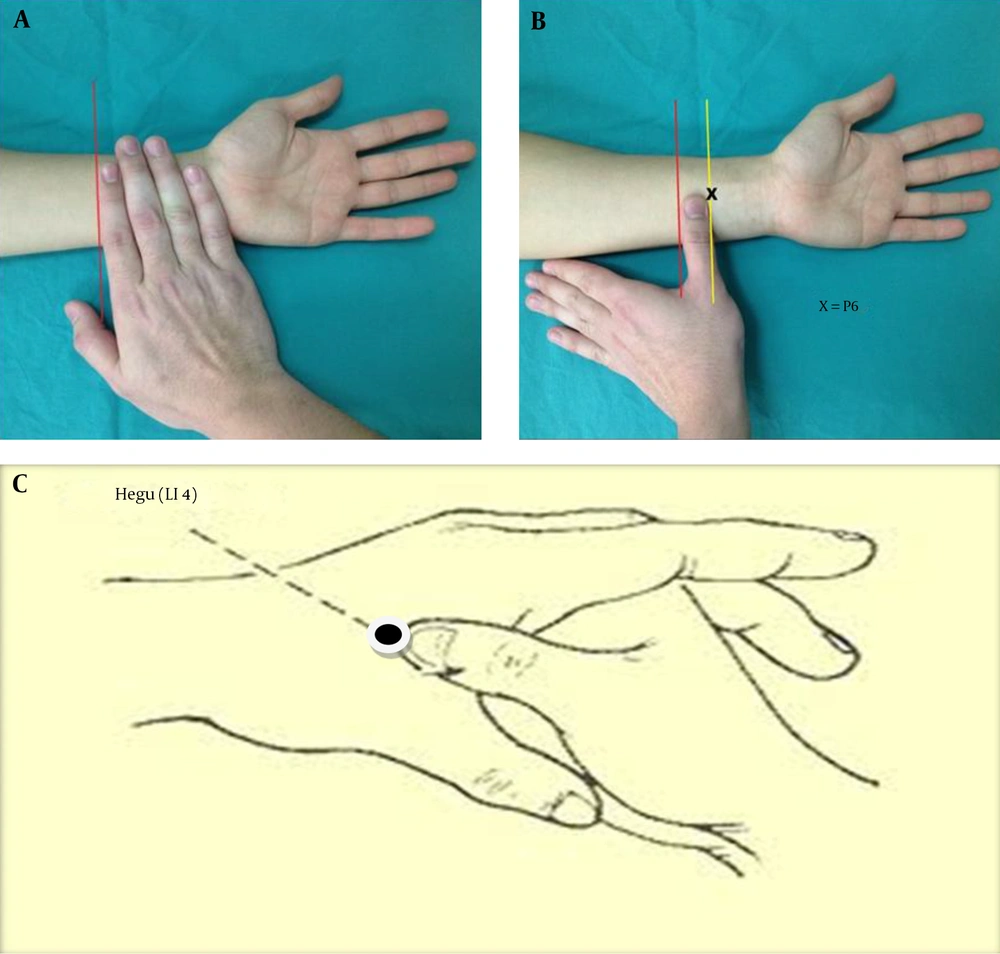
Figure 1.
A, step 1: to start to locate pericardium meridian p6 point (Neiguan), B, step 2: to finally locate pericardium meridian p6 point (Neiguan) marked x, C, location of large intestine p4 point (Hegu) marked with black circle.
Double blinding was ensured by starting EA after patients were induced under general anaesthesia and the assessors did not know if the patient received EA or not. The anaesthetist was not involved in the assessment of the patients.
3.3. Study Protocol
All patients scheduled to have surgery were approached and given time to read the information sheet, and entered into the study after signing the consent form. The consent was obtained the night before the operation once the patients were warded. They were taught how to use the patient controlled analgesia (PCA) pump, as a standard practice.
Patients were anaesthetised following a standardised anaesthetic protocol. They were induced with I.V Fentanyl 1 - 2 µg/kg, I.V Propofol 2 - 4 mg/kg and neuromuscular blockade was provided with either I.V Atracurium 0.5 mg/kg or I.V Rocuronium 0.6 mg/kg. Anaesthesia was maintained with Sevoflurane MAC 1 to 1.2 and oxygen to air mixture of 1:1. For both study groups, analgesia was provided by inducing I.V Morphine 0.1 mg/kg while no antiemetic was given throughout the surgery. If the patient’s heart rate and blood pressure increased 20 % above baseline or it was more than 2 hours from the last Morphine dose, I.V Fentanyl 1 µg/kg rescue analgesia was provided. Residual neuromuscular block was antagonized in all patients with I.V Neostigmine (2.5 mg) and Atropine (1 mg).
Patients in the EA group had the acupuncture needles inserted at bilateral Pericardium Meridian point 6 (p6) and large intestine meridian point 4 (p4) (Figure 1) after induction of anaesthesia.
The pericardium meridian p6 point (Neiguan) was defined as follows. The patient’s four fingerbreadths were placed on the medial aspect of their forearm with the edge of the 4th finger on the wrist crease. This is then subtracted from the width of the interphalangeal joint of her thumb. The point between the tendons of extensor carpi radialis and palmaris longus was the pericardium meridian p6 point (Neiguan) (Figure 1).
The large intestine p4 point (Hegu) located on the dorsum of the hand, between the first and second metacarpal bones, at the midpoint of the second metacarpal bone and close to its radial border (Figure 1).
The needles were inserted by a trained acupuncturist using a “flicking in” technique with a needling guide tube to ensure it is at an appropriate depth. The EA needles were stimulated before the start of surgery until the end of surgery at a frequency of 2 Hertz that was produced by Electronic Acupuncture Treatment Instrument (Hwato brand, model SDZ - IV). It was set at intensity level 1 with continuous wave emission. This device used alternating current (AC) for a substantial step-down in voltage and amperage and ensured that there was virtually no current transmitted through the patient’s body for intraoperative safety. The proximal and distal electrodes were clipped on to the sterile single use acupuncture needles. No local anaesthetics were used at the end of surgery. Stimulation was stopped and needles removed before the patient woke up at end of surgery.
In the recovery room, patients from both study groups were put on a PCAM machine. PCAM was set as a bolus IV Morphine 1 mg delivered with each ‘on demand’ dose, and lock-out period of 5 minutes with no background infusion. Rescue analgesia in the postoperative period included IV Morphine boluses if the patient experienced severe pain despite being on PCAM. These doses were included in our data entry.
If at any time postoperatively the patient experienced vomiting, I.V Metoclopramide 20 mg was given as first line, followed by I.V Granisetron 1.5 mg 30 minutes later as second line if persistent vomiting.
The recovery nurses who assessed the patients at 30-minute postoperatively were blinded to the study group. Once discharged from operation theatre (OT), patients were transferred to the general gynaecological wards for the remainder of their stay. They were put under the acute pain services (APS) that followed up the patients 2 hourly as part of their standard practice. Respiratory rate and drowsiness were evaluated by the APS team but these variables were not studied. The patients were evaluated by blinded assessors at 2 hours, 4 hours, and 24 hours postoperatively for study purposes.
3.4. Assessment
We analysed postoperative analagesia via numerical rating scale (NRS) at 30 minutes, 2 hours, 4 hours, and 24 hours. The NRS is used to determine the amount of perceived pain felt by each subject. It is a 0 to 10 scale with 0 being no pain and 10 being most severe pain.
Data on the total PCAM demand and total PCAM doses in the first 24 hours were collected. We also analysed incidence of nausea and postoperative antiemesis use by looking at incidences of need for rescue pharmacologic antiemetic in the first 30 minutes and 24 hours.
3.5. Statistical Methods
Data entry and analysis was conducted using PASW Statistics Data Editor (Statistical Package for Social Sciences SPSS Version 21). The data were analysed using Independent samples T test for numerical data (NRS for pain, PCAM demand, and total PCAM doses) between EA group and control group and expressed as mean ± standard deviations.
Chi Square and Fisher exact test were applied to categorical data (incidence of nausea and need for rescue pharmacologic antiemetic). Incidence of nausea and antiemetic usage was expressed as frequencies (n) and percentages (%). We defined the level of significance at p value of < 0.05
4. Results
A total of 64 patients were enrolled into this study. All patients were examined and no drop-out was occurred (Figure 2). The study was performed from July 2013 to July 2014. Patients from both study groups were homogenous in all demographic parameters (Table 1).
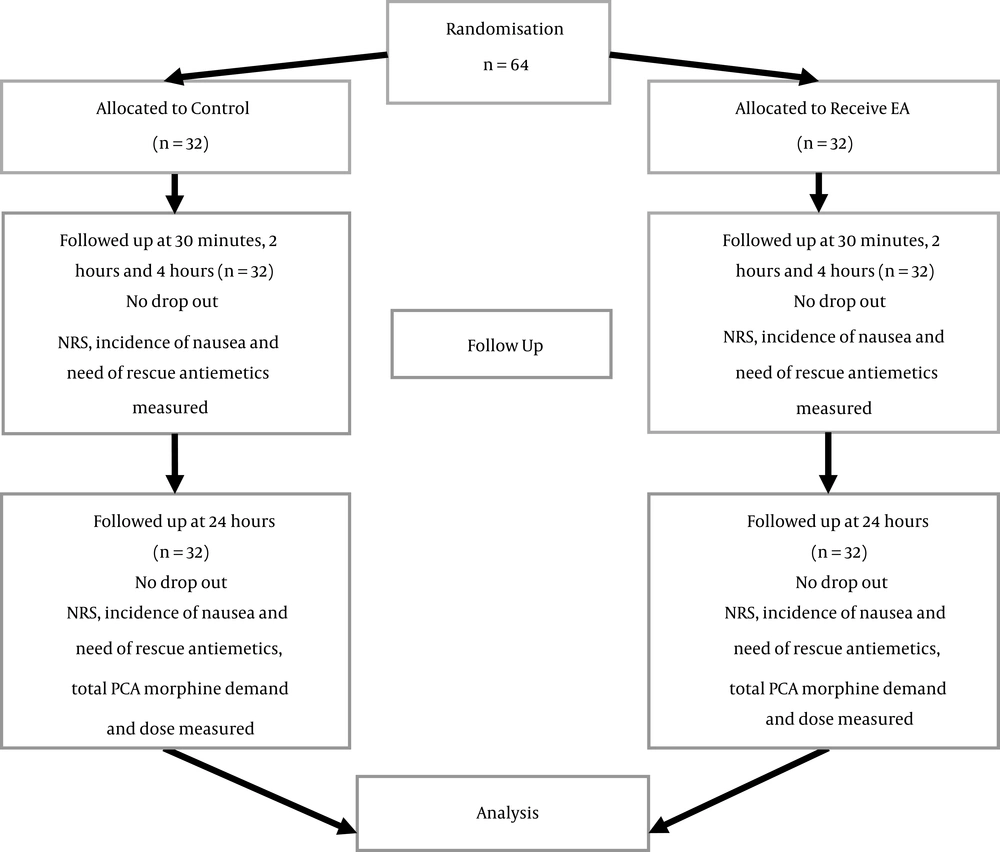
Figure 2.
Flow Chart of patients in Trial
Table 1.
Baseline Characteristics Between Electroacupuncture Group and Control Group
| Variables | EA Group, n = 32, Mean (SD) | Control Group, n = 32, Mean (SD) | Mean Difference (95% CI) | t Statistic (df) | P Valuea |
|---|---|---|---|---|---|
| Age, y | 47.50 (7.94) | 48.72 (6.72) | -1.22 (-4.89,2.47) | -0.66 (62) | 0.510a |
| Weight, kg | 60.22 (8.75) | 59.25 (9.71) | 0.97 (-3.65,5.59) | 0.42 (62) | 0.676a |
| Height, m | 1.57 (0.06) | 1.58 (0.07) | -0.01 (-0.04,0.03) | -0.32 (62) | 0.754a |
| BMI value, kg/m2 | 24.28 (2.97) | 23.71 (3.16) | 0.57 (-0.96,2.10) | 0.75 (62) | 0.458a |
| Duration of surgery, min | 149.06 (42.64) | 151.97 (50.71) | 0.805a |
aIndependent t test.
In this study, the mean pain score was significantly lower in the EA group than the control group at 30 minutes and 2 hours (P value < 0.05). At 4 hours, however, the mean pain score was similar in both groups. At 24 hours, the mean pain score was lower in the EA group than the control group with no statistically significant difference (Figure 3).
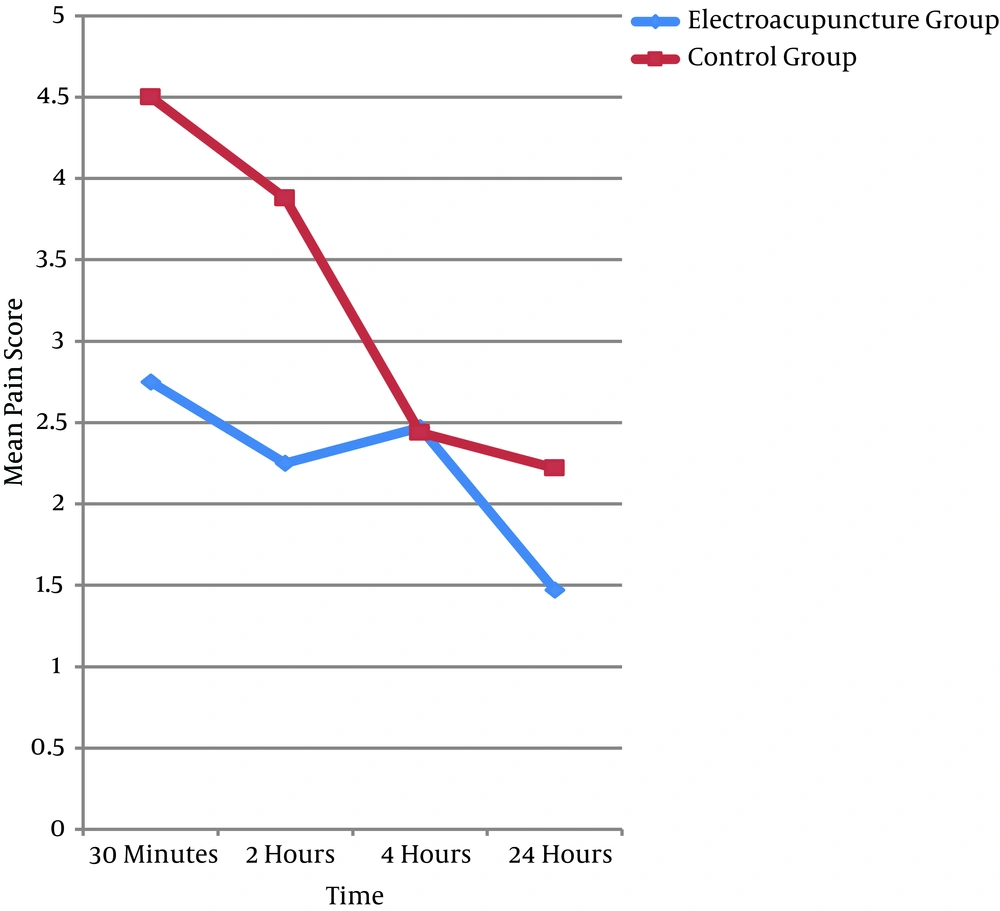
Figure 3.
Mean Numerical Rating Score at Various Time Intervals Between Electroacupuncture and Control Groups
The mean PCAM demand within 24 hours was significantly lower in EA group compared to the control group (P value < 0.05). The opioid consumption within 24 hours showed a significant reduction in EA group compared to the control group (P value < 0.05) (Table 2).
Table 2.
Comparison of Mean Total PCA Morphine Demand and Dose within 24 Hours Between Electroacupuncture and Control Groups
| Variable | EA Group, n = 32, Mean (SD) | Control Group, n = 32, Mean (SD) | Mean Difference, (95% CI) | t Statistic (df) | P Valuea |
|---|---|---|---|---|---|
| Total PCA Morphine in 24 hours | |||||
| Demand (times pressed) | 27.28 (21.61) | 55.25 (46. 85) | -27.97 (-46.20,-9,74) | -3.07 (62) | 0.003* |
| Dose, mg | 21.38 (14.38) | 33.94 (20.24) | -12.56 (-21.34,-3.79) | -2.86 (62) | 0.006* |
aIndependent t test.
Incidence of postoperative nausea significantly reduced in EA group at 30 minutes compared to control group (P value < 0.05) (Figure 4). Incidence of postoperative nausea also reduced at 2 hours and increased at 4 hours but both groups were not statistically different in these terms.
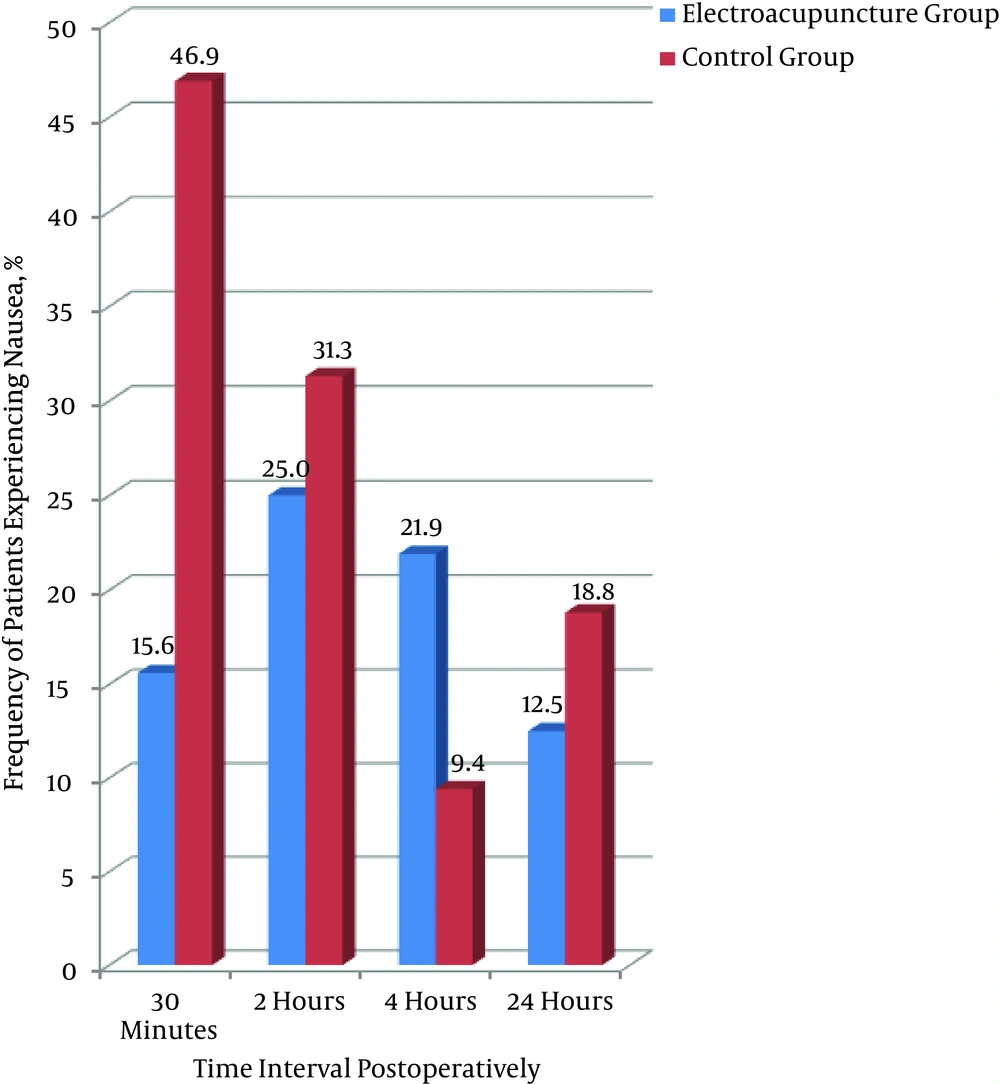
Figure 4.
Incidence of Nausea at Various Time Intervals Between Electroacupuncture and Control Groups
5. Discussion
We found low frequency stimulation of 2 Hertz EA intraoperatively during a gynaecological surgery that shows a significant reduction in mean pain scores up to 2 hours post operatively, opioid demand, and total opioid consumption in the first 24 hours. The low frequency stimulation also reduced the incidence of opioid-induced side effects like PONV up to the first 30 minutes.
Patients in this study were started on EA after they were induced under general anaesthesia. They were blinded to the intervention. Hence, we avoided any possible placebo effect attributed to the intervention. However, according to the traditional Chinese medicine theory, acupuncture provided intraoperatively may not be as comparable as those provided in a conscious subjects. This is because of the failure to establish the De Qi sensation that improves the efficacy of acupuncture (17). Anaesthetics such as propofol also reduces the neurophysiological response to acupuncture stimulation as shown in the study of Wang (18). Despite this, our study with its rigorous methodology shows a statistically significant effect on opioid reduction which will contribute to the body of work regarding optimal timing of acupuncture in the perioperative period.
This study shows a transient antinociceptive effect up to 2 hours postoperatively with a reduction in total opioid dose and demand in the first 24 hours. There is not much evidence with regard to how long the EA analgesic effect lasts postoperatively as it is attributed to the endogenous opioid production in the acute postoperative period. In a meta-analysis by Sun et al. that looked into 10 randomised controlled trials, there were opioid sparing -effects at 8, 24, and 72 hours postoperatively at rates of 21%, 23%, and 29%, which were clinically significant (19). This meta-analysis also concluded that the analgesic effect of a single session EA will last for about two to three hours, which is similar to our study.
The results of this study accurately follow the prediction of risk of PONV by Apfel simplified risk score (20). If we intended to assess the baseline risk factor for our study population according to the Apfel simplified risk score, this study comprised female patients as study population and used postoperative opioid in methodology. This gives a score of 2 that indicates medium risk. According to the Apfel simplified scoring system, subjects with medium risk would report an incidence of approximately 40 %. Similarly, we recorded an incidence of 46.88% in the control group in the first 30 minutes. Subjects receiving EA reported lesser incidence of nausea as expected.
However, one of the limitations in the current study was that we did not collect data on whether our patients were smokers or not, which is part of the Apfel simplified risk score. If we knew the patient’s smoking status, we could have classified baseline risk of PONV as high risk in the non-smoker group.
In conclusion, this study explores potential benefits of intraoperative EA. The findings of this study can contribute to the body of work which encourages the use of cost efficient non-pharmacological agents with minimal side effect profile.