1. Background
Intravenous regional anesthesia (IVRA) is a simple type of regional anesthesia that has many advantages such as: reliability, effectiveness, economic for day care, and safe for emergency surgery when patient is full stomach (1-4). However, it has some limitations such as lack of postoperative analgesia, tourniquet pain, insufficient muscle relaxation, and local anesthetic toxicity (5, 6). To improve postoperative analgesia, different additives have been combined with local anesthetics during IVRA (7).
A survey in North American showed that 11% of anesthesiologists added other drugs to lidocaine for IVRA (8). These additives are: NSAID, opioids, muscle relaxants, clonidine, and magnesium sulfate (9-12). However, just regarding NSAID especially ketolorac, there is good evidence to use as an additive for improving postoperative pain control after IVRA (13). However, other additives have been limited to success in improving postoperative analgesia following IVRA (7). There are many studies shown that opioids have local anesthetic effect and use them as an effective additive to IVRA (14). There is no clinical study in the literature to compare the efficacy of tramadol with magnesium sulfate when added to lidocaine IVRA.
2. Objectives
The resent study was designed to compare additive effect of tramadol with magnesium sulfate when added to lidocaine in IVRA during upper extremity orthopedic surgery. The primary aim was to investigate postoperative analgesia. The secondary aims were to investigate the onset of sensory and complications of the adjuvant drugs.
3. Methods
This randomized clinical trial was a single center, double - blind, placebo - controlled, parallel - group trial with a balanced randomization. The study was registered in the Iranian registry of clinical trials (IRCT2014040511662N6) and was approved by Shiraz medical University ethics committee. The study was conducted in the operation theater of the Chamran Hospital, Shiraz, Iran, from June to November 2014. The purpose of the study was explained to the patients and written informed consent were obtained from them.
The eligible patients were all patients aged 15 - 65 years with ASA І and Π who were candidates for elective orthopedic surgery under IVRA. The exclusion criteria of the study were patients having a history of cardiopulmonary disorders, allergic reaction to the drugs used in the study, G6PD deficiency, sickle cell anemia, body mass index > 35 kg/m2,Reynaud diseases, renal failure, alcohol addiction, addiction to opium or other illicit drugs, chronic pain syndrome, and convulsion. Eligible patients were randomly allocated into 3 groups through simple randomization, which was carried out by a computer-generated random sequence. A nurse of anesthesia who was not involved in data collection performed the enrollment and assignment into the groups. In group A, 100 mg tramadol (Tramadol Hydrochloride 50 mg/1 mL, Tehran chimie pharmaceutical Co, Tehran, Iran) was diluted with 0.9% normal saline to a total volume of 10 cc (n = 23), in group B, 1.5 gram magnesium sulfate (Infu - magnesol ® 20%, 10 mL amp, Shahid Ghazi pharmaceutical Co, Tehran, Iran) was diluted with 0.9% normal saline to a total volume of 10 cc, and in group C, 10 cc of 0.9% normal saline were injected following local anesthetic solution as the adjuvant in groups A, B, and C, respectively. These 10 cc syringes A, B, and C were identical in appearance and were prepared by a nurse anesthetist, not related to the study. The syringes were labeled as A for group A (n = 23), B for group B (n = 23), and C for group C as the control group of study. The patients and the research assessors were not aware of the content of either syringe. Two nurses who were trained for acute pain service and a resident of anesthesia were research assessors. All of them not aware of adjuvant drugs were used in IVRA for each patient.
Before starting the block with IVRA, 1 angiocatheter (20 gauge) was applied in the dorsal vein of the hand near the site of surgery through which local anesthetic drugs are to be given, and the other angiocatheter (18 gauge) in the opposite hand for intra - operative fluid transfusion. Then, the surgical upper extremity elevated up to 90 degrees for 10 minutes until exsanguinated from the blood completely. After that, a double pneumatic tourniquet was placed around the upper arm. The proximal cuff was inflated to 250 mm Hg. The proper performance of the tourniquet was assured by loss of pulse oximetry tracing of the ipsilateral finger and absence of radial pulse. Then, 3 mg/kg 0.5% lidocaine diluted with 0.9% normal saline to a total volume of 40 cc was injected over 1 min through cannula (20 gauge). Furthermore, 10 cc syringes A, B, and C were injected following the local anesthetic solution as the adjutants in groups A, B, and C, respectively.
The sensory block was assessed every 30 s starting 2 min after injection until complete sensory block was established in the sensory distribution of the ulnar, median, and radial nerves by a pinprick test using a short beveled needle. A total 5 minutes after sensory and motor block was ensured, the distal cuff was then inflated to 250 mm Hg followed by release of the proximal tourniquet. Then, the surgeon allowed having an intervention. During the surgery, patients did not received any analgesic otherwise, if they did, they were excluded from the study. The tourniquet was not deflated before 40 min of local anesthetic injection and was not inflated more than 90 min. At the end of surgery, the tourniquet deflation was performed by repeated inflation-deflation technique; the tourniquet was deflated 3 times for a 10 s period followed by 1 min of re - inflation. If surgery took longer than 90 min, the patient received general anesthesia and was excluded from study.
Postoperative analgesia was evaluated using VAS (visual analogue scale), [0 = No pain, 10 = the most severe pain that they could imagine] every 15 minutes after tourniquet deflation for 1 hour in post anesthesia care unit (PACU). During the first 24 hours postoperative analgesia was evaluated every 4 hours. In the PACU, if NSR was more than 7, patients received 2 mg morphine intravenously every 5 minutes and if NSR was between 4 - 7, patients received 1 mg morphine intravenously every 5 minutes until the NSR decreased to less than 4. In the orthopedic ward patient - controlled analgesia (PCA) [brand of PCA: B. Braun perfusor fm Melsungen, Germany] was initiated with morphine. The PCA device used morphine with 0.5 mg/mL concentration. The PCA was programmed as bolus dose 2 mL with duration of lock out: 7 minutes and without basal infusion. The total amount of morphine that each patient consumed through the PCA in the first 24 hours post - operation, respiratory depression, and postoperative nausea and vomiting were recorded.
Postoperative nausea and vomiting was evaluated by asking the patients to grade their nausea and vomiting according to the 3 - point scale: 0 = no nausea, vomiting, 1 = nausea only, and 2 = retching and/or vomiting. Respiratory depression was defined as a respiratory rate less than 8 per minute.
According to previous studies, we considered a 30% increase in analgesic time with addition of tramadol or Mg sulfate to lidocaine with a power of 80% and α level of 0.05. The sample size was calculated to be at least 23 patients in each group. The study data were transferred into a computer database for statistical analysis using SPSS for Windows, Version 20.0 (SPSS Inc., Chicago, IL, USA). Kolmogorov - Smirnov test was used to detect normal distribution of the variables. One - way ANOVA was use to compare parametric variables and Kruskal - Wallis was used to compare nonparametric variables. All data are presented as means ± SD. Percentage and a p value of < 0.05 was considered statistically significant.
4. Results
Among the 521 patients scheduled for orthopedic upper extremity surgery from May to November 2013, only 74 patients underwent IVRA for their orthopedic surgery and were eligible for our study. However, a total of 5 patients were excluded from the study due to intraoperative pain due to failure of IVRA, where we had to change IVRA to G/A. Finally, 69 patients were enrolled into this study and were randomly allocated into 3 groups (Figure 1).
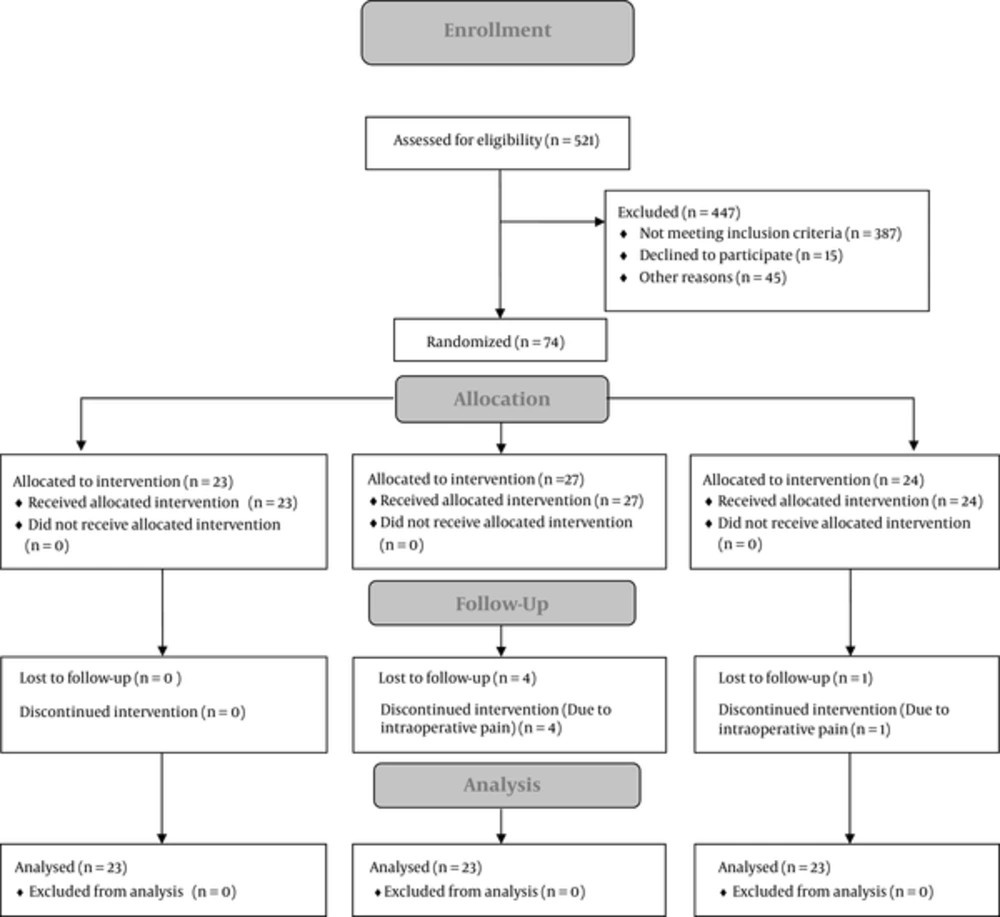
Figure 1.
Flowchart of the Patients According to the Consort Guidelines
Table 1 shows demographic data of the participants, type of the surgery, and tourniquet time of the 3 study groups and there were no significant differences regarding these variables between the groups (P > 0.05; Table 1).
Table 1.
Demographic Data of the Patients, Type of the Surgery and Tourniquet Time of the Three Study Groupsa
| Tramadol Group (n = 23) | Mg Sulfate Group (n = 23) | Control Group (n = 23) | P Value | |
|---|---|---|---|---|
| Age (Year) | 34.00 ± 9.90 | 38.91 ± 14.70 | 34.17 ± 15.71 | 0.625 |
| Weight (Kg) | 69.70 ± 11.28 | 62.83 ± 9.70 | 68.91 ± 10.76 | 0.082 |
| Sex (M/F) | 10/13 | 13/10 | 12/11 | 0.111 |
| Total tourniquet time | 42.13 ± 11.28 | 43.18 ± 14.27 | 39.09 ± 12.79 | |
| Type of surgery | ||||
| Fracture of radius | 69.6 % | 67.6% | 64.7% | 0.935 |
| Fracture of metacarpal bone | 17.4 % | 20.0% | 19.2 | 0.876 |
| Fracture of phalanges bone | 13% | 12.4% | 16.1 | 0.853 |
aAll data in mean ± Standard deviation.
Sensory block onset times were similar between the Mg sulfate group, tramadol group, and control group (P = 0.63; Table 2). Furthermore, the first analgesic request time were statistically different between 3 groups. Pair wise comparisons revealed that first analgesic request time was more prolong in the tramadol group than the Mg sulfate group and in the Mg sulfate group than control group (P = 0.01; Table 2). Also, total morphine consumption during postoperative 24 hours were statistically different between the 3 groups and (P = 0.01; Table 2) pair wise comparisons revealed that total morphine consumption during postoperative 24 hours time was lower in the tramadol group than the Mg sulfate group and the Mg sulfate group was lower than the control group (P = 0.01; Table 2).
Table 2.
Sensory Block Onset Times, First Analgesic Requirement Time and Total Morphine Consumption in the Patients of Study Groupsa
| Tramadol Group (n = 23) | Mg Sulfate Group (n = 23) | Control Group (n = 23) | P Value | |
|---|---|---|---|---|
| Sensory block onset time (min) | 3.52 ± 2.48 | 3.18 ± 1.79 | 3.96 ± 2.57 | 0.63 |
| First analgesic requirement time (min) | 180.87 ± 206.39 | 125.00 ± 117.24 | 108.53 ± 89.43 | 0.01 |
| Total morphine consumption (mg) | 8.91 ± 5.81 | 11.95 ± 4.81 | 16.72 ± 4.07 | 0.01 |
aAll data in mean ± Standard deviation.
Regarding postoperative VAS scores, the scores at 15 minutes after operation were significantly different between 3 groups. Pair wise comparisons revealed that VAS scores at 15 minutes was lower in the tramadol group than Mg sulfate and control group (P = 0.01; Table 3), however, VAS scores at 15 minutes in the Mg sulfate and control group were no significant differences. However, no significant differences were observed between 3 study groups regarding VAS scores at each time interval after 15 minutes until 24 hours post operation (P > 0.05; Table 3).
Table 3.
Postoperative VAS Scores in the Patients of the Study Three Groups during Different Time Points of the Studya
| Tramadol group (n = 23) | Mg sulfate group (n = 23) | Control group (n = 23) | P Value | |
|---|---|---|---|---|
| VAS in the First 15 Min | 2.83 ± 2.61 | 4.33 ± 3.32 | 4.21 ± 3.46 | 0.01 |
| VAS in the 30 - 45 Min | 2.20 ± 1.78 | 2.14 ± 1.62 | 2.82 ± 2.03 | 0.49 |
| VAS in the 1 - 6 Hours | 1.44 ± 1.23 | 1.56 ± 0.99 | 1.54 ± 1.30 | 0.65 |
| VAS in the 10 - 24 Hours | 0.97 ± 0.81 | 0.88 ± 0.56 | 0.92 ± 0.93 | 0.78 |
Abbreviation: VAS, visual analogue scale.
aAll data in mean ± Standard deviation.
Moreover, no significant differences were observed in the incidence of postoperative nausea and vomiting between the 3 groups (P > 0.05) during different time points of the study. In addition, respiratory depression was not recorded in the participants of the study in the 3 groups and not significantly different between the groups (P > 0.05). Also, skin rash was not recorded in the tramadol group (P > 0.05).
5. Discussion
The present study showed that tramadol, as an adjuvant to IVRA, is more effective than magnesium sulfate as an adjuvant in reducing postoperative pain intensity and analgesic requirement in patients underwent IVRA for orthopedic surgery.
In order to prolong postoperative analgesia, anesthesiologists usually add an adjuvant to lidocaine (15). Clinical studies have shown that opioids as adjuvant to lidocaine to IRVA improved sensory block and postoperative analgesia (16, 17). In our study, we used tramadol as an opioid adjuvant to IVRA, tramadol effectively reduce postoperative pain intensity and analgesic requirement in the postoperative period. Several laboratory and clinical studies have shown that tramadol might have a local anesthetic type effect (18, 19). However, Acalovschi et al. showed that tramadol does not have a local anesthetic effect when used as a sole drug for IVRA, but could modify the action of local anesthetic when used as an adjuvant (20). In another study by Goel Sunita et al., tramadol was more effective than ketolorac as an adjuvant to IVRA without opioid related side effects (21). Like our study, they found that tramadol, as an advent to IVRA, reduces postoperative pain intensity and analgesic requirement in the postoperative period. Furthermore, tramadol in comparison to placebo decrease onset of sensory block may be due to its local anesthetic effect.
In some limited study, magnesium sulfate was used as an adjuvant to IVRA. Turan et al., in their study, found that Mg sulfate in comparison to placebo has effective control of postoperative pain (22). However, El-Tahawy et al., in 1 study, compared dexmedetomidine and Mg sulfate as an adjuvant to IVRA and found that Mg sulfate was not effective as an adjuvant to IVRA in control of tourniquet pain and decreasing postoperative pain intensity (23). Another study by Nasr et al., revealed that tramadol and dexmedetomidine, as an adjuvant to IVRA, caused delayed onset of postoperative pain, and less postoperative consumption of supplementary analgesia (24). In our study Mg sulfate as an adjuvant was effective in reduction of postoperative pain intensity and delayed onset of postoperative pain in comparison to placebo but in comparison to tramadol, Mg sulfate was not effective in delayed onset of postoperative pain and decreasing post operative pain intensity.
A major complication of tramadol when used as an adjuvant to IVRA is skin rash distal to tourniquet, which may be due to histamine release; this complication was seen in the study by Acalovschi and his colleagues (19). However, in our study, we did not record the report of skin rash.
When opioids such as morphine, fentanyl, and meperidine have been added to improved quality of perioperative analgesia and to increase duration of postoperative analgesia they usually cause significant incidence of side effects such as sedation, dizziness, as well as postoperative nausea and vomiting (25). However, in this study we used tramadol as an adjuvant and it did not cause side effects such as sedation, dizziness, and postoperative nausea and vomiting.
There are some limitations to our current study. The main limitation was drug dose, which were used according to previous studies. We should use serial dose of tramadol or Mg sulfate to find the optimal dose that provide better intra operative and postoperative analgesia. Also, inclusion of a study group in which the tramadol given systemically could determine whether its analgesic effect as an adjuvant was due to its local or systemic action.
In conclusion, when tramadol is added to lidocaine, duration of postoperative analgesia increases and analgesic consumption is decreased without increasing opioid-related side effects. However, in comparison with tramadol, magnesium sulfate does not improve analgesia duration or analgesic consumption. Therefore, tramadol can be accepted as a better adjunctive drug than magnesium sulfate in IVRA.