
1. Background
Delivery is a physiological condition that is accompanied by great pain. Based on the World Health Organization (WHO) report, almost 60% of deliveries were carried out through the natural route (1). Thus nearly 920000 natural deliveries were carried out in Iran in 2014, and this measure is increasing due to the policies made by the Ministry of Health and Medical Education toward increasing the rate of natural vaginal delivery and decreasing the rate of cesarean section. In this context, more attention has to be paid to natural vaginal delivery and episiotomy (1, 2). The episiotomy is the most common surgery after cutting the umbilical cord (3). It refers to a surgical incision performed at the perineum or the posterior vaginal wall to widen the opening of vagina in order to quicken the second stage of labor (4, 5).
Nowadays, various methods are used to reduce pain during an episiotomy. These methods are comprised of non-pharmacological methods (warm compress, cold compress, and perineal massage) and utilization of topical anesthetics (lidocaine gel or spray and lidocaine injection with or without vasoconstrictors) (6, 7). Using topical anesthetics such as lidocaine is an available, low-cost, effective, and certain way to achieve numbness. Moreover, the injection itself is painful and may lead to tissue edema. Therefore, other anesthetic techniques have to be considered in repairing vaginal ruptures (6). In this context, non-injection anesthetic techniques, such as acupuncture, music therapy, and hypnotism, have gained a novel position in medicine (8). However, topical compounds such as sprays, gels, and ointments have been introduced as an appropriate substitution for injectable anesthetics (9, 10). The advantages of these compounds consist of no considerable systemic absorption, ease of use, and the possibility of the application by the patients (11).
The XYLA cream is among topical anesthetics. This cream is made of lidocaine 2.5% and prilocaine 2.5% and is applied to healthy skin under skin patches. It numbs the desirable area by releasing lidocaine and prilocaine to dermis and epidermis and affecting cutaneous pain receptors and neural terminals. Initiation, depth, and length of effect of XYLA cream depend on the duration of its application. For instance, the cream has to remain under the patch for at least one hour for using intravenous catheters and for at least two hours for skin grafting. The desired effect is exerted an hour after application of the cream. Indeed, the highest impact is created after 2 - 3 hours and remains up to 1 - 2 hours after removing the cream. Furthermore, systemic absorption of lidocaine and prilocaine is directly associated with length and area of application (12). However, XYLA cream has few complications such as a feeling of burning, coldness, and warmness of skin, paleness, redness, and swelling. Its rare complications also consist of allergic (rash or urticarial) or systemic skin reactions (12).
XYLA cream is widely used in minor pediatric, skin, and plastic surgeries (13-15). It is also utilized in minor gynecological surgeries such as minor surgery of genital mucosa, genital warts, vulvar biopsy, laser therapy for cervical intraepithelial neoplasia (CIN), and hysteroscopy (16). Up to now, studies on applications of topical anesthetics in midwifery have focused on pain during the second phase of labor or after delivery (9, 17). However, a limited number of studies have assessed pain during perineal repair after episiotomy (11, 18). It should be mentioned that in some cases, there is not enough time to inject lidocaine or infant’s head comes out before numbness of the area. Indeed, injection increases the risk of needling. On the other hand, since non-injectable topical anesthetics are applied at the end of the first phase of labor, the desired numbness can be achieved. The possibility of damage to the infant or the provider is eliminated, as well. Moreover, the effects of such anesthetics remain up to 1-2 hours, which can be influential in the reduction of pain during episiotomy repair.
2. Objectives
The present study aimed to compare the effects of lidocaine-prilocaine cream (XYLA cream) and lidocaine injection on the reduction of perineal pain during the episiotomy and its repair in natural vaginal delivery.
3. Methods
This randomized clinical trial was conducted on 100 women referred to Vali-e-Asr Hospital, Fasa, Iran for natural vaginal delivery. The study was performed after obtaining permission from the research vice-chancellor of Fasa University of Medical Sciences, dean of the hospital, and maternity ward of the hospital. This study was ethically approved by Fasa University of Medical Sciences with (ethics committee code: IR.FUMS.REC.1395.114; and was also approved in Iranian Registry of Clinical Trials at 2018 - 05 - 22 with a registration code IRCT20160830029608N2.
According to a study carried out by the same method by Franchy by taking into account 20% sample loss due to emergency cesarean and instrumental delivery, the sample size for the study was considered to be 100 subjects and assigned to one of two groups of XYLA cream and lidocaine injection. According to the findings of Kargar et al. (18), The standard deviation of pain in the two groups was 2.5 and 2.2. In addition, by using the comparison formula between the two groups, considering the 95% confidence level, and test power of 90%, the minimum required sample size was 80 (40 in each group). Because of the probability of sample loss, the sample size was considered as 50 in each group. P < 0.05 was considered statistically significant.
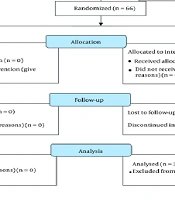
In this study, participants were randomly allocated to either XYLA cream or lidocaine injection groups. Randomization was conducted with sealed envelopes containing computer-generated randomization numbers. The researcher generated the random allocation sequence, research assistant enrolled participants and assigned participants to interventions. Those assessing outcomes blinded after assignment to interventions. After explaining the study procedures to the eligible participants, written informed consents were obtained. Then their personal characteristics such as age, weight, gestational age, and cervical dilation were recorded. The inclusion criteria were gestational age > 37 weeks, normal pregnancy without skin allergies, singleton pregnancy, and cephalic presentation. On the other hand, patients with assisted delivery, need for emergency cesarean section, cervical rupture, and the existence of several types of rupture were excluded. It should be mentioned that mediolateral episiotomy was done by a midwifery specialist in all patients. Finally, 98 people remained in the study. Two of the XYLA cream group were excluded from the study due to the need for emergency cesarean section.
XYLA is a 30gr topical cream, which is packed in 5gr sterile tubes. In the XYLA cream group, 5 gr XYLA cream was applied to the mediolateral incision area on the perineum at 9 cm cervical dilation an hour prior to the approximate time of delivery. Since sodium hydroxide, which is one of the components of XYLA cream can irritate infants’ eyes, the remainder of the cream was removed before the head was delivered. It should be noted that no other anesthetics were used in this group. After the end of delivery, 5 gr XYLA cream was applied to the healthy skin around the episiotomy site and repairing was done after 10 minutes. In case of active bleeding, packing method was used. In the second study group, 5 cc lidocaine 2% was injected to the incision site before performing an episiotomy. After the end of delivery also, 5 cc lidocaine 2% was injected to the incision line and repairing was done after 10 minutes. In case of need for more anesthetics, lidocaine 2% was used in the two study groups.
Before moving the patients out of the delivery room, delivery characteristics such as duration of the third stage of labor, infant’s weight and head circumference, and 1st and 5th minute Apgar scores were recorded. Additionally, the patients were asked to report their pain intensity while episiotomy performance and repair on the visual analogue scale (VAS). The VAS is a 10-point vertical linear scale in which, 0 and 10 represent no pain and the greatest pain possible, respectively. The patients were also asked about their satisfaction with the applied technique using a 5-point Likert scale with the following options: completely satisfied, satisfied, no idea, dissatisfied, and completely dissatisfied. Utilization of further lidocaine injections was recorded, as well. In order to prevent wound area infection, similar antibiotic regimen was prescribed for both study groups. Moreover, episiotomy wound infection signs such as pain, discharge, fever, vulvar edema, and red and swollen mucosa were explained to the patients at discharge. They were also examined for episiotomy wound infection a week later.
The data were analyzed using the SPSS statistical software, version 22. Number and percent were used for qualitative variables, while mean and standard deviation (SD) were used for quantitative ones. Chi-square test was employed to compare the two groups regarding qualitative variables and satisfaction with the applied technique. Also, independent t-test was utilized to compare the study groups with respect to quantitative variables and pain intensity. P < 0.05 was considered statistically significant.
4. Results
The two groups were similar concerning demographic (age, weight, occupation, and education level), delivery (number of deliveries and lengths of the active, second, and third phases of labor), and infants’ characteristics (weight and head circumference) (P > 0.05, Tables 1 and 2). It should be noted that placental expulsion occurred spontaneously in all studied participants.
Table 1.
Frequency Distribution and Comparison of Demographic Characteristics, Labor Characteristics and Maternal and Neonatal Factors in the Two Groups of Studya
| Personal Characteristics, Delivery, Maternal and Neonatal Factors | Xyla Ointment Group, N = 48 | Lidocaine Group, N = 50 | P Valueb |
|---|---|---|---|
| Age, y | 23.98 ± 3.61 | 25.36 ± 4.03 | 0.69 |
| Maternal weight at delivery, kg | 72.83 ± 10.94 | 76.4 ± 11.17 | 0.11 |
| Duration of active phase of labor, h | 4.67 ± 1.58 | 4.7 ± 1.16 | 0.9 |
| Duration of the second stage of labor, min | 54.31 ± 13.95 | 56 ± 15.57 | 0.25 |
| Duration of the third stage of labor, min | 15.31 ± 3.91 | 14.91 ± 4.13 | 0.81 |
| Birth weight, kg | 3239.58 ± 278.09 | 3249.00 ± 304.97 | 0.84 |
| Baby head circumference, cm | 34.23 ± 1.2 | 34.12 ± 0.98 | 0.83 |
aValues are expressed as mean ± SD.
bP value for qualitative variables, the chi-square test was used and the independent t-test was used for quantitative variables.
Table 2.
Frequency Distribution and Comparison of Demographic Characteristics and Maternal in the Two Groups of Studya
| Personal Characteristics, Delivery, Maternal and Neonatal Factors | Xyla Ointment Group, N = 48 | Lidocaine Group, N = 50 | P Valueb |
|---|---|---|---|
| Pariety | 0.558 | ||
| 1 | 38 (79.2) | 40 (80) | |
| 2 | 10 (20.8) | 10 (20) | |
| Mother’s job | 0.51 | ||
| Employed | 2 (4.2) | 3 (6.1) | |
| Housewife | 46 (95.8) | 47 (93.9) | |
| Mother’s educationb | 0.51 | ||
| Elementary | 1 (2.1) | 0 (0) | |
| Intermediate | 7 (14.6) | 11 (22) | |
| Diploma | 31 (64.6) | (62) | |
| College education | 9 (18.8) | 8 (16) |
aValues are expressed No. (%).
bP value for qualitative variables, the chi-square test was used and the independent t-test was used for quantitative variables.
According to the results, 66% of the women in the XYLA cream group compared to 52% of those in the lidocaine group were satisfied and completely satisfied with the applied technique, but the difference was not statistically significant (P > 0.05). Moreover, none of the participants needed further anesthetics during episiotomy repair. Episiotomy wound infection was detected in three participants in the XYLA cream group and four individuals in the lidocaine group (P = 0.367). The two groups were also similar regarding the 1st and 5th minute Apgar scores. It should be mentioned that none of the infants in the XYLA cream group had irritated eyes immediately and one week after delivery. The mean intensity of pain was 4.06 + 1.15 in the XYLA cream group and 4.19 + 1.38 in the lidocaine group. Although the mean intensity of pain was lower in the XYLA cream group, the difference was not statistically significant (P = 0.63, Table 3).
Table 3.
Frequency Distribution and Comparison of Maternal and Neonatal Outcomes in Two Groupsa
| Consequences | Xyla Ointment Group, N = 48 | Lidocaine Group, N = 50 | P Valueb |
|---|---|---|---|
| Mother’s satisfaction from analgesia during episiotomy | 0.288 | ||
| Totally satisfied | 3 (6.3) | 3 (6.1) | |
| Satisfied | 29 (60.4) | 23 (46) | |
| Not satisfied not dissatisfied | 12 (25) | 18 (36) | |
| Dissatisfied | 4 (8.3) | 3 (6) | |
| Totally dissatisfied | 0 (0) | 3 (6) | |
| Episiotomy site infection (a week later) | 0.367 | ||
| Yes | 3 (6.25) | 4 (8) | |
| No | 45 (93.75) | 46 (92) | |
| Apgar, mean ± SD | |||
| First minute | 9 ± 0.00 | 9 ± 0.00 | 0.000 |
| Fifth minute | 10 ± 0.00 | 10 ± 0.00 | 0.000 |
| Pain intensity (VAS), mean ± SD | 4.06 ± 1.15 | 4.19 ± 1.38 | 0.63 |
aValues are expressed No. (%) unless otherwise indicated.
bP value for qualitative variables, the chi-square test was used and the independent t-test was used for quantitative variables.
5. Discussion
The results of the present study revealed no significant differences between the two groups regarding demographic characteristics (age, weight at delivery, education level, and occupation). The two groups were also homogeneous with respect to delivery characteristics (lengths of labor stages and number of deliveries) and infants’ features, including weight and head circumference. Also, the result of our study showed that XYLA cream reduced the pain during episiotomy repair. Franchi et al. (11) used lidocaine-prilocaine cream (EMLA cream) to the episiotomy area and reported its ease of use and effectiveness in the reduction of pain. In the same line, Aghazadeh conducted a study in Tehran in 2010 to assess the impact of the application of lidocaine-prilocaine cream (EMLA cream) to the episiotomy area an hour prior to surgery and before episiotomy repair in primiparous women undergoing natural vaginal delivery. The results demonstrated that the applied technique was as effective as lidocaine injection and was followed by a similar satisfaction rate among patients (18). Dohan also performed research in India in 2013 and reported that the application of EMLA cream was safe, easy, and satisfactory, and could reduce pain while doing and repairing episiotomy (19).
Although the mean intensity of pain while doing and repairing episiotomy in our study was lower in the XYLA cream group, the difference was not statistically significant. Consistently, Aghazadeh indicated that the mean intensity of pain was lower in the EMLA cream group compared with the lidocaine group, but the difference was not statistically significant (18). In Dohan’s study also, the mean intensity of pain was 4.3 in the EMLA cream group and 4.14 in the lidocaine group, but the difference was not statistically significant (19). However, Franchi showed that the pain score was significantly lower among the women who had used EMLA cream (9). The EMLA cream contains both lidocaine and prilocaine and exerts its anesthetic effect by penetrating into dermis and epidermis layers. Nonetheless, it penetrates less into the lower muscular layers (19). Therefore, it creates more effective numbness while repairing lacerations as first-degree ruptures that do not involve muscles in comparison to episiotomy as a second-degree rupture in which muscles are involved. The significantly lower pain intensity in Franchi’s study might have resulted from the application of the cream while repairing episiotomy as well as spontaneous lacerations. On the other hand, in the present study and those performed by Aghazadeh and Dohan, the anesthetic cream was used while doing and repairing episiotomy. Consequently, Franchi’s studied participants experienced better numbness and their mean of pain intensity was considerably lower in comparison to the present study and those carried out by Aghazadeh and Dohan.
In the current study, 66.7% of the women in the XYLA cream group were satisfied or completely satisfied with the applied technique compared with 52.1% of those in the lidocaine group, but the difference was not statistically significant. Aghazadeh also indicated that the EMLA cream group were more satisfied with their anesthetic technique, but the difference was not statistically significant. However, Franchi demonstrated that 83.3% of the women in the EMLA cream group were satisfied with the applied anesthetic technique compared with 53.3% of those in the mepivacaine injection group, and the difference was statistically significant (11). This significant difference might be due to the fact that in Franchi’s study, the anesthetic cream was applied while repairing lacerations, resulting in better numbness and higher satisfaction. Dohan also reported that women in the EMLA cream group were significantly more satisfied with the applied technique. In that study, a significantly larger number of participants in the EMLA cream group required further anesthetics compared to the lignocaine injection group. However, no such a significant difference was found in the current study and those carried out by Franchi and Aghazadeh. In other words, a large number of participants who had received EMLA cream in Dohan’s study needed injection during episiotomy repair.
Nevertheless, they experienced lower stress and pain due to numbness resulting from the application of the anesthetic cream, which might have enhanced their satisfaction with the applied technique. This might justify the difference between that study and the present one with respect to the rate of satisfaction among women. Overall, the application of cream led to higher satisfaction in all studies, which might be ascribed to women’s anxiety and fear from the injection of needles into their bodies and fetuses’ heads. Unintentional injection of anesthetics into fetus skull is quite probable in occiput posterior fetal presentation (19).
In the current study, XYLA cream caused no eye irritations in infants immediately and a week after delivery. Indeed, none of the women in this group reported skin allergies at the location of the cream application. As the same as the above study (11, 18, 19).
5.1. Conclusions
Using lidocaine-prilocaine cream was not accompanied by any complications and created a similarly appropriate numbness to lidocaine injection. However, women were more satisfied with the application of topical creams. Thus injection could be replaced with the application of anesthetic creams. Nonetheless, further multi-centered clinical trials have to be conducted on the issue to achieve more reliable results.