
1. Background
Spinal surgery usually has a high risk of hemorrhage during and after the operation, thus most patients need blood transfusions and blood products (1-3). Hemorrhage during or after surgery is extremely important and this situation is known as a crisis in the operating room throughout the world (3, 4). Reducing hemorrhage is important in maintaining hemodynamic stability of the patient and improving the field of surgery and reducing complications such as hemolytic and non-hemolytic reactions, acute injuries, viral and bacterial infections, hypothermia, and coagulation disorders (4, 5). Previous studies have shown that fluid therapy or infusion of red blood cells is less than the amount of blood loss, leading to dilutions of the blood and a decrease in the concentration of coagulation factors such as fibrinogen (6). Different methods, including induction of controlled hypotension during surgery, injection of various medications during surgery, or change in the mechanical ventilation with a positive pressure during anesthesia have been proposed to reduce hemorrhage during and after the surgery, with positive outcomes in many cases (7-10). In addition, the results of studies on the efficacy of prophylactic fibrinogen injections have been reported to reduce the hemorrhage during surgery (11-17). Fibrinogen binds to platelet glycoproteins, enhances platelet aggregation and improves cross-linking, resulting in stabilization and clotting of the clot (18-20). Therefore, the administration of fibrinogen to restore the blood concentration level to normalize clot formation in patients who have hemorrhage is important (21-23). Allergic reactions, fever, thrombotic events e.g. cardiac infarction and pulmonary embolism are complications of intravenous fibrinogen infusion. Fibrinogen is used in various forms such as the injection method to control the hemorrhage. In the injection method, the drug is absorbed throughout the body and may not be sufficiently damaged to the affected tissue, and a large amount of this product should be prescribed for proper hemorrhage. Considering the importance of hemorrhage during and after lumbar surgery, the role of prophylactic administration of fibrinogen in this field has not been considered.
2. Objectives
The purpose of the study was to evaluate the results of fibrinogen prophylactic infusion in reducing the hemorrhage of lumbar surgery.
3. Methods
All of the procedures of this study were approved by the local Ethics Committee of Ahvaz Jundishapur University of Medical Sciences, Ahvaz, Iran (ethics code: IR.AJUMS.REC.1396.1136). This study was designed as a double-blind, placebo-controlled, clinical trial (IRCTID: IRCT20180811040763N1). The study population consisted of 30 patients (23), aged 18 - 60 years old, with one or two levels of discopathy, candidates of lumbar disc surgery with an ASA class I-II anesthetic risk admitted in Ahvaz Golestan Hospital (September 2017 - October 2018). They were randomized to receive either fibrinogen concentrate or placebo. Following the clear explanation of the object and potential risks and benefits of the study, written informed consent was obtained from all participants. Patients in the intervention group (N = 15) received 1 g of fibrinogen dissolved in 50 cc distilled water along with surgical incision. The patients in the control group (N = 15) were injected with 50 cc distilled water as placebo along with surgical incision. The exclusion criteria were: the patients with cardiovascular problems, coagulation disorders, anticoagulant drugs, smoking, HCT, BMI > 30. The plasma levels of fibrinogen, as well as HB, HCT, INR, PT, PTT, were checked as a preoperative base. After providing a reliable intravenous line for patients and installing the necessary monitoring (pulse oximetry, pressure gauge, and ECG) and covering the compressive device to both feet of the patients by an anesthesiologist, they underwent general anesthesia with the same drugs (general anesthesia was induced with midazolam 0.05 mg/kg, fentanyl 3 mcg/kg, sodium thiopental 5 mg/kg, and atracurium 0.5 mg/kg. The anesthesia was maintained using 1% isoflurane in the oxygen and N2O mixture). After the induction of anesthesia arterial line was arranged, and the patients were placed in the prone position. Depth of anesthesia was controlled via BIS. The amount of intraoperative blood loss was estimated based on the volume of blood in the suction bottle and the amount of the blood-soaked gauze pads (20 mL for a completely blood-soaked gauze and 50 mL for a completely blood-soaked long gauze). Whenever necessary, packed cell was injected for patients based on the calculated allowable blood loss (for each 4 units PC, one unit of FFP was injected). The primary outcomes were intraoperative hemorrhage, injected blood, fresh frozen plasma, and platelets. After the end of the surgery, patients returned to the supine position. They were transferred to the recovery room after extubation. Secondary outcomes, including serum fibrinogen levels, HB, HCT, PT, PTT, and hemovac drain volume, were again measured at 0, 6, and 24 hours. To describe the data, the mean and standard deviation (SD) in quantitative variables and in qualitative variables frequency and percentage were used. To compare the results, t-test and chi-square test were used. All analyses were performed using the statistical package of SPSS (version 22) and the significance level for all statistical analyses was considered 0.05 (P ≤ 0.05).
4. Results
During the study period from September 2017 to October 2018, 120 patients undergoing elective lumbar disc surgery were eligible to participate in the trial (CONSORT Diagram, Figure 1). After initial screening, 60 patients agreed to participate and provided written informed consent. Among them, 30 patients did not meet the inclusion criteria. Finally, 30 patients were selected and divided into the two groups (intervention and control). There were no significant differences between them in terms of demographic characteristics (P > 0.05) (Table 1).
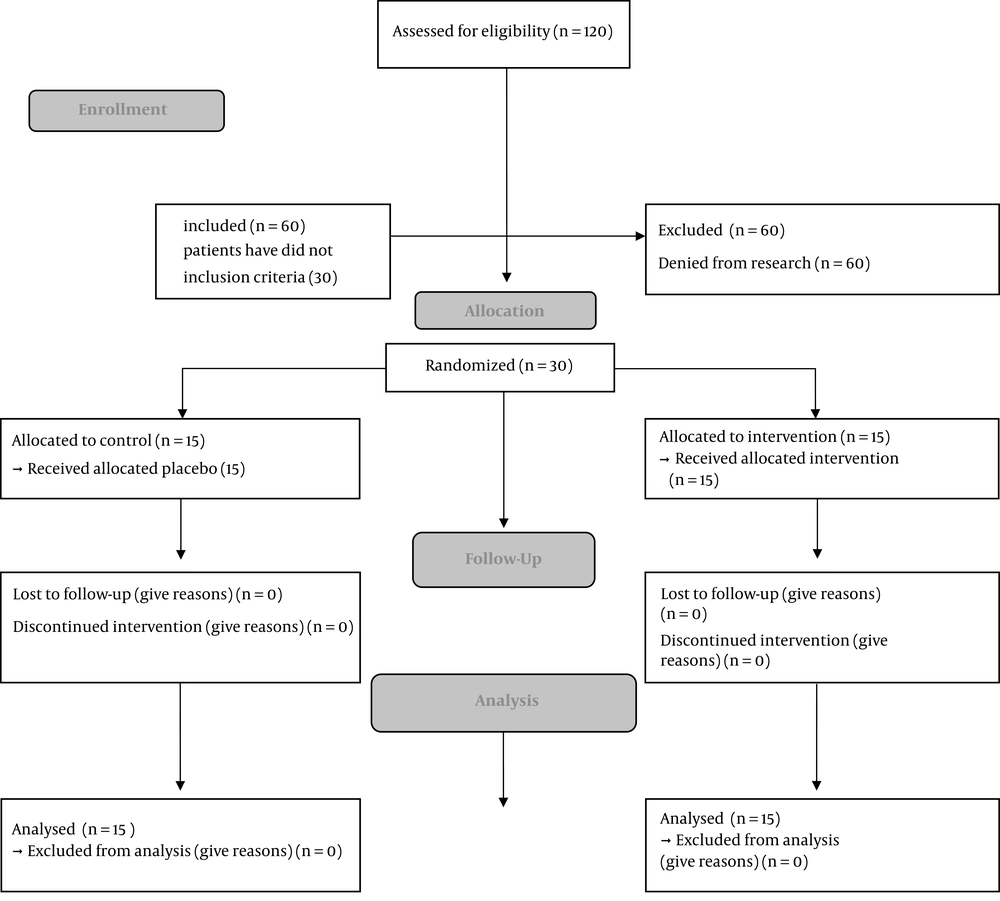
Figure 1.
Flow diagram
Table 1.
Demographic Characteristics of the Intervention and Control Groups
| Variable | Intervention | Control | P Value |
|---|---|---|---|
| Age, mean ± SD | 45.00 ± 8.418 | 47.46 ± 13.289 | 0.421 |
| Gender, male/female, No. (%) | 9/6 (60/40) | 8/7 (53.3/46.7) | 0.520 |
| BMI, kg/m2 | 22.57 ± 3.2 | 22.64 ± 3.29 | 0.910 |
Although the hemoglobin level and serum fibrinogen levels were not significantly different between both groups pre- and post-operatively (P > 0.05) (Table 2), the fibrinogen level was significantly different between the intervention and control groups pre- and post-operatively (P < 0.001) (Table 3).
Table 2.
Comparison of Hemoglobin and Serum Fibrinogen Pre- and Post-Operatively Between the Two Groups
| Variable | Intervention, Mean ± SD | Control, Mean ± SD | P Value |
|---|---|---|---|
| Pre-operative hemoglobin, mg/dL | 12.647 ± 1.8361 | 13.367 ± 2.1148 | 0.35 |
| Post-operative hemoglobin, mg/dL | 11.553 ± 2.0836 | 12.336 ± 1.7775 | 0.35 |
| Pre-operative serum fibrinogen, mg/dL | 293.27 ± 72.448 | 290.20 ± 86.257 | 0.383 |
| Post-operative serum fibrinogen, mg/dL | 346.67 ± 55.845 | 320.27 ± 65.952 | 0.383 |
Table 3.
Comparison of Serum Fibrinogen Pre- and Post-Operatively in Both Groups
| Variable | Intervention, Mean ± SD | Control, Mean ± SD |
|---|---|---|
| Pre-operative serum fibrinogen, mg/dL | 293.27 ± 72.448 | 290.20 ± 86.257 |
| Post-operative serum fibrinogen, mg/dL | 346.67 ± 55.845 | 320.27 ± 65.952 |
| P value | < 0.001 | 0.383 |
Intraoperative hemorrhage in the intervention group was significantly lower than the control group (225.33 ± 180.431 versus 530.00 ± 275.032, P < 0.001). In addition, postoperative bleeding in the intervention group was significantly lower than the control group (43.33 ± 41.690 versus 107.33 ± 85.228, P < 0.001) (Table 4).
Table 4.
Comparison of Hemorrhage and Blood Products Transfusion Intra- and Postoperatively Between the Two Groupsa
| Variable | Intervention, Mean ± SD | Control, Mean ± SD | P Value |
|---|---|---|---|
| Intraoperative hemorrhage, cc | 225.33 ± 180.431 | 530.00 ± 275.032 | < 0.001 |
| postoperative hemorrhage, cc | 43.33 ± 41.690 | 107.33 ± 85.228 | < 0.001 |
| PC transfusion, unit | 0.07 ± .258 | 1.00 ± 1.195 | < 0.001 |
| FFP transfusion, unit | 0.00 ± 0.000 | 0.00 ± .000 | > 0.05 |
aThe postoperative hypotension was not significantly different between the two groups (P = 0.083).
The need for blood transfusion and blood products in the intervention group were significantly lower than the control group (intraoperative use unit of PC: 0.07 ± .258 versus 1.00 ± 1.195). However, intraoperative use unit of FFP showed no significant difference between the groups: 0.00 ± 0.000 versus 0.00 ± .000) (Table 4).
There were no significant differences between PT, PTT, and HCT levels in the two groups at preoperative, 0, 6 and 24 hours postoperatively. There was a significant difference in the rate of INR in the two groups at the preoperative (P < 0.029), 6 (P < 0.017) and 24 (P < 0.04) hours postoperative intervals, but there was no significant difference at 0 time point (Table 5).
Table 5.
Comparison of Blood Factors Before and After the Intervention Between the Two Groups
| Variable | Intervention, Mean ± SD | Control, Mean ± SD | P Value |
|---|---|---|---|
| PTT | |||
| Before | 29.747 ± 3.2500 | 28.400 ± 3.5617 | 0.155 |
| 0 | 29.667 ± 3.3310 | 29.231 ± 4.0652 | 0.562 |
| 6 | 29.867 ± 3.1366 | 28.231 ± 3.0592 | 0.148 |
| 24 | 29.933 ± 2.875 | 28.692 ± 2.8978 | 0.341 |
| PT | |||
| Before | 12.567 ± 0.4169 | 12.433 ± 0.1759 | 0.325 |
| 0 | 12.400 ± 0.2070 | 12.692 ± 0.8391 | 0.6 |
| 6 | 12.400 ± 0.2803 | 12.385 ± 0.2996 | 0.87 |
| 24 | 12.333 ± 0.2440 | 12.423 ± 0.2774 | 0.397 |
| HCT | |||
| Before | 37.660 ± 4.1300 | 39.429 ± 4.2941 | 0.348 |
| 0 | 34.953 ± 5.6149 | 33.300 ± 10.5110 | 1 |
| 6 | 34.600 ± 5.8542 | 35.843 ± 3.9656 | 0.445 |
| 24 | 34.980 ± 5.1079 | 35.769 ± 4.2838 | 0.565 |
| INR | |||
| Before | 1.007 ± 0.0258 | 1.060 ± 0.0828 | 0.029 |
| 0 | 1.013 ± 0.0352 | 1.069 ± 0.1251 | 0.199 |
| 6 | 1.007 ± 0.0258 | 1.069 ± 0.1109 | 0.017 |
| 24 | 1.007 ± 0.0258 | 1.062 ± 0.0961 | 0.04* |
5. Discussion
This study was a double-blind, randomized controlled trial that was designed to determine the effect of the prophylactic fibrinogen injection on reducing the hemorrhage in the lumbar discopathy surgery. The results showed that the administration of prophylactic fibrinogen reduced the need for blood supply during and after surgery significantly. Most studies in the past, similar to the present study, confirmed the effect of intraoperative fibrinogen use on reducing hemorrhage during and after surgery (24). Several studies have shown that fibrinogen plasma concentration during surgery determines the volume of the hemorrhage and the need for blood transfusion (13, 25). In the study of Ucar et al., on the patients who were candidates for coronary artery bypass graft surgery, the level of fibrinogen during surgery significantly correlated with the amount of hemorrhage 48 hours after surgery (25). Similarly, Blome et al. reported a strong direct relationship between fibrinogen concentration and 24-hour hemorrhage volume in patients with cardiac arrest (26). Our findings showed that the rate of hemorrhage in both groups was decreased after the operation. In a clinical trial conducted by Pournajafian et al., they examined the reduction in the hemorrhage during spinal surgery and found no significant difference between serum hemoglobin and fibrinogen level before and after surgery. In addition, the average amount of hemorrhage and the need for blood transfusion were significantly more than the control group, which was consistent with the results of this study (24). Karlsson et al. evaluated the effects of 2 g fibrinogen prophylactic infusion in patients undergoing cardiac arrest. They reported that the level of fibrinogen after surgery was increased in the intervention group compared with the control group. In the study of Karlsson et al., the rate of hemorrhage in the fibrinogen-receiving group was 32% lower than that of the control group (13), which was consistent with the results of our study, thus it was 42% in the current study. However, observing all of the surgery procedures, including the site of the surgery and the type of homeostasis by the surgeon, is an effective parameter in this regard. The results of Thorarinsdottir et al. showed that the administration of fibrinogen for severe hemorrhage was associated with an increased fibrinogen concentration and a significant decrease in APTT, PT, and the requirement for PRBCs., which was in line with the results of the present study about the requirement for PRBCs (27). Carling et al. studied a patient undergoing scoliosis in a clinical trial and found that hemorrhage in the patient had a significant correlation with fibrinogen plasma concentration but did not show significant correlation with platelet count, PT, and PTT (28). Wafaisade et al. investigated a large number of trauma patients (N = 294) and reported that the 6-hour-mortality rate in the fibrinogen-receiving group was lower than the control group, and not only an increased time to death but also an increased rate of multiple organ failure was reported. A reduction of overall hospital mortality was not observed in patients receiving FC, but contrary to our findings, the need for blood and blood product administration between the intervention and control groups indicated no significant differences. This difference can be as a result of the effect of the number and variety of patients and also the effect of various factors such as the severity of lesions during trauma and the volume of hemorrhage (29). In a clinical trial performed on children with craniosynostosis and scoliosis, Haas et al. saw that receiving intracerebroventricular concentrate can reduce hemorrhage during craniosynostosis; however, does not affect scoliosis, which is consistent with the results of the present study (30). In a cohort study, Geck et al. argued that preoperative fibrinogen level had a negative logarithmic correlation with the total blood loss, and there was no significant relationship between thrombin and thromboplastin with preoperative plasma fibrinogen, which was consistent with our study (31). The limitations of the current study are the difference in the duration of surgery and the lack of follow-up of long-term complications of surgery in patients. To reduce the amount of the hemorrhage during and after surgery in spinal surgery, several measures should be taken in terms of surgical and anesthetic techniques, the use of anti-fibrinolytic drugs, such as tranexamic acid and coagulation compounds such as FFP, cryoprecipitate, and fibrinogen.
5.1. Conclusions
Our findings indicated that fibrinogen plays a key role in reducing hemorrhage and the need for blood products in patients undergoing acute spinal surgery. Therefore, this compound could be used as an important factor in preventing and stopping the hemorrhage. Considering the adverse effects of hemorrhage and coagulopathy in the patients undergoing surgery, the use of this treatment prophylactically in all surgeries with a high risk of hemorrhage is recommended. From the viewpoint of this study, it is better to consider these findings in the planning of hospital managers and policymakers to allocate funds for providing sufficient fibrinogen for the hospital operating rooms.